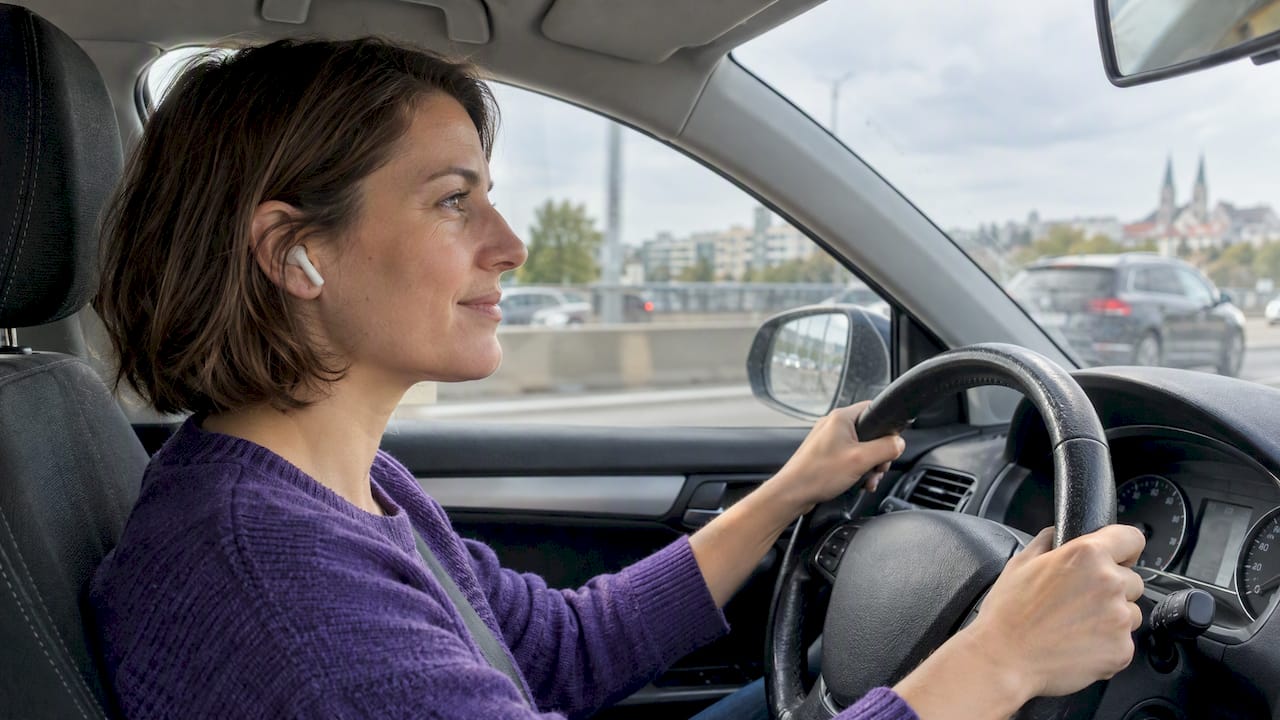
Audiobooks in the car: How every drive becomes a good story
With audiobooks in the car a drive feels shorter, whether a traffic jam on the A7, the daily commute to the office or the long drive on vacation. For that to work you need three things: a stable connection between smartphone and car, stories that are already downloaded before you leave, and a selection that fits the route. A short story that lasts exactly as long as your commute is often a better choice than a 20-hour novel, where after three days you no longer know who is who. Here we explain how to set up your listening program, which stories fit which trip and what you should pay attention to for safety reasons.
TL;DR
- Decide before the drive: Choose the story before starting and download it offline. Don't search for anything while driving.
- Technology matters: Apple CarPlay or Android Auto are the most convenient, Bluetooth works almost always, an AUX cable helps in older cars.
- Content matching the route: In the city light, calm stories fit; on the highway it can be more exciting.
- For commuters: Short stories and serialized stories in chapters fit one trip exactly, so you hear each story to the end.
- With children: Choose radio plays and read-aloud stories together beforehand, then there will be less fighting over the program in the back seat.
Table of contents
- Why stories for the car work so well
- How the audiobook gets to the car speakers
- Before you set off: your checklist
- Safe listening: which story fits which route
- Audiobooks for commuters: one route, one story
- Long drives with children: calm in the back seat
- Our selection for the next trip
- What OutaStory brings to your trips
- FAQ
- Sources
Why stories for the car work so well
Driving and listening go well together as long as the story doesn't demand more attention than you can spare. Your eyes belong to the road, your hands to the wheel, but your ears are free. Music fills this time, the radio too. A story turns the same half hour into something you look forward to in the morning.
Many well-known audiobooks are actually too long for the car. An unabridged novel quickly runs ten, fifteen or twenty hours. If you commute 25 minutes every day, you hear such a book in small pieces over weeks, with interruptions from phone calls, navigation prompts and traffic reports. The thread breaks, secondary characters blur, and at some point you skip back to find out what you missed. That's annoying, and you shouldn't be rewinding while driving anyway.
This is exactly where short stories show their strength. They have a beginning, middle and end, all in a length that fits a drive. You get in, start the story and arrive at your destination with the ending. The next morning you start in a new world without baggage from yesterday's chapter. If you prefer a longer arc, choose serialized stories: each chapter is one trip, and the suspense carries you to the next day.
How the audiobook gets to the car speakers
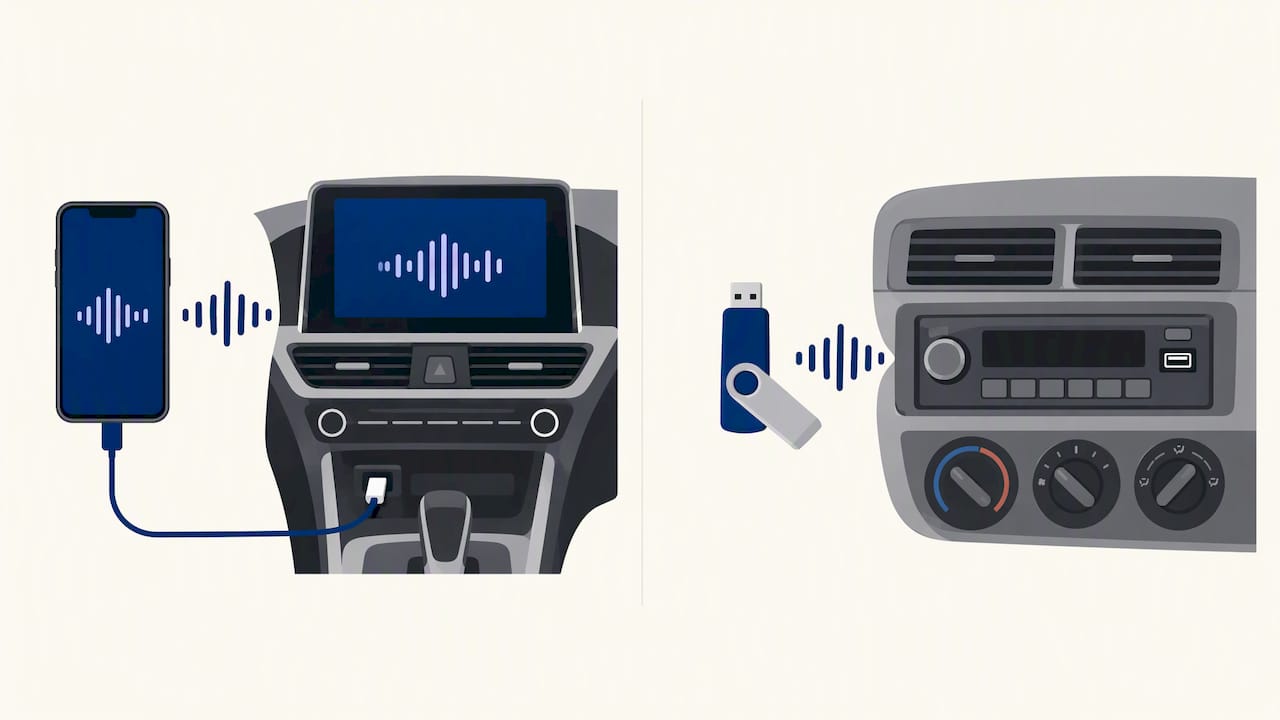
Before the first story plays, the sound must go from the smartphone to the car. Which method is best mainly depends on how old your car is and which infotainment system is installed.
| Connection | How it works | Advantages | What to watch out for |
|---|---|---|---|
| Apple CarPlay / Android Auto | Pair the smartphone via USB cable or wirelessly, compatible apps appear on the display | Large controls, voice control, navigation and audio on one screen | Not every app supports the interface, controls differ by manufacturer |
| Bluetooth | Pair the smartphone with the car once, then it connects automatically | Works in almost all cars of recent years, no cable | Control usually only via steering wheel buttons (pause, next), selection happens on the phone |
| AUX-Kabel (3,5-mm-Klinke) | Cable from the headphone jack or an adapter into the AUX socket | Simple, cheap, also in older cars | Newer smartphones often need an adapter, no control via the car |
| USB-Anschluss | Plug the smartphone in with a cable | Charges at the same time, often starts CarPlay or Android Auto | Some cars play only files from a USB stick over USB, not from apps |
A note on wireless connections: they are convenient, but the smartphone does not automatically charge. Volkswagen describes at App-Connect how selected smartphone apps run on the vehicle display. The wireless variant Wireless App Connect works without cables. On long trips a charging cable or a wireless charging pad is still worthwhile so your battery doesn't run out after two hours.
And the question many ask: can you listen to music or audiobooks via the car's USB port? Mostly yes, but not always in the way you expect. In many newer cars USB directly starts CarPlay or Android Auto. Older systems only read audio files from a stick or a smartphone in storage mode over USB. A look in your car's manual saves a lot of trial and error.
Before you set off: your checklist
The most important rule for audiobooks in the car has nothing to do with technology: Decide what you will listen to before the drive. According to ADAC traffic psychologist Ulrich Chiellino full attention at the wheel is a basic prerequisite for safety, and searching through menus is a form of distraction. He therefore advises setting the listening program before departure (Celler Presse about the holiday-start action by ADAC and the Lower Saxony Ministry of the Interior).
Here's how to prepare in five minutes:
- Choose stories. Prepare two or three stories for the trip so you have an alternative if you don't like the first one.
- Download offline. There are still dead spots on country roads, in tunnels and on some sections of the highway. A downloaded story keeps playing without interruption. How to do this step by step we explain in our Guide to Offline Listening to Audiobooks and briefly in the Help for Offline Listening.
- Check the connection. Pair the smartphone, play a test tone, set the volume so that you can still hear sirens and horns well.
- Battery and cables. Plug in the charging cable or use a charging pad, especially with a wireless connection.
- Put the phone away. The smartphone goes in the holder or the center console. While driving you operate at most pause and next, via the steering wheel buttons or by voice command.
If you notice on the road that a story doesn't grab you or demands too much: press pause and switch at the next stop. The rest area is the right place to search for the next title, not the fast lane.
Safe listening: which story fits which route
Stories can be very gripping. That's what makes them great, and that's exactly what can become a problem at the wheel. If you hold your breath during a thriller you might not pay close attention to the cyclist at the roadside for a moment. The ADAC makes the calculation clear: at 100 km/h five seconds of distraction means you travel roughly 140 meters in blind flight (Celler Presse, July 2026).
This does not mean that exciting stories are taboo in the car. It means that the traffic situation helps decide what should be playing. Our rule of thumb:
| Traffic situation | What fits well | What to avoid |
|---|---|---|
| Dense city traffic, many intersections | Light, calm narratives, humor, everyday stories | Complex plots with many characters, horror with jump scares |
| Steady highway drive | Crime, science fiction, fantasy, also longer serialized stories | Stories where you need to catch every sentence precisely |
| Traffic jam and stop-and-go | Stories with clear chapters that you can easily interrupt | A climax that hooks you exactly when it starts moving again |
| Night drive | Something with tension that keeps you awake but doesn't excite you | Very calm bedtime stories that make you sleepy |
| Unknown route, bad weather | Prefer a break or music | Any story that demands attention |
Two points are often underestimated. First: bedtime stories and soft voices are made for bed, not for the highway at 11 p.m. What puts children to sleep at night can affect adults as well. Second: if navigation prompts and the story constantly overlap, set the prompts so the audiobook gets quieter. Most systems offer that option.
Audiobooks for commuters: one route, one story
People who drive to work every day have a fixed time window that can be planned perfectly. Instead of frantically searching in the morning, prepare a small listening list at the weekend. It takes a few minutes and saves you the search five times a week.
Here's what a commuter week we recommend looks like:
- Monday: something light to start, a comedy or a cozy everyday story.
- Tuesday to Thursday: a serialized story, one chapter per trip. That way you have a reason each morning to depart on time.
- Friday: a genre you don't usually listen to. Alternate history, a swashbuckling adventure, a drama.
- Return trip: in the evening, rather calm and easy to digest; your head is full after a long day anyway.
Length is the decisive factor for commuters. A story that is a bit shorter than your commute ends safely before the parking spot, with a buffer for traffic lights and jams. One that is much longer ends in the middle of a sentence when you turn off the engine. Serialized stories solve this elegantly because the authors write the chapters deliberately as independent units.
Practically, you can also switch between reading and listening. If you listened to the first half of a story in the car in the morning, you can continue reading during your lunch break without headphones. With the read-along feature and the seamless playback we present in Audio matures, text and audio become a single experience. And if you also use running time as listening time, you'll find the right format for every route in our article about Audiobooks while running.
Long drives with children: calm in the back seat
The classic of summer holidays: after an hour someone asks when you'll finally be there, after two hours siblings are fighting over the tablet. Shared stories are one of the best means against that, because everyone in the car is in the same world.
A few things have proven effective:
- Choose together. Let the children have a say before the drive. Whoever picked a story themselves listens more patiently.
- Take turns. One title for the little ones, one for the older kids, one for the adults in the front. That way everyone gets a turn.
- Short segments. Children concentrate better when a story doesn't last forever. Animal adventures, funny everyday stories and first rhymes are ideal for the youngest.
- Plan breaks. Every second story a rest stop, with conversations about how things might continue.
- Quiet at the end. For the final stretch in the evening a bedtime story fits, then the children may already be asleep when you arrive. The driver, however, listens only halfheartedly.
We have more titles that adults and children can listen to together in our guide Audiobooks for families. Two quick tips from our children's section: The cloud that rents itself out for a nap and Three frogs cross the street, the second already fits well with a car trip just from the title.
Our selection for the next trip
At OutaStory you can read or listen to every story for free. For the car we have sorted some titles by mood so you can find more quickly what fits your route:
For the highway, when it can be exciting
- Dark Deals, a thriller for steady kilometers
- The Curse of the Other Side, for those who like it a bit more eerie
- The Ink Runner, alternate history for the curious
For city traffic and the return trip in the evening
- The Shape of the Shore, a small-town romance
- The Accidental Guru Mother, a light companion for the evening
- Field Notes from the Elbe Valley, ideal for anyone who likes driving through landscapes
For Friday, when you try something new
- The Second She Couldn't Refuse, a swashbuckling adventure
- The Library Where the Books Talk Back at Night, for fans of the fantastical
- Between the Lines and Where I Stand, two dramas for quiet stretches
Listen to the first minutes briefly before the drive. That way you know if you like the voice before you take the on-ramp.
What OutaStory brings to your trips
We built OutaStory for exactly the moments when you can't read but want a story. Every short story on our platform can be played as an audiobook, professionally voiced or in the voice of the author themself. The range runs from fantasy, romantic fantasy and science fiction to crime, thriller and horror, and to our children's section with bedtime stories, animal adventures and first rhymes. Everything is available in German and English, in case you want to refresh your language skills on the go.
You can read and listen for free immediately. If you spend a lot of time in the car you benefit from OutaStory Premium: unlimited listening, ad-free use and offline access so the story keeps playing even in the dead spot behind the next curve. For commuters who are on the road an hour or more each day, this is the most convenient way to fill travel time with stories.
Your route, your story: get in, play, arrive.
And if you're already thinking about a story while stuck in traffic: on OutaStory you publish your short story in a few minutes, also chapter-wise as a serial, and you participate in revenue sharing. How this works for narrators and speakers, including our platform commission of 8%, we explain on the page for speakers.
FAQ
Where can I listen to audiobooks for the car for free?
On OutaStory you can read all short stories for free and listen to them as audiobooks in the browser or via your smartphone connected to the car. For unlimited ad-free listening and offline downloads there is Premium. There are also public-service audio offerings with radio plays and borrowing via public libraries.
How do I listen to audiobooks in the car without CarPlay or Android Auto?
The easiest way is Bluetooth: pair the smartphone with the car radio once, then it connects automatically each time you start. In older cars an AUX cable helps; for newer smartphones usually an adapter is needed. You make the selection on the phone, and do so before the drive.
Does listening in the car use a lot of mobile data?
When streaming, yes — depending on length and quality, a month of commuting can add up. If you download the stories beforehand over Wi‑Fi, you use no mobile data on the road and dead spots no longer matter. Offline downloads are possible with OutaStory Premium.
Are exciting thrillers dangerous while driving?
Not inherently, but they demand attention. In heavy city traffic or bad weather a calm narrative is the better choice; on a steady highway drive it can be more exciting. If a scene grips you so much that you lose sight of the traffic, press pause.
What length should an audiobook for commuters have?
Ideally a story is a bit shorter than your commute so that it ends safely before the parking spot. Short stories and serialized stories with one chapter per trip are particularly well suited. That way you never start in the middle of a scene and you hear each story to the end.
Sources
- Celler Presse: Joint holiday-start campaign of the Lower Saxony Ministry of the Interior and the ADAC Lower Saxony/Saxony-Anhalt e.V.
- Volkswagen App-Connect: Smartphone apps in the vehicle
- Volkswagen Wireless App Connect
Recommendations
- Audiobooks while running: the right format for every running route
- Audiobooks for families: the best titles for shared listening time
Read and write on OutaStory
Thousands of short stories to read for free — or publish your own and find an audience.