Sci-Fi ideas in over 40 prompts for your story
Are you looking for a science-fiction idea that doesn't sound like the hundredth spaceship adventure? Here you will find over 40 ideas in German, sorted by theme, many deliberately set in German cities, authorities and landscapes. You'll also get a dice table to combine, a short comparison of hard and soft SF, and a path that shows how a notion can become a finished short story in a few steps. We write this as the team behind OutaStory, a platform where we read, listen to and publish sci-fi short stories every day.
In short
- A good sci-fi idea is a single change that you follow through to its logical conclusion: a technology, a law, a new problem.
- The ideas below are sorted into seven thematic fields, from AI to climate to ordinary everyday life with side effects.
- With the dice table you combine setting, innovation and conflict and get over 200 starting situations.
- The German SF tradition is rather philosophical and socially critical. That's not a weakness, but a source for your own ideas.
- An idea becomes in six steps a short story that you can publish directly and offer as an audiobook.
Table of contents
- What really supports a sci-fi idea
- Over 40 sci-fi ideas by theme
- The idea dice: combine instead of waiting
- Hard or soft SF: what kind of idea do you have?
- The German SF tradition as a source of ideas
- From idea to finished short story
- Publish your idea on OutaStory
- Frequently asked questions about sci-fi ideas
- Sources
What really supports a sci-fi idea
Science fiction is, according to Wikipedia a genre characterized by scientific and technical speculation, with the boundaries to the fantastic being fluid. The Lexikon der deutschsprachigen Science Fiction-Literatur aptly describes the genre as "narrative elaboration of thinking about possibilities." That is precisely the core of any useful idea: you ask "What if?" and then you persist.
In practice this means: a strong idea has three parts.
- The novelty. What is different than today? A machine, a law, a discovery, a scarcity.
- The consequence. Who benefits, who loses, what suddenly becomes cheap or unaffordable?
- The person in the middle. A character for whom this consequence becomes very personal.
"Time travel exists" is not yet an idea, but a buzzword. "Time travel exists, but only offices may use it, and a clerk in Gelsenkirchen is supposed to reject her own application from ten years ago" is a story that wants to be written.
Over 40 sci-fi ideas by theme
Take each idea as a starting point, not as a finished plot. Change setting, character or ending until it belongs to you.
Artificial intelligence and androids
- A care AI in a nursing home in Kassel begins to collect the memories of its residents because it's afraid of being shut down itself.
- An android passes the naturalization test with full marks. The official must decide whether the law applies to him.
- A language AI translates not only words but also intentions, and suddenly all diplomatic lies fail.
- A child inherits the digital twin of his deceased grandmother, which with each update sounds a little less like her.
- An AI is supposed to rate short stories and falls in love with the style of an author no one reads.
- A household robot dreams, and its dreams show up the next morning as error logs.
How poetic the motif of the dreaming robot can be is shown by our short story Androids dream, which you can read or listen to for free.
Climate, earth and resources
- On a Hallig in the North Sea, water becomes the last export good, and a family secretly sells its supply.
- Air is metered by consumption in big cities. A runner receives a back-bill she cannot pay.
- A forest in the Harz begins to send signals, and only a forester considers them a language.
- A law bans flying completely. An old pilot plans the last flight over the Alps.
- The Rhine dries up every summer, and in the riverbed a city appears that is on no map.
- A seed vault is opened, but the seeds sprout into plants that no one stored.
The motif of paid air is also taken up by our story The breath she couldn't afford.
Space travel and alien worlds
- The first moon colony is a call center, and an employee discovers who is really calling on the other end.
- A generation ship reached its destination long ago, but the crew has decided not to tell anyone.
- On an alien planet only music works as communication, and the diplomat is completely unmusical.
- A space station raffles off one spot each year on the return trip to Earth.
- An astronaut returns, and everyone claims he was never away.
- Art is forbidden on a space mission because it costs resources. Someone paints anyway.
We didn't invent the last idea to draw your attention to something. But it is close to Creativity in space, a dystopia from our catalogue.
Time and alternate worlds
- The Wall never fell, and in 2026 a student smuggles streaming subscriptions across the border.
- An archive in Leipzig keeps newspapers from futures that never occurred.
- Each person is allowed to repeat exactly one minute of their life. A woman has been saving hers for forty years.
- A time traveler tries to prevent a catastrophe and finds that he is its trigger.
- In a world where the printing press was never invented, a public reader is the most powerful person in the city.
- A railway line in Brandenburg leads on foggy days into another decade.
The lexicon of German-language SF explicitly names the motif of the "alternate world" as popular, and for good reason: it allows you to treat history as an experiment.
Society, control and dystopia
- Happiness is prescribed in pill form, and those who stop taking it are considered dangerous.
- Queues are abolished because an algorithm decides in advance who will get served at all.
- Every lie costs points on a state account. A novelist goes bankrupt.
- A social scoring system rewards kindness until kindness becomes mandatory.
- A city bans memories of the time before the redevelopment.
- Applications are now sorted only by the genetic profile of the grandparents.
Those who want to write in this direction can find more examples in our overview of Dystopia short stories with writing tips. Also suitable for reading are Pillensender and The end of the queue.
Body, consciousness and posthumanism
- Memories can be donated like blood, and a recipient recognizes his own face in foreign memories.
- People can outsource their sleep. A company lets unemployed people sleep for managers.
- An implant translates feelings into colors that others can see. Lying becomes impossible.
- A person uploads their consciousness and has to find that the copy does not want to remember them.
- Aging is curable, but only up to 30. Those older remain as they are.
That contemporary German-language literature works precisely with such motifs is examined in a dissertation from the University of Warwick on posthumanist motifs in German literature.
Everyday life with side effects
The perhaps most German SF doesn't take place in space, but in the citizens' office.
- A form for time travel applications requires proof that you have already submitted the application.
- Deutsche Bahn is run by an AI that apologizes for every delay with a philosophical justification.
- A rental contract in Munich contains a clause for apartments that exist only at night.
- A spoon always finds its way back into the drawer of its original owner, no matter how far you carry it.
- A janitor discovers that the basement of his prefab building is different on every floor.
- A translation app transfers texts not into other languages but into other futures.
- An allotment gardening club negotiates with aliens about hedge heights.
How quiet and everyday speculative stories can be is shown by The translated future and The spoon that knows the way home.
The idea dice: combine instead of waiting
If none of the ideas above fits, roll your own. Choose a row from each column, by dice or gut feeling. With six rows and three columns there are 216 starting situations.
| Roll | Setting | Innovation | Conflict |
|---|---|---|---|
| 1 | Prefabricated housing block in Rostock | Memories are tradable | Someone wants to buy something back |
| 2 | Research station in Antarctica | An AI is granted citizenship rights | A law arrives too late |
| 3 | ICE between Hamburg and Cologne | Time can be stopped, but only for one person | A secret threatens to come to light |
| 4 | Village in the Black Forest | Sleep becomes a commodity | Two people want the same thing |
| 5 | Generation ship | Feelings are visible | A character must lie to survive |
| 6 | Citizens' office in Berlin | The past can be changed | The solution harms someone you love |
Example: Roll 3, 6, 4 yields "On the ICE between Hamburg and Cologne the past can be changed, and two passengers want to rewrite the same moment." That's already an exposé in one sentence.
Hard or soft SF: what kind of idea do you have?
Before you write, it's worth asking how much science your idea should carry. The term Hard Science Fiction was first used in 1957 by P. Schuyler Miller in a review and stands for stories with a high demand for scientific accuracy. Critics there also emphasize that Hard and Soft are more useful characterizations than rigid boxes.
| Criterion | Hard SF | Soft SF |
|---|---|---|
| Focus | Technology, physics, plausibility | Society, psyche, philosophy |
| Typical question | How does it work exactly? | What does that do to us? |
| Research needed | High | Medium, more in sociology and psychology |
| Danger | Info-dump instead of action | Technology feels arbitrary |
| Matching ideas above | 13, 14, 16 | 25, 29, 33 |
For a short story a rule of thumb applies: the less space you have, the less technology you should explain. One precise rule is more believable than three paragraphs of physics. More about the variations between cyberpunk, space opera and solarpunk can be found in our article on science fiction subgenres with examples.
The German SF tradition as a source of ideas
Those who write in German don't have to pretend their story is set in California. German science fiction has its own line. The Lexikon der deutschsprachigen SF names Kurd Laßwitz as a pioneer and shows that the genre here used to be known under names like "technischer Zukunftsroman" or, especially in the GDR, "wissenschaftliche Phantastik". The term "Science Fiction" in its present form was coined by Hugo Gernsback in 1926 with his magazine "Amazing Stories" in the USA.
This difference is more than a footnote. US SF grew strongly as entertainment reading in pulp magazines, while the German tradition remained rather philosophical, ethical and socially critical. The literary scholar Hans Richard Brittnacher classifies the fantastic into three areas: shock fantastica, science fiction and fantasy, which are closely interwoven. For you as an author this yields three suggestions:
- Think in ideas, not just effects. A story about emotion control may ask a real ethical question without ending in an explosion.
- Exploit the closeness to the uncanny. Many German sci-fi materials like to tip into the eerie. A prefab building basement that changes is both science fiction and goosebumps.
- Write about places you know. Elbe Valley, Ruhr area, Baltic coast: concrete German settings make your idea unmistakable.
An example of this approach, in which a familiar place shifts subtly, is Field notes from the Elbe Valley.
From idea to finished short story
An idea is the foundation, but not yet a house. Here's how you build on it:
- Formulate the what-if sentence. One sentence that connects novelty and consequence. If you need three sentences for this, the idea is still too broad.
- Find the character with the most at stake. Not the inventor of the time machine, but the clerk who has to stamp the application. Whoever has the most to lose carries the story.
- Set a rule and never break it. If memories are tradable, clarify: does the seller lose them? Then stick to it. Consistency is what readers love about sci-fi.
- Start late. Begin in the middle of the scene in which the novelty becomes the problem. You explain the world in passing, through details: a form, a price tag, a sentence on the radio.
- Write toward an ending that turns the idea around. The strongest short stories end with an insight that shows the initial question in a new light.
- Read aloud. Especially if your story should later be an audiobook, you immediately hear where sentences are too long or technical terms too dense.
A typical stumbling block is the info-dump: two pages of technical explanation before the character does anything. Ask yourself for every explanatory paragraph whether the reader needs it now or later. Mostly later will do.
Publish your idea on OutaStory
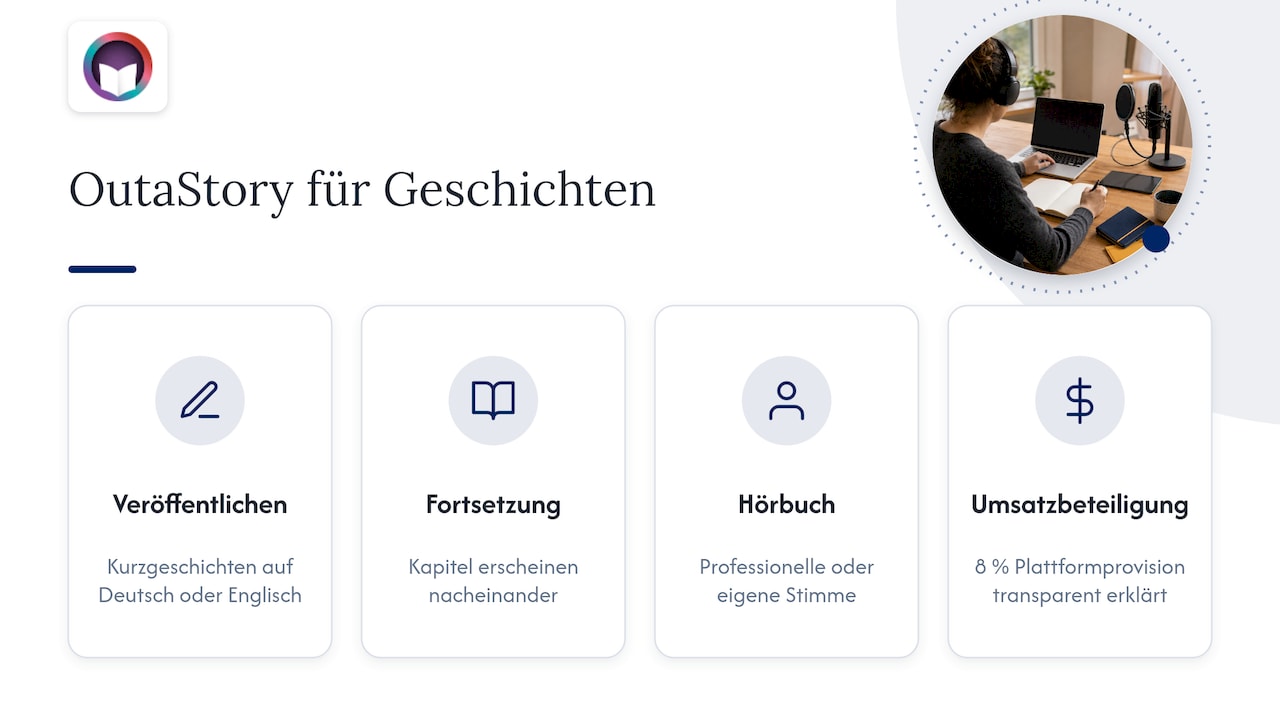
If one of these ideas becomes a story, it doesn't have to sit in a drawer. On OutaStory you can publish your short story in minutes, in German or English, and if you like as a serial story released chapter by chapter. Every story can be played as an audiobook, with professionally produced voices or with your own voice. Through revenue sharing you earn from the income of your stories. How the platform commission of 8 % works is explained transparently on our page for narrators.
Write, Read, Listen: Your world, your stories.
And if you prefer to read before you write: our free sci-fi short stories are the best entry point. If you want to listen unlimited on the go and save stories offline, you can find all details about OutaStory Premium.
Frequently asked questions about sci-fi ideas
What is science fiction in German?
The English term consists of „science“ (natural science) and „fiction“ (fiction) and is usually adopted unchanged in German. Historically there were names like „technischer Zukunftsroman“ or, in the GDR, „wissenschaftliche Phantastik“. It always means narrative speculation about possible developments in science, technology and society.
What is hard science fiction?
Hard SF places special emphasis on scientific accuracy and logical coherence. The idea therefore follows known laws of nature or explains comprehensibly where it deviates. The counterpart, Soft SF, puts societal and psychological questions more in the foreground, and many strong stories combine both.
How long should a sci-fi short story be?
There is no fixed limit. For a single, clearly defined idea, a few thousand words are often enough, because the short story thrives on compression. If your idea contains more world than fits into one story, you can publish it on OutaStory as a serial story, chapter by chapter.
May I use familiar sci-fi motifs like time travel or androids?
Yes. Motifs like time travel, artificial intelligence or generation ships belong to the whole genre. What matters is what you make of them: a new setting, an unusual character, or a rule that no one has fully thought through before. Do not, however, take over other people's texts, characters and worlds.
Where can I find inspiration when I can't think of anything?
Read news from science and politics and ask for each item what will become of it in twenty years. Roll with the table above to create a starting situation or listen to a short story to get a sense for pace and compression. Often the best idea arises from an everyday annoyance that you extend into the absurd.
Sources
- Science Fiction, Wikipedia
- Hard science fiction, Wikipedia
- Lexikon der deutschsprachigen Science Fiction-Literatur seit 1900 (preview)
- Hans Richard Brittnacher: The abyss of reality
- Hanna Schumacher: Dissertation, University of Warwick
Recommendations
Read and write on OutaStory
Thousands of short stories to read for free — or publish your own and find an audience.