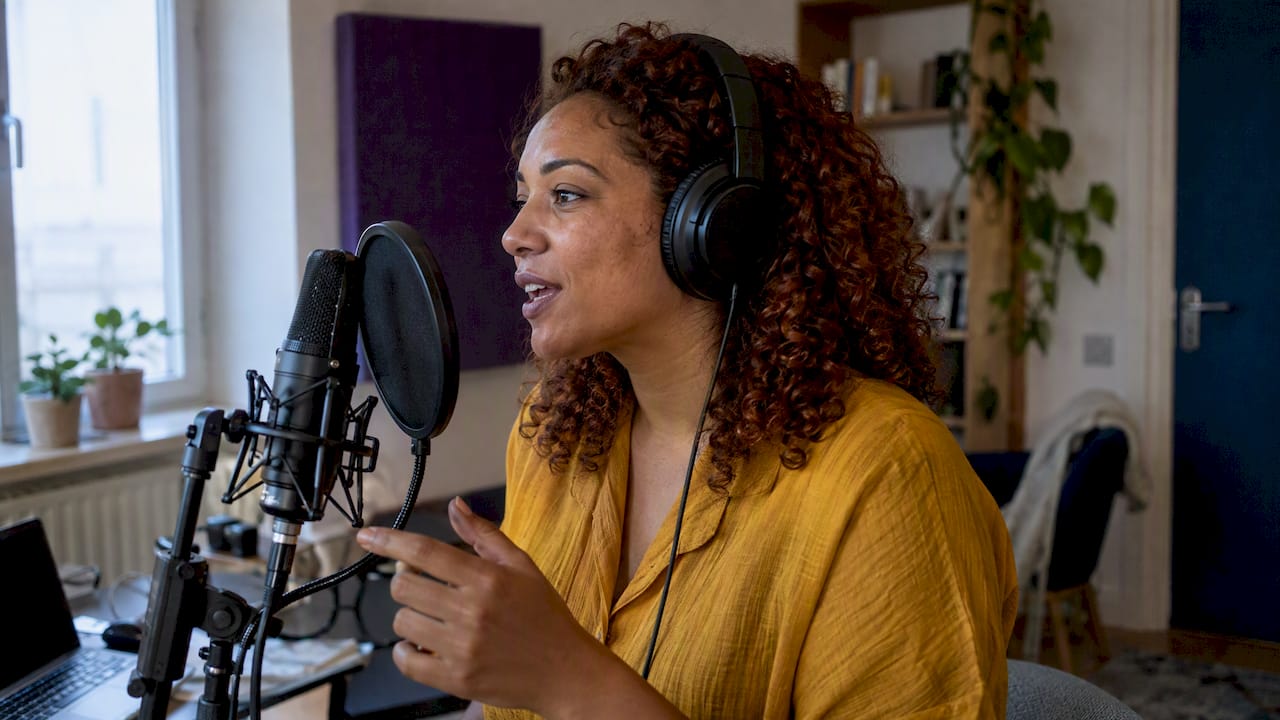
Record your own story: from text to listening experience
When someone wants to record their own story they usually mean one of two things: a sound story, where children make scenes audible with instruments, voice and body, or a spoken audio version of their text — in other words a small audiobook. You don't need a studio for either. You need a text written for the ear, a quiet room, a few basic technical rules and an idea of where the finished recording will find its audience. In this guide we show you both paths step by step, with concrete values for microphone distance and levels, an honest comparison between your own voice, a professional narrator and a voice clone, and the legal points you should know.
In short
- Sound story: You read the story aloud, children assign sounds to characters and events and play them at the right moments. A smartphone is enough to capture the result.
- Audio version: Rewrite the text for the ear, record in a damped room, keep about 30 to 50 centimeters distance to the microphone and set levels so peaks are around minus 10 to minus 6 dB.
- Choosing a voice: Your own voice feels especially personal, a professional narrator brings routine, a voice clone saves recording time.
- Legal: Other people's voices, even imitated by AI, are protected by personality rights. Use only voices you have permission for.
- Publishing: On OutaStory you can put your short story online in minutes and offer it as an audiobook, narrated by you or by a professional voice.
Table of contents
- Two ways to make a story audible
- Record a sound story with children
- Record your story as an audiobook
- Your own voice, professional narrator or voice clone?
- Voice, AI and law: what you should know
- Publish your recorded story
- Frequently asked questions
- Sources
Two ways to make a story audible
Search results on this topic are almost entirely dominated by daycare and primary school materials. That's no coincidence: the sound story is one of the most popular methods in early musical education to introduce children to rhythm, instruments and listening. At the same time the number of people who write themselves and want to let their texts be heard — not just read — is growing: parents who want to record a self-invented bedtime story, or authors who want to publish their short story as an audiobook.
Both paths share a basic idea: a story unfolds differently in the ear than on paper. Sentences must carry without the ability to flip back. Pauses become arcs of tension. And every sound, whether a drumbeat or a breath, contributes to the story. Which path suits you depends on who you are recording for and what you want to create in the end: a shared group experience or a recording others can play anytime.
Record a sound story with children
A sound story is a told story in which certain characters, places or events are given a fixed sound. The process is usually the same: first the story is read aloud, then the group considers together how individual scenes could sound. The Herder article on sound stories in kindergarten describes exactly this introduction and gives illustrative examples: falling snow sounds like tiny bells, the steps of a dragon rumble deep like a drum.
How to proceed
- Choose or write a story. Short texts with many audible events work best: weather, animals, movement, doors, water. Five to eight sound moments are enough to start.
- Mark sound spots. Underline in the text every word where a sound occurs. Recurring characters get a fixed identifying sound.
- Find sounds together. Let the children experiment instead of prescribing instruments. The teaching material for the autumn weather sound story explicitly emphasizes that example tables are only suggestions and that the children should develop a shared sound version themselves.
- Rehearse. Read slowly and make a short pause with eye contact at the sound spots. This helps the children learn their cues.
- Record. Place a smartphone in the middle of the room and start the voice memo app. The SRF guide to making a radio play with a smartphone shows that the preinstalled recording apps on iPhone and Android are sufficient for such projects.
- Listen together. Playback is often the most beautiful moment. Children hear themselves as part of a story and usually want to play it again right away.
Which sound fits what?
| Scene in the story | Sound idea with instrument | Sound idea without instrument |
|---|---|---|
| Rain begins | Rainmaker, shaker | Tap the table with your fingertips |
| Thunderstorm | Timpani, cymbal | Stamp with your feet |
| Wind | Wind chime, soft whistle on the flute | Blow slowly, "fffff" |
| Snow falls | Small bells, triangle | Gently rub the palms together |
| An animal sneaks | Soft drum taps with the fingers | Tiptoe across the floor |
| Door creaks | Guiro, ratchet | Drawn-out "eeeek" with your voice |
| Happy ending | Upward xylophone | Hum together |
The table is a starting point. The more original ideas the children bring, the more the story becomes theirs.
Record your story as an audiobook
If your text is to become a recording others can listen to independently, the focus shifts: away from the group experience and toward voice, room and technique. Audiobook producer Mikael Lundt sums up the goal well: you shouldn't hear the effort behind a well-produced audiobook — it should tell the story compellingly. In his overview of self-producing audiobooks he therefore prioritizes clear pronunciation and emphasis over clinical perfection, while the technology remains unobtrusive.
Prepare the text for the ear
Before you turn on the microphone, read your story out loud once. You'll quickly notice where it works on paper but trips up when heard:
- Break up long nested sentences. Listeners can't jump back. Two short sentences are almost always better than one long one.
- Make speaker changes clear. In dialogue "said Mira" helps more often than in printed text, especially if you don't distinguish characters strongly by voice.
- Write out numbers and abbreviations. Write the way you want to say it so you don't stumble while reading.
- Add breathing and emphasis marks. A slash for a pause, an underline for an emphasized word: your script is a working tool.
- Portion chapters. Lundt recommends in his post on the recording process to plan at most 30 to 45 minutes of reading time per chapter so the production remains controllable. With short stories you are usually below that anyway. Longer texts can be recorded chapter by chapter as a serial story.
Room and equipment
The room is more important than the most expensive microphone. Bare walls, tiles and large windows reflect sound, and that reverberation is hard to remove later. A bedroom with a carpet, curtains and a wardrobe usually sounds better than an empty study. Many narrators therefore record directly in front of an open wardrobe or hang a thick blanket behind them.
For starters a smartphone with a voice memo app is enough if you speak close and quietly. If you record more often, reach for a USB microphone or a microphone with an audio interface. In untreated living rooms a dynamic microphone that you speak closely into usually picks up less room sound than a sensitive condenser microphone. Two small accessories make a big difference:
- Pop filter: It catches bursts of air from "p" and "b" before they land as a dull thump on the recording.
- Shock mount: A sprung holder decouples the microphone from the table. Lundt notes in his post on the recording process that a mic rigidly attached to the table transmits body-borne noise like rumbling.
Recording: distance, angle, levels
Three values you should remember, all from Lundt's guide to the recording process:
| Setting | Guideline | Why |
|---|---|---|
| Distance to mouth | about 30 to 50 centimeters | even sound without an exaggerated proximity effect |
| Angle | around 30 degrees to the side | breath blasts pass the microphone |
| Level peaks | about minus 10 to minus 6 dB | headroom against clipping |
Level is the point where beginners fail most often. A signal that's too loud clips digitally, and that clipping cannot be repaired. A slightly too quiet signal, however, can be raised later without quality loss. So leave a bit of headroom.
A few practical habits:
- Water within reach. A glass of still water next to the microphone helps when your mouth gets dry during long readings.
- Put your phone in airplane mode. Notifications otherwise ruin the best take.
- Leave mistakes, start again. If you slip up, take a short pause, clap once and read the sentence again. The clap is easy to find in the waveform later.
- Make your smile audible. For cheerful passages it actually helps to smile while speaking. The voice sounds warmer.
- Plan breaks. Reading too long in one go makes you tired, and you can hear it. Short breaks keep tone and energy even.
Editing and finishing touches
After recording comes editing. Free audio editors are completely sufficient for this. Remove slips and long pauses, but not every breath: an audiobook without any breathing sounds unnatural. Then normalize the loudness of the individual sections so no one has to adjust the volume while listening. Background music is tempting but quickly distracts from spoken prose. If you use it, keep it low, sparse and only use music whose usage rights you have clarified.
Finally listen to the file once completely with headphones and once on a simple speaker. What sounds good on both will also sound good in the car and on the subway.
We have described how this path looks with us, from choosing the voice to upload, in detail in the article How an audiobook is created.
Your own voice, professional narrator or voice clone?
Not every story has to be read by its author. The decision is strategic and depends on the text. For very personal stories, memories or autobiographical texts your own voice often sounds more authentic than any professional interpretation. For a thriller with many characters or a fantasy story full of tension a trained narrator can, by contrast, get more out of it.
| Criterion | Your own voice | Professional narrator | Voice clone of your voice |
|---|---|---|---|
| Authenticity | very high, your personality is audible | high, but interpreted | high, sounds like you |
| Effort for you | recording, editing, retakes | prepare the text, approve the result | one-time voice recording |
| Speech technique | depends on practice | trained breathing, emphasis, character voices | as good as your base recording |
| Ideal for | personal texts, children's stories, memories | genres with lots of tension and many characters | serial stories with many chapters |
On OutaStory you can take all three routes. In our help we explain how to record your narration voice, how to hire a professional voice and what happens when creating a voice clone with your recording. If you want to know how the work of audiobook narrators and dubbing actors differs, you can find the answer in our article Audiobook narrators vs. dubbing actors compared.
Voice, AI and law: what you should know
Once you publish a recording, a hobby becomes a public work. With your own text and your own voice the situation is straightforward. It becomes tricky when other people's voices come into play, especially via AI.
There is no specific voice law in Germany. The voice is still protected: general personality rights cover the voice as an expression of individuality, as the guide to voice cloning and law explains. How seriously courts take this is shown by a case at the Berlin Regional Court from 2025: the law firm Rose & Partner describes in their article on the rights to a voice that the court considered the unauthorized AI imitation of a famous narrator's voice an intrusion and upheld claims for damages because average listeners could clearly identify the voice.
The imitated person doesn't have to be famous. According to the law firm Fieldfisher in their analysis of generative AI in film production, convincingly realistic imitations can be enough for acquaintances to recognize the voice. Practically this means for you:
- Clone only your own voice or that of a person who has expressly and preferably in writing given you permission.
- Don't make a character "sound like" a well-known actor or dubbing actor.
- Clarify the license for music and sounds from the web before you publish.
How copyright law deals with AI-generated content overall is summarized by the Federal Ministry of Justice in its questions and answers on AI and copyright. If you plan a commercial production with other people's voices or a voice clone of another person, have the agreement reviewed in advance by a lawyer for copyright and media law.
Publish your recorded story
A recording that sits only on your hard drive tells no one anything. That's exactly why we built OutaStory: Your world, your stories: write, read, listen.
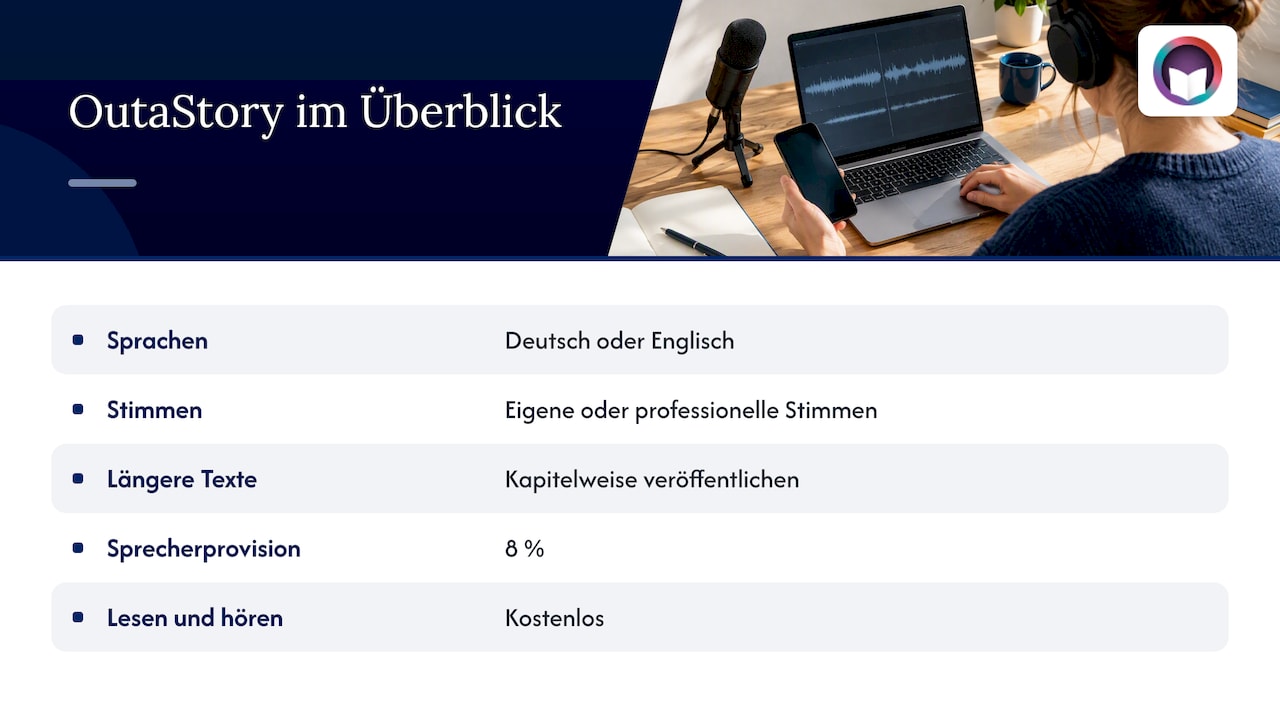
With us you publish your short story in minutes, in German or English. Every story can be played as an audiobook, narrated with your own voice or with professionally produced voices. Longer texts can appear chapter by chapter as a serial story, which fits perfectly with the manageable recording portions we recommended above. Through revenue sharing you earn from the income of your stories. For narrators we state the terms openly: the platform fee for narrators is 8%.
We have also further developed how your listeners experience the story: with synchronized reading and seamless playback, which we present in the article Audio grows up. If you want to hear how it sounds, start for example with the story The library where the books talk back at night. Reading and listening is free. If you want unlimited and offline listening, find the details about OutaStory Premium.
And if you're still wondering whether your story works better as an audiobook or a podcast episode: our comparison Podcast or audiobook helps with the decision.
Frequently asked questions
Is a smartphone enough to record a story?
Yes, for a sound story with children or a first audio version the preinstalled voice memo app is sufficient. What matters is a quiet, furnished room and a consistent, close speaking distance. If you record regularly, you will notice a clear difference with a USB microphone and a pop filter.
How long does it take to record a short story?
Plan significantly more time for recording than the finished audio lasts, because slips of the tongue and retakes are part of the process. Then comes the editing, which for beginners often takes longer than the recording itself. With some practice both become noticeably faster.
May I record my story using an AI voice?
Yes, with your own cloned voice or a licensed synthetic voice. You may not imitate another person's voice without their consent, because it is protected by general personality rights. In case of doubt, a lawyer specializing in media law can help.
What is the difference between a sound story and a radio play?
In a sound story a text is read aloud and sounds accompany certain passages, usually live with children. A radio play, by contrast, relies on multiple voice roles, noises and scenes that act like a film for the ear. An audiobook is the read version of a text, usually with a single voice.
Can I make money with a recorded short story?
On OutaStory you participate in revenue from your stories through revenue sharing. How much that is depends on how many people read and listen to your story. A good recording and regular new chapters help build an audience.
Sources
- Herder: Sound stories in kindergarten
- Teaching material: Autumn weather sound story
- SRF: Record your own radio play with a smartphone
- Mikael Lundt: Record an audiobook yourself
- Mikael Lundt: Self-producing an audiobook, Part 16 (The recording process)
- Legal guide: Voice cloning and law
- Rose & Partner: Copyright in the voice
- Fieldfisher: Film production in the age of generative AI, Part III
- BMJV: Artificial intelligence and copyright, questions and answers
Recommendations
- Field notes from the Elbe valley
- Whispers of houses
- The grammar of printing
- The boy who could hear stones
Read and write on OutaStory
Thousands of short stories to read for free — or publish your own and find an audience.