Space horror short stories: the best stories to read and listen to
Space Horror lives from a simple idea: out there is nothing that keeps you alive, and inside there might be something that doesn't belong on board. The best space-horror short stories turn that claustrophobia into pure unease in just a few pages. Here you will find classics like A. E. van Vogt's alien hunts and Octavia Butler's "Bloodchild", modern stories you can listen to for free as audio, pointers to German and English texts, an honest look at scares for children, and tips on how to write and publish your own story from the darkness between the stars.
In short
- Space Horror combines science fiction with horror: isolation, a hostile space environment, alien beings on board, and physics you can no longer rely on.
- Classics to start with: "The Black Destroyer" and "Discord in Scarlet" by A. E. van Vogt, "Bloodchild" by Octavia Butler, "Schrödinger’s Catastrophe" by Gene Doucette.
- Listen for free: Several modern stories, such as those by KC Grifant and Todd Keisling, are available freely as audio.
- For children keep in mind: check the synopsis and the ending beforehand, and watch for violence, cruelty, and hopelessness.
- On OutaStory you can read sci‑fi short stories for free or listen to them as audiobooks, and as an author you can publish your own in just a few minutes.
Table of contents
- What makes a space-horror story
- Space-horror short stories worth reading
- Read and listen to space horror for free
- In German or in English?
- Eerie Sci‑Fi stories on OutaStory
- Space scares for children: what parents should watch out for
- Write your own space-horror short story
- Frequently asked questions about Space Horror
- Sources
What makes a space-horror story
Why does horror work so well in space? Because the setting does half the work. A spaceship is a closed space with limited air, a limited crew, and no escape. If you hear a noise there that shouldn't be there, you can't just open the door and run away. The threat already starts with the environment: vacuum, cold, radiation, and distances that make any rescue impossible.
From this basic situation several recurring motifs have developed, by which you can quickly recognize good space-horror short stories:
- The alien on board. A creature sneaks onto a research ship and begins hunting the crew. The author and critic Scott Nicolay describes the motif of the last surviving alien that haunts a human research ship as typical for classic stories of the genre.
- Isolation. A single person, days or months away from any help, and their own perception becomes uncertain ground.
- Broken reality. Laws of nature that every spacefaring venture relies on suddenly stop applying.
- Cosmic horror. Not a monster, but the realization of how small and insignificant humans are in the universe. Here Space Horror touches the tradition of Cosmic Horror.
- The body as a boundary. Alien biology interfering with the human body belongs to the most disturbing variations.
The short form suits these motifs especially well. A short story doesn't have to explain a whole world. It puts you in a cabin, switches off the light, and leaves you alone with a single idea. That's exactly why many of the most powerful space-horror texts feel more intense in 20 minutes of reading than some novels.
The boundaries to neighboring genres are fluid. If magic, myths, or ancient powers come into play, you move toward science fantasy. If this mix appeals to you, you'll find more recommendations and writing ideas in our post about science‑fantasy short stories.
Space-horror short stories worth reading
The following selection ranges from the beginnings of the genre to stories from recent years. It shows how varied dread in space can be: as a hungry alien, as breaking physics, or as a knock on the hull.
| Titel | Autor | Worum es geht | Spielart |
|---|---|---|---|
| The Black Destroyer | A. E. van Vogt | An intelligent, hungry alien sneaks onto a research ship | The alien on board |
| Discord in Scarlet | A. E. van Vogt | Another creature hunts the crew of a research ship | The alien on board |
| Bloodchild | Octavia E. Butler | Families must provide a child as a host for the eggs of the Tlic | Body horror |
| Schrödinger’s Catastrophe | Gene Doucette | On the USFS Erwin, physics and probability fail | Broken reality |
| The Substance of Shadow | Brett J. Talley | Astronauts lose their grip on their own perception in the darkness | Cosmic horror |
| The Darkness Between Dead Stars | Todd Keisling | A lone traveling Mars astronaut hears knocking on the hull of his ship | Isolation |
| Negation | KC Grifant | Space researchers stumble upon a disturbing discovery | Cosmic horror |
The classics: aliens on board
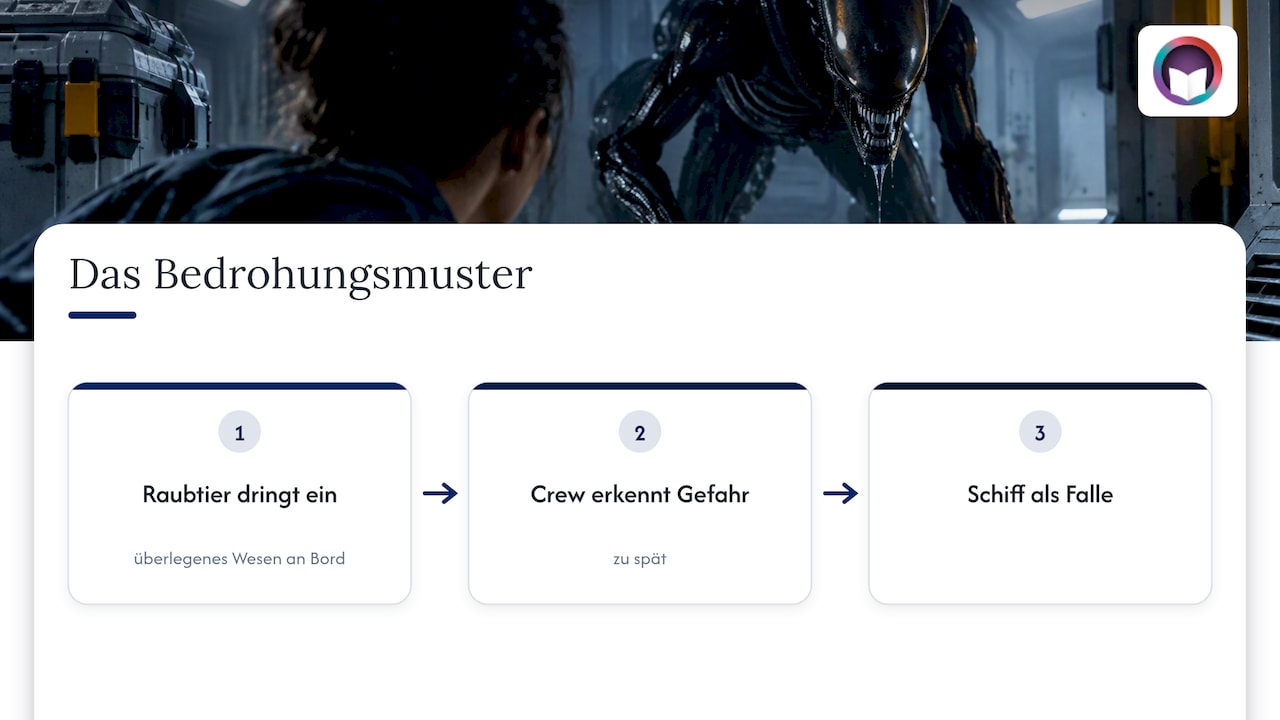
If you want to understand where the image of the monster in the cargo hold comes from, you will sooner or later land at A. E. van Vogt. In "The Black Destroyer" and "Discord in Scarlet", highly intelligent, hungry creatures invade research ships and hunt the crew. The pattern still resonates today: a superior predator, a crew that realizes too late, and a ship that becomes a trap.
When reading, it's worth paying attention to the pace. Van Vogt doesn't just tell from the humans' perspective, he also lets you look into the mind of the alien. That makes the threat tangible and uncanny at the same time, because you know more than the characters.
Body horror with depth: "Bloodchild"
Octavia E. Butler's story is one of those texts you keep thinking about for days. In "Bloodchild", humans live with the alien species Tlic, and families must provide a child as a host for their eggs. The horror lies less in single scenes than in the system behind it: dependency, power, and the question of what living together costs. If you seek space horror with social edge, start here.
When physics fails: "Schrödinger’s Catastrophe"
Gene Doucette takes a different route. On the spaceship USFS Erwin suddenly all known laws of physics and probability fail, and chaos breaks loose. The title already references Schrödinger's famous thought experiment, and that's exactly what it's about: a state in which nothing is certain anymore. This story is suitable for those who prefer their horror confusing rather than bloody.
Fear in your own head: "The Substance of Shadow"
Brett J. Talley's 2015 story shows space as a shattering place where astronauts wrestle with their own perception in the darkness. Here the monster is not necessarily a creature, but the uncertainty about what is real. If you appreciate Lovecraft and cosmic dread, you'll feel at home in this text.
Alone: "The Darkness Between Dead Stars"
Todd Keisling's 2017 story plays with one of the oldest fears: being alone and still hearing something. An astronaut travels alone to Mars, and suddenly there's a knock on the hull of his ship. This story needs no more, and especially as audio the knocking unfolds an effect that will make you prick up your ears at the next weird noise in the stairwell.
Modern and atmospheric: "Negation"
KC Grifant's "Negation" is about space researchers who encounter a disturbing discovery. The mood is reminiscent of films like "Annihilation": beautiful, alien, and deeply unsettling at the same time. If you then prefer something a bit more grounded but no less eerie, the same author offers "The U Train", in which four strangers wait in vain for a subway that never comes.
Read and listen to space horror for free
Many great space-horror stories cost you nothing but a bit of courage when the lights go out. Especially modern authors make their texts freely available, often as audio.
- KC Grifant collects on her website free horror stories to listen to and read, including "Negation" and "The Peerlings", each with a note about where the audio version appeared.
- Todd Keisling: "The Darkness Between Dead Stars" is listed in a collection of freely available horror audio stories.
- Our library on OutaStory: You can read all stories for free, and each can be played as an audiobook.
A practical tip for listening: Space Horror lives from silence. Headphones, a dark room, and no notifications turn a good story into an experience. Especially stories with sound motifs, like the knocking in Keisling, often hit harder as audio because the voice sets the pace and you can't flip ahead.
If you like to dive beyond stories into alien, cosmic worlds, for example for your own pen‑and‑paper session, you'll find inspiration for cosmic horror campaigns here. Many motifs from space-horror short stories, from the abandoned ship to the unexplained signal, make excellent starting points for a shared game night.
In German or in English?
Most classics of Space Horror are English originals. This applies to all the titles in the table above. If you read or listen to English fluently, you'll have the largest selection, including freely available audio stories like those from KC Grifant and Todd Keisling.
Translations often appear under different titles. If you're looking specifically for a German version, searching for the author and original title in your city library catalog or the German National Library will help, because translations are usually linked to the original title there.
For stories written directly in German, take a look at platforms with German-speaking indie authors. On OutaStory stories appear in both German and English, so you can switch between the two languages depending on what you feel like.
Eerie Sci‑Fi stories on OutaStory
We built OutaStory for people who love stories, whether they prefer to read or listen. Every short story on our platform can be read for free, and each can be played as an audiobook, voiced by professionally produced voices or by the author themself. For Space Horror this is a real advantage: a voice in your ear telling you about a silent ship feels closer than any screen.
If you're looking for stories among the stars, start with these sci‑fi short stories from our library:
- Signal from Andromeda
- Light Years Away
- Mirror World
- Creativity in Space, a dystopia
- The Curse of the Other Side, for those who prefer it creepier
Do you like to listen to stories on the go, on the train, or to fall asleep? With OutaStory Premium you get extended features like unlimited listening, ad‑free use, and offline access so the next story keeps going even in a dead zone.
Your World, Your Stories: Write, Read, Listen.
Space scares for children: what parents should watch out for
Children also love to be scared, and space is a fascinating setting for many. However, most space-horror short stories above are written for adults. Body horror like in "Bloodchild" or the hopelessness of some cosmic stories don't belong in a bedtime story.
The author Tommy Krappweis gives parents some clear tips on scaring children on KiKA that transfer well to space stories:
- Check age recommendations. If a story or audio play has a recommendation, that's the first clue.
- Watch for violence and cruelty. An eerie signal is different from a crew being hunted.
- Avoid hopelessness. For children it's crucial who is affected and how it resolves.
- Read the synopsis and ending in advance. Children react very differently to loss or unresolved threats.
- Show anxious children the ending. Knowing that everything turns out okay lets them enjoy the suspense beforehand.
If your child sleeps poorly after a story or fears persist, talk calmly with them and seek advice from a pediatrician if problems continue.
For younger listeners we have a dedicated kids section on OutaStory with bedtime stories, animal adventures, and first rhymes. Space can remain a place of wonder there before it one day becomes a source of goosebumps.
Write your own space-horror short story
Did you think while reading: the knocking on the hull, I'd tell that differently? Then that might be the beginning of your own story. Space Horror is a generous genre for the short form because few elements are enough.
Five building blocks for effective space horror
- A confined setting. A ship, a station, a lifepod. The less space, the greater the claustrophobia.
- A clear rule that breaks. The radio goes silent, gravity fails, a crew member is one too many on board. One broken rule can carry an entire story.
- Few characters. In 3,000 to 5,000 words you rarely need more than two or three people. Every extra character costs space the atmosphere needs.
- Sounds and silence. What does your character hear, and what do they no longer hear? Acoustic details are pure gold, especially for an audiobook version.
- An ending that lingers. Space Horror doesn't have to explain everything. Often an open question resonates longer than any resolution.
Write, publish, earn
On OutaStory you can publish your short story in minutes. Longer ideas can be released chapter by chapter as a serial, which works well for Space Horror: each chapter ends with a new sound in the dark, and your readers wait for the next one. You can narrate your story yourself or have it professionally produced, and through revenue sharing you earn from the income your stories generate. For narrators there is a platform commission of 8%.
If you want to see how others build tension on our platform, read for example the thriller Dark Deals. And if you prefer witches to aliens, find more reading in our recommendations for witch‑fantasy short stories.
Frequently asked questions about Space Horror
What is the difference between Space Horror and Cosmic Horror?
Space Horror describes the setting: the story takes place in space, on a ship, or on an alien planet. Cosmic Horror describes a type of dread, namely the realization that humans are small and powerless in the universe. Many stories combine both, for example Brett J. Talley's "The Substance of Shadow".
Which space-horror short story is suitable as an introduction?
For a classic introduction, A. E. van Vogt's "The Black Destroyer" is suitable because it shapes the motif of the alien on board. Those who prefer something more psychological should start with Todd Keisling's "The Darkness Between Dead Stars". For profound body horror, Octavia E. Butler's "Bloodchild" is the best choice.
Can I listen to space-horror stories for free?
Yes. Modern authors like KC Grifant make stories available freely as audio, and Todd Keisling's "The Darkness Between Dead Stars" is also available to listen to for free. On OutaStory you can read all stories for free and play any of them as an audiobook.
How long should a space-horror short story be?
There is no fixed rule. Many effective stories manage with a few thousand words because they focus on one setting, few characters, and a single threat. If the idea grows, you can publish it on OutaStory as a serial story in chapters.
Sources
- Scott Nicolay: Stories From the Borderland, "The Black Destroyer" and "Discord in Scarlet"
- Destructoid: 10 Best spacefaring sci‑fi short stories
- Shoggoth.net: The Substance of Shadow
- Horror Delve: Four Free Audio Horror Stories
- KC Grifant: Free horror stories to listen to and read
- KiKA: Scaring children, tips for parents
Recommendations
Read and write on OutaStory
Thousands of short stories to read for free — or publish your own and find an audience.