
Science-Fantasy Short Stories: read, listen and write your own
Science-fantasy short stories combine spaceships with runes, algorithms with curses, and distant planets with ancient myths — all on so few pages that they fit a train ride or the half hour before falling asleep. In this guide we explain what defines the genre and how to recognize a strong story. You will learn where to find good texts, why science fantasy is particularly well suited to listening, and what parents should look for in read-aloud stories. At the end we show you how to publish your own short story and earn from it.
In short
- Science fantasy mixes elements of science fiction — such as technology and strange worlds — with magic and mythic powers. The impossible does not have to be scientifically explained.
- The short form fits perfectly: A single idea, an alien world, and a turning point are enough for a story that lingers.
- Listening is worth it: In audio narratives the images form in your own head, and that matters a lot for a visually rich genre.
- For children calm stories with recurring elements are suitable. Adventures with big fights are better for daytime.
- For writers there are several paths: magazines, anthologies, or a platform where you publish immediately and share in the revenue.
Table of contents
- What defines science fantasy
- Why the short form suits the genre
- How to recognize a strong science-fantasy story
- Where to find good science-fantasy short stories
- Science fantasy: listening instead of reading
- Science fantasy for children: calm, repeatable, with clear rules
- Stories on OutaStory: read or listen
- Write it yourself: your science-fantasy short story
- Frequently asked questions
- Sources
What defines science fantasy
The term sounds like a contradiction, and that is exactly its appeal. The German-language Wikipedia describes science fantasy as a hybrid genre that unites elements of science fiction and fantasy in literature, film and games. Futuristic technology, alien worlds or space travel sit alongside magic, supernatural powers and settings that feel medieval or mythological.
The decisive difference to classic science fiction: the focus is not on the technical invention and its plausible derivation. A science-fantasy story does not have to explain why the wizard on the space station can actually perform magic. It accepts it as a rule of its world and tells what follows from it.
Three genres compared
| Characteristic | Science fiction | Fantasy | Science fantasy |
|---|---|---|---|
| Basis of the world | Laws of nature, scientifically conceivable | Supernatural powers, own laws | Both at once, often without a clear boundary |
| Typical settings | Spaceships, future cities, alien planets | Kingdoms, forests, magical realms | Orders of knights in space, magic in the ruins of a high-tech civilization |
| Central question | What if this technology existed? | What happens when magic works? | What happens when technology and magic meet? |
| Need for explanation | High — the new should seem plausible | Low — the world has its own logic | Low to medium — the mixture matters |
The boundaries are fluid, and readers often argue about them in reading groups. For you as a reader classification is secondary. What matters is whether a story pulls you into its world and whether its rules remain consistent within that world.
Why the short form suits the genre
Novels in the fantastic realm often need hundreds of pages to build world, magic system and political situation. A short story cannot afford that, and that is its strength. It must open a strange world with a few sentences, set a problem and end with a twist or an idea that lingers.
That forces a precision you feel immediately as a reader. Instead of an entire stellar empire you see a single workshop where a mechanic repairs broken protective amulets. Instead of a prophecy spanning twelve volumes you get a single night in which a shipboard computer starts speaking prayers. You sense the world behind it, and it is exactly those gaps your imagination fills.
Short stories also serve as a bridge to real topics. The portal Wissenschaftskommunikation.de describes science-fiction short stories as a format for conveying research ideas through stories set on distant planets or in parallel worlds. Often a short paragraph about the science behind the story follows at the end. Science fantasy treats the facts more freely but hits the same nerve: it asks big questions about technology, power and responsibility in a frame that doesn't feel like a textbook.

How to recognize a strong science-fantasy story
Not every story with a laser sword and a dragon is successful science fantasy. These traits have been observed in texts that stay longest with readers:
- A clear rule for the mix. Good stories establish early how magic and technology interact. Maybe magic is forgotten technology, maybe electronics cannot tolerate sorcery, maybe every spell requires computing power.
- A concrete entry point. The first sentences show a character in a situation rather than a world description. Starting with three paragraphs of empire history wastes the short form.
- A conflict born from the mix. The strongest stories have a problem that can exist only in this world: an exorcism on an artificial intelligence or a contract with a fairy creature that demands data as payment.
- Sparse terminology. Invented words are a spice. Too many of them and you read a glossary instead of a story.
- An ending with resonance. A short story does not have to resolve everything, but it should leave you with an image or a question.
Typical motifs you will find again
- Distant future in which advanced technology acts like magic and is worshiped as such
- Orders of knights or monks with supernatural abilities between the stars
- Planets with mythological beings that pose riddles for colonists
- Parallel worlds where a portal connects science and sorcery
- Libraries, archives and codes that know more than their readers
One of the best-known examples of the first motif comes from short stories themselves: Jack Vance’s tales of the dying earth gave a whole subgenre of science fantasy its name. In that world fading science mixes with returning sorcery.
Where to find good science-fantasy short stories
If you search deliberately you encounter quite different sources. Each has its pros and cons:
- Anthologies and collected editions: Editors curate stories around a theme, often with high quality. The drawback: pure science-fantasy collections are rare; the genre usually sits between science-fiction and fantasy pieces.
- Genre magazines: In the German-speaking area there are several magazines for speculative literature that regularly publish new short stories. Ideal if you want to discover current German-language voices.
- Public-domain classics: Many older works are available free as e-books. They show where the genre comes from but often feel linguistically dated.
- Forums and reading groups: Recommendations from communities help with orientation but do not replace reading itself.
- Platforms for short stories: Here you'll find new texts, often free, frequently posted directly by the authors and ideally also available as audio versions.
Our tip: read across these sources. A classic shows the roots, a current text shows where the genre is heading now.
Science fantasy: listening instead of reading
Fantastic stories live from imagery, and paradoxically these images often feel stronger when listening than in film. In film everything is given: what the spaceship looks like, what color the spell is. When listening all of that forms in your head. ZEIT described in an article about audio plays for children that children develop their own images through listening and that sounds help contextualize the text. The principle applies to adults as well.
For an audio version to work, however, the text must be precise. Spaces, time and action must be conveyed through language because you cannot flip back. Precisely for that reason the short story is so well suited to listening: it is dense, manageable and finished in one sitting.
Practically this means:
- On the go: A story of 15 to 30 minutes fits a commute, a walk or a lunch break.
- For falling asleep: Choose calmer texts. A space battle with a cliffhanger is more likely to keep you awake.
- To rediscover: A story you have already read often feels entirely new when spoken because a voice emphasizes things you skimmed while reading.
Science fantasy for children: calm, repeatable, with clear rules
Children love robots, dragons and alien planets — often all in the same story. Science fantasy is actually the natural state of their imagination. But read-aloud stories follow a few special rules.
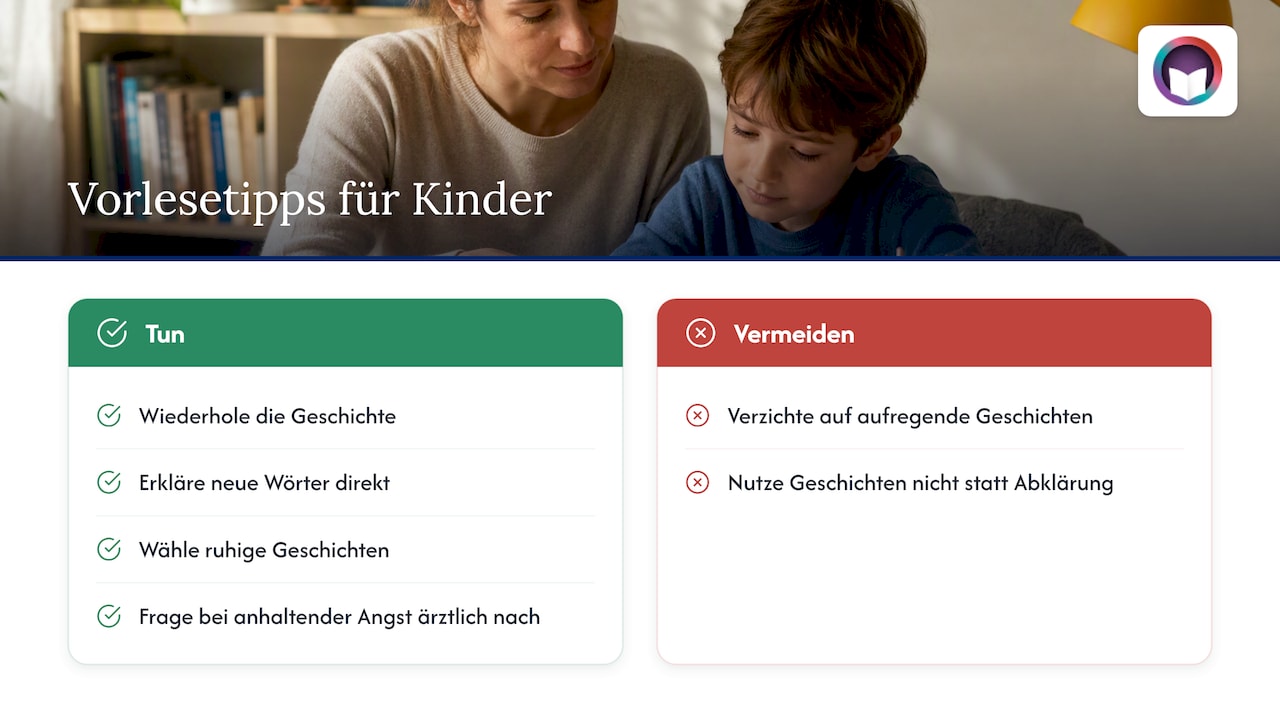
Repetition is desirable. Professor Sandra Niebuhr-Siebert explains in the mentioned ZEIT article why children want to hear the same story up to a hundred times: it helps them remember content and the predictable calms them. With complex worlds featuring spaceships and magical creatures your child becomes an expert in their story.
Explain new words briefly. Terms like antigravity or star portal are best explained directly in the story and repeated later. That way vocabulary grows alongside.
Prefer calm before sleep. A pilot study from 2024 found indications that structured reading of picture books can reduce sleep-related anxieties in children aged around four and a half to seven within two weeks. It is important that the story is not too exciting and that the volume remains comfortable. The DAK recommends in its tips for helping children fall asleep to use stories and songs to calm down, but actual falling asleep should happen in silence. Sleep researcher Prof. Dr. Schlarb also, in an interview on whether audio plays can harm falling asleep, does not fundamentally oppose stories for bedtime.
If your child has major fear of bedtime for weeks or regularly wakes up startled at night, talk to your pediatrician. A story can soothe but does not replace medical assessment.
Find more ideas for calm evenings in our overview of the best bedtime stories and in our tips on bedtime stories for reading aloud and listening.
Stories on OutaStory: read or listen
On OutaStory you can read short stories for free or listen to them. Every story can be played as an audiobook, either with professionally produced voices or with the author's own voice. Our genre range spans fantasy, romancelike fantasy and science fiction to crime, thrillers and horror and includes a dedicated children's section.
If you are looking for stories where technology, puzzles and the uncanny intertwine, these titles are a good starting point:
- The Third Storage Slot, a GameLit story for those who like switching between digital and magical worlds
- The Code in the Library Books
- The Library Where the Books Talk Back at Night
- The Last Library
- The Curse of the Other Side
If you prefer classic-magic, you will find more reading material in our recommendations for witch-fantasy short stories.
Reading is free, listening is too. Those who want more — for example unlimited listening, an ad-free experience or offline access to stories — can find all details about our premium membership.
Write it yourself: your science-fantasy short story
Maybe you are reading this article not only as a reader. Science fantasy is a grateful genre for beginning writers because it gives you a lot of freedom. Freedom, however, needs structure.
How to build the story
- Find the one mix. Write in one sentence how magic and technology relate in your world. That sentence is your compass.
- Start in the middle of the scene. A character, a place, a problem. Explain the world incidentally.
- Limit the locations. In a short story one to three places usually carry more than ten.
- Let the conflict grow from the world. Ask yourself: Could this story also take place in pure science fiction or pure fantasy? If so, you are not yet using your genre.
- Plan the ending first. A twist only works if it is prepared. Leave small clues when revising.
- Read aloud. Especially if your story will later appear as an audiobook, you will immediately notice where sentences are too long or terms too awkward.
Magazine, anthology or platform?
Many genre magazines and anthologies accept submissions, often with fixed length requirements, frequently in a range of several tens of thousands of characters. Pay close attention to submission guidelines: some editors require professionally formatted manuscripts, a short synopsis including the ending, and above all that the text is unpublished, not even on the internet. Fees in the genre are usually modest. And the time between submission and response can be months.
That is not an argument against magazines but a question of strategy. If you want to submit a text to a specific call, do not publish it anywhere beforehand. If, on the other hand, you want to reach readers now, get feedback and earn from your texts, a platform is the more direct route.
Publishing on OutaStory
With us you can publish your short story in minutes. Longer ideas can appear chapter by chapter as a serial, which is especially appealing in science fantasy with its large worlds: readers return for each new chapter. Your story can also be played as an audiobook, optionally with your own voice.
As an author you pay nothing to use the service and participate in revenue sharing from your stories' earnings. We explain transparently on our info page how the model is structured and which platform fee of 8% applies. Because OutaStory is available in German and English, your story can also find an audience beyond the German-speaking area.
Your world, your story: write, read, listen.
Frequently asked questions
What is the difference between science fantasy and science fiction?
Science fiction tries to make its innovations appear scientifically plausible. Science fantasy mixes technology and strange worlds with magic or supernatural powers without having to explain everything. The center is often not the invention but the interaction of future and myth.
Where can I read science-fantasy short stories for free?
You can find public-domain classics as e-books for free as well as new texts on short story platforms. On OutaStory you can read stories for free and also play them as audiobooks, with professional voices or the author's voice.
Is science fantasy suitable as a bedtime story for children?
Yes, if the story is told calmly and does not end with an exciting fight. Recurring characters and routines give children security; it's best to explain new terms directly in the story. Exciting space adventures are better for the afternoon.
Can I publish my story on OutaStory and later submit it to a magazine?
That depends on the conditions of the respective magazine. Many require unpublished texts, not even previously published on the internet. If you have a specific call for submissions in mind, check the requirements before you publish.
Sources
- Science Fantasy – Wikipedia
- Dying Earth (genre) – Wikipedia)
- Science-fiction short stories – Wissenschaftskommunikation.de
- Audio plays for children – ZEIT ONLINE (PDF)
- Pilot study on children's sleep-related anxieties (2024)
- Tips for helping children fall asleep – DAK
- Can audio plays harm falling asleep? – leben & erziehen
Recommendations
- Witch-fantasy short stories: recommendations for reading and listening
- Fantasy short stories: where to read, listen and share them
- Start now: free science-fiction short stories on Outastory
Read and write on OutaStory
Thousands of short stories to read for free — or publish your own and find an audience.