Podcast vs. Audiobook: Which audio format suits you?
Audiobooks are suitable if you want a complete, produced narrative or deep learning. Podcasts are a better fit if you prefer current, episodic or dialogical content. For commuting, a casual podcast episode is often enough, while for focused studying in the evening a fully composed audiobook scores better. Platforms like OutaStory offer short stories that can be either read or listened to as audiobooks.
In short:
- Podcasts provide current and spontaneous content, are usually free, episodic and suitable for short listening sessions on the go.
- Audiobooks are linear, produced and offer a complete narration of a work, ideal for focused listening in the evening.
- For learning purposes, a clear structure and chapter markers in audiobooks are advantageous, while podcasts with changing topics can be more distracting.
- Producing an audiobook is more complex and expensive because it requires direction, recording and post-production, compared to the usually lean podcast productions.
- On platforms like OutaStory, short stories can be both read and listened to, enabling quick publishing and flexible use.
Table of contents
- Core differences: origin, structure and tone
- When podcast, when audiobook: decision questions for everyday life
- Technology and distribution: RSS, subscriptions and offline listening
- What listening really brings for learning
- Production and costs: why audiobooks are more elaborate
- Short stories as audiobooks: how OutaStory implements this
- Short and honest: OutaStory for listening or publishing
- Sources
- FAQ
Core differences: origin, structure and tone
A podcast is an episodic audio format that is distributed via an RSS feed. New episodes land automatically in the subscription as soon as they are published. An audiobook, by contrast, is the voiced version of a book: built linearly, with a beginning, middle and end, usually without interruption by advertising or guest conversations.
The roots explain a lot. Podcasts come from radio and journalism, audiobooks from literature mediation. This also shapes the tone: podcasts often sound spontaneous and conversational, almost like a conversation at the kitchen table. Audiobooks are scripted, considered and often carried by a single narrative voice.
The most important distinguishing features at a glance:
- Structure: Podcasts are episodic and open to continuation, audiobooks follow a fixed, linear narrative structure.
- Tone: Podcasts often sound dialogical and topical, audiobooks feel produced and literary.
- Intent: Podcasts aim to inform or entertain in the moment, audiobooks aim to convey a story or work in full.
If you know both formats, you quickly notice: it's not about better or worse, but about different purposes. A podcast accompanies you through the day, an audiobook takes you on a journey with a clear destination.
When podcast, when audiobook: decision questions for everyday life
Three questions help with the choice. First: Do you want to inform yourself or dive into a story? Second: How much time do you have, ten minutes or several hours at once? Third: Do you expect a scripted production or is a spontaneous conversation sufficient?
Typical everyday situations show how this looks in practice:
- Commuting in short stretches: A 20-minute podcast episode fits the train ride without you having to get off in the middle of a chapter.
- Housework or workout: Both run in the background, an audiobook with a calm narrative voice or an energetic podcast work equally well here.
- Focused studying in the evening: An audiobook with a clear structure supports comprehension better than a format with many topic changes.
- Falling asleep: Calm short stories or audiobooks with a steady pace are better suited than excited conversational formats.
- Time together with children: Short, self-contained stories fit better into set bedtime rituals than open series formats.
Pro tip: Always test the first episode or the first chapter of new formats in a quiet moment before using them on the go or when falling asleep: this way you quickly notice whether the pace and tone suit you.
Technology and distribution: RSS, subscriptions and offline listening
Podcasts thrive on the open RSS standard. Whoever subscribes to a feed receives new episodes automatically, regardless of the provider. This openness explains why podcasts are available on so many platforms at the same time.
Audiobooks usually run through more closed systems: shops with single purchases, flat rates with monthly access or apps with their own player. Many providers additionally rely on copy protection and fixed chapter structures.
For you as a listener this means:
- Podcasts are usually free and ad-funded, but less structured by chapters.
- Audiobooks often offer clear chapter markers and a progress sync between devices.
- Offline downloads are the rule for audiobooks, for podcasts they are an additional feature of the respective app.
What listening really brings for learning
Research on whether reading or listening is better for comprehension does not provide a uniform picture. Comparative studies on reading and listening modality sometimes show no large differences between pure reading and pure listening, sometimes small advantages for the combination of both, depending on the text and test design.
Dual modality, that is reading and listening at the same time, can support comprehension, especially with complex texts or weaker readers, as the same research literature suggests.
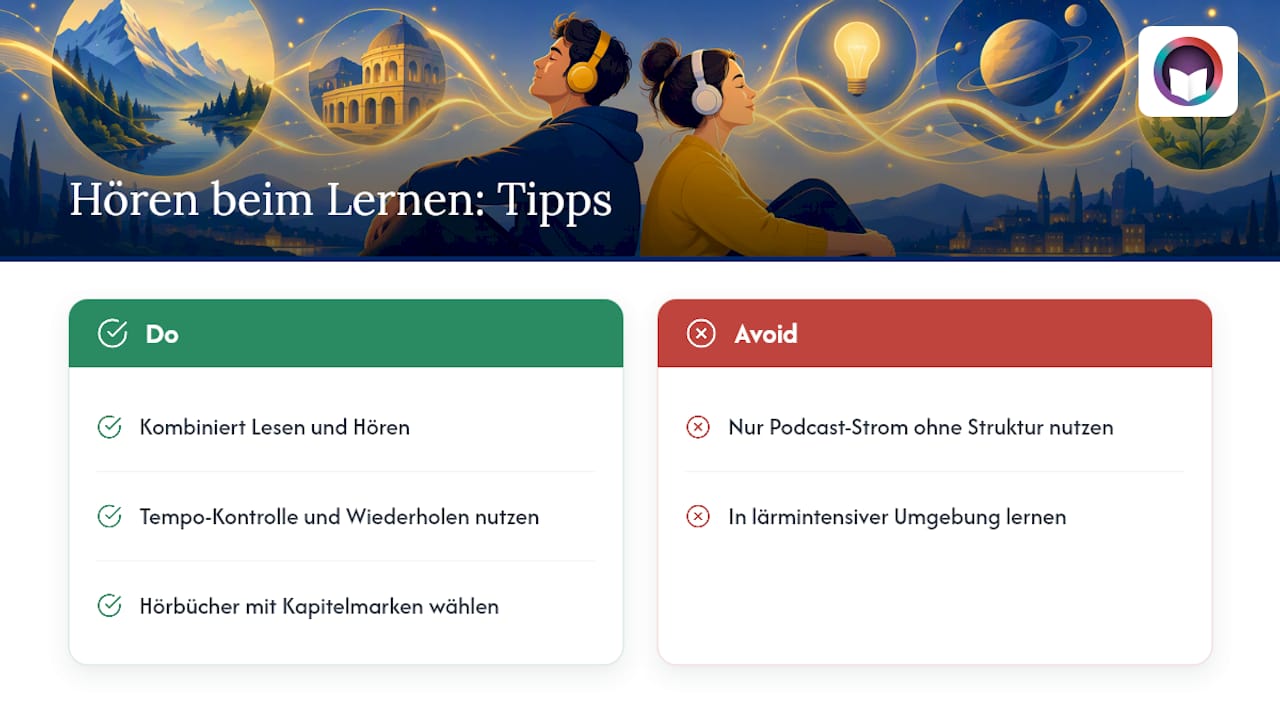
Practically speaking: tempo control and the ability to replay a passage strongly affect learning outcomes. An audiobook with clear chapter markers can be reviewed more purposefully than a stream of podcasts without a fixed structure. Background noise in the environment also significantly reduces intelligibility, regardless of the format.
Production and costs: why audiobooks are more elaborate
An audiobook is created in several steps: narrator selection, direction, recording and post-production. Anyone who wants to hire a narrator for their story quickly notices how much fine work goes into emphasis, pacing and editing. Podcasts, on the other hand, often arise more leanly: recording, one round of editing, done.
This difference is also reflected in the business model:
- Audiobooks are often purchased individually or billed via a flat rate.
- Podcasts are usually financed through advertising, donations or memberships like Patreon.
- The production time for an audiobook is often significantly higher than that of a single podcast episode because direction and post-production require more passes.
Narrator quality is not a side issue: according to the Audible Listening Compass 2025, a large majority of listeners value an appealing reading voice. So whoever invests in production invests exactly where the audience cares.
Short stories as audiobooks: how OutaStory implements this
OutaStory shows how the effort of a classic audiobook production can be combined with the speed of a short format. Each short story on the platform can be either read or listened to, with professionally produced voices or the author's own voice.
- Stories are also released as continuations, chapter-wise, similar to the episodic logic of podcasts.
- Anyone looking for a narrator for their own story will find a guide to hiring a narrator.
- For on the go there is a practical guide to offline listening.
- Authors publish their texts in minutes and participate in the revenue share of their stories.
The genre spectrum ranges from fantasy, romantasy and science fiction to crime, thriller and horror, as well as a dedicated children's section with bedtime stories and animal adventures.
Short and honest: OutaStory for listening or publishing
If you want to get started independently of the rigid chapter grid of a classic audiobook, OutaStory is a practical entry: short stories that you can read or listen to in a break, without the time investment of a multi-hour novel.
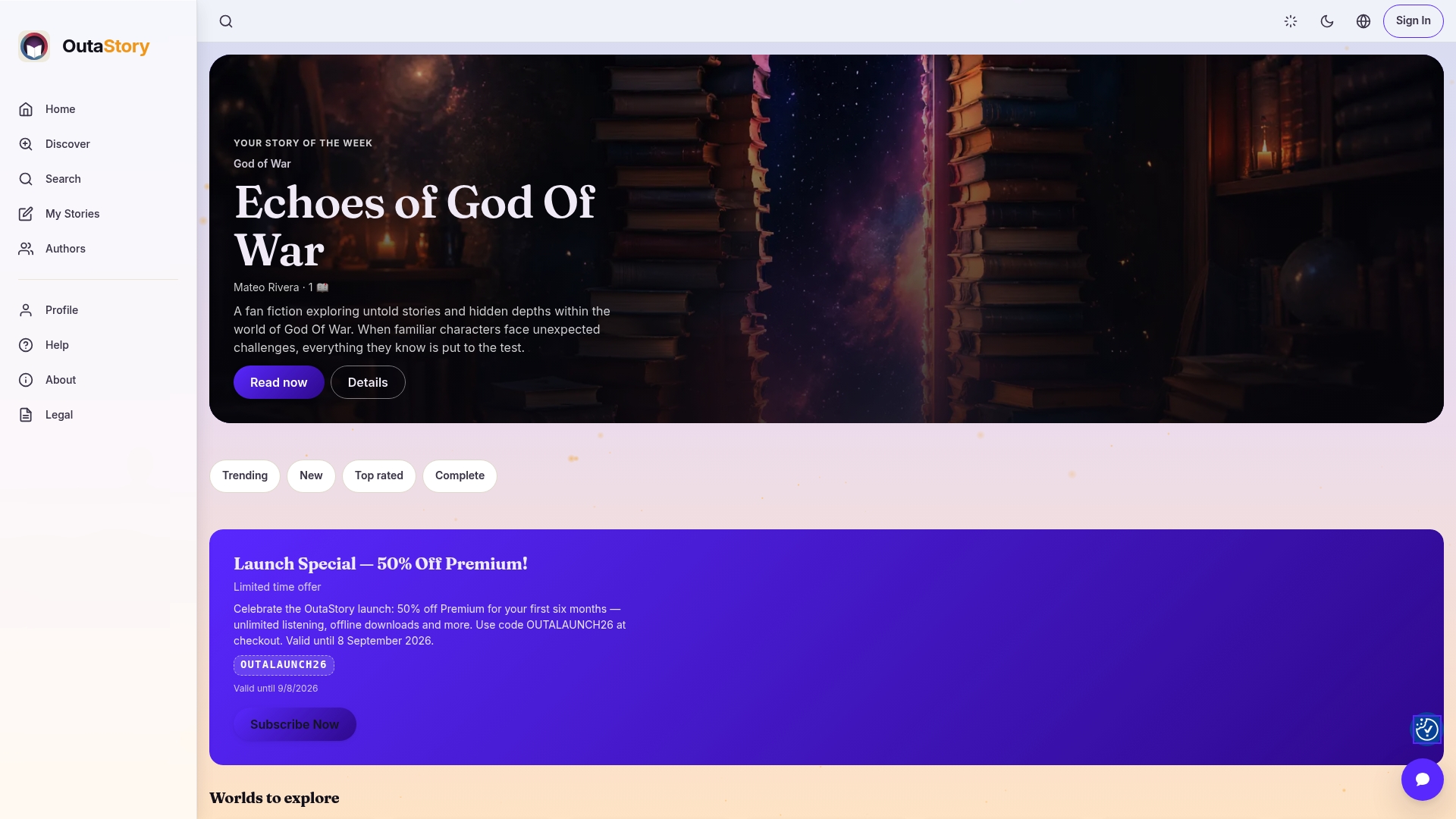
- Those who want more than the basic offer can find details about premium access with unlimited listening and offline use on the members page.
- If you write or speak yourself, read on the page for authors and narrators how the 8% platform fee revenue share works.
- Both offers can be set up quickly.
Anyone who wants to publish or listen to a story today can start directly on the OutaStory members page.
Sources
The figures and assessments in this article are based on the Online Audio Monitor 2025, the Audible Listening Compass 2025 and technical information on RSS-based podcast publishing. Practical guides come from OutaStory's help pages.
- What is a podcast and what is an audiobook? — Kabelplus
- Audible Listening Compass 2025 — BuchContact / Audible
- Does Modality Matter? The Effects of Reading, Listening, and Dual Modality on Comprehension
FAQ
What is the advantage of podcasts?
Podcasts are usually free, structured episodically and can be automatically subscribed to via an RSS feed. They are particularly suitable for current topics, conversations and short listening sessions in everyday life.
Is listening to podcasts healthy?
Listening to podcasts is in itself neither healthy nor unhealthy, it depends on the context. Background noise and multitasking can reduce intelligibility, as technical texts on speech intelligibility show, while calm, focused listening makes absorption easier.
Which is better for the brain, reading or listening to an audiobook?
Research on reading and listening modalities does not find a clear winner between pure reading and pure listening. The combination of both modalities can support comprehension in some situations, especially with more complex texts.
What exactly is a podcast, simply explained?
A podcast is a series of audio episodes that is distributed via an RSS feed and can be subscribed to. New episodes land automatically on the listener's device as soon as they are published.
Recommendations
- Three questions decide: Audiobook or eBook for your everyday situation
- Listen now: short stories for adults in 10–25 minutes
- Learn English with audiobooks: how to get started
Read and write on OutaStory
Thousands of short stories to read for free — or publish your own and find an audience.