
Episodic stories: Read and listen to stories in episodes
Episodic stories tell a larger story in individual episodes. Each episode has its own beginning, its own tension and its own ending, and yet characters, world and narrative arc lead from one episode to the next. That is exactly what makes them so pleasant: you can read an episode on the train, listen to the next one in the evening and never have to tackle a whole book at once. In this guide we show you how to recognize good episodic stories, which genres work best in episodes, what parents should pay attention to for bedtime episodes and how you as an author can publish your own story chapter by chapter.
In short
- Episodic stories divide a continuous plot into sections that are understandable on their own and together form a whole.
- Fantasy, science fiction, crime and horror work particularly well because worlds, detectives or threats can carry across many episodes.
- For listening episodes are ideal: an episode fits a commute, a walk, or the time before falling asleep.
- For children: calm, self-contained episodes whose length matches your child's attention span.
- For authors, a clear plot arc, a reliable rhythm and episodes that even new readers can understand matter.
Contents
- What defines episodic stories
- From the serialized novel in newspapers to the episode on the smartphone
- Which genres are suitable for episodes
- Listening to episodic stories: on the go and for falling asleep
- Episodic stories for children: what parents should pay attention to
- Reading and listening to episodic stories on OutaStory
- Writing and publishing episodic stories
- Frequently asked questions about episodic stories
- Sources
What defines episodic stories
Narrative research describes episodic storytelling as a linear story that is divided into relatively autonomous and relatively closed units. The word 'relatively' is the core: an episode is neither a completely loose standalone piece nor just a severed chapter. Some episodes stand almost entirely on their own, others are more closely linked to what came before. Episodes are therefore more closely connected to each other than a collection of independent stories.
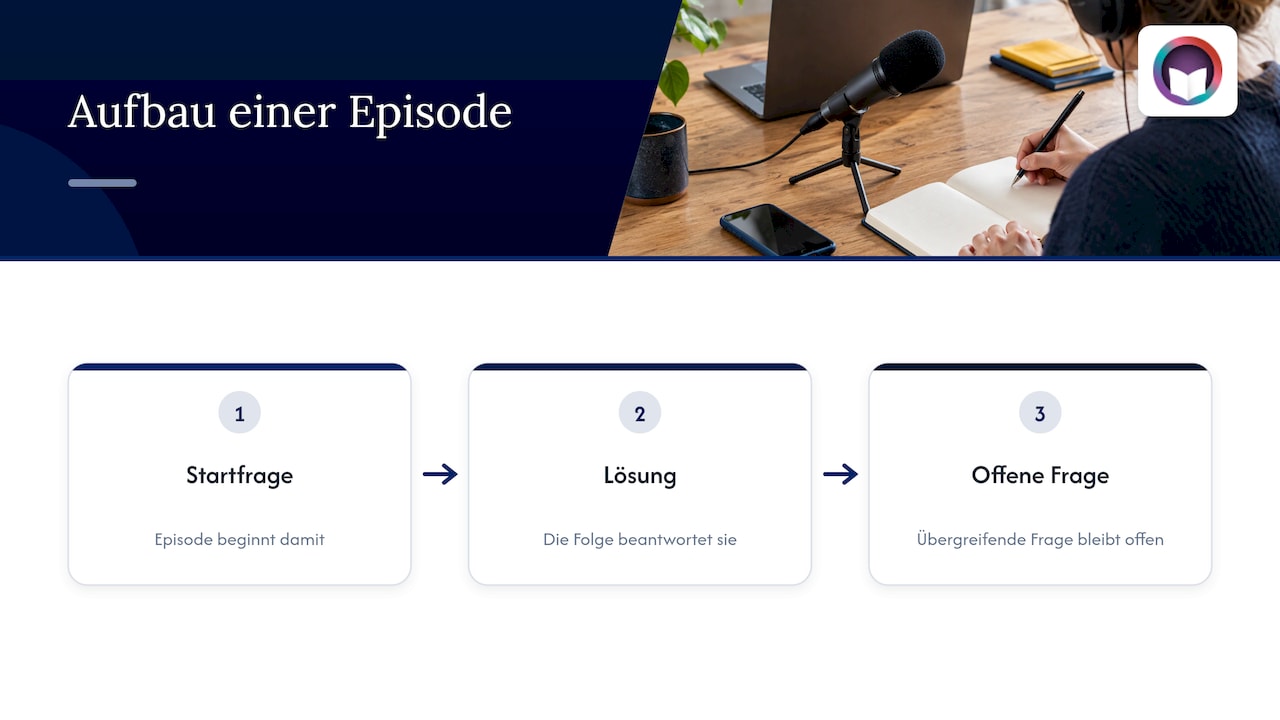
In practice this means: a good episode answers the question it opens with. The thief is caught, the journey reaches an intermediate goal, the evening's mystery is solved. At the same time, a larger question remains open that draws you to the next installment.
Episode, continuation, serial: terms at a glance
In everyday use the terms are often mixed. This overview helps you separate them:
| Form | How it's structured | Who it's suited for |
|---|---|---|
| Standalone short story | One plot, one ending, no sequel needed | For a short reading break without commitment |
| Episodic story | Each episode has its own arc; characters and world link all episodes | For anyone who likes to jump in, pause and come back |
| Serial story | Chapters build directly on one another, often with an open ending per part | For readers who want to follow a story closely |
| Serial | Regularly released episodes with an overarching story | For loyal readers and for authors with a fixed publication rhythm |
The Self-Publisher Association describes a serial as a sequence of regularly appearing episodes, usually monthly, with an average of 20,000 to 30,000 words per episode. These episodes are fundamentally self-contained and often follow an overarching story. On platforms for short stories, episodes are usually much shorter, but the principle remains the same.
Why the structure from TV series feels familiar
Anyone who watches series already knows the pattern. In a strongly episodic series each episode stands on its own, while characters, setting or theme create the connection. The same structure is found in comic series and in episodic stories. The advantage for you as a reader: if you miss an episode, you still find your way back quickly because the world and its inhabitants are familiar to you.
From the serialized novel in newspapers to the episode on the smartphone
Stories in episodes are not an invention of the digital age. In the 19th century many novels first appeared as installments. Charles Dickens published, for example, “The Pickwick Papers” (1836–1837) and “David Copperfield” (1849–1850) in monthly installments. Readers waited for the next issue, talked about open questions and speculated about what would happen next.
Today only the medium has changed. Instead of waiting for the newspaper you wait for the next episode in an app or the browser. And instead of only reading, you can also listen to the same episode. The basic idea has remained the same: small, easily digestible portions of a large story that fit wonderfully into everyday life.

Which genres are suitable for episodes
Not every story benefits from being split into episodes. The best results come from genres in which a world, an investigator or a threat carries across many adventures.
Fantasy and romantasy
Fantasy thrives on worlds that are discovered step by step. Each episode can open a new region, a new trial or a new secret, while the larger journey continues. In romantasy a relationship is added that develops over many episodes: rapprochement, misunderstanding, reconciliation. How well a fantasy world unfolds in shorter texts is shown on our platform for example by The Mapmaker's Daughter.
Science fiction
Spaceships, colonies and distant futures offer a natural episodic structure: one mission per episode, one station per chapter, a new problem per jump through space. The crew or the main character remains, the challenges change. Gradually a picture of an entire civilization emerges.
Crime and thriller
The classic detective story is perhaps the purest form of the episodic story: one case per episode, solved by the end, and in the background a personal conflict of the investigator that runs through the whole series. Thrillers, on the other hand, more often work with cliffhangers that push you straight into the next episode. If you like dark suspense, try starting with Dark Deals.
Horror and dark fantasy
Horror often feels particularly intense in episodes. A house, a village or a curse can reveal ever new terrors over many episodes. Short units keep the tension high and give you a chance to catch your breath in between. Atmospheric examples from our library are House Whispers and The Curse of the Other Side.
Drama and literary stories
Quieter genres can also work episodically, for example as a sequence of life stages or as letters written over years. Here the connection is made less by plot than by the character, who changes from episode to episode.
Listening to episodic stories: on the go and for falling asleep
Episodes and listening go surprisingly well together. An episode has a manageable length, a clear ending and is therefore easy to plan into fixed everyday moments. These situations are particularly suitable:
- Commuting: One episode per trip quickly becomes a ritual. You get on, press play and know that the episode is over when you arrive.
- Exercise and walks: Exciting genres like thrillers or science fiction carry you well through a run.
- Housework: Cooking or tidying up becomes more entertaining when a story continues in the background.
- Falling asleep: Calm fantasy or literary stories read in a gentle voice help you switch off. Here it's worth choosing less stirring genres so the mind can calm down.
The voice plays a big role when listening. A professional narrator ensures even pacing and clear emphasis. If the author reads their own work, you hear the story exactly as intended, with all the pauses and accents that were in the writer's head. Both have their charm, and with episodic stories a familiar voice often grows on you over many episodes.
Episodic stories for children: what parents should pay attention to
Reading aloud is becoming popular again in German families. According to the Reading Monitor 2026 from Stiftung Lesen, Deutsche Bahn Stiftung and DIE ZEIT, the proportion of parents of one- to eight-year-old children who read aloud at least several times a week rose from 67.7 percent (2024) to 76.4 percent (2026). Episodic stories fit this routine very well because they provide a fixed point each evening: "What does the little fox experience today?"
To ensure episodes help with falling asleep instead of exciting, pay attention to these points:
- Each episode ends calmly. For bedtime, self-contained episodes are ideal. A dramatic cliffhanger just before lights-out is more likely to keep children awake.
- The length fits the child. Base the length on your child's attention span and how much time you have as a family in the evening. For younger children a few minutes are enough; schoolchildren often manage longer episodes.
- Familiar characters provide security. Recurring animals, friends or places create a sense of comfort. Children enjoy meeting the characters again every evening.
- The theme fits the age. Animal adventures, small everyday mysteries and first rhymes work for younger children. Adventures with a bit more tension are better suited to the afternoon than to bedtime.
- Plan for conversation. The researchers behind the Reading Monitor emphasize that reading together creates opportunities for conversation that strengthen vocabulary and language comprehension. Ask briefly after the episode: What do you think will happen tomorrow?
Practically, a mix works well: during the week you read aloud yourself, and on evenings when you're tired or on the go you listen together to a voiced episode. You can find more ideas in our guides to the best bedtime stories for children, to stories for reading aloud and to short stories for on the go. A dreamy introduction for children is The Cloud That Rents Itself Out for a Nap.
Reading and listening to episodic stories on OutaStory
On OutaStory you can read short stories for free or listen to them. Each story can be played as an audiobook, with professionally produced voices or with the author's own voice. Authors can publish their stories chapter by chapter as continuation stories so you can follow a plot installment by installment. The range spans fantasy, romantasy and science fiction to crime, thriller and horror as well as our children's section with bedtime stories, animal adventures and first rhymes, in German and English.
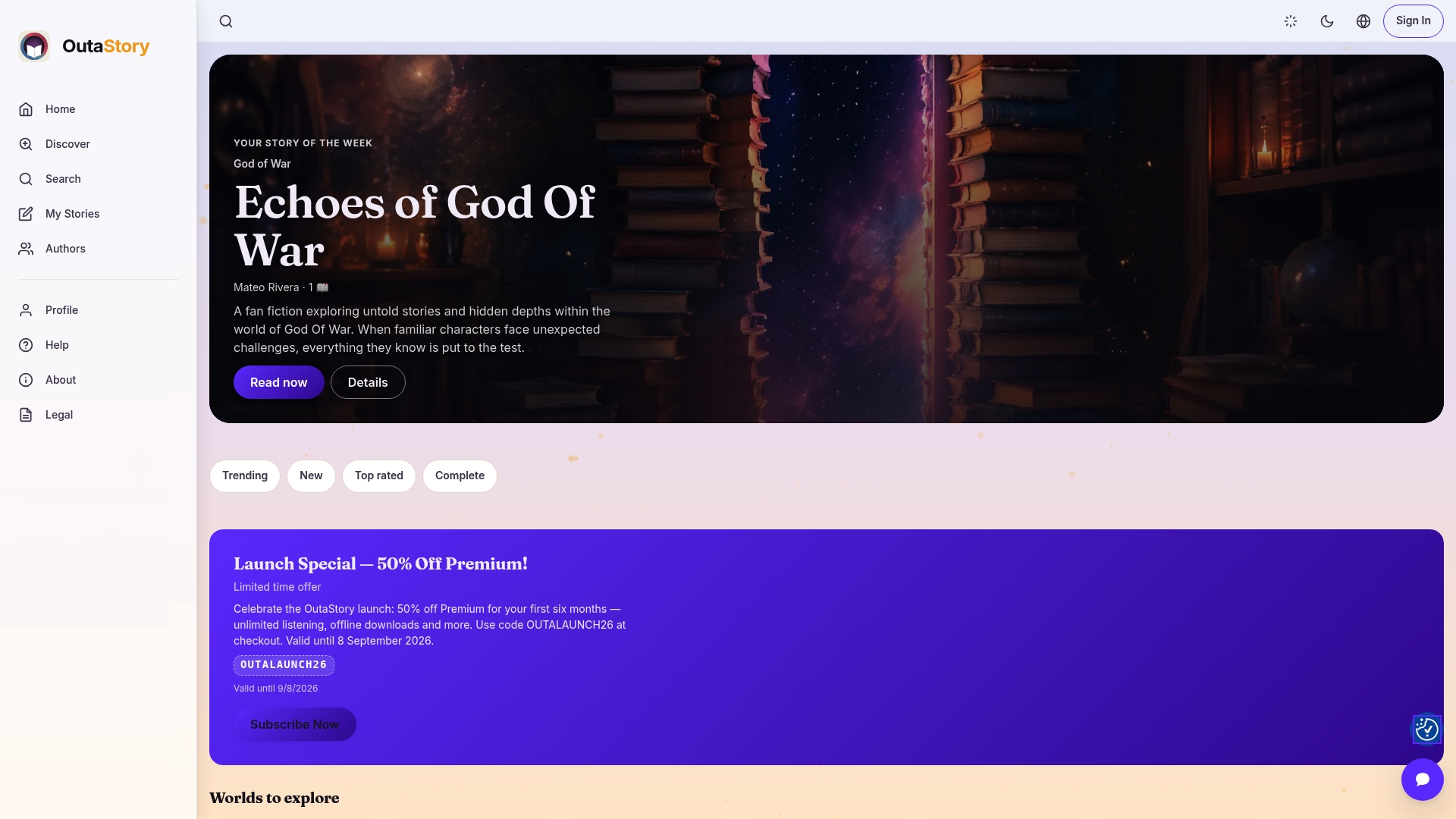
If you prefer to listen to episodes, it's worth taking a look at our Premium subscription: it extends the free use with features like unlimited listening, ad-free use and offline access. That way the next episode keeps playing even in the signal gap between two stations.
Your world, your stories: write, read, listen.
Writing and publishing episodic stories
Maybe you yourself have a world in your head that's too big for a single short story. The episodic format is a wonderful way to tell it bit by bit. The Self-Publisher Association sees the core of a successful serial in the combination of self-contained episodes, an overarching plot arc and a regular publication rhythm. Each new episode becomes another point of contact with your readers.
In six steps to your own episodic story
- Define the big arc. Before you write the first episode, clarify the question that stands above all episodes: Does the heroine find her brother? Is the colony saved? This question keeps your readers hooked.
- Plan each episode with its own goal. Give every episode a small conflict that is resolved within the episode. This keeps each installment satisfying, even for someone who jumps in halfway.
- Set familiar anchors. Recurring characters and locations make re-entry easier if readers miss an episode and spare you long summaries at the start of each episode.
- Design endings deliberately. Decide for each episode whether it winds down calmly or ends on an open moment. Both have their place, but not every episode should end on a loud cliffhanger.
- Choose a fixed rhythm. Whether weekly or every two weeks: more important than frequency is that your readers can rely on it. It's best to write two or three episodes ahead before you publish the first.
- Think about later. Individual episodes can later be combined into collections. Those who plan cleanly from the start will have a work at the end that also functions as a whole.
Publish chapter by chapter and share in earnings
On OutaStory you can publish your short story in minutes and make it appear chapter by chapter as a continuation story. Your readers can read each episode or listen to it as an audiobook, optionally with your own voice. Through revenue sharing you take part in the earnings from your stories. The terms, including the platform fee of 8%, can be found on our page with terms for narrators.
Our tip for getting started: publish the first episode only when the big arc is in place. Then you can focus entirely on the text, and your readers will feel from the first episode that the story has a goal.
Frequently asked questions about episodic stories
What is the difference between an episodic story and a serial story?
In an episodic story each episode is largely self-contained, and characters or the world connect the parts. In a serial story the chapters build more closely on each other and more often end open. In practice there are many hybrids; the transitions are fluid.
How long should an episode be?
That depends on the format. Classic serials in self-publishing often comprise 20,000 to 30,000 words per episode; on short-story platforms episodes are usually much shorter. For everyday use a length that fits a commute or a read-aloud session has proven effective.
Can I start an episodic story in the middle?
With well-written episodic stories, yes, because each episode is understandable on its own. You will, however, enjoy it most if you begin with the first episode, because then you won't miss the development of the characters.
Are episodic stories suitable for children to fall asleep to?
Very much so, if each episode ends calmly and the length matches your child's attention span. Recurring characters give children security and make the bedtime story into a fixed ritual.
Can I also listen to episodic stories offline?
On OutaStory offline access is part of the Premium subscription features, as are unlimited listening and ad-free use. Reading and listening are also available for free without a subscription.
Sources
Episodic storytelling – Storytelling in episodes (DIEGESIS, University of Wuppertal) Through serials as a self-publisher to success (Selfpublisher Association) Alternative narrative structures (Storyanalyse.de) Feuilleton novel (Wikipedia) Press release: Reading Monitor 2026 (Stiftung Lesen, presseportal)
Recommendations
- House Whispers — Dark Fantasy short story
- AI short stories: reading and listening on one platform
- The Scribe Who Counted Twice — Short story
- Listen now: short stories for adults in 10–25 minutes
Read and write on OutaStory
Thousands of short stories to read for free — or publish your own and find an audience.