Bilingual Short Stories: The Best Format for Learning
You learn fastest with synchronized text and professional audio narration, ideally aligned sentence by sentence or line by line. This combination works significantly better than pure reading material because the eyes and ears work together. There are several sources for this: publisher collections, specialized learning portals, free archives and platforms with full narration. Some of these are free, some paid — both paths lead to useful results.
In short:
- On the LearnEnglish offering of the British Council, "Big City Small World" is tailored to B1 and includes full transcripts and exercises; Project Gutenberg usually does not provide audio.
- For parallel reading, facing original and translation is suitable; when listening, clickable translation lines, adjustable playback speed and repeat loops for individual sentences are particularly helpful in everyday practice.
- Beginners should choose simplified readers; Mark Twain offers humorous dialogues, while Edgar Allan Poe's dense vocabulary is more suitable for advanced learners.
- Practice daily for four weeks: first read and listen, then shadow the same texts, later note vocabulary and finally understand paragraphs without translation.
- On OutaStory you can read and listen to stories for free; however, unlimited listening, ad-free use and offline access are part of the premium offering for regular practice.
Table of contents
- Resource types: Where to find bilingual short stories
- Formats and features: Selection criteria for learners
- Recommended short stories and authors for learners
- Usage guide: 4-week plan with bilingual short stories
- OutaStory: Practical example of a platform for short stories with audio
- OutaStory Premium as a convenient addition
- FAQ
- Sources
Resource types: Where to find bilingual short stories
Not every source is equally suitable for every learning phase. Publisher volumes and anthologies, whether printed or as eBooks, often bundle classic texts with translations on the facing page. They are a good fit if you already have a certain basic level and want to read at your own pace, without audio accompaniment.
Learning portals take a different approach: they sort stories by language level and thereby build a clear learning path. The LearnEnglish offering of the British Council illustrates this well, for example with the series "Big City Small World", which is tailored to level B1 and provides full transcripts and exercises.
Platforms with line-by-line translation and synchronized narration are particularly practical for the read-while-listen method because each line is accessible by click. Free archives are worth checking for classic literature, for example via Project Gutenberg, though usually without audio.
These points help when choosing:
- Check whether an audio sample is available before you decide on a collection.
- Pay attention to the pricing model: free, one-time purchase, or freemium with a subscription.
- See whether transcripts or line-by-line translations are actually provided.
A more detailed introduction to why short stories work so well for learning English can be found in our article on learning English with short stories.
Formats and features: Selection criteria for learners
Not every bilingual format brings the same benefit. Parallel text, where original and translation stand side by side, is suitable for attentive reading and sentence comparison. Line-by-line translation, on the other hand, is better for quick lookup while listening because you don't have to jump between two columns.
It's worth taking a close look at audio quality: professional speakers usually provide clearer pronunciation, while author readings are often more authentic but less consistent. Don't hesitate to ask for an audio sample before committing.
These five points help with a quick assessment of an offering:
- Are there clickable lines that directly link text and audio?
- Can the playback speed be changed?
- Are repeat loops for individual sentences possible?
- Does the service work offline as well?
- Is the language level clearly indicated, ideally using the A1 to C2 framework?
Pro tip: Start one level below your estimated level so there is enough cognitive capacity left for pronunciation and rhythm.
Recommended short stories and authors for learners
Some authors are simply better suited for learning purposes than others, usually because of short plots and a manageable vocabulary. O. Henry, Kate Chopin, Mark Twain and Edgar Allan Poe are among the names that repeatedly appear in learning contexts because their stories are short, self-contained and often have a clear twist at the end.
- O. Henry writes concise stories with a surprising ending, ideal for practicing prediction skills.
- Kate Chopin uses a rather calm, clear sentence structure, good for intermediate levels.
- Mark Twain brings humor and dialogues that reflect spoken language well.
- Edgar Allan Poe delivers dense, atmospheric texts, but with more demanding vocabulary.
Such texts work didactically because the plot remains compact and new vocabulary is limited. If you are just starting out, opt for simplified editions, so‑called graded readers, which tailor vocabulary and sentence length to a specific level.
Usage guide: 4-week plan with bilingual short stories
The core method is Reading‑While‑Listening, i.e. reading and listening at the same time. Research on L2 vocabulary acquisition shows that this multimodal condition supports vocabulary acquisition more than reading alone. This exact method is at the center of the following plan.
- Week 1: Read a short story for a few minutes each day while listening at the same time, without pausing — just to get started.
- Week 2: Repeat the same texts, this time with shadowing, i.e. directly repeating aloud while listening.
- Week 3: Note new vocabulary and listen to individual sentences on loop several times until the pronunciation is secure.
- Week 4: Increase the difficulty and try to understand a paragraph without translation.
Shadowing trains pronunciation and speech rhythm at the same time, while targeted repetitions of individual sentences sharpen listening comprehension. Notes on pronunciation and meaning help make progress visible, for example when after four weeks you can understand a familiar text without translation.
Reading‑While‑Listening is considered in research to be one of the most reliable methods for consolidating vocabulary in context, according to the study on RWL and L2 processing.
In class, the plan can be easily assigned as homework; for self-study, a fixed time of day is sufficient, for example on the way to work. More practice ideas can be found in our article on short audiobooks for beginners.
OutaStory: Practical example of a platform for short stories with audio
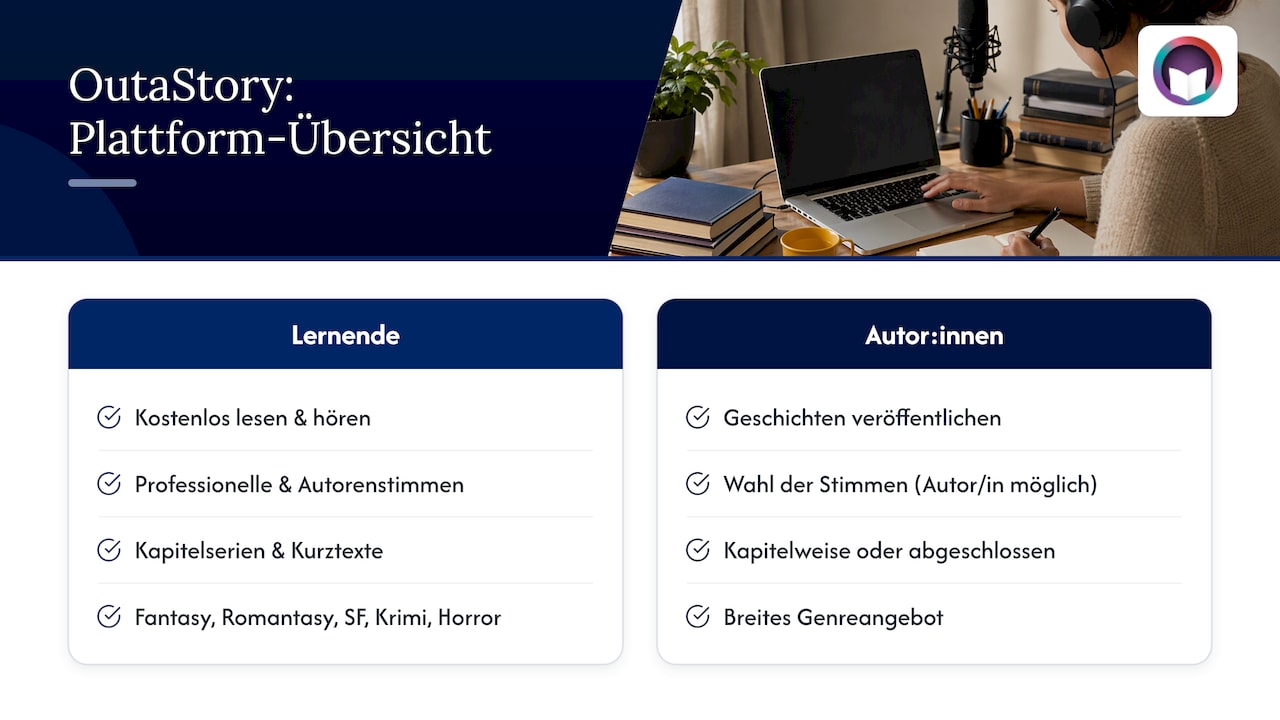
With us you can read or listen to short stories for free, with the option to play any story as an audiobook. Various voice options are available, including professional narrators and the voices of the authors themselves. The genre spectrum includes, among others, fantasy, romantasy, science fiction, crime, thriller, horror as well as children's sections with bedtime stories and animal adventures.
For learners, the combination of text and professional narration is particularly interesting, complemented by continuing stories that appear chapter by chapter. If you prefer to practice in small, self-contained units, the wide genre offering provides plenty of short texts for getting started. The content is available in German and English, which facilitates direct language comparison.
Authors can publish their stories and receive a revenue share from the income of their texts. If you write and narrate yourself, you can find more on our page for speakers and authors.
OutaStory Premium as a convenient addition
Those who practice regularly with audio can benefit from features such as unlimited listening, ad-free use and offline access, which are offered in a premium package. This is especially worthwhile for the 4‑week plan with daily practice because no wait times or interruptions disrupt the learning flow.
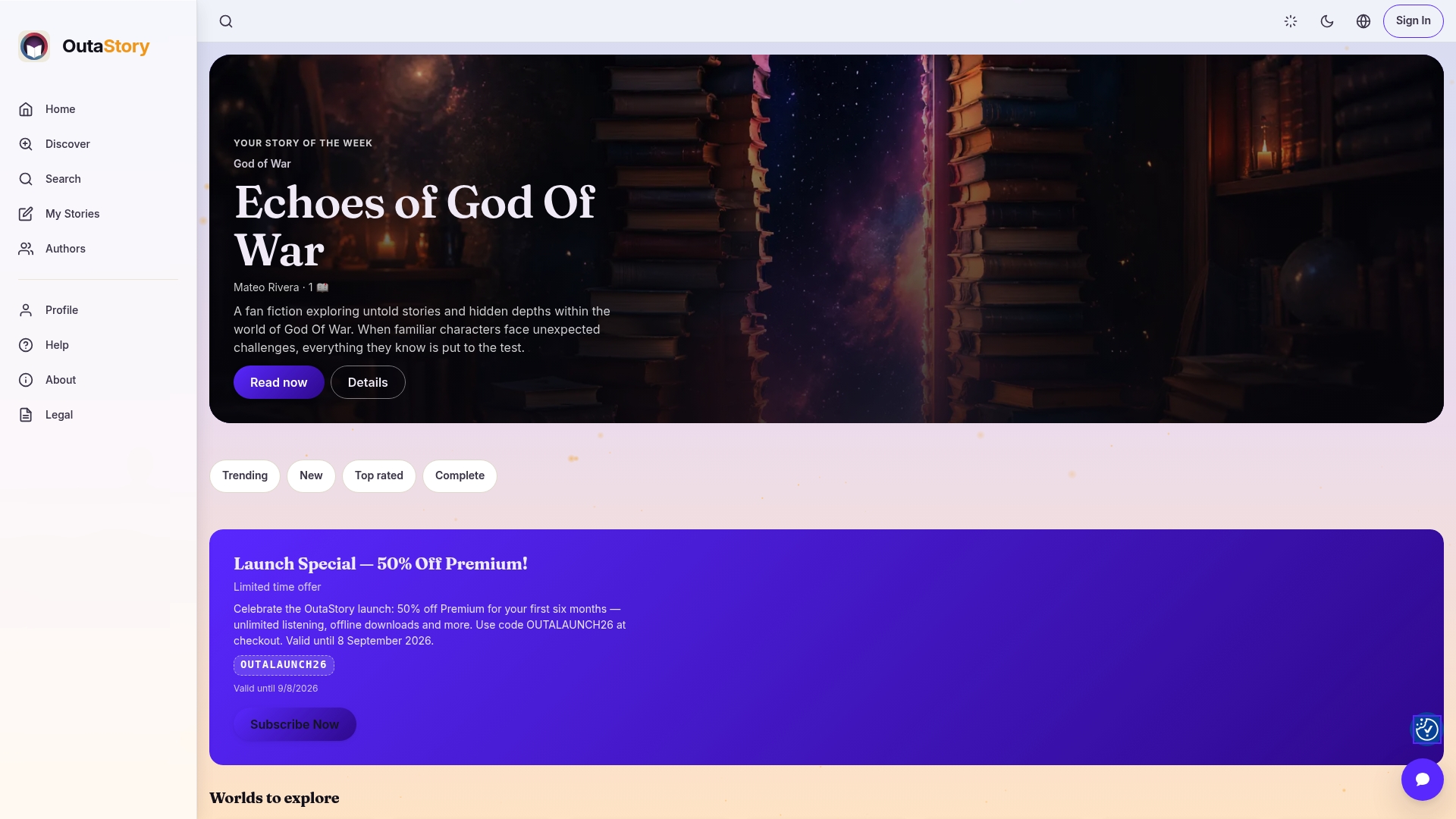
Read a story, listen to it, and feel for yourself how text and sound work together.
To get started we recommend first reading and listening to a story like "Die Tür, die wartete". If you want more afterwards, you can find all the details about the premium offering on our members page.
FAQ
Which are the 10 most popular short stories?
There is no fixed list of the ten most popular short stories, as popularity varies depending on source and audience. For learners, texts by authors such as O. Henry, Kate Chopin, Mark Twain and Edgar Allan Poe are considered particularly reliable because they are short, clearly structured and well suited for teaching.
What are some well-known English short stories?
Among the best-known are works by O. Henry, Mark Twain, Kate Chopin and Edgar Allan Poe, which are also frequently recommended in learning contexts. These texts are characterized by compact plots and often surprising twists.
What very short short stories are there?
Very short stories are mainly found in learner collections and on platforms with graded levels, often requiring only a few minutes of reading time. Short stories are particularly suitable for classroom instruction and self-study, because they can be read quickly and involve little text.
Where can I find free English short stories?
Free stories with audio and learning materials can be found, for example, in the LearnEnglish offering of the British Council, which provides transcripts and exercises. Many stories can also be read or listened to for free with us, for example via our overview of free short stories.
Sources
- Big City Small World | LearnEnglish
- Toward A Theory‑Based Account Of The L2 Vocabulary Processing And Learning Benefits Of Reading While Listening
- Improve your English with Short Stories - Discover English
- English short stories texts in German and English | Learn English
Recommendations
- Learn English with short stories: Your introduction
- Learn English with short stories: Your introduction
- English short stories for learners: Read, listen, understand
Read and write on OutaStory
Thousands of short stories to read for free — or publish your own and find an audience.