
Learning English with Short Stories: Your Introduction
Short stories are one of the most effective methods to build vocabulary and a feel for the English language. And the best part: you don't need an hour a day. Three steps are enough to start.
Your 3-step mini routine:
- Step 1 – Selection: Choose a story that matches your level. A1/A2 learners start with graded readers or bilingual texts, B1 learners with simple original stories.
- Step 2 – Focused session: Read or listen to the story actively. Mark unknown words, infer meanings from context, and take short notes.
- Step 3 – Active review: Transfer new vocabulary into a flashcard system (SRS), write 2–3 sentences with the new words, or speak a passage aloud (shadowing).
A session typically lasts twenty to forty-five minutes. Several sessions per week over a month can lead to a noticeable difference in reading comprehension. According to the language research concept of extensive reading, which Preply in its list of classics picks up, stories anchor vocabulary and grammar patterns through context in a way isolated vocabulary learning cannot.
Key Insights
Short stories are the most effective method for beginners because they train vocabulary, grammar and listening comprehension simultaneously without overwhelming you.
| Thema | Details |
|---|---|
| Optimale Sessionlänge | 20–45 Minuten pro Einheit, drei- bis viermal pro Woche, reichen für spürbare Fortschritte. |
| Niveau richtig wählen | Rund 95 % bekannte Wörter im Text ist der Richtwert: genug Kontext, um Neues zu erschließen. |
| SRS für Vokabeln nutzen | Anki oder Quizlet mit Beispielsätzen aus dem Text verankern neue Wörter dauerhaft. |
| Audio und Shadowing | Professionelle Audiospuren (z. B. auf Outastory oder Audible.de) machen Aussprache und Intonation trainierbar. |
| Sofort starten | Outastory bietet kostenlose englische Kurzgeschichten mit Audio, ideal als erster Einstiegspunkt. |
Table of Contents
- Which short stories are suitable for English beginners?
- Where can you read or listen to English short stories in Germany?
- How do you learn most effectively with a short story?
- Which text fits which language level?
- Which tools make learning with texts easier?
- How does Outastory help you concretely with learning English?
- Sources
- FAQ
Which short stories are suitable for English beginners?
There are suitable texts for every learner. The following list shows proven series and titles, ordered by the Common European Framework of Reference (CEFR).
A1 – First steps
- Oxford Bookworms Starter (e.g. Mulan or The Wizard of Oz): Around 250 basic words, very short sentences, many pictures. Reading time: approx. 30–40 minutes. Ideal for building basic vocabulary.
- Penguin Readers Level 1 (e.g. Toy Story): Simple dialogues, familiar stories. Reading time: approx. 25–35 minutes. Good for first listening exercises, as audio versions are available.
- Nine Lives in the Bookshop by Emily Carroway (Frank-Lesemethode, A1–A2): Direct context translations in the running text plus audio download. Reading time: approx. 20–30 minutes per chapter. Especially suitable because the reading flow is preserved by embedded translations.
A2 – Consolidating basic knowledge
- Berta Ziebart: 10 simple A2 short stories with vocabulary lists, audio files and parallel English-German text: Vocabulary around 1,000 words, extensive reading as a method. Reading time: approx. 15–20 minutes per story.
- Oxford Bookworms Level 1–2 (e.g. The Elephant Man, Sherlock Holmes Short Stories): Clear narrative structure, high proportion of dialogue. Reading time: 45–60 minutes per volume.
- Penguin Readers Level 2 (e.g. Notting Hill): Everyday language, many idioms. Good for listening comprehension.
B1 – Confidently understanding everyday language
- Oxford Bookworms Level 3–4 (e.g. The Secret Garden, Treasure Island): Longer sentences, more complex plots, around 1,000–1,400 words vocabulary. Reading time: 60–90 minutes.
- Penguin Readers Level 3 (e.g. The Firm by John Grisham): More authentic language, good for reading comprehension and grammar patterns.
- EasyOriginal texts (Frank-Lesemethode): Near-original texts with context aids directly in the running text, audio included. Ideal for the transition from adapted to real texts.
B2 – On the way to independence
- Oxford Bookworms Level 5–6 (e.g. Wuthering Heights, Great Expectations): Closer to original language, around 1,800–2,500 words vocabulary.
- Penguin Readers Level 4–5: Authentic novels in lightly abridged form, hardly any aids needed.
- Classic short stories (e.g. The Gift of the Magi by O. Henry, The Necklace by Guy de Maupassant in English): Short, stylistically rich, freely available on Project Gutenberg.
Where can you read or listen to English short stories in Germany?
The sources can be roughly divided into three categories: free, paid and library. Each has its strengths.
| Quelle | Kosten | Audio verfügbar | Niveaukennzeichnung | Besonderheit |
|---|---|---|---|---|
| Project Gutenberg / Librivox | Kostenlos | Ja (Librivox) | Nein | Public-Domain-Klassiker, große Auswahl |
| Outastory | Kostenlos / Premium | Ja | Nein | Professionelle Stimmen, Genres auf Englisch und Deutsch |
| Readable (App) | Kostenlos / Abo | Ja | Ja (A1–C1) | Wortübersetzungen im Text, Vokabeltrainer |
| Oxford Bookworms / Penguin Readers | Kauf | Teilweise | Ja (Level 1–6) | Didaktisch aufbereitet, weit verbreitet |
| Audible.de | Abo (ca. 10 €/Monat) | Ja | Nein | Große Auswahl, professionelle Sprecher |
| Buchhandel (jpc, Hugendubel, ebook.de) | Kauf | Teilweise | Ja | Frank-Methode-Reihen, zweisprachige Ausgaben |
| Stadtbibliothek / Onleihe | Kostenlos (mit Ausweis) | Teilweise | Teilweise | Digitale Ausleihe von graded readers möglich |
| StoryStudies (YouTube) | Kostenlos | Ja | Nein | Englische Hörgeschichten mit Übersetzungen |
When is audio useful, when plain text?
- Audio is particularly suitable for pronunciation, intonation and shadowing. Those who want to train listening comprehension should combine text and audio.
- Plain text is better for deep reading comprehension and grammar analysis. Beginners often benefit from reading first, then listening.
The Readable app combines both: level-adapted short stories with embedded word translations and an integrated vocabulary trainer. Bilingual editions, like those published by EasyOriginal or Berta Ziebart, are especially helpful for A1/A2 learners because they preserve the reading flow without constantly having to open a dictionary.
Pro tip: Project Gutenberg and Librivox offer thousands of English texts for free. For beginners, these classics are often too difficult. Start there only from B2 and use didactically prepared materials for A1–B1 instead.
How do you learn most effectively with a short story?
An effective session comprises several phases that can be designed systematically.
Schedule for a 35-minute session:
- Preparation (5 minutes): Read the title and the first two sentences. Scan the text briefly for words you don't know. Set yourself a concrete goal: e.g. "I'll learn 5 new words today" or "I'll pay attention to the use of the simple past."
- Reading and listening (20 minutes): Read the text once through without stopping at every unknown word. Mark words you don't understand. On the second pass: infer meanings from context. If audio is available, listen in parallel or afterwards and speak passages aloud (shadowing).
- Follow-up (10 minutes): Transfer marked words into an SRS app (e.g. Anki). Write 2–3 of your own sentences with the new vocabulary. Read a short passage aloud and record yourself.
Checklist for each session:
- Level chosen appropriately (approx. 95 % known words)?
- Goal set before reading?
- Unknown words marked and transferred to SRS?
- At least one passage spoken aloud?
- Review date set in the flashcard deck?
Pro tip: Shadowing, that is speaking along with the audio simultaneously or with a slight delay, is one of the most effective methods for pronunciation and intonation. Start at a slow speed and increase it step by step.
The Frank-Lesemethode by EasyOriginal demonstrates well how context aids directly in the text can preserve the reading flow: translations are placed in brackets next to the original word so you aren't torn out of the flow. This is especially helpful in the preparation phase.
Which text fits which language level?
Here you can see at a glance what to expect at each level and which learning goal is realistic.
| Niveau | Typische Textmerkmale | Wortschatz | Lernziel nach 4 Wochen | Beispieltitel |
|---|---|---|---|---|
| A1 | Sehr kurze Sätze, Grundwortschatz, viele Bilder | ca. 250 Wörter | Einfache Sätze lesen, 2–3 Sätze schreiben | Oxford Bookworms Starter, Penguin Readers Level 1 |
| A2 | Kurze Dialoge, Alltagssituationen, wenig Nebensätze | ca. 1.000 Wörter | Alltagstexte verstehen, Simple Past sicher | Berta Ziebart A2, Nine Lives in the Bookshop |
| B1 | Längere Sätze, Erzählperspektiven, Redewendungen | rund 1.000–1.400 Wörter | Alltagsdialoge sicher verstehen, Texte zusammenfassen | Oxford Bookworms Level 3–4, EasyOriginal |
| B2 | Komplexe Handlung, idiomatische Sprache, wenig Hilfen | rund 1.800–2.500 Wörter | Authentische Texte lesen, Nuancen verstehen | Oxford Bookworms Level 5–6, O. Henry Klassiker |
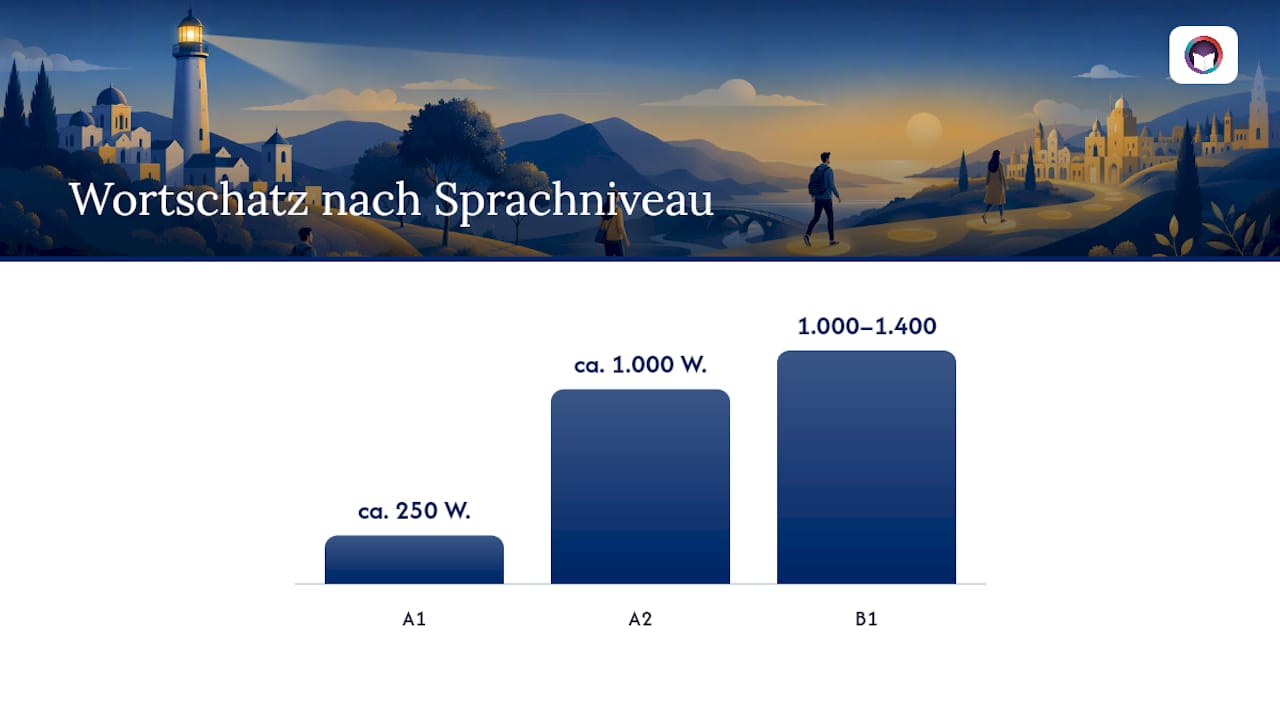
A realistic goal for four weeks at A2: You can retell a simple English dialogue from a short story and know around 150 new words. At B1 the goal is more likely to understand a passage without aids and summarize the main point in English.
Which tools make learning with texts easier?
The method is set. Now come the tools that sharpen it.
SRS vocabulary trainers:
- Anki (free, desktop and app): Create cards directly from your word list after each session. Anki shows you words exactly when you would otherwise forget them.
- Quizlet: Easier to use than Anki, good for beginners. Ready-made word lists for graded readers are often already available.
Parallel texts and transcripts:
- Bilingual editions (English/German) are especially helpful at A1/A2 because you can look up words immediately without interrupting the reading flow.
- Transcripts for audiobooks can be found from some publishers as a PDF supplement or download.
Audio player and shadowing:
- Audible.de offers speed control (0.5x to 3.5x). Start shadowing at 0.75x and increase.
- Librivox recordings are free and can be played in any podcast player.
Annotation tools:
- The built-in dictionary mode in e-reader apps (e.g. Kindle) lets you tap a word and see the translation immediately without switching apps.
- The Readable app combines annotation and vocabulary training in one interface.
For those who want to make learning occasionally more playful: escape rooms in English lessons are a surprisingly effective method to activate reading comprehension and vocabulary under time pressure, and can be adapted as an idea for self-study.
Pro tip: Create an Anki card with an example sentence from the text after each short story, not just the isolated word. Context is the decisive difference between words that stick and those you forget after a week.

How does Outastory help you concretely with learning English?
Outastory is a platform for free reading and listening to short stories, in German and English. For learners this is a direct combination: authentic English texts, immediately available, with professionally produced audio tracks.
What Outastory offers concretely:
- Reading and listening in one: Each story can be played as an audiobook, with professional voices or the author's voice. This is ideal for the shadowing phase of your session.
- Genres for every taste: Fantasy, romantasy, science fiction, crime, thriller, horror and a dedicated children's section with bedtime stories and animal adventures. If you choose a story that really interests you, you read longer and learn more.
- Chapter serialization: Many stories are published chapter by chapter. This creates natural session boundaries: one chapter per unit, done.
- Freemium model: Getting started is free. Premium unlocks unlimited listening, ad-free use and offline access.
How to incorporate Outastory into your 3-step routine:
- Choose an English short story on Outastory that matches your level and interests.
- Read the first chapter and mark unknown words in your notes.
- Then play the audio version and speak passages aloud with it.
Start today for free on Outastory and pick your first English story. Getting started takes less than two minutes.
Sources
Here you can find the main contacts, directly usable:
- Readable:Englische Geschichten‑App – App Store
- English stories: 15 classics
- Ebook
- Jpc
- Frank‑Lesemethode (EasyOriginal)
FAQ
How do I learn English by reading stories?
Choose a story at your level, read it actively with annotations, and transfer new words afterwards into an SRS app like Anki. Three to four sessions per week of 20–45 minutes each are enough to notice a tangible difference after four weeks.
Which English short stories are suitable for absolute beginners?
Oxford Bookworms Starter and Penguin Readers Level 1 are didactically prepared and start with around 250 basic words. For learners who want audio and translation aids at the same time, the A2 stories by Berta Ziebart or the Frank Method series by Emily Carroway are good entry points.
Can you really learn a language only through short stories?
Stories alone are not enough for all language skills, but they are particularly effective for vocabulary, reading comprehension and a feel for grammar. Combine them with shadowing for pronunciation and short writing exercises after each session to cover all areas.
How do I learn English fastest as a beginner?
Regularity beats intensity: daily 20-minute sessions with a short story plus SRS review bring more than a weekly two-hour study. Choose texts that really interest you, because motivation is the strongest accelerator.
Recommendation
Read and write on OutaStory
Thousands of short stories to read for free — or publish your own and find an audience.