Steampunk short stories: read, listen, and write your own
A good steampunk short story doesn't need 400 pages. An airship above a soot-covered London, an inventor with a dangerous idea, a clockwork mechanism that can do more than it should: twenty minutes is enough to immerse yourself in a world like this. That's exactly what we built OutaStory for. On our platform, you can read short stories for free or listen to them as audiobooks, narrated by professionally produced voices or by the authors themselves. In this article, we show you what makes steampunk short stories special, which German-language collections have shaped the genre, how to enjoy them on the go or at bedtime, and how to write and publish your own story.
In a nutshell
- Steampunk combines futuristic technology with steam power, brass, and a Victorian sensibility: retrofuturism with adventure, often with a dash of magic or horror.
- The short form is a particularly good fit: one strong idea, one machine, one conflict, and the world comes to life in your mind.
- In German-speaking countries, the genre has grown primarily through anthologies, collections featuring stories by multiple authors.
- On OutaStory, every story can be read or listened to; Premium gives you unlimited, ad-free, offline listening.
- If you write your own stories, you can publish with us in minutes, chapter by chapter if you wish, and receive a share of the revenue.
Table of contents
- What makes steampunk short stories special
- Why the short form suits steampunk so well
- German-language anthologies that have shaped the genre
- Listening to steampunk: on the go and at bedtime
- Reading and listening on OutaStory
- Steampunk for children: what parents should look out for
- Writing your own steampunk short story
- Publishing and earning: what authors should know
- Frequently asked questions about steampunk short stories
- Sources
What makes steampunk short stories special
Steampunk is a playground of possibilities: what if the age of the steam engine had never ended? German Wikipedia describes steampunk as a literary movement that emerged in the 1980s and combines modern, futuristic technology with the tools and materials of the Victorian era. The culture of this period is deliberately idealized, without entirely ignoring its darker sides.
Typical motifs you'll encounter in almost every steampunk story:
- Steam and gears: Mechanical systems power everything, from calculating machines and airships to steam-powered robots.
- A Victorian setting: Frock coats, corsets, etiquette, class barriers, and a strict system of values.
- Inventive spirit: The do-it-yourself mentality turns workshops into settings and tinkerers into heroes.
- The romance of adventure: Expeditions, rooftop chases, journeys into unknown regions, firmly in the tradition of Jules Verne and H. G. Wells.
- The supernatural: In some works, electricity heals or transforms people, and occultism or the summoning of spirits mingles with technology.
- Social questions: What does a new machine do to workers, cities, and power structures?
Researcher Mike Perschon sums it up particularly well. For his study of the steampunk aesthetic, he read more than 60 steampunk novels and identified three building blocks that appear almost invariably: neo-Victorianism, technofantasy, and retrofuturism. His observation: the technology looks like science but works like magic. Imaginary energy sources such as aether or phlogiston make possible what real physics never could. That's precisely the appeal: steampunk sits right between fantasy and science fiction and caters to readers in both camps.
An arcanepunk sourcebook for D&D, in which arcane forces take the place of steam and electricity, illustrates just how fluid the boundary with purely magic-based technology can be. For short stories, this blend offers fertile ground: a single magical-mechanical device can sustain an entire plot.
Why the short form suits steampunk so well
Steampunk thrives on imagery: the hiss of a valve, the smell of oil and coal, the gleam of polished brass. A novel has to keep these images alive for hundreds of pages and needs a fully developed world to do so. A short story can focus on a single moment: the night an automaton speaks for the first time, or an airship's final voyage.
This offers three advantages for you as a reader or listener:
- A quick way in: You don't have to memorize maps, family trees, and factions. The world is explained only as far as the plot requires.
- Many worlds in a short time: In a single evening, you can experience a steam-powered Venice, an ice-age dystopia, and a Victorian ghost story.
- Fits into everyday life: A story fills a train ride, a lunch break, or the time before you fall asleep.
That's why the short story isn't a sideline in steampunk, but one of the forms in which the genre has its strongest impact. For us, that's the heart of our platform: stories that fit into a short window of time yet linger long afterward.
German-language anthologies that have shaped the genre
In German-speaking countries, steampunk has grown primarily through collections. Anthologies bring many voices together and show how differently the same ingredients can be used. Some milestones:
| Collection | Year | What it's about |
|---|---|---|
| Von Feuer und Dampf. Spiegelwelten 2 | 2010, new edition 2013 | Steampunk anthology edited by Stefan Cernohuby |
| Eis und Dampf | 2013 | 13 stories by 12 authors set in a Europe that has been trapped in an ice age for centuries |
| Die Steampunk-Chroniken: Mechanische Geister und Geistermaschinen | 2015 | A total of 24 stories combining horror and steampunk |
| Dampf über Europa | 2018 | New stories set in the world of “Von Feuer und Dampf” |
“Eis und Dampf” is considered the first anthology of its kind in Germany and was funded through crowdfunding. Steam power, aeronautics, and electricity drive progress in a frozen world. The Steampunk-Chroniken show how well gears and ghosts go together; the volume “Mechanische Geister” won the Skoutz Award. The list of steampunk works lists “Von Feuer und Dampf” and “Dampf über Europa” as sharing the same world.
What these collections have in common: they build on a strong central idea and let many authors tell stories within it. That's also a good model if you're writing your own work or planning a serialized story.
Listening to steampunk: on the go and at bedtime
Steampunk is a genre for the ears. The pounding of machines, a creaky narrative voice, Victorian dialogue with its stilted politeness: when read aloud, this atmosphere often becomes even richer than on the page. Audio stories in this genre have been available for several years, and a single episode can easily run for a good forty-five minutes.
What matters when listening:
- On the go: Choose stories with a clear narrative arc and few characters. Otherwise, it's easy to lose the thread on a crowded train.
- At bedtime: Calm narrative voices and stories filled with wonder rather than terror. It's better to save steampunk's spooky ghostly side for the afternoon.
- For fans of series: Stories released chapter by chapter can be followed like an audio series, episode by episode.
On OutaStory, you don't have to choose between reading and listening: every story can be played as an audiobook. You can listen on the train in the morning and continue reading on the couch in the evening. The voices are either professionally produced or belong to the authors themselves, and an author's own voice often gives a story a particularly personal sound.
Reading and listening on OutaStory
Our genres range from fantasy, romantasy, and science fiction through crime, thrillers, and horror to children's stories. If you like steampunk, you'll usually feel at home in neighboring genres too: in dystopias such as Die Eisbergpiratin and Wintergeschichte, in classic fantasy such as Der eiserne Thron, or in a utopia such as Die gläserne Allmende.
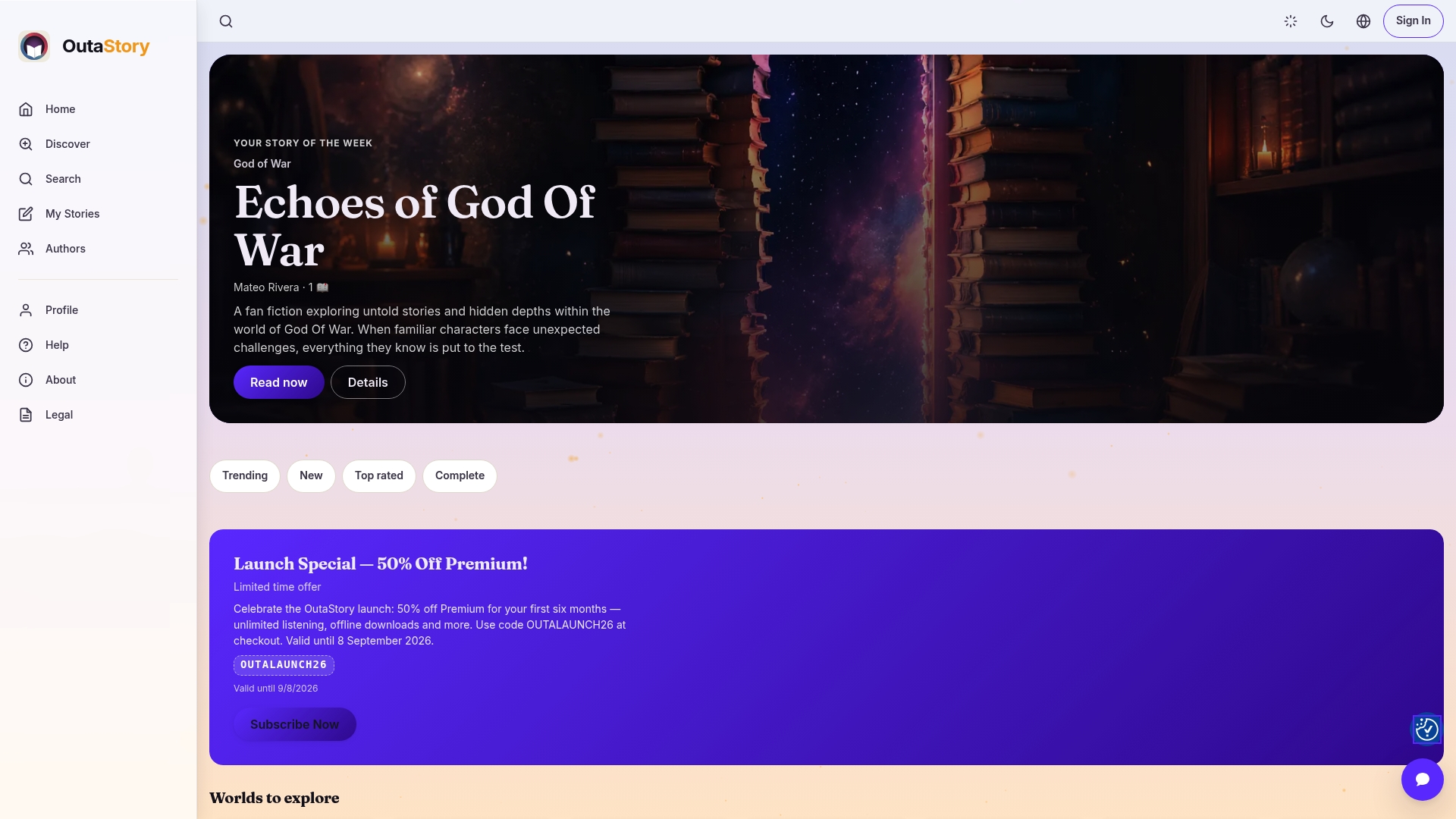
Reading and listening are free on our platform. If you listen a lot, OutaStory Premium is worth considering: unlimited listening time, ad-free use, and downloads for offline listening, so your story keeps playing even without reception or in airplane mode before bed.
And if you're drawn to the darker side that many steampunk stories associate with gaslight and ghosts, you'll find suitable recommendations for space horror short stories and witch fantasy short stories on our platform, or you can start listening to Häusergeflüster right away.
Steampunk for children: what parents should look out for
Children love machines, inventions, and flying ships. Steampunk motifs are therefore a wonderful fit for read-aloud stories, provided the tone and content are age-appropriate. A few pointers to help you choose:
- Keep the scares in check: Many steampunk stories for adults play with ghosts, gloomy factories, and sinister automatons. For younger children, stories in which the machine is a friend rather than a monster are a better choice.
- Match the length to their attention span: A story that takes ten to fifteen minutes to tell fits a bedtime routine better than a long chapter with an unresolved ending.
- Wonder before suspense: Stories about inventors, journeys, and little wonders are much better for falling asleep than chase scenes.
- Explore ideas together: Steampunk invites questions. How would your child build a steam engine that does homework? That's how a story becomes a conversation.
- Listen briefly yourself first: Especially with audiobooks, it's worth listening to a short sample to check whether the voice and mood suit your child.
For the youngest children, we have a dedicated children's section with bedtime stories, animal adventures, and first rhymes. Since every story can also be played as an audiobook, you'll still have a narrator at hand on evenings when your own voice needs a rest.
Writing your own steampunk short story
Do you have an idea for an airship, an inventor, or a city made of brass? Then a short story is the ideal way to start. Here's how to approach it:
- Choose one central invention. A single device that changes the world sustains a short story better than a whole fleet of machines. A common mistake: too much technology, too little humanity. Ask yourself what the invention means to your main character.
- Establish the world's rules. What powers the technology: steam, aether, magic? You don't have to explain it, but you do have to stick to it. A look at Sapkowski's “Season of Storms” shows how consistently a world's own order of power, magic, and history can be portrayed, even if swords rather than gears rule there.
- Write for the senses. Steampunk becomes tangible through sounds, smells, and textures. A hissing valve says more than a paragraph about pressure conditions.
- Introduce the conflict early. In a short story, you don't have fifty pages to build up to it. By the end of the first scene at the latest, it should be clear what's at stake.
- Consider society too. The strongest steampunk stories ask who benefits from progress and who pays the price. Even a factory worker at the edge of a scene gives your world depth.
- Revise for the ear. Read your text aloud. Anything awkward to say will also sound awkward as an audiobook. Since every story on our platform can be listened to, this step is doubly worthwhile.
- Publish, even in stages. You don't have to finish a bigger idea all at once. On OutaStory, you can release your story chapter by chapter as a serial and let your world grow while readers and listeners follow along.
If you narrate your story yourself, it creates a special sense of closeness: your listeners hear exactly the emphasis you had in mind while writing.
Publishing and earning: what authors should know
Anyone publishing a short story should keep two things in mind: the rights to their text and how they earn money from it.
Your rights. In Germany, copyright always remains with you. Anyone who wants to use your text needs a license. Under Section 31 of the Copyright Act, this right may be granted on a non-exclusive or exclusive basis. A non-exclusive license permits use without excluding you or others. An exclusive license, by contrast, binds your text exclusively to one partner. Before publishing, therefore, check whether you're granting a non-exclusive or exclusive license and for which types of use. If a publishing contract contains unclear clauses, a lawyer specializing in copyright and media law is the right person to consult.

Your earnings. On OutaStory, you can publish your short story in minutes and receive a share of the revenue your stories generate. The platform is free for authors to use. Anyone recording stories as a narrator can find details of the 8% platform commission on our page for narrators. Our goal is a fair model that lets you focus on what matters most: your text.
The advantage over waiting for an anthology's call for submissions: your story is immediately available to read and listen to, and you gradually build an audience that's already looking forward to your next steampunk world.
Frequently asked questions about steampunk short stories
Is steampunk fantasy or science fiction?
Both. Steampunk uses science fiction motifs such as machines, robots, and airships, but often makes them work like magic. That's why fans of both genres find a home in it.
Can I listen to steampunk short stories for free?
Yes. On OutaStory, every story can be read for free or played as an audiobook. Premium adds unlimited listening time, ad-free use, and offline downloads.
At what age is steampunk suitable for children?
That depends less on the genre than on the individual story. Stories about inventions and journeys work even for children young enough to be read to, while spooky ghost and factory tales are better suited to older children and teenagers. If in doubt, listen briefly yourself first.
How long should a steampunk short story be?
There is no fixed limit. What matters is that a central idea and a conflict sustain the story. If the world grows bigger, you can publish it with us as a serialized story in chapters.
Sources
- Steampunk, Wikipedia
- List of steampunk works, Wikipedia
- Mike Perschon: The Steampunk Aesthetic
- Henning Mützlitz: Eis und Dampf
- PhantaNews: Die Steampunk-Chroniken (2015)
- PhantaNews: Die Steampunk-Chroniken for the ears (2019)
- Section 31 UrhG, Institute for Copyright and Media Law
Recommendations
- Science fantasy short stories: read, listen, and write your own
- Witch fantasy short stories: recommendations for reading and listening
- Space horror short stories: the best stories to read and listen to
- Space opera short stories: read, listen, and write your own
Read and write on OutaStory
Thousands of short stories to read for free — or publish your own and find an audience.