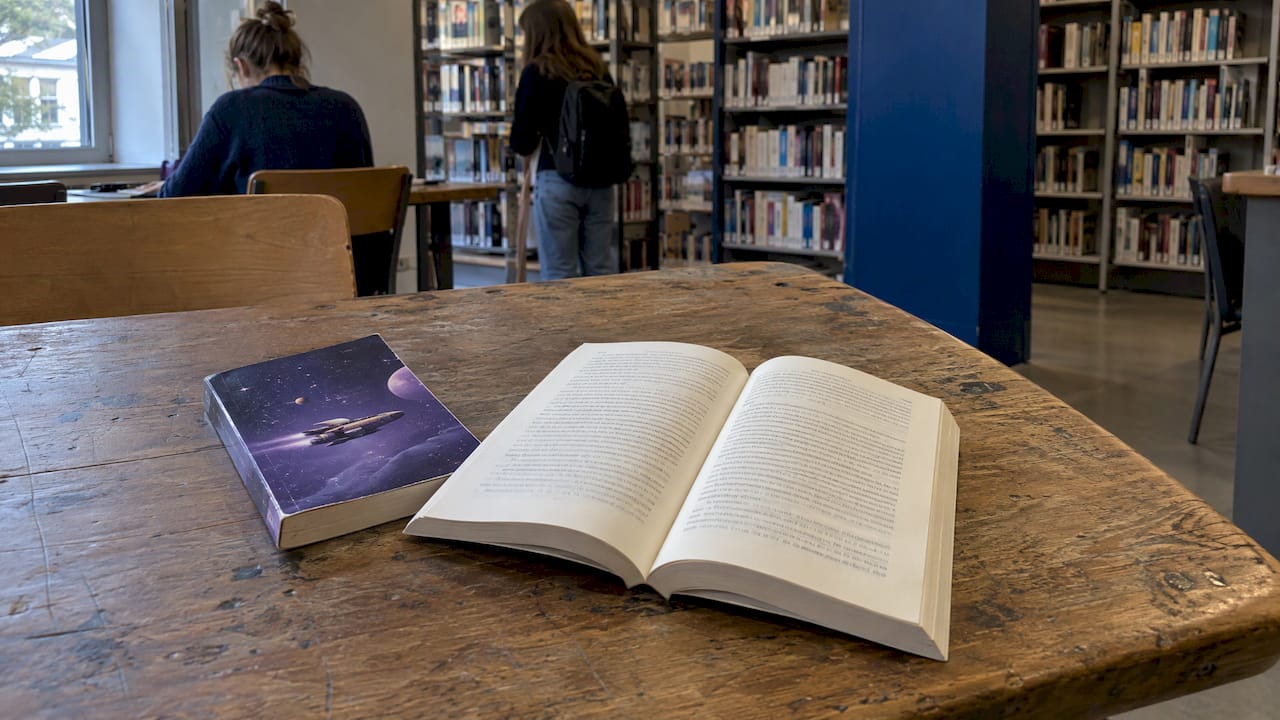
Space Opera Short Stories: Read, Listen, and Write Your Own
Space opera short stories bring interstellar empires, spaceship crews, and battles for entire galaxies into a format you can finish on a train ride or before falling asleep. You get the sweeping emotion of a space epic without 800 pages of buildup. On OutaStory, you can read or listen to these stories for free, because every story can be played as an audiobook, with professionally produced voices or the author's own voice. And if you write yourself, you can publish your own space opera with us in just a few minutes. In this article, we'll show you what defines the genre, how it works in just a few pages, how best to listen to it, and how to write your first story.
In Brief
- Space opera is action-packed science fiction on the grandest possible stage: interstellar empires, alien peoples, spaceships, plenty of emotion, and little technical explanation.
- In short form, the story focuses on a crew, a conflict, or a moment that matters to an entire galaxy.
- For listening, the genre is especially well suited because it thrives on voices, pacing, and atmosphere. On OutaStory, you can also listen to every story as an audiobook.
- Writing your own is worthwhile: a clearly defined hero, a quest, and high stakes work even in just a few pages.
- Publishing with us takes just a few minutes, including chapter by chapter as a serialized story, and you can share in the earnings through revenue sharing.
Table of Contents
- What Defines a Space Opera
- Why a Grand Stage Works Even in a Few Pages
- The Typical Building Blocks of a Space Opera
- Listening to Space Opera: On the Go, at Bedtime, and with Children
- Where You Can Start
- Writing Your Own Space Opera Short Story
- Publish and Earn a Share
- Frequently Asked Questions
- Sources
What Defines a Space Opera
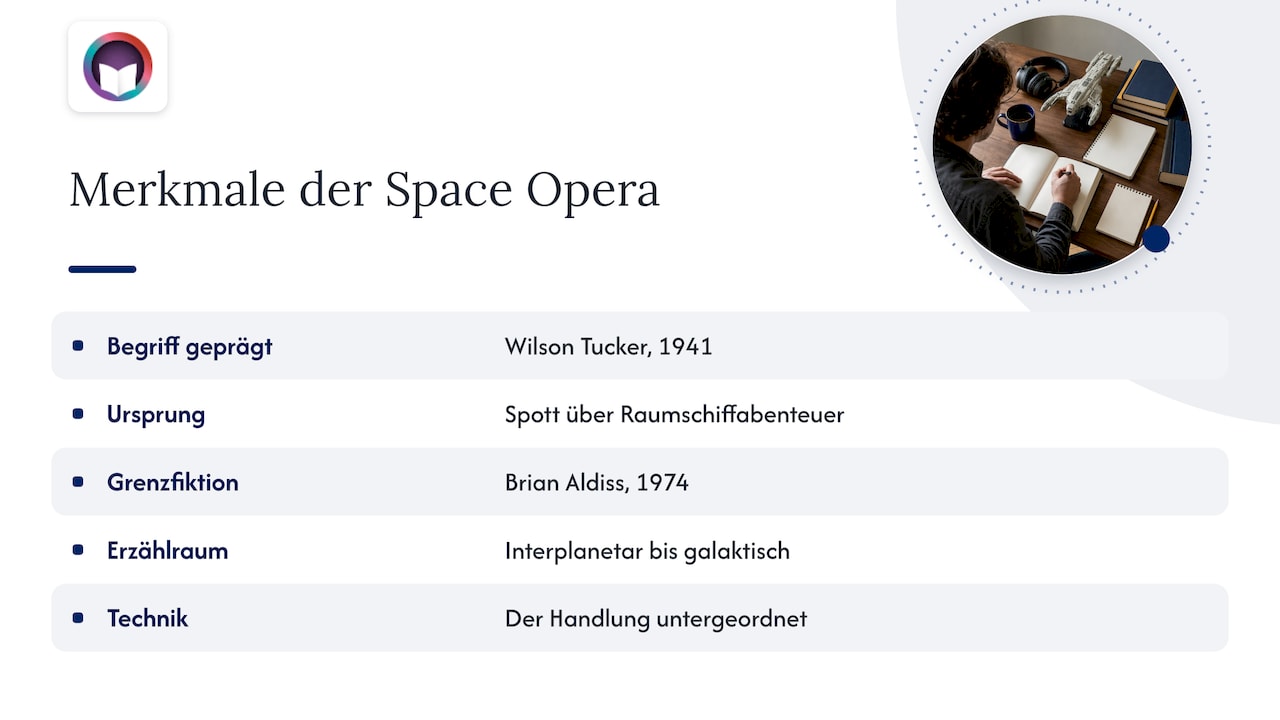
The term evokes a stage and an orchestra, and that's no coincidence. American author Wilson Tucker coined it in 1941, originally to mock clichéd spaceship adventures. The reference is deliberate: just as “soap opera” referred to radio melodrama and “horse opera” to pulp Westerns, space opera stood for adventures among the stars. The mocking nickname has long since become a genre label that now encompasses some of the most popular works of science fiction.
In terms of content, space opera is a genre featuring strongly action-driven narratives in interplanetary or intergalactic space, often revolving around conflicts between space empires. Romantic adventures, alien worlds and peoples, and spaceship battles take center stage. How a faster-than-light drive might work physically, by contrast, is of little interest to the story.
This is precisely where it differs from so-called hard science fiction, the kind of science fiction that makes its technology as scientifically plausible as possible. In space opera, technology is everywhere, but takes a back seat to the plot, and a romantic element is usually part of the mix. The action spans at least part of a solar system, and more often large parts of a galaxy.
In 1974, British author Brian Aldiss described the genre as frontier fiction: stories about the hopes and fears that arise when people encounter the unknown at distant frontiers. Early space operas therefore often retold familiar story patterns, such as pirate, detective, or Wild West stories, only set between planets. Terms such as hyperspace and warp came later.
For you as a reader, that means: if a story draws you in with a crew, an interstellar empire, and a conflict bigger than a single planet, you're right in the middle of a space opera.
Why a Grand Stage Works Even in a Few Pages
Packing a genre that thinks in galaxies and centuries into a short story might sound like a contradiction at first. In practice, it's a strength. A good short story is not a condensed novel, but a form of its own that plays with expectations, takes shortcuts through ideas, and overturns them in surprising ways.
In space opera, that means: the empire, the war, and the history of its peoples remain in the background, while a single moment on which everything hinges takes center stage. A pilot who has to make a decision. An ambassador negotiating in an alien language. A ship that is the last survivor of a fleet. You sense the vastness of the universe through hints, through the names of star systems, through scars on the ship's hull. It doesn't need to be spelled out.
For fans of fantasy and science fiction in particular, this has a practical advantage: you can immerse yourself in a new world and leave it again within half an hour. You meet characters, understand an unfamiliar social order, and experience a twist that stays with you for a while. If you want to discover new authors and variations on the genre, you can explore more quickly this way than with a ten-volume novel series.
And the range is broad. Modern space opera stretches from quiet stories about a community on board a ship to political intrigue at the court of an interstellar empire to humorous misadventures through space. Each of these variations also works in short form.
The Typical Building Blocks of a Space Opera
One tried-and-tested model for the genre is a list that traces back to a poem by Brian Aldiss. These elements are considered guidelines, not fixed rules, but they help with both reading and writing:
- A world in danger: A lot is at stake, often the fate of a planet, an empire, or an entire galaxy.
- A quest: The characters pursue a goal, an artifact, a message, a place no one has found.
- A heroine or hero: someone who rises to the occasion or grows through it.
- Alien peoples and exotic settings: cities full of different species, planets of ice or desert, black holes, ruins of ancient civilizations.
- Scenes on board and battles in space: the bridge, the engine room, docking maneuvers, clashes between fleets.
- A clear antagonist: an emperor, a rebel leader, an alien power.
- A good ending: usually with hope, even if the price was high.
Then there are familiar subgenres you'll repeatedly find in collections: stories about first contact with aliens, military science fiction centered on fleets and command structures, generation ships on which people travel to a distant star over many lifetimes, and so-called planetary romance, which focuses on a single alien planet and its cultures.
If it's the eerie side of space that appeals to you, space opera is closely related to neighboring genres. You'll find more in our articles on space horror short stories and science fantasy short stories, in which magic and spaceships coexist.
Listening to Space Opera: On the Go, at Bedtime, and with Children
Few genres are as suited to listening as space opera. The name says it all: this is about powerful emotions, dramatic twists, and voices that send a fleet into battle or give weight to a farewell on the bridge. On OutaStory, you can play every story as an audiobook, with professionally produced voices or the author's own voice. How you listen depends on when and what for.
On the Go
On your way to work, while exercising, or on long drives, stories with a clear plot and a brisk pace are a good fit. A short story has the advantage of beginning and ending in a single trip. You don't have to remember where you left off in chapter 23 of a saga. If you have a longer journey ahead, choose serialized stories, which we publish chapter by chapter, and listen to one episode per trip.
At Bedtime
Not every space battle makes a good companion for drifting off to sleep. In the evening, quieter variations are a better fit: stories about a crew on a long journey, about the wonder of gazing at an unfamiliar nebula, about encounters rather than battles. A warm voice and a hopeful ending do more here than a cliffhanger. If you're unsure, listen to the first few minutes: you'll notice a calm storytelling pace right away.
With Children
Space adventures are among many children's favorite themes: female captains, talking robots, friendly aliens. For parents, we have a dedicated children's section with bedtime stories, animal adventures, and first rhymes. When choosing space opera stories for children, it's best to look for three things: a heroine or hero your child can identify with, a conflict that avoids violence or only hints at it, and an ending that reassures. You can decide each evening whether to read aloud yourself or play the audiobook version.

Where You Can Start
If you want to get started right away, here are a few starting points on our platform. Our article on free science fiction short stories gives you a broad overview of the genre, with recommendations across the different types of science fiction.
For a first impression of how much adventure fits into a short format, we recommend Captain Mira and the Singing Storm, a story centered on a female captain. If you prefer something more reflective, read or listen to Creativity in Space, a dystopian story set in space that shows how social questions can be transposed into a space setting. And because good space opera often crosses genre boundaries, it's also worth looking at our other sections, from fantasy and romantasy to crime and thrillers to horror.
Listen More with Premium
Reading and listening are free on our platform. But if you regularly listen to stories on your commute, while exercising, or in bed at night, our Premium subscription offers enhanced features: unlimited listening time, ad-free use, and offline downloads, so your favorite stories keep playing even on a plane or where there's no reception.
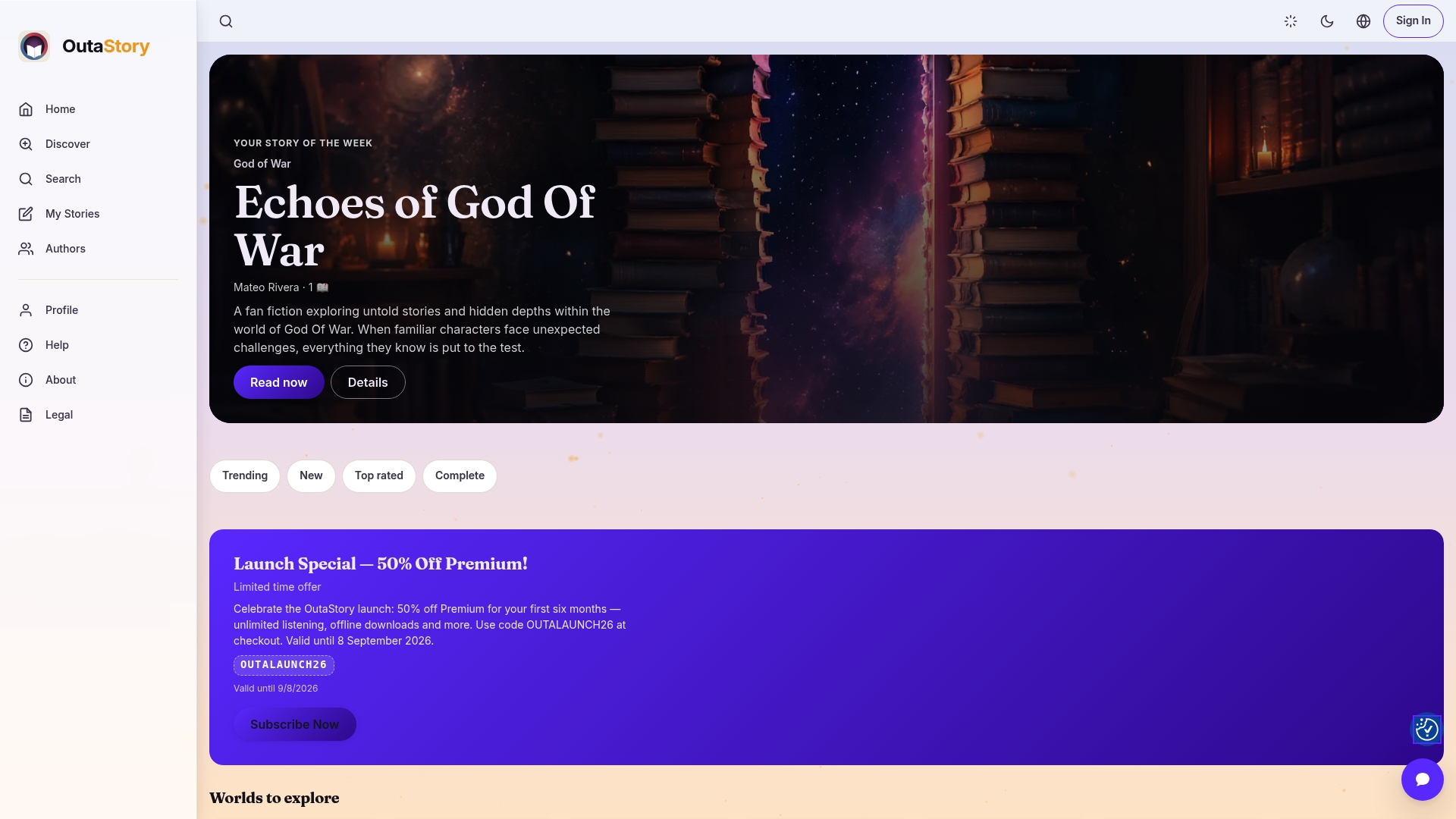
You'll find all the details on our OutaStory Premium page.
Writing Your Own Space Opera Short Story
Perhaps you've already thought while reading: I would have built this world differently. Then it's time to get started yourself. Here's a process that has proven effective for short space operas.
-
Find the central conflict. A short story can sustain only one central conflict. Express it in a single sentence: “A smuggler must decide whether to hand over the crown princess of an enemy empire.” The most common mistake is trying to fit in three wars, two conspiracies, and a love story. If you're short on ideas, you'll find writing prompts to get started in our 40-plus sci-fi ideas.
-
Build the world in the background, not on the page. Make notes about empires, peoples, and history in as much detail as you like. Only what the scene needs goes into the text. A name, a uniform, a rumor about a distant war are enough to make the galaxy feel vast. Where it goes wrong: long explanatory passages at the beginning, before readers know why they should care about this world.
-
Choose a character people want to follow. Space opera heroes are rarely complicated, and that's not a disadvantage in short form. Give your character a clear goal and a weakness that matters in this particular conflict. Whether a commander, a mechanic, or a ship's AI, readers should know what this character wants after one page.
-
Make the stakes high. The “opera” in the name comes with expectations. Something bigger than the character must be at stake: a colony, a peace treaty, the last ship of a people. At the same time, high stakes have the greatest impact when they're reflected in something personal, such as a sister aboard the threatened ship.
-
Keep technology in service of the plot. Your drive doesn't need to be explained; it just needs to fail in the crucial scene. In space opera, technology is scenery and a tool, not a subject in its own right.
-
Write toward a twist. Good science fiction short stories often end with a twist and an idea that invites further thought. Plan the ending early so that every scene leads toward it.
-
Read aloud. Because stories on our platform also appear as audiobooks, it's worth testing them with your own voice. Sentences you stumble over will also trip listeners up. Dialogue that sounds stilted when read aloud usually is. And if you enjoy reading aloud, you can record your story on our platform in your own voice.
-
Revise after some time away. Set the text aside for a few days, then read it with one question in mind: would someone without my background knowledge understand what's going on? Cut anything you can remove without losing anything.
Publish and Earn a Share
The traditional path for science fiction short stories in the German-speaking world is narrow. The market is largely supported by small publishers, usually through themed anthologies with calls for submissions. Collections by individual authors tend to be reserved for established writers, and payment for short stories is often not standard practice. If you're just starting out, you can easily wait months for a reply and then end up empty-handed.
That's exactly why we built OutaStory so you can focus on the text. With us, you can publish your short story in just a few minutes. You can release a longer space opera chapter by chapter as a serialized story, which suits the genre well: each episode ends on board, in the middle of a crisis, and readers return for the next chapter. Your story reaches readers in German and English, and like every story on our platform, it can be played as an audiobook, with professionally produced voices or your own.
And if you want to earn money from writing: through our revenue-sharing model, you receive a share of your stories' earnings. As an author, you pay nothing to use the platform. You'll find the 8% platform commission and the other terms clearly laid out on our page.
Before you publish, a short checklist helps:
- Does the title spark curiosity and signal the genre?
- Is the central conflict established by the first page at the latest?
- Does the text work when read aloud?
- Does the story work as a standalone piece, or is it already setting up the next episode?
Frequently Asked Questions
What Is the Difference Between Space Opera and Science Fiction?
Space opera is a type of science fiction. It takes place in space on a grand stage, often revolving around conflicts between interstellar empires, and prioritizes adventure, characters, and emotions over scientific accuracy. Other types of science fiction, such as hard science fiction, place greater emphasis on plausible technology and physics.
Can I Read and Listen to Space Opera Short Stories for Free?
Yes. On OutaStory, you can read stories for free and play every one of them as an audiobook. Those who want unlimited, ad-free, and offline listening can use our Premium subscription.
Is Space Opera Suitable for Children?
Space adventures with female captains, robots, and friendly aliens delight many children. Look for a relatable character, a conflict without graphic violence, and a reassuring ending. In our children's section, you'll also find bedtime stories, animal adventures, and first rhymes.
How Long Should a Space Opera Short Story Be?
There is no fixed limit. What matters is that a central conflict is told in full, with a twist and an ending. If the plot grows larger, you can publish it with us chapter by chapter as a serialized story.
Can I Earn Money from My Short Stories?
On OutaStory, you receive a share of your stories' earnings through revenue sharing, without paying to use the platform. Publishing takes just a few minutes, so your story quickly reaches readers and listeners.
Sources
Space Opera, Wikipedia Andy Sawyer: Space Opera, Taylor & Francis Space Opera, TV Tropes So You Want To Write a Space Opera, TV Tropes The New Space Opera in the Age of Commercial Spaceflight, Tor Online A Stroll Through the Future: Science Fiction Short Stories, Tor Online
Recommendations
- Space Horror Short Stories: The Best Stories to Read and Listen To
- Science Fantasy Short Stories: Read, Listen, and Write Your Own
Read and write on OutaStory
Thousands of short stories to read for free — or publish your own and find an audience.