Publish an audiobook for free: start with a short story
Publishing an audiobook for free is possible. Uploading is rarely expensive; production is what costs money: recording, editing, narrators, hours upon hours. That's why the easiest way to get started is with a short story on a platform that brings text and audio together. With OutaStory, you can publish your short story in just a few minutes. As an author, you pay nothing to use the platform, every story can be played as an audiobook with professionally produced voices or your own voice, and you earn a share of the revenue.
In a nutshell
- Publishing often costs nothing, but production does: Recording, narrator fees, editing, mastering, and cover art can each incur separate costs.
- Length determines the workload: A rule of thumb is around 9,300 words per finished audiobook hour and about four hours of work per hour. A short story can be done in an afternoon; a novel cannot.
- You can record your own narration for free, for example with free recording and editing software. A quiet room matters more than expensive equipment.
- With OutaStory, every story can be both read and listened to, you can publish chapter by chapter, and you receive a share of the revenue.
- Rights first: The text, voice, and any music must belong to you or be properly licensed.
Table of contents
- What “free” really means for an audiobook
- Why a short story is the best place to start
- Publishing options compared
- Step by step: your short story as an audiobook
- Clear the rights before you upload
- E-book or audiobook: what's the difference?
- Your story on OutaStory: read and listen in one place
- Frequently asked questions
- Sources
What “free” really means for an audiobook
People looking for a free option usually mean two different things: publishing for free and producing for free. The first is now widespread. Many distribution channels charge no publishing fee. The second is the real hurdle, because free distribution does not automatically mean the entire production is free. If you hire a professional narrator, rent a recording studio, or outsource mastering, you can quickly end up paying more than the audiobook earns in its first few months.
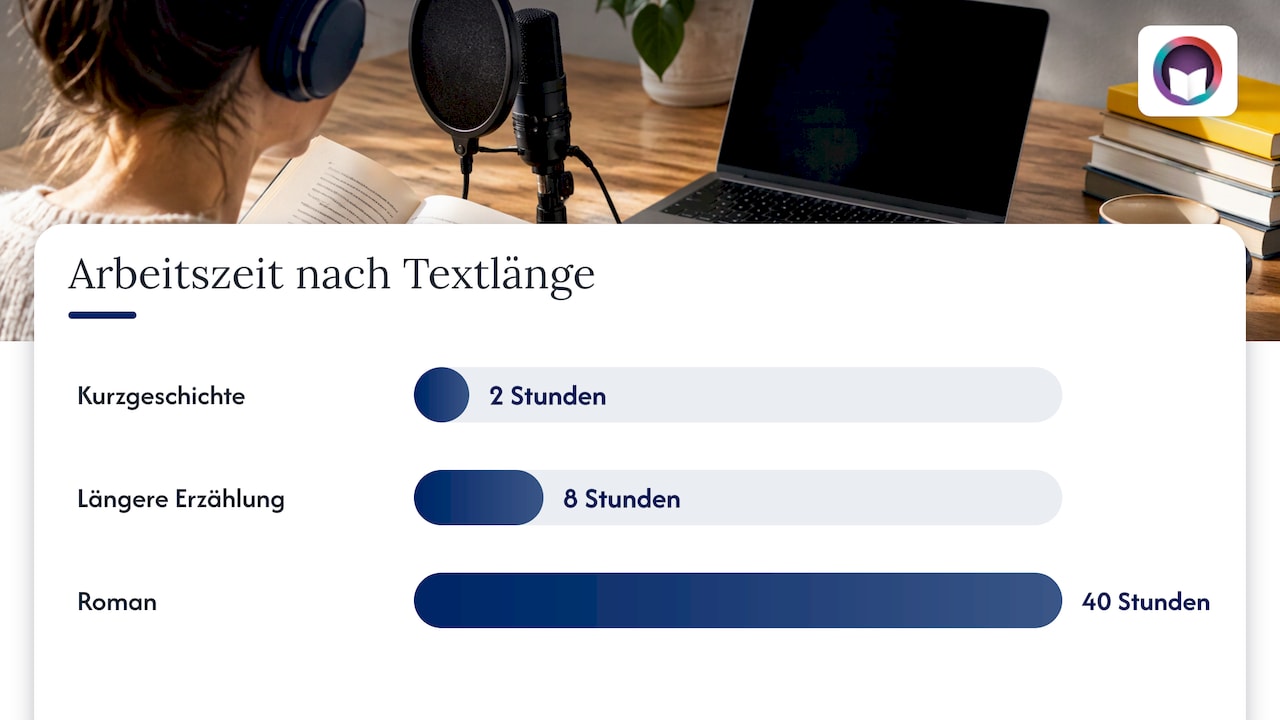
Then there is the time involved, which hardly anyone honestly calculates beforehand. A common rule of thumb is about 9,300 words per finished audiobook hour and an average of around four hours of work for each of those hours: narration, correcting mistakes, editing, and adjusting volume levels.
A sample calculation makes the difference tangible:
| Text | Length | Listening time (approx.) | Working time (approx.) |
|---|---|---|---|
| Short story | 4,650 words | 30 minutes | 2 hours |
| Longer story | 18,600 words | 2 hours | 8 hours |
| Novel | 93,000 words | 10 hours | 40 hours |
Forty hours is a full working week, and that's just for the recording. Two hours, on the other hand, fit into a Sunday afternoon. This is exactly why we consider a short story the smartest way to get started with your own audiobook.
Why a short story is the best place to start
A short story is not a second-class audiobook. It is a format in its own right with a loyal audience: people who want to hear a complete story on their commute, those looking for something short to fall asleep to at night, or parents who want to play a bedtime story. These listeners don't want a ten-hour audiobook; they want a story that fits into a train ride.
For you as an author, this has tangible benefits:
- Manageable workload: You learn recording and editing with a text you can complete in one sitting.
- Quick feedback: You find out early whether your voice, your pace, and your story resonate.
- Several chances instead of one: Rather than spending a year on a single project, you publish several stories in different genres.
- Growing chapter by chapter: If a story has staying power, you continue it. With OutaStory, you can release it chapter by chapter as a serial and build an audience waiting for the next chapter.
The range of genres is broad: fantasy, romantasy, and science fiction, crime, thrillers, and horror, plus a dedicated children's section with bedtime stories, animal adventures, and first rhymes. If you'd like to hear what that sounds like, you can listen to a dark fantasy story such as Häusergeflüster or a thriller such as Dunkle Geschäfte.
Publishing options compared
Broadly speaking, there are three types. They differ less in the price of uploading than in who handles production and what text length the option is designed for.
| Criterion | Short-story platform with audio playback (OutaStory) | Audiobook distributor for self-publishers | International audiobook platform |
|---|---|---|---|
| Publishing fee | none for authors | sometimes none | depends on the provider |
| Audio version | professionally produced voice or your own voice | you must provide a finished production | finished production or access to narrators |
| Suitable length | short stories, including chapter-by-chapter releases | mainly book-length works | mainly book-length works |
| Text also available to read | yes, read or listen | no, audiobook only | no, audiobook only |
| Earnings | revenue sharing | royalties depending on the contract | royalties depending on the contract |
Two points deserve a closer look. Some distributors for self-publishers charge no publishing fee for audiobooks but do not handle production. Recording is therefore entirely up to you. And one of the best-known international audiobook self-publishing platforms requires residency, tax details, and banking information in certain other countries. For authors living in Germany, this is not a standard direct route.
At OutaStory, the story itself takes center stage: you publish the text, and it is immediately available to read and listen to. This lets you reach both groups, readers and listeners, with a single publication.
Step by step: your short story as an audiobook
1. Revise the text for listening
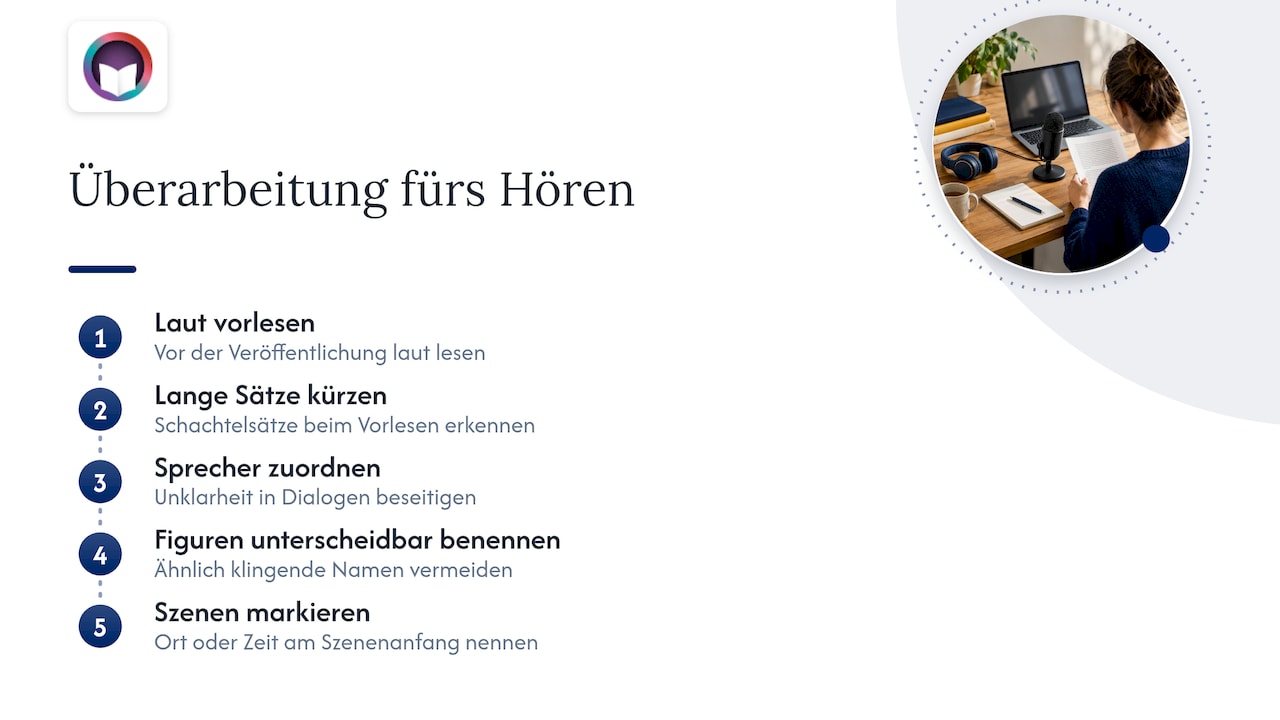
A text that reads well does not automatically sound good. Read your story aloud once before publishing it. You'll notice complex sentences that leave even you needing to catch your breath, dialogue where it's unclear who's speaking, and names that sound too similar. Shorten long sentences, add speaker attributions where the eye doesn't need them but the ear does, and give characters distinct names. The most common mistake: scene changes marked by a blank line in print simply disappear when listened to. A short sentence establishing the place or time at the start of a scene solves this.
2. Choose the voice
This is where you make the most important decision. With OutaStory, every story can be played as an audiobook, either with professionally produced voices or with your own voice. The professional voice takes all the recording work off your hands, which accounts for most of the time in the table above. Your own voice, on the other hand, brings something no one else can offer: exactly the emphasis you had in mind while writing. We explain both options in detail in our article How an audiobook is made.
3. Record your own narration without spending money
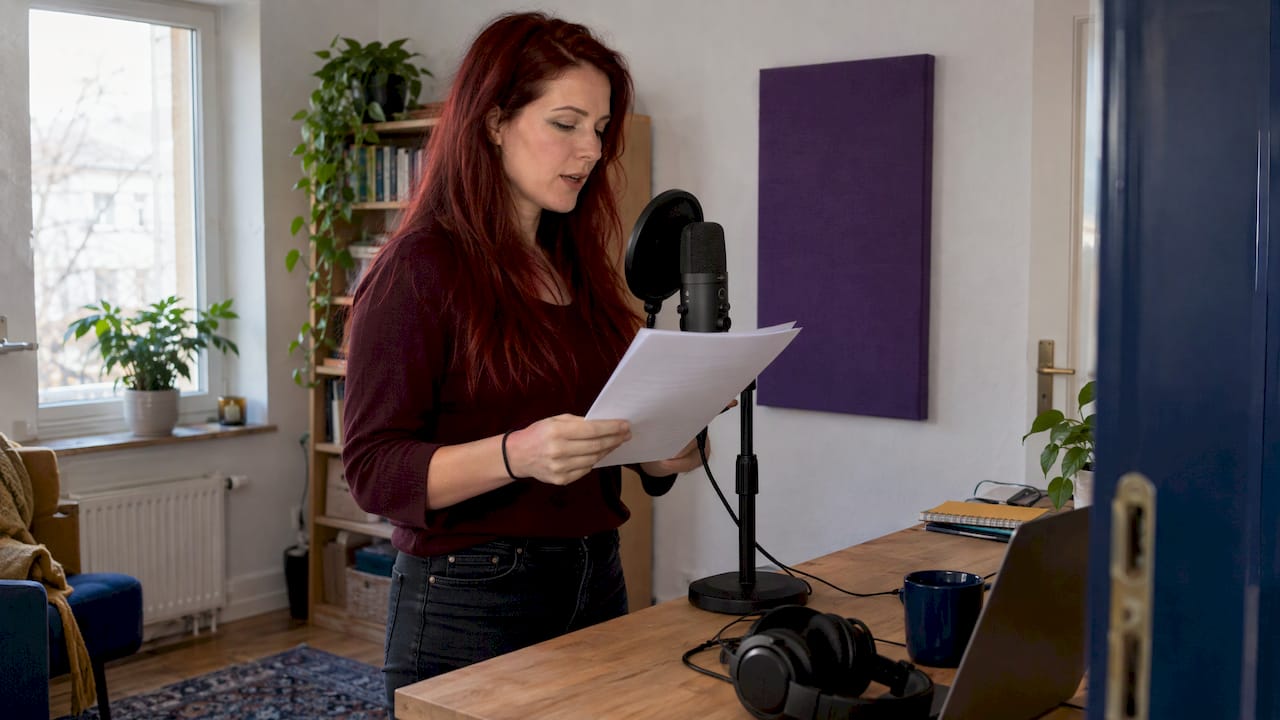
If you narrate it yourself, you don't need a studio. For recording and editing, c’t recommends the free software Audacity and advises practicing, because first attempts often sound muffled or tinny. That's normal and no reason to give up.
The room matters more than the microphone. Echo, street noise, plosive pops, and computer noise cause problems even with good equipment. A few simple adjustments help immediately:
- Record in a small room with plenty of soft surfaces, such as a bedroom or in front of a wardrobe full of clothes.
- Close the windows and record at a quiet time of day.
- Keep some distance from the microphone and speak slightly past it to one side so that “p” and “b” sounds don't pop.
- Place the laptop as far away as possible so the fan isn't picked up.
- Drink water and take breaks. After twenty minutes, a tired voice becomes audible.
If you stumble over your words, record the whole sentence again rather than starting in the middle of a word. That makes the spot easy to find when editing. Our help article Record your narration voice explains how to record your voice directly for your story.
4. Use music and sound effects only with the proper rights
A short intro or a background sound can enhance a story. But every audio track and every song must be created by you, licensed, or reliably royalty-free. “I found it online” is not enough. When in doubt, leave out the music: a good voice doesn't need accompaniment.
5. Publish, chapter by chapter if you like
Uploading itself takes just a few minutes on OutaStory. For a longer story, consider publishing it as a serial: each chapter is its own little listening experience, and your readers and listeners return for the next one. This has another benefit for you: you record chapter by chapter rather than putting off a long recording session.
6. Share in the revenue
Publishing for free on OutaStory doesn't mean working for nothing. Through revenue sharing, you receive a share of what your stories earn. If you work as a narrator, you'll find the terms on our page for narrators, including the platform commission of 8%.
Clear the rights before you upload
An audiobook involves several rights: those to the text, those to the recording, and those to everything else that can be heard. As long as you narrate your own story yourself and don't use anyone else's music, all the rights are yours. Things become more complicated in three cases:
- The text has already been released by a publisher. In that case, your contract determines who holds the audiobook rights. Check before publishing, and consult a copyright lawyer if any wording is unclear.
- Someone else narrates your story. Put in writing that the recording may be published and how any revenue will be divided.
- You use other people's texts. Quotations, song lyrics, or poems by others require permission unless they are demonstrably free to use.
This clarity protects not only you but also your listeners, who rely on a properly published work.
E-book or audiobook: what's the difference?
Many people looking for a free way to publish an audiobook also wonder whether an e-book would be enough. The difference lies in the workload: with a finished, proofread text and a cover, an e-book is essentially ready to go. An audiobook adds the entire audio production process, with the time requirements shown in the table above.
But you don't have to choose. On OutaStory, your story is both at once: a text people can read and an audiobook they can play. Someone reading on the train finds the same story as someone listening while falling asleep at night. You write once and reach both.
Your story on OutaStory: read and listen in one place
We built OutaStory for exactly this situation: you have a story, and you want it to be read and heard without having to pay for a recording studio first. You publish in just a few minutes, choose between a professionally produced voice and your own, and receive a share of the earnings through revenue sharing. As an author, you pay nothing to use the platform. Your World, Your Stories: Write, Read, Listen.
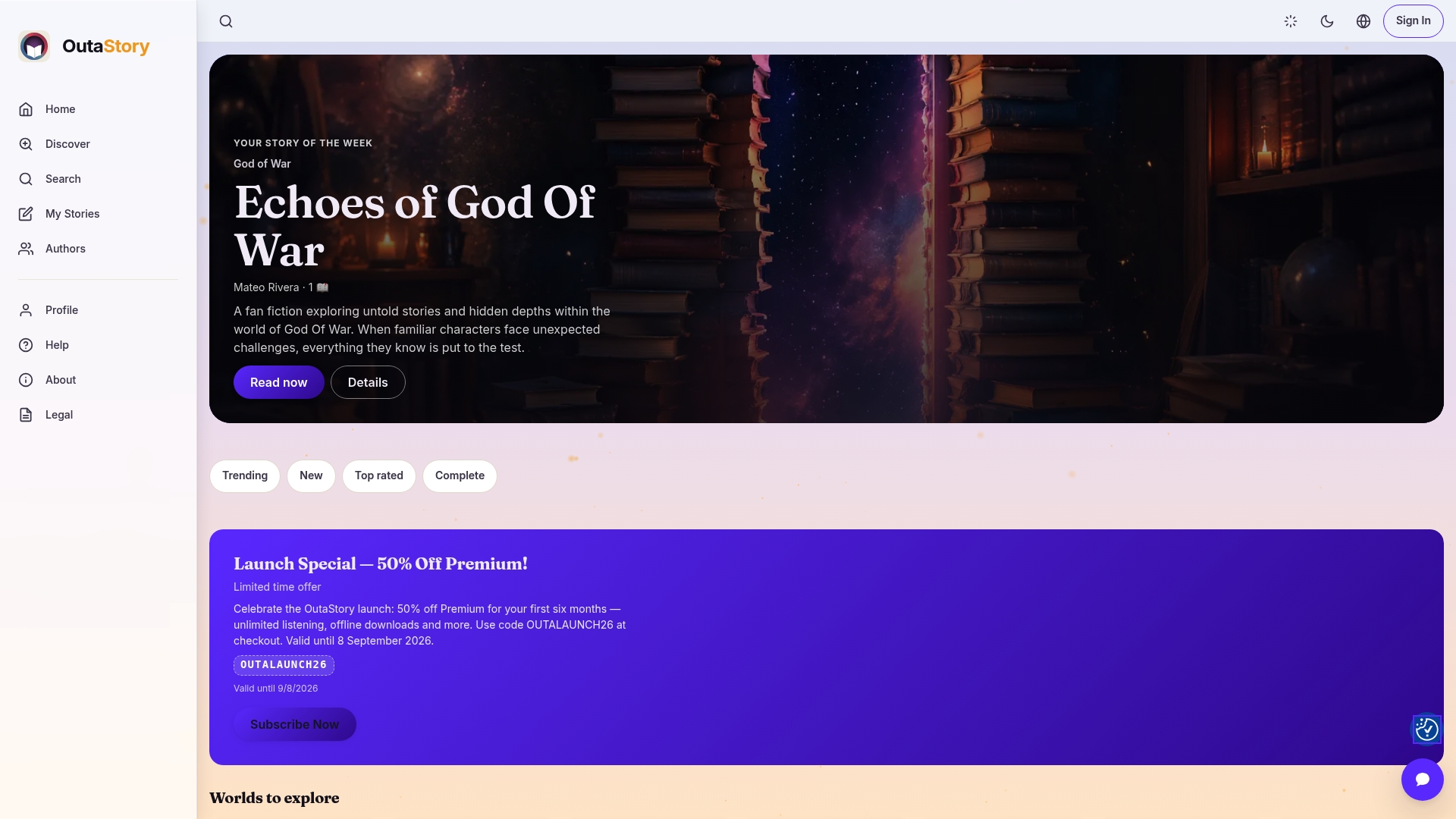
Those who prefer listening can read and listen to all stories for free. For unlimited listening, ad-free use, and offline access, there is OutaStory Premium. And if you want to get started with your own story: Publish on OutaStory, in German or English.
Frequently asked questions
Can I publish an audiobook completely free of charge?
Yes. As an author, you pay nothing to use OutaStory, and every story can be played as an audiobook with a professionally produced voice or your own. Costs arise only if you purchase equipment, hire narrators, or buy music yourself. With free software and a quiet room, you can also record your own narration without spending anything.
How long does it take to narrate a short story yourself?
A rule of thumb is around 9,300 words per listening hour and about four hours of work per finished hour. A short story of 4,650 words therefore produces half an hour of listening time and takes around two hours of work. Your first attempt will usually take a little longer; with practice, you'll get faster.
Can I earn money with an audiobook?
Yes. With OutaStory, you receive a share of your stories' earnings through revenue sharing. How much that amounts to depends on how many people read and listen to your stories. Regular releases, for example as a serial, help build a returning audience.
Do I need an expensive microphone?
No, not to get started. A quiet, acoustically dampened room without echo or background noise is more important. If you plan to keep narrating yourself, a better microphone is worth buying later, but first you should get your recording space and speaking technique under control.
Can I also publish children's stories as audiobooks?
Yes. OutaStory has a dedicated children's section with bedtime stories, animal adventures, and first rhymes. Short read-aloud stories are particularly good for getting started because they can be recorded quickly and parents like to play them at bedtime.
Sources
- Publishing an audiobook: rights, providers & distribution (buchinsider.net)
- Self-publishing an audiobook in 2026 (selfpublishing-akademie.de)
- Speaking session, c’t 5/2023 (heise.de)
- Producing a professional audiobook: guide (buchinsider.net)
- The little audio primer, Campusradio Karlsruhe
Recommendations
- Read and listen to scary short stories for free: the best sources
- Read and listen to short stories for free: the best overview
- Listen now: short stories for adults in 10–25 minutes
Read and write on OutaStory
Thousands of short stories to read for free — or publish your own and find an audience.