
The best English short stories: classics to read and listen to
The best English short stories achieve on a few pages what a novel needs hundreds for: Edgar Allan Poe's "The Tell-Tale Heart", W. W. Jacobs' "The Monkey's Paw", Shirley Jackson's "The Lottery", O. Henry's "The Gift of the Magi" and Isaac Asimov's "Nightfall" belong on any honest list. Here we present the stories that are really worth your time and tell you which language level they suit. You'll also learn where to read them for free and legally and how to enjoy them as audio on the train or before falling asleep. We'll also show you why some online "best of" lists include titles that aren't short stories at all.
In short
- For beginners, exciting short classics like "The Monkey’s Paw" are suitable; it is already available in a simplified edition at the lowest learning level.
- For intermediate learners, "The Lottery", "The Landlady" and Raymond Carver's "What We Talk About When We Talk About Love" are worthwhile, because hints and undertones often tell the real story here.
- For science fiction fans, Asimov's "Nightfall" and Octavia E. Butler's "Bloodchild" are essential reading.
- Free and legal — you can find many classics as text and audio on public educational portals, and on OutaStory every story can be read or listened to.
- Be careful with lists: "Little Dorrit" or "The Old Man and the Sea" are not short stories but a novel and a novella respectively.
Table of contents
- What really makes a good English short story
- The classics at a glance
- Be careful with "best of" lists: not everything is a short story
- Choose by language level
- Read for free and legally
- Listen instead of read: on the go and for falling asleep
- English stories to read aloud for children
- Write yourself: publish short stories and earn from them
- Frequently asked questions
- Sources
What really makes a good English short story
Before we name titles, it's worth looking at the criteria. "Best" means something different for a ninth-grader than for a listener looking for twenty minutes of chills in the evening. We measured our selection against four questions:
- Does the story carry a single strong image or idea? Great short stories don't lose focus. They have a core, a heart under the floorboards, a paw with three wishes, a village lottery.
- Does the ending resonate? A good twist retroactively changes everything you've read. Many of the stories below are therefore enjoyable to read a second time.
- Is the language accessible? Some classics are written in English that is over a hundred years old. That's not an obstacle, but you should know what you're getting into.
- Is it good to read aloud or listen to? Stories with a clear narrative voice work especially well as audio. That's an important criterion for us as a platform where every story is also an audiobook.
The classics at a glance
The table below summarizes our selection. The level indication is our estimate for the original unless stated otherwise. Many of these texts are also available in simplified learning editions.
| Geschichte | Autor*in | Genre | Niveau (Original) | Warum lesen? |
|---|---|---|---|---|
| The Tell-Tale Heart | Edgar Allan Poe | Horror | B2 to C1 | Short, intense, a narrator you can't trust |
| The Monkey’s Paw | W. W. Jacobs | Horror | B1 to B2 | Three wishes and a high price, perfectly built |
| The Landlady | Roald Dahl | Dark humor, suspense | B1 to B2 | Harmless beginning, unsettling ending |
| The Lottery | Shirley Jackson | Social drama | B2 | A classic about tradition and group pressure |
| The Gift of the Magi | O. Henry | Christmas story, romance | B2 | One of literature's most famous twists |
| The Happy Prince | Oscar Wilde | Literary fairy tale | B1 to B2 | For reading aloud to children and for adults to reflect on |
| What We Talk About When We Talk About Love | Raymond Carver | Contemporary literary fiction | B2 to C1 | Everyday language under which a lot simmers |
| Nightfall | Isaac Asimov | Science-Fiction | B2 to C1 | A single big idea thought through to the end |
| Bloodchild | Octavia E. Butler | Science-Fiction | C1 | Disturbing, award-winning, lingers long after reading |
Horror and suspense: Poe, Jacobs, Dahl and Jackson
"The Tell-Tale Heart" is the perfect first encounter with Edgar Allan Poe. A nameless narrator repeatedly insists he is not mad while describing how he kills an old man because he cannot bear the man's eye. The heartbeat he believes he hears afterwards is one of the most famous motifs in horror literature. The text is very short but dense. Read it slowly or, even better, listen to it: Poe wrote for the sound.
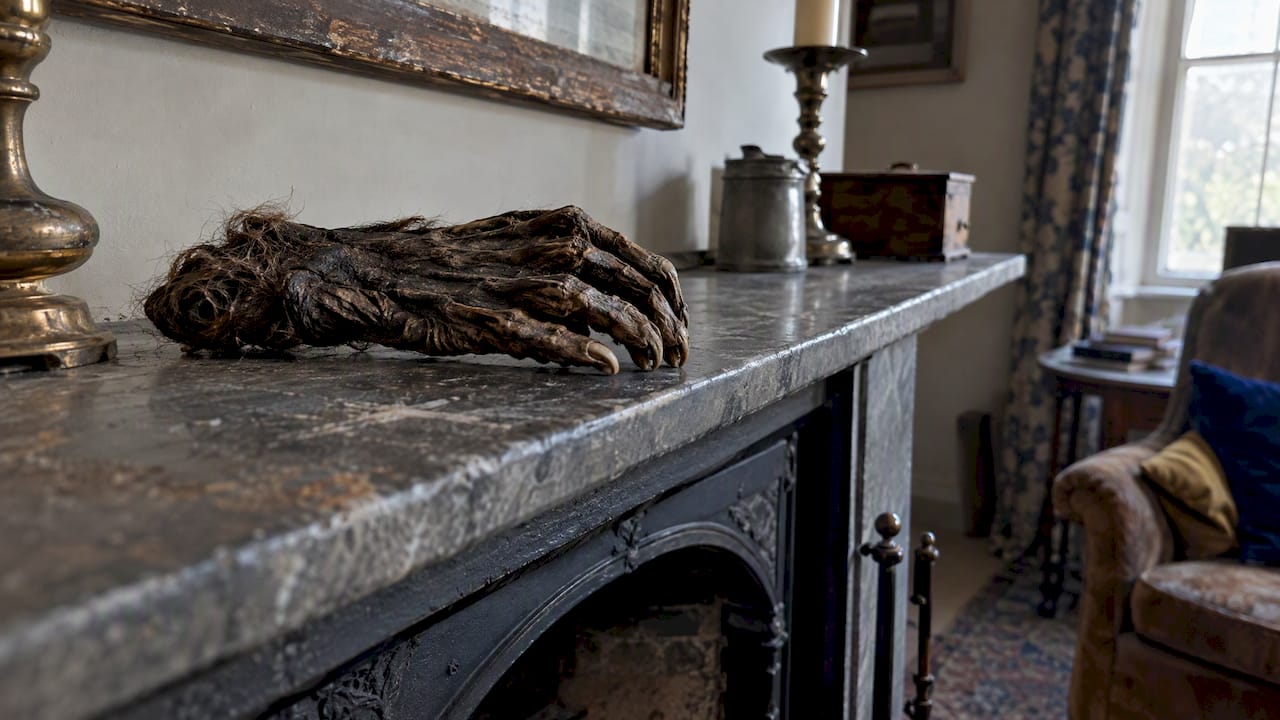
"The Monkey’s Paw" by W. W. Jacobs tells of a family given a mummified monkey's paw that is supposed to grant three wishes. What begins as harmless fun by the fireplace becomes a tragedy. The story is especially rewarding for learners: Oxford University Press lists it in the Oxford Bookworms program as a Stage 1 title, i.e. at the entry level of the series. You can therefore start with the simplified edition and later move on to the original.
"The Landlady" by Roald Dahl shows that the author of "Charlie and the Chocolate Factory" also wrote for adults. A young man finds a remarkably cheap boarding house with an unusually friendly landlady. The longer he stays, the more details don't add up. Dahl's language is clear and modern, which makes this story an ideal step after the first simplified texts.
"The Lottery" by Shirley Jackson describes a sunny summer day in a village where everyone gathers for the annual lottery. You shouldn't know more beforehand. According to Penguin Random House the story appeared in the New Yorker in 1948 and is now included in the collection "Come Along with Me", whose paperback runs 288 pages and costs $17.00 in the USA. If you like Jackson, you'll find more stories in this volume.
Heart and twist: O. Henry, Wilde and Carver
"The Gift of the Magi" is the Christmas story for those who usually find Christmas tales corny. A young couple in New York has little money but still wants to give each other something special. How they solve the problem is a lesson in irony and tenderness at the same time. O. Henry is famous for his surprising endings, and this is his best-known one.
"The Happy Prince" by Oscar Wilde is a literary fairy tale about a gilded statue and a swallow who together help the poor of the city. Wilde's language is melodic and wonderfully suited to reading aloud. Penguin offers the collection "The Happy Prince and Other Stories" as a Puffin Classics edition from 2025 with 224 pages for £8.99. It contains other tales that are suitable for several read-aloud evenings.
"What We Talk About When We Talk About Love" by Raymond Carver takes place at a kitchen table: two couples, gin, a long afternoon and a conversation about what love really is. Carver's English is simple in vocabulary but demanding in understanding because the most important things are left unsaid. For advanced readers, this is a valuable exercise.
Science fiction and fantasy: Asimov, Butler and Wells
Short stories and science fiction fit particularly well together. Oxford Royale summer school describes the format as ideal for the genre because it can focus on a single, concise concept, and names Asimov's "Nightfall" as one of his best works.
"Nightfall" is set on a planet where it never gets dark because of multiple suns, until the day it does. Asimov works through what such a night would do to a civilization. The language is factual and easy to understand, with a somewhat scientific vocabulary.
"Bloodchild" by Octavia E. Butler tells of humans living on an alien planet in a close and uncomfortable dependence with an extraterrestrial species. The story is physical, disturbing and multi-layered. It is more for experienced readers.
For more: New Scientist published in December 2024 a selection of the 26 best science fiction short stories, including "Nightfall", "Bloodchild" and H. G. Wells' "The Time Machine". Where possible, the editorial team links to online versions. Strictly speaking, "The Time Machine" is a novella, i.e. significantly longer than a typical short story.
Be careful with "best of" lists: not everything is a short story
If you search the web for the best English short stories you will come across lists that include Charles Dickens' "Little Dorrit" or Hemingway's "The Old Man and the Sea." Both are great books but not short stories. "Little Dorrit" is a novel: the Penguin Classics edition runs 1,024 pages. In the simplified Oxford Bookworms version the title is listed at Stage 5, one of the upper levels of the series. "The Old Man and the Sea" is a novella that you don't read casually in one evening.
Why does this matter? Because as a learner or as a listener with limited time you want realistic expectations. A true short story is read in one sitting, often in ten to forty minutes. That's exactly what makes it appealing: beginning, tension and ending fit into a train ride or an evening routine.
Choose by language level
The best story is the one you finish. That's why it's worth honestly assessing your own level:
- A1 to A2: Reach for simplified learning editions, so-called graded readers. According to Oxford University Press, the Oxford Bookworms series includes over 250 adapted and original books, each with an exercise section. "The Monkey’s Paw" is available there at the entry level.
- B1: Now you can try some originals. Dahl's "The Landlady" and Wilde's "The Happy Prince" are good candidates because the sentence structure is manageable.
- B2: "The Lottery", "The Gift of the Magi" and "The Monkey’s Paw" in the original. It's worthwhile to mark unknown words here, but not to look up every single one.
- C1: Poe, Carver and Butler. Poe challenges you with older English, Carver with the unspoken, and Butler with the complexity of the world.
A tried-and-true method: listen first, then read, then listen again. On the first pass you understand the plot, on the second the language, and on the third you hear how both work together. Our introduction to learning English with short stories shows you step by step how to approach it. Concrete reading recommendations with comprehension tips can be found in our post on English short stories for learners.
Read for free and legally
Many major classics are so old that their copyright has expired. They are therefore freely available in public-domain digital libraries and on educational portals. A particularly good address for learners in Germany is the Hessian Education Server: there you can find English short stories as text and audio recordings, supplemented by exercises and vocabulary aids, including works by Joseph Conrad, Charles Dickens, Arthur Conan Doyle, Jack London, Edgar Allan Poe and Virginia Woolf.
For more recent authors like Shirley Jackson, Roald Dahl, Raymond Carver or Octavia E. Butler it's different. Their texts are copyright protected. If you want to read them, reach for the printed collection, the e-book or the public library. Free full texts on random websites are usually not legal in these cases.
And of course there are platforms where new stories appear free from the start. On OutaStory authors publish their short stories in German and English, and you can read them at no cost. A broad overview of other routes can be found in our guide Read and listen to short stories for free.
Listen instead of read: on the go and for falling asleep
Short stories are made for the ears. A story fits a commute, a walk or the quarter hour before falling asleep. For learners, listening has an additional advantage: you train pronunciation, sentence melody and listening comprehension at the same time, without it feeling like studying.
For the evening, calm, fairy-tale-like texts such as "The Happy Prince" are suitable. Chills like "The Tell-Tale Heart" or "The Monkey’s Paw" are better saved for the afternoon, unless you like falling asleep with a shiver.
Read or listen? With us you don't have to choose. On OutaStory every story can be played as an audiobook, narrated by professionally produced voices or by the author themselves. You can read and listen for free immediately. Those who want unlimited listening, an ad-free experience and the ability to save stories offline, for example for airplane travel or areas without reception, can find the details on our Premium membership page. A starter guide specifically for learners is offered in our tips on short English audiobooks for beginners.
Tip: Don't slow down the playback on your first listen. Try first to follow the thread even if individual words slip by. Only on the second pass does careful listening pay off.
English stories to read aloud for children
Parents who want to read English stories to their children face two questions: Does my child understand it, and is the content appropriate for children? Many "best short stories" are written for adults. "The Lottery", "The Landlady" or "The Tell-Tale Heart" definitely do not belong in a child's bedroom.
Well suited are fairy tales like Oscar Wilde's "The Happy Prince" or "The Selfish Giant" from the same collection. But keep in mind that Wilde addresses serious themes such as poverty and death. Read the story yourself first and consider whether your child would want to talk about it. That can be a nice opportunity for a conversation.
What else to pay attention to:
- Length: For primary school children, five to fifteen minutes of read-aloud time is a good frame.
- Repetition: Children love hearing the same story multiple times. By the third time they often speak the first sentences along.
- Pictures in the mind: Pause while reading and ask what your child is imagining. That way you'll notice whether they can follow.
- Mixing: Read a paragraph in English, then briefly retell it in German. That reduces the fear of not understanding.
OutaStory has its own children's section with bedtime stories, animal adventures and first rhymes. Because every story also runs as an audiobook, on evenings when your voice is tired you can simply sit with your child and listen along.
Write yourself: publish short stories and earn from them
If you read many good short stories you will eventually want to write one yourself. The classics above are the best school for that: pay attention to how Jacobs builds tension in small steps, how Dahl sprinkles details that only make sense at the end, and how Carver writes dialogue so that the most important things remain unspoken.
There are several routes to publication: literary magazines and anthologies, writing competitions, self-publishing as an e-book or platforms for short stories. Magazines and competitions bring prestige but are often slow and selective. Self-publishing gives you full control but requires your own marketing.
On OutaStory we tried to keep the hurdles as low as possible. You can publish your short story in minutes, in German or English. Longer material can appear chapter by chapter as a serial so readers can follow you from chapter to chapter. Your story will also be playable as an audiobook, optionally with your own voice. And you participate in the revenue from your stories. The platform commission is 8%, and all details are on our platform commission page. How a finished story reads and sounds on our site is shown, for example, by "The library where the books talk back at night".
Frequently asked questions
Which English short story is best for beginners?
"The Monkey’s Paw" by W. W. Jacobs is a very good starting point because the story is available as a simplified learning edition at the lowest Oxford Bookworms level. After that you can read the same story in the original and feel your progress directly. Roald Dahl's "The Landlady" is also doable early on thanks to its clear language.
Where can I read English short stories for free?
Older classics whose copyrights have expired can be found for free on educational portals like the Hessian Education Server and in public-domain digital libraries. You can read new stories by contemporary authors on OutaStory for free, in German and English. For more recent copyrighted works, the legal route is through a book, e-book or library.
How long is a short story?
There is no fixed word limit, but a short story is generally read in one sitting, often in ten to forty minutes. Works that are significantly longer are usually considered novellas, such as "The Old Man and the Sea." Works like "Little Dorrit" are full novels.
Are English short stories for listening good for learning English?
Yes, especially if you combine listening and reading. Listening trains pronunciation and listening comprehension, reading trains vocabulary and grammar. On OutaStory you can play any story as an audiobook and read the text in parallel.
Sources
Hessian Education Server: Read and listen to English texts Penguin Random House: Come Along with Me by Shirley Jackson Penguin Random House: Little Dorrit by Charles Dickens Oxford University Press: Bookworms Library Set Penguin: The Happy Prince and Other Stories New Scientist: The 26 best science fiction short stories Oxford Royale: 9 Essential Short Stories
Recommendations
- English short stories for learners: read, listen, understand
- Short English audiobooks for beginners: start listening immediately
- Learn English with short stories: your introduction
- English short stories for learners: read, listen, understand
Read and write on OutaStory
Thousands of short stories to read for free — or publish your own and find an audience.