How an audiobook is created: From choosing the narrator to the upload
An audiobook is created in a clear sequence: choosing the narrator, studio recording, editing and mastering, rights clarification, then publication. Each phase has its own pitfalls, and production is not the same as publication: weeks often lie between the finished file and shop availability. Costs and the schedule decide which steps you take yourself and which you outsource.
In short:
- The choice of narrator depends heavily on the genre; while a professional voice costs more, it brings experience in emphasis and pacing.
- The manuscript should be made clearly understandable and adapted to the audio format before recording to avoid questions and rework in the studio.
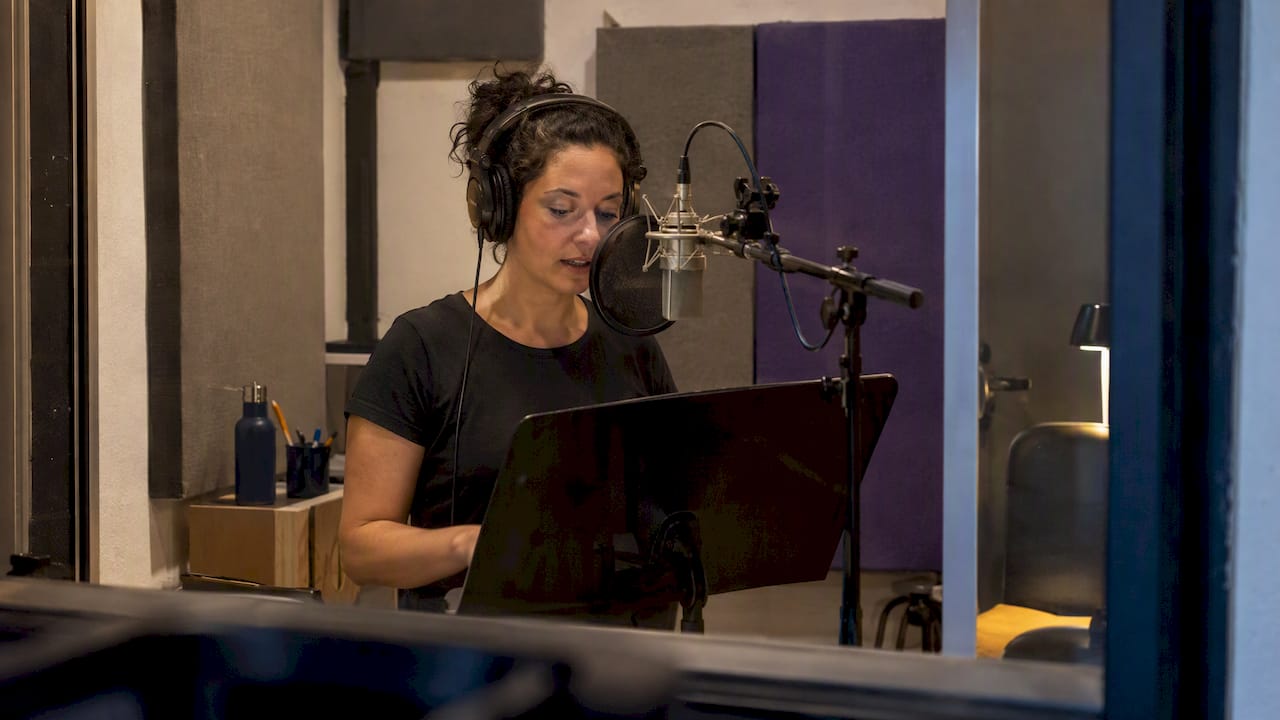
- The room acoustics in the studio are crucial for sound quality; untreated rooms produce reverberation that is hard to remove.
- Post-production typically requires two to four hours of editing time per finished audiobook hour, which many producers underestimate.
- Legal protection through written contracts for narrators, usage and licenses is necessary to prevent later conflicts.
Table of contents
- Choosing the narrator and casting: Who fits the voice of the text?
- Manuscript preparation: Making the text audible
- Recording: Equipment, room and common mistakes
- Direction and performance: Maintaining consistency over hours
- Editing and post-production: What happens in the editor
- Mastering and file formats: How the export file must look
- Rights and licenses: What must be clarified before publication
- Publication and distribution: Distributors, metadata and time windows
- Costs and fees: Orientation using the VDS Fee Compass
- Schedule and milestones up to publication
- How we support authors in the audio production
- Publish now: Booking narrators and Premium at OutaStory
- FAQ
- Sources
Choosing the narrator and casting: Who fits the voice of the text?
The choice of narrator shapes an audiobook more than any technical decision afterwards. Authors face a basic question: read it themselves or hire a professional voice? Your own voice can feel authentic but requires vocal stamina and technical skill. A professional voice costs more but brings experience in emphasis and pacing.
Fitting the genre is important: a crime novel needs different tonal colors than a bedtime story. Casting can be helped by:
- Comparing the speaker's demo reels, ideally with a short text sample from your own manuscript.
- Contacting agencies or matching platforms if you don’t have your own network.
- Requesting a trial reading of one to two pages before signing the contract.
Contracts should early on regulate the Final Audio Hour fee, the scope of usage rights, the duration and any marketing clips. Anyone looking for narrators can also book them through a mediation service without building their own agency network.
Manuscript preparation: Making the text audible
A manuscript for an audio version needs its own review. Difficult names, foreign words or dialects should be provided with pronunciation notes so time is not lost in the studio with questions. Tables, footnotes and margin notes that work in a printed book must be reformulated or removed for listening only.
It often pays to moderately shorten redundant passages, since spoken text feels longer than written text. Important steps:
- Mark difficult terms and proper names with phonetic notation or audio examples.
- Convert tables and footnotes into continuous text or omit them.
- Tighten longer passages without changing the narrative tone.
The author and director should agree on content changes together before recording begins. Late text changes in the studio cost time and money.
Recording: Equipment, room and common mistakes
In the studio, room acoustics often determine the quality more than the microphone. An untreated room produces reverberation that is scarcely removable in post-production, as acoustics experts explain. If you record in a home studio, invest in acoustic treatment first, then in expensive equipment.
A typical workflow:
- Dampen the room with curtains, rugs or acoustic panels, switch off disturbing noises like air conditioners.
- Position the microphone at an appropriate distance, use a pop filter, test levels before the first take.
- Back up each session automatically, ideally to two separate storage locations.
Pro tip: Test the room acoustics with a short trial recording and listen back over headphones before starting the actual session.
Direction and performance: Maintaining consistency over hours
Direction differs significantly depending on the text type. A non-fiction book requires clear, even emphasis; a novel lives from tempo changes, pauses and distinguishable character voices. Over several hours of recording, the voice only stays stable if narrators take regular breaks and stay hydrated.
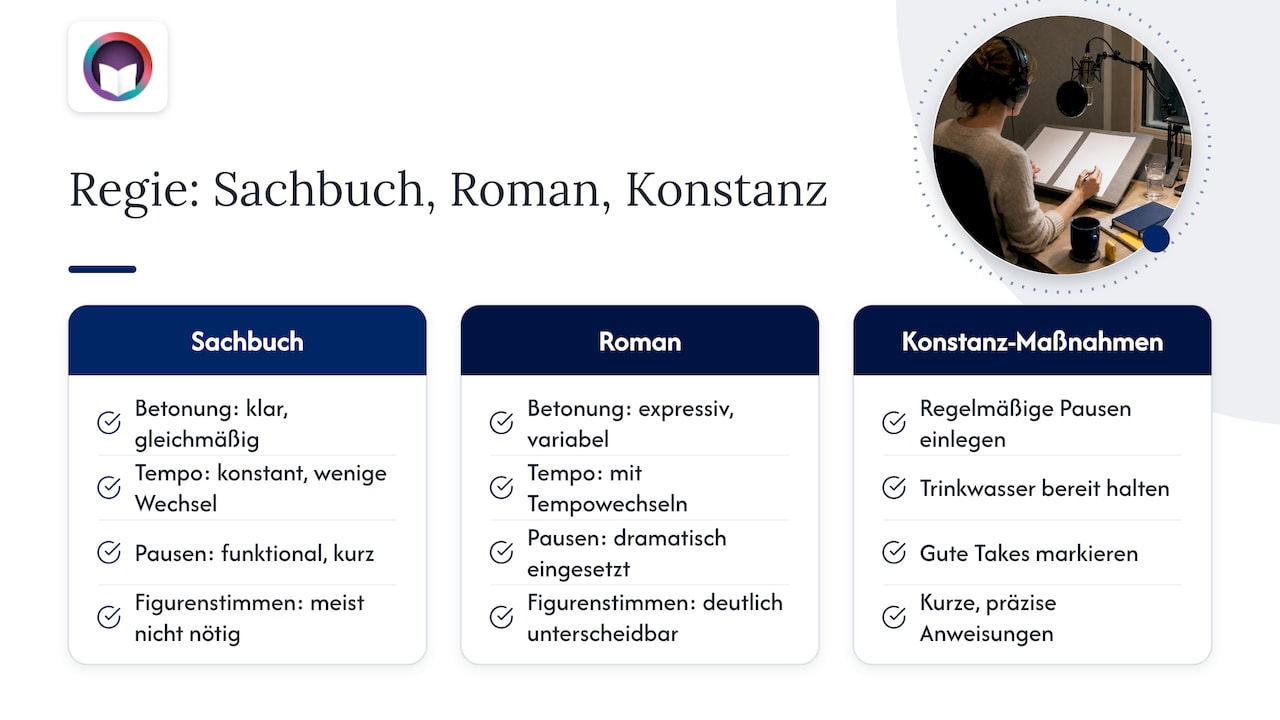
Direction notes slips, marks good takes directly during recording and gives short, precise instructions between runs. Practical reports from recording studios show that well-prepared direction is often more important than the most expensive equipment.
Editing and post-production: What happens in the editor
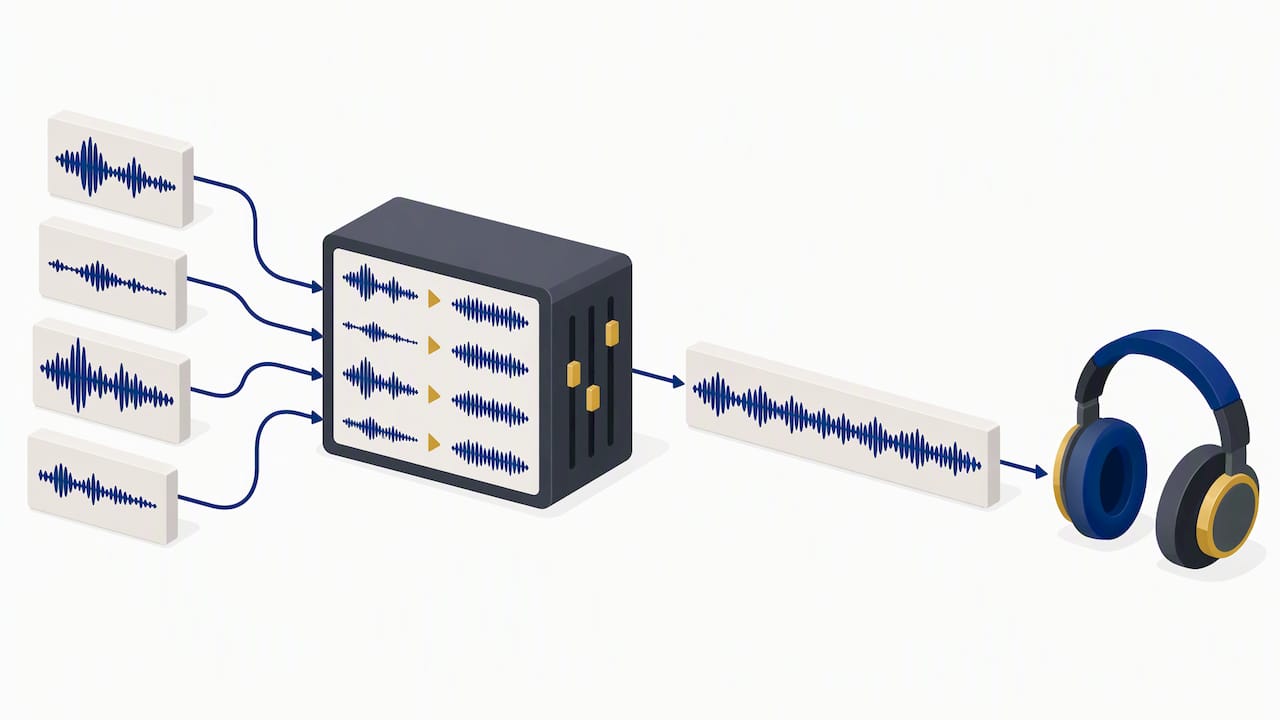
After recording comes the rough cut: remove slip-ups, select the best takes. The fine cut removes breaths, plosives and clicks, then noise reduction, EQ and compression are applied.
- Rough cut: trim broadly; fine cut: edit in detail.
- Check transitions between chapters and sentences for consistent loudness.
- Plan for cross-listening by a second person to catch overlooked errors.
In practice, studios often calculate several hours of editing effort per finished audiobook hour, frequently between two and four hours per Final Audio Hour, as reports from the self-publishing practice show. This is a factor many first-time producers underestimate.
Mastering and file formats: How the export file must look
Mastering ensures consistent loudness and a format accepted by distributors. The specific requirements differ by provider, as a guide to audiobook publication shows:
Before the upload, a final listening check of the complete audiobook including the transitions between files is worthwhile.
Rights and licenses: What must be clarified before publication
Legally, two levels must be distinguished: the copyright in the text and the contractually granted usage rights to the recording. If there is no written agreement, later blocks or claims may arise, as the copyright brochure of the German Patent and Trademark Office explains.
Before uploading, these points should be documented:
- Record the narrator contract with scope, duration and territorial rights.
- Fix rules for marketing excerpts and samples in writing.
- Clarify music rights for intro, outro or background music separately.
A clear overview of rights significantly reduces the risk of later distribution conflicts, according to practice guides and checklists for audiobook publication.
Publication and distribution: Distributors, metadata and time windows
There are three paths for distribution: a distributor for already finished files, a full-service producer who handles recording and distribution, or a direct platform without intermediaries.
- Prepare metadata: keep title, author, narrator, genre and description consistent across all channels.
- Plan audio and metadata checks with the chosen distributor before uploading the file.
- Allow time for shop indexing, as activation is not immediate.
Missing or inconsistent metadata significantly hinders discoverability later.
Costs and fees: Orientation using the VDS Fee Compass
The common billing unit is the Final Audio Hour, i.e. a finished audiobook hour. The VDS Fee Compass 2026 provides indicative rates in the lower, middle and upper ranges of about the mid-to-upper double-digit and the low-to-mid triple-digit euro range per Final Audio Hour, depending on the scope of the license and profit sharing.
Studio, direction, editing, mastering and possible music licenses are additional. Self-publishers often save using tiered models: part of the production in a studio, the rest done independently with external post-production.
Schedule and milestones up to publication
A realistic schedule protects against nasty surprises shortly before release.
- Preparation and casting: one to three weeks, depending on narrator availability.
- Recording days: often a few days for a novel, as studio reports show; fine editing and mastering then take additional days to weeks.
- Quality check and distribution: another one to two weeks buffer for shop indexing.
Dependencies between narrator availability, rights clarification and distributor dates should be coordinated early, not just shortly before the planned release.
How we support authors in the audio production
We connect professional narrators for short stories and publish continuing stories chapter by chapter as soon as they are ready. Our player offers synchronized reading, gapless playback between chapters and a semantic search. For short formats this is often the faster route; for elaborate multi-voice productions a classic recording studio remains the more suitable choice.
Publish now: Booking narrators and Premium at OutaStory
We make the entry deliberately simple: short stories can be published in minutes, continued chapter-wise and monetarily shared via revenue participation. Anyone looking for a voice for their story can book one directly via a narrator mediation without having to build an agency network.
For complex audiobook projects with multiple voices, a specialized recording studio often remains the better solution; for short stories and fast publication paths our platform is a pragmatic addition. Check out the terms for Premium or learn about working as a narrator, where a platform fee of 8% applies.
FAQ
How can I make an audiobook myself?
You need a revised manuscript, a quiet, acoustically treated recording environment and a suitable microphone with an interface. After recording come editing, mastering and adapting to the file requirements of the chosen distributor, as a guide for self-publishers describes.
What is the difference between an audio drama and an audiobook?
An audiobook is usually a single voice that reads a text aloud, while an audio drama with multiple narrators, sound effects and music creates its own dramatic staging. The production workflows therefore differ significantly in effort and casting.
How much does an audiobook narrator earn?
The VDS Fee Compass 2026 gives indicative rates for the Final Audio Hour in the lower, middle and upper ranges, which per Final Audio Hour are roughly in the mid-to-upper double-digit and low-to-mid triple-digit euro range. The exact amount depends on the scope of the agreed usage rights and any profit participation.
How much does it cost to produce an audiobook yourself?
The costs consist of narrator fees, studio or equipment costs, editing, mastering and any music licenses. Editing and fine editing often require several hours per finished audiobook hour, as practical experiences from the self-publishing sector show, which pushes the total costs well beyond the narrator fee alone.
Sources
- Publishing an audiobook: Rights, providers & distribution
- How is an audiobook made? – Visit to the recording studio (SWR)
- Ekustik
- Making audiobooks yourself — Autoren‑Dienstleistungen
Recommendations
Read and write on OutaStory
Thousands of short stories to read for free — or publish your own and find an audience.