
Serialization or book publication: Which path suits you?
If you serialize a story, it is published in episodes and at a fixed rhythm. With a book publication it appears all at once and finished. A series quickly brings you readers, direct feedback and a bond that grows with each episode. A book is a finished work for sale that usually has a long lead time. For many authors it's not an either-or question: they begin with the serial story and later make it into a collected volume. Below we show how both paths work, what they bring you, and what to watch out for regarding money and rights.
In short
- Serialization means your story appears in episodes. You set the rhythm, and your audience grows while you are still writing.
- Book publication means a finished work appears all at once, either through a publisher or via self-publishing.
- Regularity is the most important thing for a series: whoever announces a rhythm must keep it.
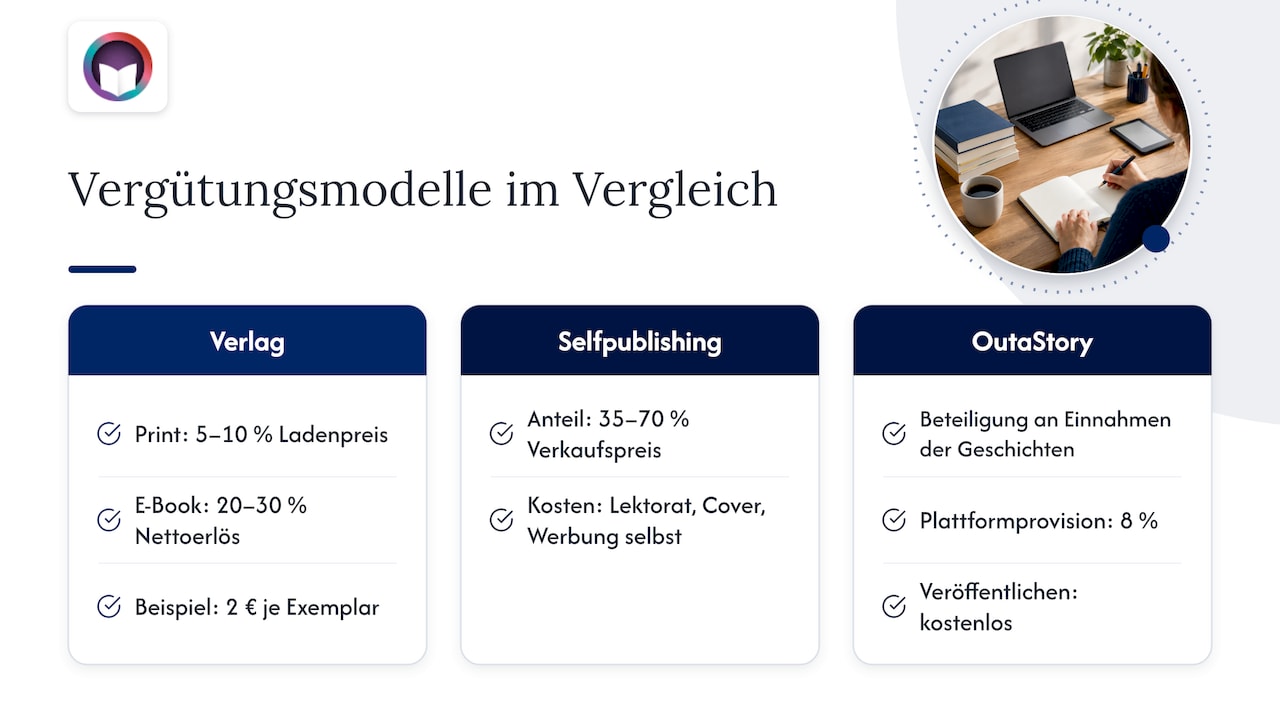
- Money: Publisher royalties for print are usually 5 to 10 percent of the cover price. Platforms share revenue with you directly.
- Combining pays off: First the series, then the book. This way you test your material and build anticipation.
Table of contents
- What serialization means and what a book does differently
- The two paths in direct comparison
- How a serial story is published
- How a book publication proceeds
- What your audience gets from it
- Making money: fees, royalties and revenue sharing
- Rights and contracts in Germany
- Combining both: first the series, then the book
- How to base your decision
- Your serial story on OutaStory
- Frequently asked questions
- Sources
What serialization means and what a book does differently
The idea is older than the internet. Serialized novels appear in installments rather than as a single unit. In the past this happened in newspapers and magazines, today in many digital forms. In German this is called a Fortsetzungsroman or serial story. Many still know the feuilleton novel from the daily newspaper, where it ran chapter by chapter.
In today's self-publishing a clear term has established itself. The Selfpublisher Association describes a serial as episodes that appear at regular intervals, usually monthly and with about 20,000 to 30,000 words each. Each episode is basically self-contained and often part of a larger overall plot. These figures apply to e-book serials. On a short-story platform the chapters are often considerably shorter: one episode for the train ride, one for falling asleep.
But the difference to a book lies not only in length, but above all in the reading situation:
- The book is a single, complete object. Readers set the pace themselves. After publication the text is fixed.
- The series consists of many parts and remains open until the last chapter appears. You as the author set the pace. While the series runs, you can still adjust later chapters to your audience's reactions.
This last point is often underestimated. A series is essentially a conversation with your readers, whereas a book is more like a speech.
The two paths in direct comparison
| Criterion | Serialization (serial story) | Book publication |
|---|---|---|
| Time of publication | From the first finished chapter | After the finished and revised manuscript |
| Rhythm | Fixed, chosen by you (weekly, biweekly, monthly) | A single publication date |
| Feedback | Ongoing, after each episode | Only after publication |
| Reader engagement | Grows with each episode | Depends on the marketing around the launch |
| Flexibility | Later chapters can still be adjusted | Text is largely fixed after printing or upload |
| Effort | Steady, distributed over the run | Concentrated before publication |
| Risk | Low: you test your material episode by episode | Higher: all the work before the first reaction |
| Later exploitation | Possible as a collected volume or book | As a new edition, audiobook or translation |
How a serial story is published
A series is not simply cut into pieces. It is planned as a series from the start. In practice this sequence has proven effective:
- Plan the arc and episodes. Sketch the overall plot and determine which question each episode raises and which it answers. Each chapter needs its own small climax and a reason to open the next episode.
- Write a buffer. Only start publishing when several chapters are finished. This way you can keep your rhythm even if life gets in the way.
- Set and announce the rhythm. The Selfpublisher Association names regularity as a central requirement: whoever has set a rhythm should keep it so the audience is not unsettled.
- Publish and link chapters. Episodes must be clearly findable in the correct order. How this works with us is explained in the help on Publishing a serial story.
- Build in reminders. Between two episodes readers easily forget details. A line in a dialogue, a short recap at the chapter start: such small reminders bring everyone back without slowing the flow.
- Read reactions. Comments, dropouts and repeat readers show you which characters carry the story and where the tension slackens.
More on dramaturgy, cliffhangers and rhythm can be found in our article on serial stories that work as a series.
How a book publication proceeds
There are two routes for a book, and both require a finished manuscript.
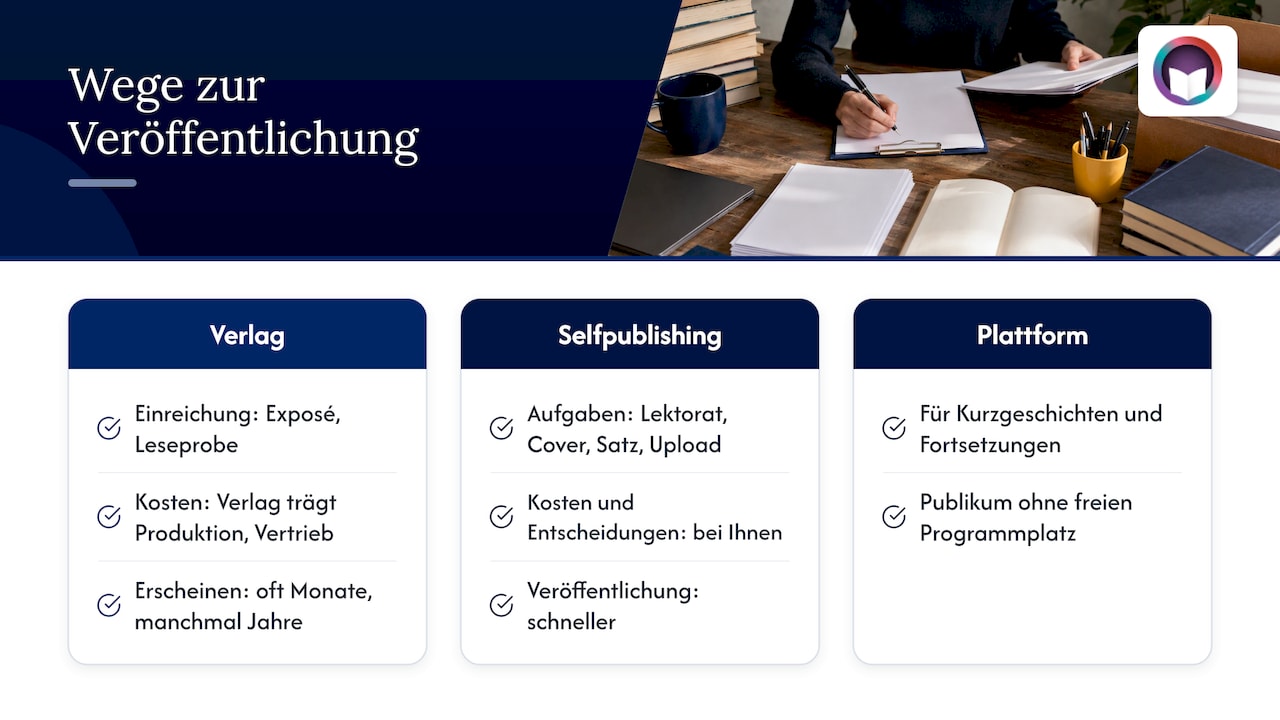
Over a publisher: You submit a synopsis, a sample and often a cover letter, either directly or via a literary agent. After acceptance follow contract, editing, cover, typesetting, printing and distribution. According to Tagesspiegel publishers generally cover all production and distribution costs as well as marketing. However, months or sometimes years often pass until publication.
In self-publishing: Here you are your own publisher. You commission editing and proofreading, design or outsource the cover, typeset the book and upload it to a distributor. This is faster, but the costs and decisions are yours.
For short stories the traditional publishing route is particularly difficult. Individual tales are almost only published in anthologies or story collections, and there are fewer program slots for those than for novels. This is exactly where a platform for short stories and serials has its strength: your text finds its audience without having to wait for an available slot in a publisher's program.
What your audience gets from it
The decision affects not only you but also the people who read or listen to your story.
The appeal of the pause. In a series there is time between episodes for reflection, puzzling and speculation. From this anticipation comes the attachment that makes series so powerful. Someone waiting for the next chapter on Friday will come back on Friday.
Small barrier to entry. No one has to commit to hundreds of pages. A first chapter can be read or listened to in a few minutes. If they like it, the next one follows.
Reading built into everyday life. An episode fits into the commute, lunch break or the evening in bed. If every chapter is also available as an audiobook, the series becomes a companion on the go. For parents a serial can become a fixed bedtime ritual: one chapter each evening.
Orientation. So that no one loses the thread, episodes must be clearly numbered and linked. How to start a series from the beginning with us is explained in Reading serials in the correct order.
By contrast, a book offers a continuous reading flow in one piece. Those who like to read everything at once simply wait until a series is complete and then listen to or read it all at once. A finished series is therefore just as accessible to this audience as a book.
Making money: fees, royalties and revenue sharing
The honest starting point: According to the Federal Ministry for Economic Affairs and Energy, many writers can hardly make a living from their income because only very few books become bestsellers. For most, readings are among the most important income sources. Therefore it is worth comparing the models carefully.
In self-publishing authors receive, according to the same Tagesspiegel research, depending on the platform, 35 to 70 percent of the sale price. For this they bear the costs for editing, cover and advertising themselves.
With a series on OutaStory you participate in the revenues of your stories through our revenue sharing. The platform fee is 8 percent. You can find the details on the page about the platform fee. Publishing is free for you as an author. How revenue-sharing models are generally structured, which rates are common and what pitfalls exist are explained in detail in the article on revenue sharing for authors.
Regardless of the model, your income depends on the same factors: how often your texts are read or bought, what you earn per unit, how long a work finds readers, and how many works you have published. Especially on the last point a series is strong, because each new chapter brings your audience back and draws attention to earlier stories.
Rights and contracts in Germany
First the good news: In Germany copyright arises automatically with the creation of the work. You do not need a registry entry or a copyright notice. Protection lasts until 70 years after the death of the author.
What's important are the usage rights. According to the Börsenverein authors usually transfer the economic usage rights to a publisher by publishing contract, and to a greater or lesser extent. After that the publisher is usually your contact when it comes to use of the work. Before signing you should therefore check:
- Scope: Which rights are transferred (print, E-Book, audiobook, translation, film) and for which territory?
- Exclusivity: Does the publisher get the rights exclusively, or may you publish your text elsewhere in parallel?
- Duration and reversion: How long does the contract apply, and when do the rights revert to you, for example if the book is no longer available?
- Prior publication: If your story has already appeared online as a series, disclose this openly. Clarify in writing whether the chapters may remain online.
If you plan later to turn a series into a book with a publisher, have the draft contract reviewed before signing. This can be done by a lawyer specializing in copyright and publishing law, or by the legal advice of an authors' association such as the Association of German Writers (VS) in ver.di, if you are a member.
Combining both: first the series, then the book
The comparison sounds like a choice, but in practice both routes often intertwine. Already in the 19th century publishers could, with serials, reduce investment and risk. They could see during the run how well a story was received, and built excitement that could later boost book sales. The same logic works for you today as an author.
The Selfpublisher Association also describes this route: many later compile their episodes in collected volumes and publish them in print. Your roadmap could look like this:
- Start the series and publish chapter by chapter at a fixed rhythm.
- Use feedback to sharpen characters, pace and turning points.
- Finish the series so new readers can experience the whole work in one go.
- Prepare the collected volume: revise, have it edited, possibly expand it with a bonus chapter.
- Launch the book with an audience: Those who liked your series are often your first buyers.
How strongly episodes change reading and listening is shown in our article about stories in episodes.
How to base your decision
These questions help you find the right entry point for your next project:
- How long is your story? Short stories and novellas fit the chapter format ideally. A publisher rarely accepts them individually.
- Do you want to gain readers now? Then the series is the faster route. Your audience grows while you write.
- Can you maintain a rhythm? A buffer of several chapters turns good intentions into a reliable plan.
- Do you want feedback while writing? The series provides it after every episode.
- Is your goal the printed book in stores? Then keep the collected volume in mind as a second step. A successful series is a good basis for that.
- Should your story also be heard? A chapter format with an audio version reaches people on the move and while falling asleep.
Your serial story on OutaStory
On OutaStory you can publish your short story in minutes, optionally as a serial story that appears chapter by chapter. Each story can also be played as an audiobook, narrated by professional voices or your own voice. Through revenue sharing you earn from the income of your stories. Everything is available in German and English, from fantasy, romantasy and science fiction to crime, thriller and horror to children's genres.
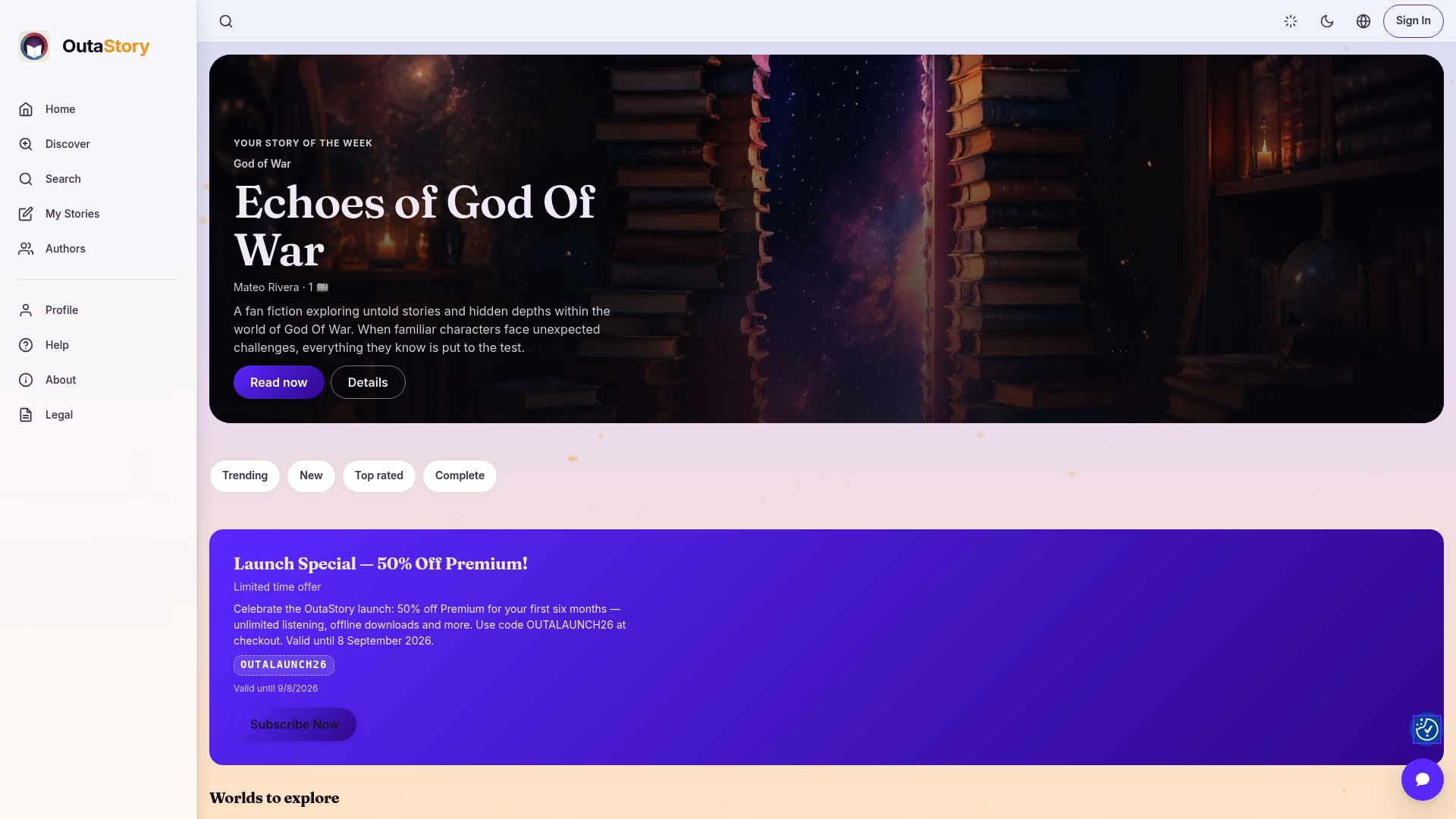
Readers and listeners discover stories with us for free. Those who want to listen unlimitedly and take stories offline can find the extended features in our premium membership. You can hear an example of our narration voices in “The library where the books talk back at night”.
Your World, Your Stories: Write, Read, Listen.
Frequently asked questions
Can I later release an online-published series as a book?
Yes, this is a proven route. Many authors later compile their episodes into a revised collected volume. If a publisher is involved, you should disclose the prior publication and record in the contract what happens to the online chapters.
How often should a new episode be published?
More important than frequency is that you maintain the rhythm. Weekly builds strong engagement but also costs a lot of effort. Biweekly or monthly is easier to sustain alongside a job. Build up a buffer and announce the rhythm.
Do I lose my copyright if I publish online?
No. In Germany copyright arises automatically with the work and remains with you. What matters is which usage rights you grant. Therefore read the terms carefully for each platform and each publisher.
How long should a chapter of a serial story be?
Long enough to carry its own arc of tension, and short enough to fit into a break. For a short-story platform, chapters that can be read or listened to in a few minutes are suitable. Each episode should end with an open question.
Sources
Serial Novels, Cultures of the Book at Penn Selfpublisher Association: Through serials to success as a self-publisher Tagesspiegel: What it takes for a successful book Federal Ministry for Economic Affairs and Energy: Writers, practical tips korrektur.de: What does an author earn? Börsenverein of the German Book Trade: Copyright
Recommendations
- Publish a serial story
- Publish a serial story: How to make the series a success
- Write your first book
- Self publishing short stories: The practical way to publish
Read and write on OutaStory
Thousands of short stories to read for free — or publish your own and find an audience.