
Revenue sharing for authors: models, rates and pitfalls
Revenue sharing for you as an author means: you receive a fixed percentage of the money earned with your text for as long as it is sold or listened to. In the traditional publishing house, for fiction about 10% of the net shop price for hardcovers and 5% for paperbacks is considered an appropriate lower limit. Different models apply on digital platforms. In any case, it's not just the percentage that counts. It is also important what the percentage is calculated from, what may be deducted and how you can check the accounting. In this guide we go through all three points, with a calculation example, a contract checklist and the legal basics in Germany.
In short
- Revenue sharing means: you earn from every sale or use, instead of receiving a one‑off flat fee.
- Rule of thumb in publishing: at least 10% of the net shop price (hardcover) and 5% (paperback), according to ver.di's recommendation.
- The basis matters more than the percentage: The net shop price is more transparent for you than a revenue figure from which costs are deducted beforehand.
- Co‑authorship: Without an agreement, proceeds are split according to the extent of contribution. That's why a written split is worthwhile.
- Tax and KSK: Royalties are business income and count towards your earned income.
Table of contents
- What distinguishes revenue sharing from fees, advances and royalties
- Which percentages are common in Germany
- The calculation basis: what your percentage is calculated from
- Revenue sharing on digital platforms
- Written together: revenue sharing in co‑authorship
- Checklist: These contract points you should check
- How to check your accounting
- Tax and Künstlersozialkasse: what applies in Germany
- How we structure revenue sharing at OutaStory
- Frequently asked questions about revenue sharing
- Sources
What distinguishes revenue sharing from fees, advances and royalties
In discussions about author remuneration four terms are often confused. But they describe different things, and if you separate them clearly you read any contract faster.
Fee is the umbrella term for everything you get for your text. That can be a flat fee, i.e. a fixed amount regardless of success, or a share of sales.
Revenue sharing is the success‑dependent variant: you receive a share of the income your work generates. If a book sells for ten years, you earn for ten years.
Royalties are the concrete payments from this sharing. They are usually calculated per sold copy and settled at regular intervals. In everyday language revenue sharing and royalties are often equated.
Advance (also guaranteed fee) is an advance payment on future royalties. The publisher offsets it against your later income: only when your share exceeds the advance does additional money flow. If the book sells worse than expected, you usually keep the advance, because that is precisely what the guarantee is for. Whether that applies in your case is set out in the contract.
| Term | When paid | Dependent on success? | Typical use |
|---|---|---|---|
| Flat fee | one‑off | no | commissioned texts, anthologies, specialist articles |
| Advance | before or at publication | no, but it is offset | publishing contracts for novels and non‑fiction |
| Revenue sharing / Royalties | ongoing, e.g. semi‑annually | yes | publishers, self‑publishing, digital platforms |
For you as an author revenue sharing is usually the more interesting long‑term model, because it treats your text as an asset: every new reader and every new listener pays into your account.
Which percentages are common in Germany
For book publishing in Germany there is a clear reference point. The union ver.di states in its tips for the first book contract for fiction books at least 10% of the net shop price for hardcovers and 5% for paperbacks as an appropriate minimum remuneration.
These figures do not come out of nowhere. They go back to the joint remuneration rules for fiction authors that have applied since 1 July 2005. They usually provide for ten percent for hardcovers and five percent for paperbacks, with fixed escalation steps for high print runs. So if very many copies are sold, you should also receive a higher percentage.
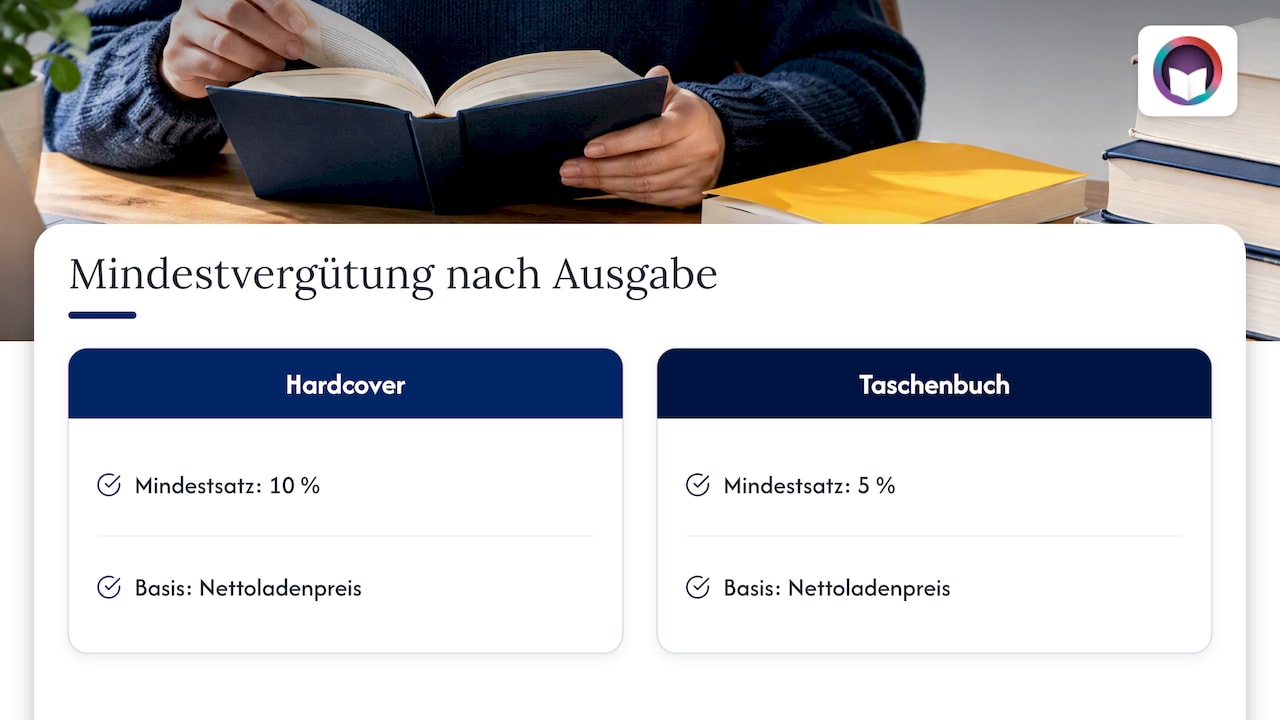
For you this means: if an offer for a novel is significantly below these values, you have a factual basis for negotiation. If it is above them, you know you have a good contract in front of you.
For e‑books, audiobooks and digital formats there are no comparably fixed values. The share is often higher here than for the printed book, because printing, storage and shipping are eliminated. How high exactly depends heavily on the model. That is why it is all the more worthwhile to look at the calculation basis for digital offers.
The calculation basis: what your percentage is calculated from
Ten percent is not always the same. Whether you end up earning a lot or little depends on which amount the percentage is applied to. ver.di therefore advises to agree royalties on the basis of the net shop price or the net sale price.
The two most common bases at a glance:
- Net shop price: the price that readers pay in bookshops, minus VAT. It is publicly known, so you can verify your accounting yourself.
- Net publisher proceeds: what actually reaches the publisher after retailer discounts and possibly other items have been deducted. This amount is considerably smaller and harder for you to verify, because you do not know the discounts and costs in detail.
The law firm Herfurtner sums it up in its article on contract practice for revenue sharing with four questions: which revenue counts, when the claim arises, which deductions are permissible and how the participation is evidenced. With these four questions you can check any contract, whether from a publisher, for an audiobook production or from an online platform.
A calculation example
For illustration, let's assume a novel with a net shop price of €20.00. The numbers are fictitious, the calculation is not.
| Variant | Basis per copy | Rate | Your share per copy | at 3,000 copies |
|---|---|---|---|---|
| A: Net shop price | €20.00 | 10 % | €2.00 | €6,000 |
| B: Net publisher proceeds (assumed €10.00 after discounts) | €10.00 | 10 % | €1.00 | €3,000 |
| C: Net publisher proceeds with higher rate | €10.00 | 15 % | €1.50 | €4,500 |
The example shows why the higher percentage in variant C still yields less than variant A. If a contract promises you “15 %”, always first ask: 15% of what?
If the publisher has additionally paid you an advance of, for example, €2,000, it will be offset against your royalties. In variant A you would have recouped the advance after 1,000 copies sold. From the 1,001st copy on, new money flows.
Revenue sharing on digital platforms
Besides the classic publisher there are today several ways to earn money with texts, and each accounts differently. Broadly three types can be distinguished:
- Self‑publishing service providers and distributors bring your book as an e‑book or print‑on‑demand into the shops. You receive a share of the sale price after shop commission and possibly printing costs have been deducted.
- Subscription and flat‑rate models do not pay per sold copy but distribute a pot of subscription income, for example by read pages or listened minutes. It is particularly important here to understand according to which key the distribution is made.
- Story platforms like OutaStory publish short stories and serial stories directly for readers and listeners. The revenues come from subscriptions and other platform revenues, in which authors participate.
The same review questions apply to all three as with a publisher: what is the basis? What commission does the platform keep? When and above what amount is payment made? And can I trace how my income is composed?
An advantage of digital models: you don't have to wait for an acceptance. A short story that would hardly have a chance at a publisher to be published on its own can immediately find readers online and generate income. Especially for shorter formats, series and experiments this is a real gain.
Written together: revenue sharing in co‑authorship
If you write together in pairs or threes, the question quickly arises who gets how much. The Copyright Act provides a basic rule: under § 8 UrhG the proceeds from the exploitation of a joint work belong to the co‑authors according to the extent of their contribution to the creation, unless they have agreed otherwise.
"According to the extent of contribution" sounds fair, but is hard to measure in a dispute. Who had the idea, who built the plot, who wrote most chapters, who revised? Therefore our recommendation: agree the distribution key in writing before the first money flows. A few lines are often enough:
- Division of income in percentages (e.g. 50/50 or 60/40)
- Who acts as the account holder towards the publisher or platform and forwards the money to the others
- How sequels, audiobook versions and translations are handled
- What happens if a person drops out
If the accounting runs through a single account, the forwarding to the co‑author must also be documented properly for tax purposes. A tax advisor experienced with creative professions can help with this.
Checklist: These contract points you should check
Before you sign or grant a platform your rights, go through these points. The law firm Herfurtner names calculation basis, permissible deductions as well as accounting and audit rights as the points that should be clearly regulated.
- Calculation basis: net shop price, net sale price or net proceeds? Is the basis clearly stated in the contract?
- Deductions: which costs may be deducted before your share? A vague phrase like "other costs" is a warning sign.
- Percentages per format: hardcover, paperback, e‑book, audiobook and licenses should each have their own rates.
- Step increases: does the rate increase at higher sales figures? The remuneration rules explicitly provide for this for high print runs.
- Advance: is it offset, and is it guaranteed so you don't have to repay it?
- Accounting rhythm and payment: how often is accounting done, is there a minimum threshold for payment?
- Audit right: may you check the accounting yourself or have it checked by an expert?
- Scope of rights and term: which rights do you grant, for which territory and for how long? Can you reclaim rights if they are not used?
- Costs for you: do you have to pay for publication yourself? ver.di explicitly advises avoiding so‑called subsidy publishers (vanity presses) where authors pay for publication.
If a literary agency represents you, it negotiates such points for you and receives a commission on your income. For complex contracts, e.g. with film or translation rights, a lawyer specializing in copyright and media law is also advisable.
How to check your accounting
Revenue sharing is only as fair as its accounting. According to the law firm Herfurtner it can be checked based on comprehensible documents about the underlying revenues and deductions. In practice this means:
- Compare the unit numbers with what you observe yourself, such as sales ranks, sales at readings or statistics in your author account.
- Recalculate the basis: does the price used match the shop price? Were discounts deducted only where the contract allows?
- Watch for returns: in the book trade unsold copies can be returned to the publisher. Check how they are offset.
- Keep every statement. You need them for taxes, for the Künstlersozialkasse and for later inquiries.
- Ask when something is unclear. Serious partners explain their accounting. Those who evade also give you an answer.
On digital platforms transparency is often easier because reading and listening figures are recorded continuously. Check whether you can see how often your story was read or listened to and how your income is derived from that.
Tax and Künstlersozialkasse: what applies in Germany
Income from revenue sharing is taxable. As an author you are generally self‑employed in Germany and report your income on your income tax return. Whether VAT is charged in addition and at what rate depends on your situation, for example whether you use the small business regulation. The right contact for this is a tax advisor with a focus on creative professions.
If you are insured in the Künstlersozialkasse or want to be, your royalties are included. The KSK defines in its form for changing earned income earned income from self‑employed artistic or journalistic activity as the difference between business income and business expenses. Royalties are explicitly included in business income. If your income from revenue sharing increases significantly, report the expected earned income in good time so that your contributions match the actual situation.
Practically this means for you: create a simple overview in which you record each statement with date, source and amount. This saves you a lot of searching when doing taxes and KSK reporting.
How we structure revenue sharing at OutaStory
We built OutaStory because we believe short stories deserve more stage time and their authors a fair share. On our platform you publish your short story in a few minutes, without application and without waiting time. You can publish it as a whole or release it as a serial chapter by chapter. Through revenue sharing you earn from the revenues of your stories.
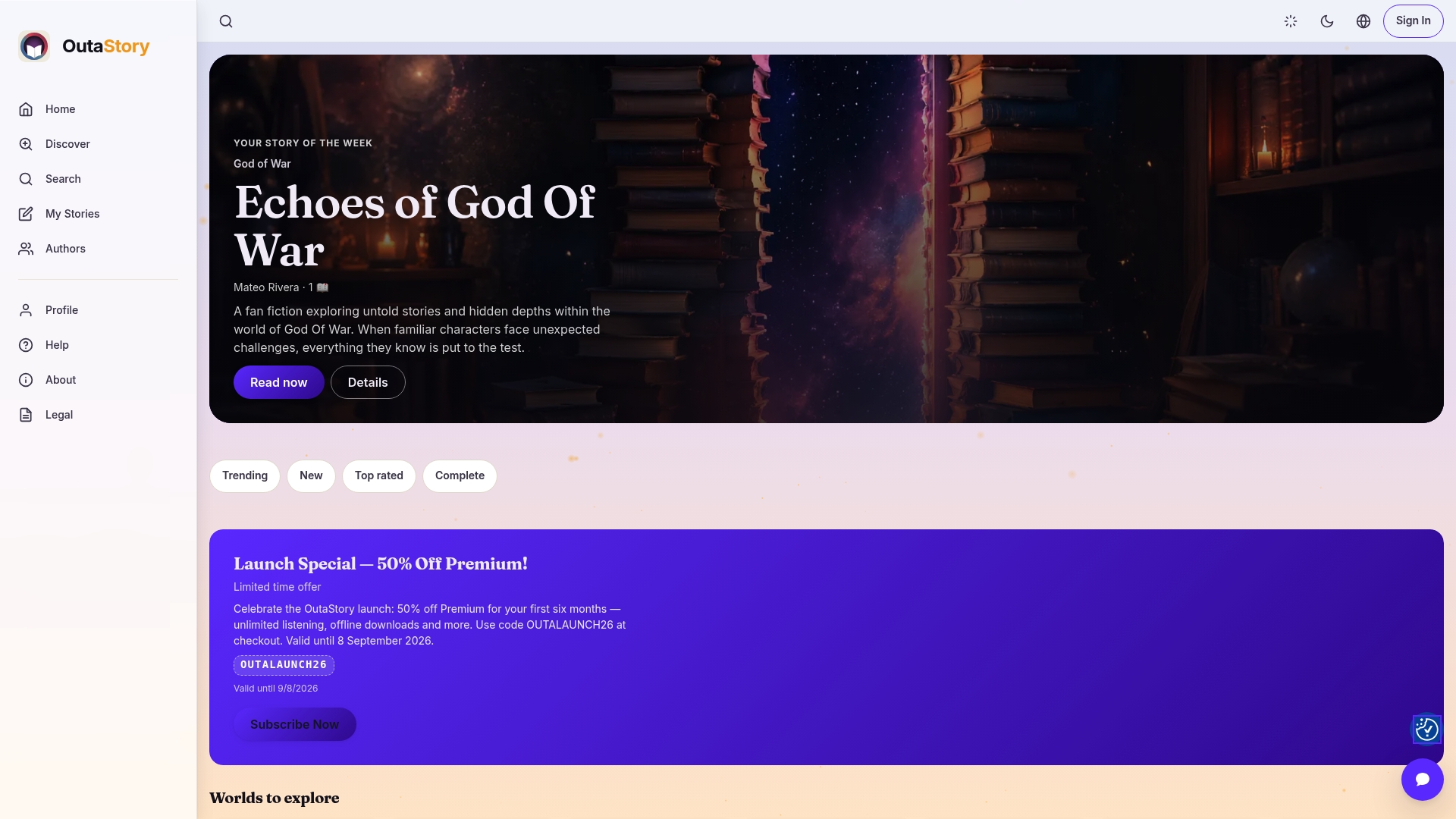
Every story on OutaStory can also be played as an audiobook, with professionally produced voices or with your own voice. This way your text reaches not only readers but also people who listen on the go or to fall asleep. Our platform commission of 8 % is openly disclosed so you know where you stand. Reading is free. Those who want more use OutaStory Premium with extended features like unlimited listening and offline use. Want to see how stories look and sound with us? Listen to „Der Schreiber, der zweimal zählte“ or the thriller „Dunkle Geschäfte“.
Your world, your stories: write, read, listen.
Frequently asked questions about revenue sharing
What percentage of the book price does an author receive?
In German book publishing, for fiction at least 10% of the net shop price for hardcovers and 5% for paperbacks is considered an appropriate minimum. For high print runs the remuneration rules provide for higher rates. For e‑books, audiobooks and platforms there are separate models that you should check in the contract or terms.
Do I have to repay an advance if my book sells poorly?
An advance is usually agreed as a guaranteed fee and is only offset against future royalties. If the book sells poorly, you normally keep it. What matters, however, is what your contract specifically stipulates. Therefore read the clause on the advance carefully.
How do we split the earnings when we write together?
Without an agreement, the proceeds are allocated to co‑authors according to the extent of their contribution under § 8 UrhG. Because that is hard to measure, you should agree on a fixed split in writing. Also regulate who receives the money and forwards it.
Can I earn money with short stories?
Yes. Contributions to anthologies usually receive a flat fee, on story platforms there is an ongoing share of the revenues. On OutaStory you can publish your short story in minutes and participate in its revenues through revenue sharing.
Do I have to pay tax on income from revenue sharing?
Yes, royalties are income from your writing activity and belong on your tax return. If you are in the Künstlersozialkasse, they also count towards your earned income. Which tax obligations apply in detail is best clarified with a tax advisor.
Sources
- ver.di: 10 tips for the first book contract
- VS in ver.di: Association of German Writers and remuneration rules
- Kanzlei Herfurtner: Revenue sharing, rights, risks and contract practice
- Künstlersozialkasse: Notification of change of the expected earned income
Read and write on OutaStory
Thousands of short stories to read for free — or publish your own and find an audience.