
Science Fiction for Beginners: How to Get Started
The easiest way into science fiction leads through three questions: What attracts you — adventure, society, or science? Which subgenre suits that? And how much time do you want to invest? If you start with an accessible subgenre like space opera or dystopia, choose a humorous or thrilling book, and read or listen to short stories alongside, you'll quickly find out which kind of future grips you. In this guide we show you how: with an overview of the subgenres, a reading list in sensible order, tips for listening on the go and for falling asleep, and a section for parents.
In short
- Science fiction tells how people respond to science and technology. Fantasy, by contrast, does not require a scientific explanation.
- Space opera and dystopia are considered the most inviting entry subgenres. Hard science fiction is worthwhile if you enjoy thinking along.
- Start with humorous or very exciting titles such as „The Hitchhiker's Guide to the Galaxy“ or „The Martian“ and work your way up to more complex works.
- Short stories are the quickest test: In 15 minutes you know whether a subgenre suits you.
- Listening instead of reading works excellently, on the train, while walking, or for falling asleep.
Table of contents
- What defines science fiction and how it differs from fantasy
- Which subgenre suits you
- Books for beginners, in a sensible order
- Why short stories are the ideal entry
- Listening to science fiction: on the go and for falling asleep
- Science fiction for children: what parents should consider when reading aloud
- Read or listen: Science fiction on OutaStory
- From reader to author: writing science fiction yourself
- Frequently asked questions
- Sources
What defines science fiction and how it differs from fantasy
Before you open the first book, a clear idea of what to expect helps. Science fiction is a genre that is at home in literature, film, audio drama and video games. It is characterized by scientific and technological speculations, space travel, the distant future, alien civilizations and usually future developments.
The boundary to fantasy runs along a simple question: Can what is told somehow be explained by natural laws? Fantasy crosses the boundaries of reality in a way that cannot be explained by scientific findings. Science fiction, on the other hand, places the further development of science and technology at the center. A dragon is fantasy. A genetically reconstructed reptile with wings created in a laboratory is science fiction.
Interesting for beginners: The two genres are more closely related than they seem. Science fiction often adopts classic fantasy elements and reinterprets them. Magic becomes psi powers, gods become evolutionarily highly advanced lifeforms. So if you have mainly been reading fantasy so far, you are closer to science fiction than you think. Incidentally, it is exactly at this seam that our Science-Fantasy short stories take effect.
One more term you'll encounter: the “future novel”. It is broader than science fiction, as it also includes dystopias and future scenarios that do entirely without new technologies.

Which subgenre suits you
“Science fiction” is a collective term. Someone who says they don't like sci-fi has often only run into the wrong subgenre. A hard, technology-obsessed story about orbital computations has little in common with a wacky journey through the galaxy. The following overview helps you choose. The example titles come from the genre overview by BUCHSZENE.DE and common beginner lists.
| Subgenre | What it's about | Fits you if … | A title to start with |
|---|---|---|---|
| Space Opera | Big adventures in space; at its core it's about the relationships of the characters | you like blockbuster films and epic fantasy | „Leviathan Wakes“ (James S. A. Corey) |
| Dystopie | Societies under control, characters under surveillance | you're interested in power, freedom and questions about the future | „1984“ (George Orwell), „The Hunger Games“ (Suzanne Collins) |
| Hard Science-Fiction | Scientific and technical accuracy | you like to think along and find concepts more exciting than action | „The Martian“ (Andy Weir), „The Three-Body Problem“ (Cixin Liu) |
| Soft Science-Fiction | Society, psychology and politics, technology as a backdrop | you care more about characters and ideas than formulas | „Dune“ (Frank Herbert) |
| Comic Science-Fiction | Humor comes first | you want to laugh while discovering new things | „The Hitchhiker's Guide to the Galaxy“ (Douglas Adams) |
| Cyberpunk | Highly technologized societies with visible social divides | you're fascinated by the net, corporations and artificial intelligence | Philip K. Dick's source material for „Blade Runner“ |
| Near Future | Stories set only a little distance from the present | you want to think further about today's AI, climate and medicine | „Ready Player One“ (Ernest Cline) |
The two most inviting doors: Space Opera and Dystopia
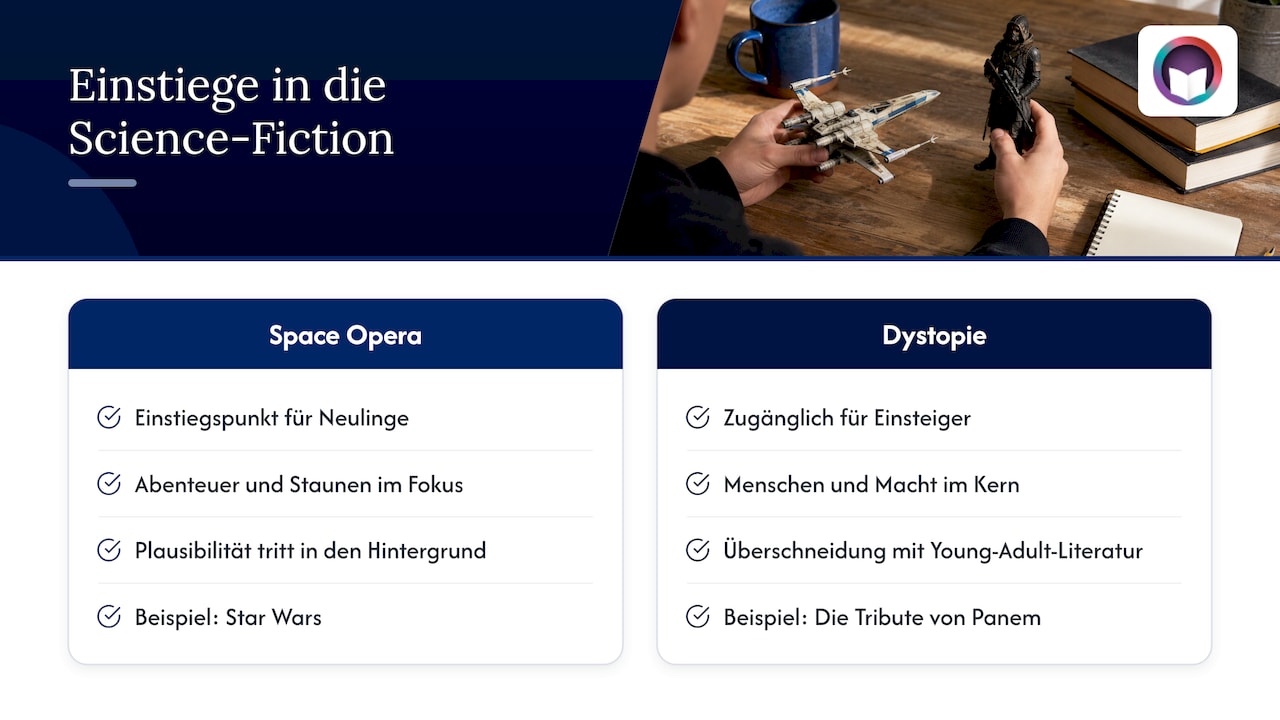
If you really don't know where to start, take one of these two. Space opera is considered the most welcoming entry point for newcomers because plausibility here takes a back seat to adventure and wonder. If you like “Star Wars”, this is for you. Dystopia and post-apocalypse are equally accessible because at their core they are about people and power and the subgenre overlaps strongly with young adult literature. Many readers have thus already read science fiction with „The Hunger Games“ without calling it that.
Hard science fiction: the entry for the curious
Hard SF sounds like a physics degree, but it is not a must for beginners. Crucial is your temperament: If you like to watch documentaries and ask during films whether something could really work, you'll be happy here. „The Martian“ proves that scientific accuracy and humor go wonderfully together.
Those who find the genre via the question of what is physically possible often also enjoy scientific analyses of fictional fights: there, duels between superheroes are calculated with real data — a good way to sharpen your sense for plausibility before you tackle novels that play exactly with that.
A detailed explanation of all variants with characteristics and examples can be found in our post on science fiction subgenres.
Books for beginners, in a sensible order
A good starter list is not a best-of list. The most influential classics are not necessarily the most accessible. We recommend you start with light fare and work your way up. The following titles are explicitly mentioned as accessible for beginners on overview pages for science fiction book tips.
- „The Hitchhiker's Guide to the Galaxy“ by Douglas Adams. Cult wit, delightfully absurd. Ideal if you've so far thought science fiction was too serious.
- „The Martian“ by Andy Weir. Realistic space travel with lots of humor. An astronaut is stranded on Mars and must survive using science. Along the way you learn how hard SF ticks.
- „Ready Player One“ by Ernest Cline. Virtual reality meets 80s nostalgia. Fast, pop-cultural, perfect for anyone who grew up with games.
- „I Am Legend“ by Richard Matheson. Science fiction meets horror. The right step if you find that the dark sides of the future appeal to you.
- „The Three-Body Problem“ by Cixin Liu. Complex, philosophical, fascinating. Save this novel for the time when you already feel somewhat at home in the genre.
- „Dune“ by Frank Herbert. A milestone of soft SF about ecology, religion and politics. Dense and rewarding if you want a complete, alien world.
Why this order? The first three carry you with humor and pace. They build the confidence that science fiction is fun. The last three demand more patience, but reward you with ideas you'll still think about weeks later.
If at number four the border region between science fiction, horror and the uncanny grabs you, it's worth a look at the entry into Weird Fiction: the genre combines alien ideas with subtle dread and is a natural neighbor for anyone who liked „I Am Legend“.
Why short stories are the ideal entry
A 600-page novel is a commitment. A short story is a promise you keep in one evening. Especially in science fiction the short form has a long tradition: many big ideas of the genre were first published as stories before they became novels or films. Anthologies like „Aufbruch in die Galaxis“, edited by Wolfgang Jeschke, collect stories for beginners by authors such as Ray Bradbury, Arthur C. Clarke, Theodore Sturgeon and Brian W. Aldiss.
For you as a beginner the short form has three concrete advantages:
- You test subgenres in a quick run. A dystopia on Monday, a space opera on Tuesday, a first contact on Wednesday. After a week you'll know what grips you.
- The idea is in the foreground. Short stories have no room for long worldbuilding chapters. They bring a single question to the point: What if …?
- You keep at it. People who return to reading after years rarely fail because of desire, but because of length. A success after 20 minutes motivates you for the next story.
How to go about trying things out
- Choose three subgenres from the table above that immediately appeal to you.
- Read or listen to two to three short stories for each. Pay attention not only to whether you like them, but why: the characters, the idea, the atmosphere?
- Note what sticks with you. One sentence per story is enough.
- Then reach for the matching novel from the reading list. You now know what to look forward to.
That's exactly why we've created our collection of free science fiction short stories: you'll find stories of various types there that you can read in a break or have read to you.
Listening to science fiction: on the go and for falling asleep
Not every entry has to go through the eyes. Science fiction lends itself excellently to listening because a good voice makes alien worlds tangible. A creaking spaceship, an AI that speaks calmly: much of what reading requires imagination for arises almost by itself when listening.
For the commute to work
On the go you're distracted: announcements, transfers, conversations. Therefore choose stories that are easy to follow:
- One perspective, few characters. A first-person narrator on a space station is easier to follow than an ensemble of twelve races.
- Length matching the route. A 20-minute trip suits a short story that ends at the destination. Serial stories in chapters are ideal for the daily commute rhythm.
- Tension is allowed. Near-future thrillers or first contact stories keep you awake and make the journey pass more quickly.
For the evening in bed
The opposite applies to falling asleep. Here you don't want cliffhangers, but atmosphere:
- Calm utopias and quiet space stories are better suited than dystopias or horror. A slow flight through a foreign solar system almost feels like a meditation.
- A familiar, warm voice makes a big difference. Try different narrators until you find one that relaxes you.
- A sleep timer on your smartphone ensures the story doesn't continue until morning.
- Repetition is allowed. A story you already know helps you let go more easily.
How to legally and freely access good audio material we've compiled in our guide on listening to audiobooks for free.
Science fiction for children: what parents should consider when reading aloud
Children love robots, rockets and aliens long before they know the word science fiction. For story time it's still worth taking a closer look. These criteria help you choose:
- Humor instead of threat. For younger children the unfamiliar should spark curiosity, not fear. A clumsy robot is a better entry than an invasion.
- Technology as a toy and friend. Stories in which inventions help and friendships with robots or aliens form inspire enthusiasm for science.
- Manageable length. A story that fits into a ten to fifteen minute read-aloud time can be finished without discussion.
- A reassuring ending. In the evening space travel should end safely back on Earth or in a cozy spaceship bed.
- Allow questions. Science fiction invites conversation: What would it be like to live on the moon? Such questions are not interruptions but the best part of reading aloud.
Dark dystopias, war scenarios or body horror are better saved for adolescence. At OutaStory we have a dedicated children's section for the youngest with bedtime stories, animal adventures and first rhymes so parents don't have to search long.
Read or listen: Science fiction on OutaStory
We built OutaStory for exactly this moment: you want to know whether a genre suits you without immediately buying a thick book. With us you read short stories for free, from science fiction to fantasy and romantasy to crime, thriller and horror. And when your eyes are tired, you can play any story as an audiobook, narrated by professional voices or by the author themselves.
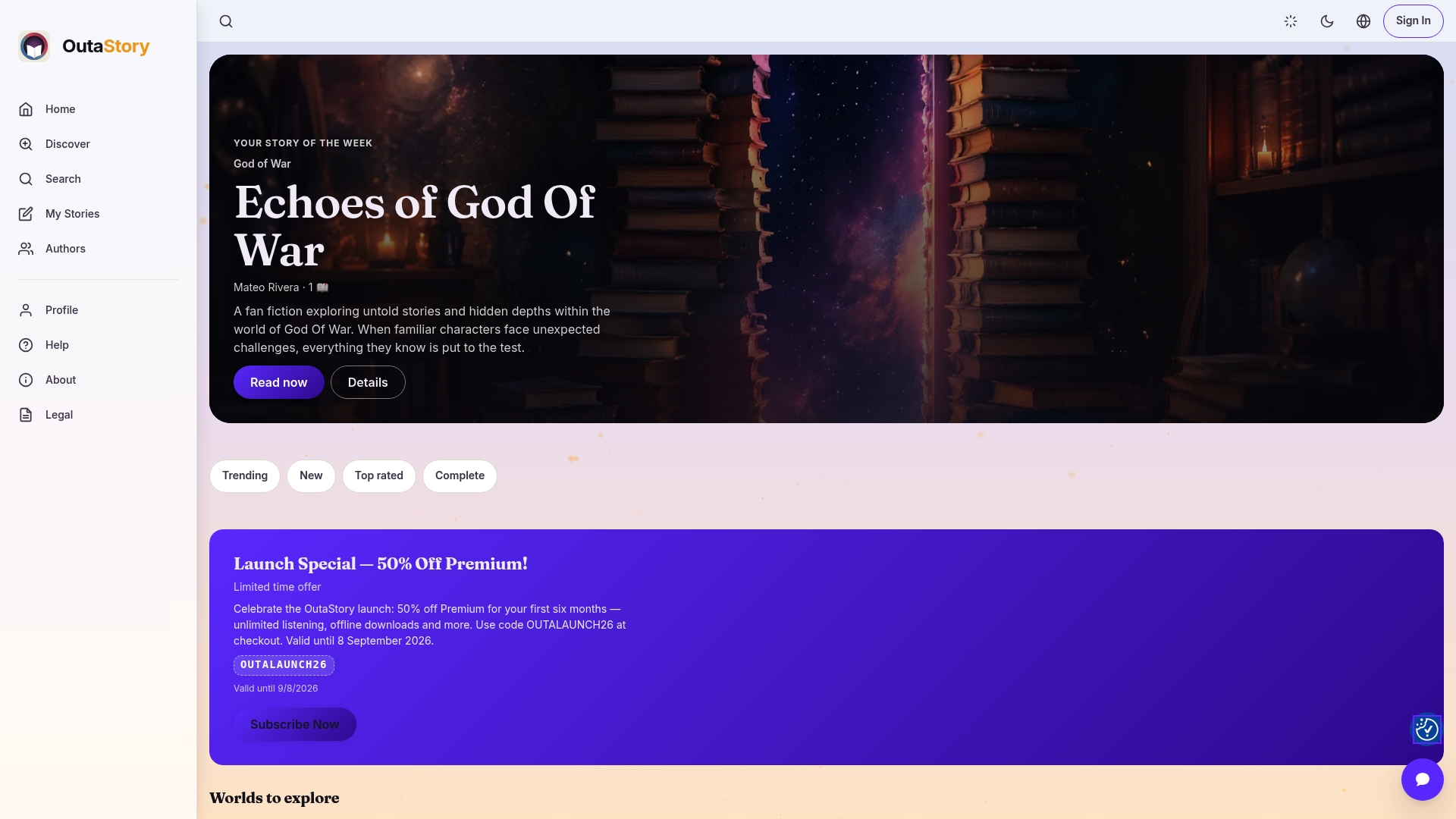
Many stories appear with us as serials, chapter by chapter, like a series feels: a chapter on the way to work, the next in the evening. If you listen a lot, are offline on the go, or want to enjoy ad-free, you can switch to our Premium subscription. With it you listen unlimited and download stories for offline use. You can start directly on OutaStory, in German or English.
Your world, your stories: read, listen, write.
From reader to author: writing science fiction yourself
After reading science fiction for a few weeks, you know the feeling: there's an idea of your own that won't let go. Getting started in writing is easier than starting a novel. A short story only needs a question, a character and a consequence. In dystopian texts, for example, every decision of a character only makes sense when you understand the system behind it, and even a small action can have big consequences.
On OutaStory you publish your short story in a few minutes, optionally chapter by chapter as a serial. Through revenue sharing you earn from the proceeds of your stories. Narrators can find the terms, including our platform commission of 8 %, on the page for narrators.
Frequently Asked Questions
Which science fiction book should I start with?
With a title that brings pace or humor. „The Hitchhiker's Guide to the Galaxy“ and „The Martian“ are considered particularly accessible because they entertain and explain the genre along the way. Complex works like „The Three-Body Problem“ or „Dune“ have a greater effect when you've already read a few stories.
Do I need to know about technology or physics for science fiction?
No. Most subgenres use technology only as a backdrop for stories about people, power and emotions. Even in hard science fiction, good authors explain everything you need to understand. Curiosity is enough.
Is science fiction the same as fantasy?
No, even though they often overlap. Science fiction refers to science and technology that are real or at least conceivable. Fantasy tells of phenomena that cannot be explained scientifically, such as magic. Hybrids are called science-fantasy.
Can I listen to science fiction short stories for free?
Yes. At OutaStory you can read short stories for free and play each one as an audiobook. With Premium you listen unlimited, ad-free and offline.
From what age is science fiction suitable for children?
Even preschool children enjoy stories about robots, rockets and friendly aliens. Important are child-appropriate themes, humor and a reassuring ending. Dark dystopias are more suitable for adolescence.
Sources
Science Fiction – Wikipedia Fantasy or Sci-Fi: What is actually the difference? – film.at What is fantasy and what is science fiction? – BUCHSZENE.DE A Beginner’s Guide to Science-Fiction Subgenres – BookList4u The best science fiction books – buch-bestsellerlisten.de Wolfgang Jeschke (ed.): Aufbruch in die Galaxis – buchwurm.org
Recommendations
- Start now: Free science fiction short stories on OutaStory
- Science fiction subgenres: definitions, examples, features
- Sci-fi ideas with over 40 prompts for your story
Read and write on OutaStory
Thousands of short stories to read for free — or publish your own and find an audience.