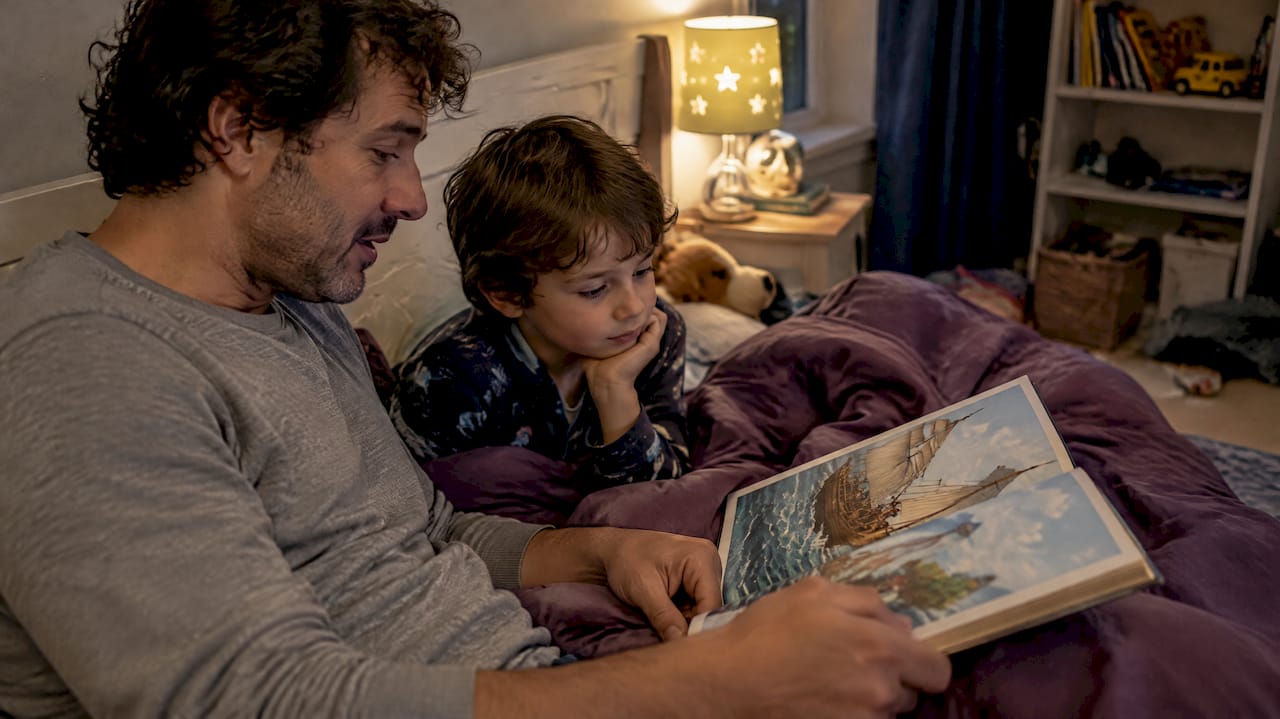
Pirate stories for children: free to read aloud and listen
Good pirate stories for children are short, exciting and have a happy ending. They tell of treasure maps, parrots, rocking ships and a crew that sticks together. Here you’ll find which story suits which age, how to turn a wild buccaneer adventure into a calm bedtime story and where to get pirate stories for free to read aloud or listen to. Two of them you can open immediately with us on OutaStory.
TL;DR
- From about 3 years old, short, calm sea adventures with few characters are suitable. Riddles, treasure maps and tall tales come later, roughly in preschool and elementary school age.
- Before falling asleep it can be exciting, but the ending must be safe: ship in the harbor, treasure shared, everyone in their bunk.
- Reading aloud and listening complement each other: in the evening you read aloud, in the car or when parents are tired the audio version takes over.
- Free pirate stories are available from nonprofit reading promoters, in libraries and on platforms like OutaStory, where every story is also available as an audiobook.
- Joining in turns the story into a game: movements, pirate words and a self-drawn treasure map.
Table of contents
- Which pirate story suits which age?
- What makes a good pirate story for children
- Two pirate adventures to start with on OutaStory
- Read aloud or listen?
- Pirate stories for falling asleep: excitement with a safe harbor
- Joining in on board: ideas for daycare, birthdays and home
- Little pirate facts: Klabautermann and tall tales
- Where to find pirate stories for free
- More listening time for little buccaneers
- Write your own pirate story
- Frequently asked questions about pirate stories for children
- Sources
Which pirate story suits which age?
Pirates may at first glance seem like a topic for schoolchildren. In reality there is a suitable form for almost every age; it just needs to match the child's attention span and courage. Reading aloud is worthwhile early on anyway: according to the read-aloud study by Stiftung Lesen, most parents start when their child is about 10 months old, and regular, ideally daily reading aloud has the strongest effect.
The age recommendations in the table are based on experience, as publishers and read-aloud providers also state. They are not developmental boundaries. You know your child best: some four-year-olds love the Klabautermann, others prefer a seal as a ship's cat.
| Age | What works well | Length | Better left out |
|---|---|---|---|
| 1 to 3 years | Pictures, sounds (Splash! Ahoy!), repetitions, a friendly captain | 2 to 3 minutes | Fights, storms, technical terms |
| 3 to 5 years | Small crew, a goal (treasure, lost parrot), clear emotions, happy ending | 3 to 5 minutes | Long chains of riddles, real villains |
| 5 to 7 years | Treasure maps, small puzzles, tall tales, funny mishaps aboard | 5 to 10 minutes | Violence as a solution |
| 7 years and older | Sequels in chapters, Klabautermann and ghost ship, real pirate history as background | 10 to 15 minutes or several evenings | Hardly any limits, as long as it fits the evening mood |
An example for the entry age: A well-known collection of 13 short pirate stories is described by its publisher as suitable for children from 4 years. That is a good guideline for stories with treasure chests and pirate ships that have more plot than a picture book.
What makes a good pirate story for children
Why do children love pirates? Because pirates are allowed to do everything that’s forbidden in everyday life: be loud, not wash, go on a big voyage without asking. A good children's story takes this freedom seriously and packages it so that in the end friendship, courage and fairness win.
These ingredients make almost any successful pirate story:
- A crew instead of a lone fighter. The cook, the ship's boy, the captain, the parrot. Each character can do something, and together they make it.
- A clear goal. A treasure, an island, a missing hat. Young children need a goal they can retell in one sentence.
- An obstacle that can be overcome. A calm, a knot that won't untie, a map that runs into the water. Please no obstacles that can only be solved with cutlasses.
- Humor. A parrot that repeats everything wrong, a captain who gets seasick: laughter takes the edge off the tension.
- A surprising treasure. Often the gold isn't the most valuable thing. Shells, a friendship or a message in a bottle are nicer treasures, and you can ask questions about them afterwards.
The last point in particular makes pirate stories educationally valuable. The value lies less in conveying knowledge about sailing ships than in shared language and opportunities for conversation: What would you have done with the treasure? What was the ship's boy afraid of? The Stiftung Lesen emphasizes that reading aloud promotes language, reading motivation and social skills. A pirate story is a wonderful vehicle for that.
Two pirate adventures to start with on OutaStory
In our children's section we have pirate stories that you can read for free or play as an audiobook. Two are particularly suitable as a starting point:
The Littlest Pirate of the Sea Cucumber: The title already reveals the main character, the smallest on board. For children who are often the youngest themselves, that's a character to empathize with, and a ship name like “Sea Cucumber” usually brings a grin before the first line.
The Pirate Who Was Afraid of Boats: A pirate who's afraid of boats—that's a delightful contradiction. The story offers an easy way to talk about one's own fears without anyone feeling exposed. Afterwards many children ask on their own: “And what are you afraid of?”
Both stories can be read directly in the browser. Or you press play and let the audio version run, recorded with professionally produced voices or by the author themselves.
Read aloud or listen?
Both have their place, and most families use both depending on the day.
Reading aloud is unbeatable when it comes to closeness. You can change voices, pause when your child asks something, and soften difficult passages. With a word like “grappling hook” you pause briefly and explain it. A recording can't do that.
Listening helps when your voice is tired after a long day, on long car rides to the seaside or when older children want to listen independently. Audiobooks are no longer a niche format: according to the German Publishers and Booksellers Association, audiobook revenue rose by 13.2 percent in 2025, and downloads (47.4 percent) and streaming (47.2 percent) were almost equal. CDs accounted for only 5.3 percent.
What to look for in an audio version for children:
- Duration matters. You want to know beforehand whether the story is 4 or 14 minutes long.
- The voice is calm and clear. For children, intelligibility matters more than drama.
- No music bed that drowns it out. A bit of sea noise is nice, loud effects are less suitable before sleep.
- The text is also readable. So you can follow along or read it aloud yourself on another evening.
A tip from many families: Read the story yourself the first time and use the audio version for repetitions. Children often want to hear favorite stories ten times, and by the seventh time the recording can take over.
Pirate stories for falling asleep: excitement with a safe harbor
An evening pirate adventure is not a contradiction; it just needs a different dramaturgy than an afternoon one. The Stiftung Lesen explains that fixed routines give children orientation and security and that 10 to 15 minutes can be sufficient for a reading-aloud ritual. A pirate story fits perfectly into this time window if you keep a few things in mind:
- The tension rises early and falls late. The storm comes in the middle, not in the last two minutes.
- The ending is an arrival. The ship is in the harbor, the hammocks rock, the parrot tucks its head under its wing.
- Calm images at the end. Stars over the sea, quiet splashing along the hull, a lantern on the mast. You can also extend the story yourself with these if your child is not yet tired.
- Scary figures are friendly. The Klabautermann may stomp around, but he protects the ship.
If your child dreams about pirates at night or feels scared, choose a calmer sea story and save the treasure hunt for the afternoon. More evening ideas can be found in our guide to bedtime stories for children and in the overview of the best bedtime stories from 0 to 8+.
Joining in on board: ideas for daycare, birthdays and home
Pirate stories invite play-acting; not for nothing are movement stories a staple in daycares and after-school clubs. These ideas work with any story, including ours.
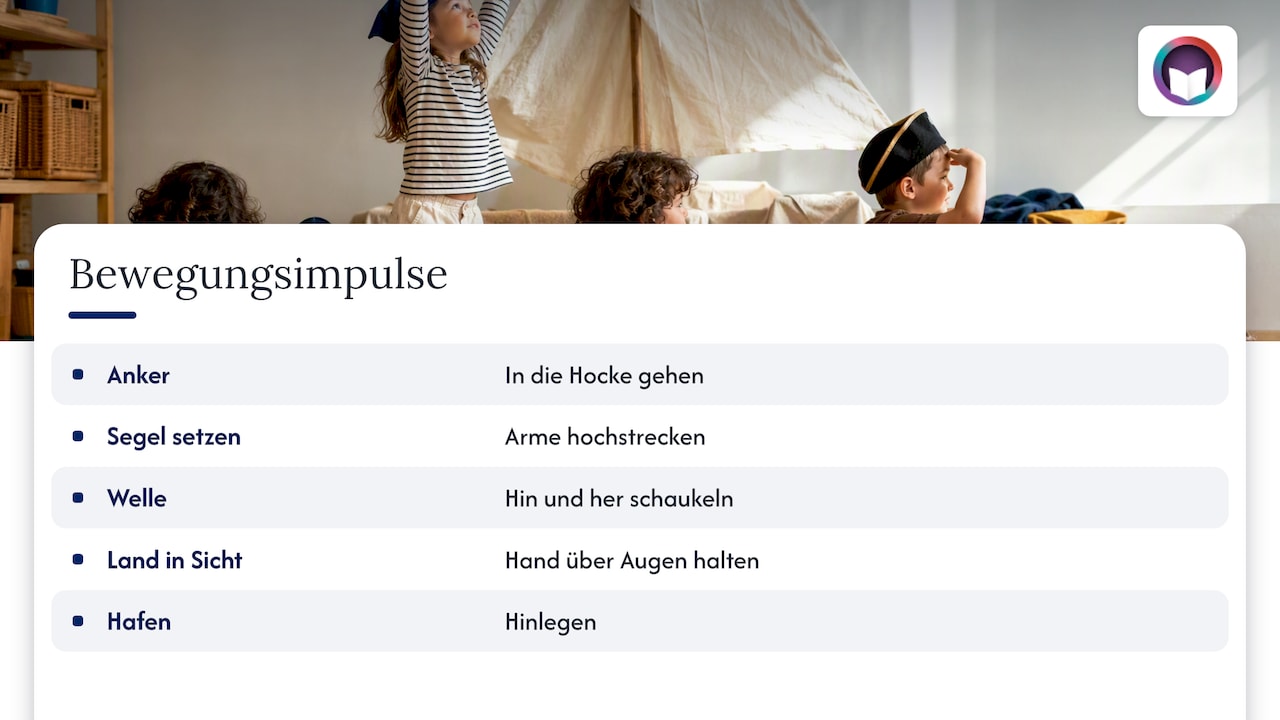
The movement story
Agree on movements tied to key words before reading. At “anchor” everyone squats, at “set sail” everyone stretches their arms up, at “wave” everyone rocks back and forth, at “land in sight!” everyone shades their eyes with a hand. For children between 3 and 6 years three to four words are enough, otherwise it becomes chaos instead of fun. Just before the end add a calm word, like “harbor”: everyone lies down.
Little pirate glossary
Children love strange words. Collect a few after the story and explain them: port is left, starboard right, the lookout is the place up the mast, the galley is the ship's kitchen. Anyone who wants can draw a picture for each word. That way a story becomes vocabulary work almost by itself.
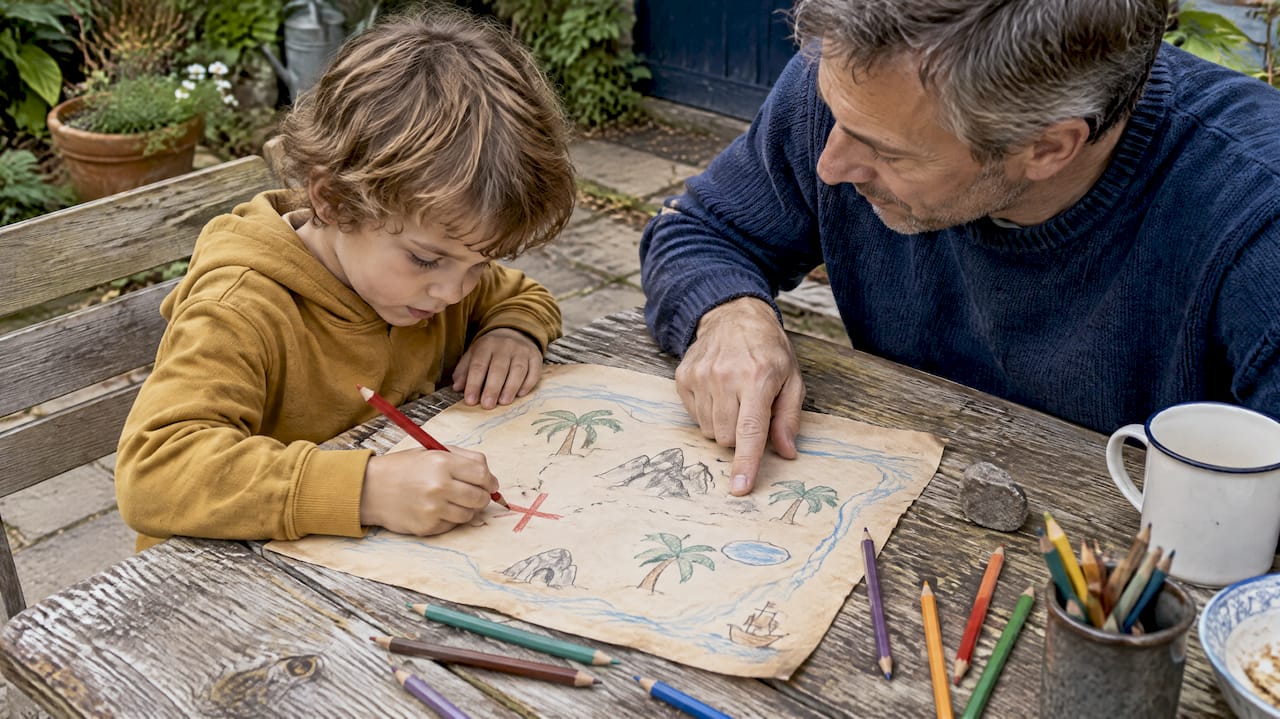
The treasure map for the story
For older preschool and elementary children the treasure map is the highlight: after a longer, more exciting story you draw the island from the tale together, with palm trees, rocks and a big X. Then you hide a small treasure in the apartment or garden. The treasure box should contain not only chocolate but also a message. A card like this postcard “With courage the most beautiful stories begin” fits wonderfully with any pirate story in which someone outgrows themselves and can later hang on the child's bedroom door.
For the children's birthday
At a pirate party you can use the story as a framework: at the start read or play a short story that ends with a lost treasure map. Afterwards the guests search for the map and the treasure hunt is the continuation of the story. Children from about 5 years are usually completely enthusiastic about this.
Little pirate facts: Klabautermann and tall tales
Children ask questions. You should have an answer ready at the latest when the Klabautermann comes up. The Digital Dictionary of the German Language describes him as a ship goblin whose appearance indicates danger for the ship. In seafaring belief he is mostly seen as a good spirit who helps and warns on board. For children's stories that's ideal: a character who sounds a bit eerie but is on the crew's side.
If you're traveling in northern Germany you can even visit the Klabautermann: in Bremerhaven a fountain at the museum harbor of the German Maritime Museum shows a depiction of the ship goblin. A nice excursion after you've heard a Klabautermann story.
And the real pirates? They were anything but funny. For elementary school children a frank sentence is worthwhile: real pirates stole from and hurt people, the pirates in stories are fictional and therefore allowed to be nice. Children can understand this difference well, and it doesn't make the play any less.
Where to find pirate stories for free
Free pirate stories exist in several forms: as text for direct reading aloud, as a PDF with pictures and as a digital story with audio. The main sources at a glance:
| Source | Format | Strengths | Limits |
|---|---|---|---|
| Nonprofit reading promotion | Digital stories, app | Curated selection by age, regularly new | Changing themes, pirates not always included |
| Public library | Books, audiobooks, often lending library | Large selection, personal advice | Loan periods, waiting lists for popular titles |
| Daycare and craft portals | PDF, movement stories | Practical for groups and parties | Often only short texts without audio |
| Story platforms like OutaStory | Text and audiobook | Read or listen immediately, children's section, new stories from authors | Free use with limitations, more listening with Premium |
A good example from reading promotion is the offer “einfach vorlesen!” from Stiftung Lesen: every Friday from 12 pm three new stories for the age groups 3, 5 and 7 years appear there, accessible via website or app. How widespread reading aloud is in German families is measured by the annual Read-Aloud Monitor, a representative survey of over 800 parents with children between one and eight years old.
More selection beyond the pirate theme, sorted by age, can be found in our guide Stories for reading aloud: free and age-appropriate.
More listening time for little buccaneers
On OutaStory you can read every story for free, and each can be played as an audiobook. If your family listens a lot—on the trip to vacation, at bedtime or in a dead zone on the ferry—our Premium subscription is worth it: it brings extended features like unlimited listening, ad-free use and offline access. That way the bedtime story remains available even when the Wi‑Fi at the holiday cottage fails.
Read, listen, set off together on a big voyage.
Write your own pirate story
Maybe you already invent new adventures every evening for your child about Captain Fishbeard? Then you are not far from publishing them. With us you can put a short story online in a few minutes, publish it in chapters as a serial and participate in the revenue share. How exactly that works, including the platform commission of 8 %, is explained on our page for narrators and authors.
A few tips to make your pirate story work well when read aloud and heard:
- Write for the ear. Short sentences, few subordinate clauses, characters with clearly distinguishable names. A listener cannot flip back.
- Give an age recommendation and the duration. Parents decide in seconds whether a story fits tonight.
- Plan chapters with gentle endings. For serials a chapter may arouse curiosity, but it should not end with the ship in a storm if it is meant to be an evening story.
- Include repetitions. A call like “Ahoy, you landlubbers!” that recurs becomes a quick repeat-along phrase.
- Think text and voice together. If your story will be recorded, a clear structure helps. Given the growing importance of audio, as shown by the numbers from the Publishers Association, a good audio version reaches additional families.
Frequently asked questions about pirate stories for children
From what age are pirate stories suitable?
Very short, friendly sea adventures with pictures and sounds work from about 2 to 3 years. Many pirate stories with treasure hunts and a small plot are recommended from 4 years. Riddles, treasure maps and spooky figures like ghost ships are more suitable from preschool and elementary school age.
Are pirate stories too exciting for falling asleep?
Not if the story has a safe, calm ending. The tension should be in the middle, the ending with the ship in the harbor and a sleeping crew. If your child still reacts restlessly, move the adventure to the afternoon and choose a gentler story for the evening.
How long should a pirate story for reading aloud be?
For children aged 3 to 5 years 3 to 5 minutes are ideal, older children can handle 10 to 15 minutes. For an evening reading ritual, Stiftung Lesen estimates that 10 to 15 minutes in total are already sufficient. Longer adventures can be spread over several evenings as a serial.
Can I listen to pirate stories for free?
Yes. On OutaStory every story can be read for free and played as an audiobook. The Premium subscription adds extended features like unlimited listening, ad-free use and offline access. Libraries and nonprofit reading promoters also offer free audio options.
What is the Klabautermann?
The Klabautermann is a ship goblin from seafaring belief. He is mostly seen as a good spirit who helps on board and warns of dangers. In children's stories he is therefore an ideal character: a bit mysterious, but always on the crew's side.
Sources
- Stiftung Lesen: Read-aloud study "Reading aloud – but from when?"
- Stiftung Lesen: How to succeed with evening read-aloud rituals
- Stiftung Lesen: einfach vorlesen!
- German Publishers and Booksellers Association: Book market compact 2025/2026
- Publisher information: Little pirate stories
- DWDS: Klabautermann
- Schulfahrt.de: Klabautermann, the patron of ships
- German Education Server: Read-Aloud Monitor
Recommendations
- The Pirate Who Was Afraid of Boats
- The Littlest Pirate of the Sea Cucumber — Short story
- Stories for reading aloud: Free and age-appropriate for children
- Bedtime stories for children: Free reading and listening tips
Read and write on OutaStory
Thousands of short stories to read for free — or publish your own and find an audience.