Reading or Listening: When each is better, honestly compared
Reading or listening — which is better? The short answer: For stories the two formats make less difference than many think. Our brain processes language in largely the same areas when reading and when listening. What matters most is how focused you are and what you intend to do with the text. If you want to work through a complex non-fiction text, printed or digital text usually serves you better. If you want to sink into a story — on the commute, while cooking or in bed at night — you lose little with a good audiobook and often gain a voice that adds depth to the story. At OutaStory we offer every short story in both forms, so this question is part of our daily work. Here’s what the research says and how to decide for your everyday life.
TL;DR
- Hardly any difference in the brain: Reading and listening largely activate the same language areas. Neither is fundamentally superior.
- Reading wins with difficult material: Controlling your own pace, jumping back and marking help with learning and critical reflection.
- Listening wins for immersion: A good narrator's voice conveys rhythm, emotion and tension, especially in narrative texts.
- The real enemy is distraction: If you listen while doing a lot of other things, you retain less. The same applies to reading with your phone in your hand.
- Short stories are ideal to try out: After a single session you will notice which format suits you in which situation.
Table of contents
- What happens in the brain when we read or listen
- Where reading has the edge
- Where listening plays to its strengths
- The real difference: your attention
- Reading and listening in direct comparison
- How to decide in everyday life
- Why short stories are the ideal testing ground
- Children: reading aloud and listening belong together
- For authors: those who are heard are found
- Frequently asked questions
- Sources
What happens in the brain when we read or listen
For a long time audiobooks were considered the comfortable, somewhat superficial sister of the book. Neuroscience now paints a different picture. Berlin neuroscientist Prof. Dr. Fatma Deniz researches exactly this question, and her work shows that reading and listening engage very similar language-processing areas in the brain. Once the meaning of a sentence is grasped, it no longer makes much difference for understanding whether it arrived through the eyes or the ears.
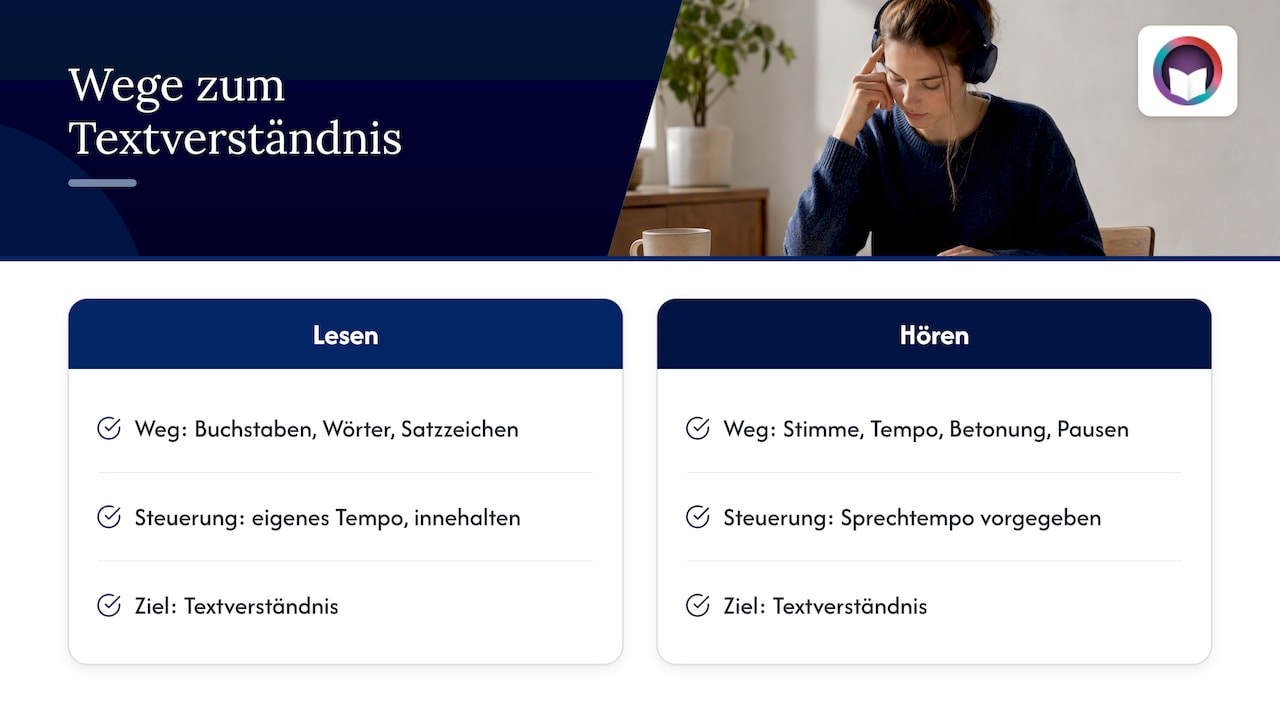
That is not to say both routes are identical. The pathway to meaning differs. When reading you decode letters, words and punctuation, you set the pace and can pause at any time. When listening someone delivers the text at their pace, with their emphasis and their pauses. The magazine New Scientist puts it succinctly: reading and listening draw on different elements of our cognition, and each form has its own advantages.
Numbers circulate online claiming that listening is superior to reading by a fixed percentage. Recent research does not support such blanket statements. It prefers to ask: which text, which goal, which situation?
Where reading has the edge
When reading you are your own director. That's the most important advantage, and it matters all the more the more demanding the text is.
An article in The Conversation explains why: When listening you are bound to the speaker’s pace. Your working memory must hold what was just heard while the next sentence is already coming in. That is why listening can be more tiring than reading for complex or unfamiliar material. A reader can simply jump back a paragraph.
Norwegian reading researcher Marte Pupe Støyva from the University of Stavanger also sees differences. Her finding: contents can be taken in both ways, but reading has several advantages, especially when it comes to deliberate, critical work-through and new, structured information.
Concretely, reading is advantageous for:
- Learning and exam preparation: Textbooks, scripts and factual texts with many figures, technical terms and references.
- Working with the text: Finding a quote, highlighting a passage, writing a margin note. An audiobook is hard to quote.
- Recognizing structure: Headings, tables, paragraphs and footnotes show at a glance how a text is built.
- Your own pace: Difficult passages slowly, easy ones quickly. With listening that only works with the speed control, and that's a coarse tool.
- Your inner voice: You decide how a character sounds. Some readers value exactly this freedom.
Where listening plays to its strengths
The audiobook has strengths that no book can reproduce. The most obvious: hands and eyes remain free. You can experience a story while commuting, walking, ironing or lying in the dark.
The second strength is subtler and often underestimated: the voice. You don't just hear a professional narrator, you feel them. They place pauses where tension rises, give each character a distinct tone and carry the rhythm of a text. Especially for narrative texts this can enrich the story, provided you listen attentively. The research that favors reading for non-fiction describes listening for narratives as an equivalent, often particularly immersive experience.
A research project at the University of Vienna goes even further. The authors note that audiobooks are often seen as a superficial, less demanding alternative to the book, and investigate the auditory reception of literature as an independent form. In short: listening is not a shortcut, but another way to experience literature.
Arguments in favor of listening:
- Narrative texts: Novels, short stories, fairy tales, suspense literature. Here comprehension and memory with concentrated listening are comparable to reading.
- Time that would otherwise be lost: Commuting, housework, exercise, waiting rooms.
- Tired eyes: After a day at the screen a voice is often more pleasant than another page of text.
- Atmosphere: Horror, thrillers and fantasy live from tone and tempo. A good voice turns goosebump moments into real goosebumps.
- Accessibility: For people with visual impairments or reading difficulties, listening opens doors to literature.
The real difference: your attention
If reading and listening are so close in the brain, where does the feeling come from that you retain less with an audiobook? The answer is unspectacular: we often listen while doing other things. According to Deniz, concentration management is the decisive factor: people who listen tend more toward multitasking, and that reduces how much sticks.
A book forgives no distraction — you notice immediately if you haven't taken anything in for three lines. An audiobook just keeps playing. The idea that listening is always easier is therefore a trap: it encourages replying to emails at the same time, and at the end of the chapter the red thread is gone.
Three habits help you take in as much while listening as when reading:
- Combine listening with routine tasks. Walking, washing up or jogging hardly demand language processing. Writing texts, reading messages or navigating traffic do.
- Use short sessions. A short story or a single chapter keeps attention better than three hours straight.
- Rewind without guilt. That's the counterpart to flipping back and just as legitimate.
Reading and listening in direct comparison
| Criterion | Reading | Listening |
|---|---|---|
| Tempo | Self-paced | Preset, only roughly adjustable |
| Complex non-fiction | Clearly advantageous | More demanding, requires more working memory |
| Narrative texts | Very good | Very good, comparable with concentrated listening |
| Atmosphere and emotion | Created in your own head | Enhanced by the voice |
| Possible as a side activity | Hardly | Yes, for routine tasks |
| Working with the text | Highlighting, quoting, looking up | Only to a limited extent |
| Eyes and hands | Occupied | Free |
| Risk | Fatigue, screen time | Distraction due to multitasking |
How to decide in everyday life
Instead of a principled decision we recommend three questions you can ask before each text:
- Do I want to learn or to experience? Learning argues for reading, experiencing opens both ways.
- What am I doing at the same time? Nothing: both formats work. Something routine: listening. Something demanding: better read later.
- Will I need the text afterwards? If you want to quote, look up or discuss it, the text is the better basis.
We explore these questions in more detail in our guide Audiobook or e-Book: three questions for your everyday situation. And if you're unsure, you don't have to decide: many of our readers start a story on the train as an audiobook and read the ending on the sofa in the evening.
Why short stories are the ideal testing ground
The question "Read or audiobook?" is best answered not in theory but by your own ear. Short stories are particularly suitable for that. They finish in one session, require no weeks-long commitment to a format and quickly show whether a voice carries you or whether you prefer to read yourself.
That's exactly why we built OutaStory. Every story on our platform you can read for free or play as an audiobook, spoken by professionally produced voices or by the author themself. Try the comparison on a text you like: read the beginning of "Dunkle Geschäfte" if you like thrillers, and then continue listening. If you enjoy the uncanny, test the effect of a voice with "Der Fluch der anderen Seite". And for quiet evenings try "Die Bibliothek, in der die Bücher nachts zurückreden".
Reading, listening, writing: Your stories, your format.
If you listen a lot on the go, take a look at OutaStory Premium: unlimited listening, ad-free use and offline access so the story keeps playing even in a dead zone. How audiobooks work without a connection is explained in our practical guide to offline listening. And if you want to start without a subscription, our overview of legal sources for free audiobooks is a good entry point.
Children: reading aloud and listening belong together
For children the question "Read or listen?" is entirely different, because long before a child can read on their own, they learn language through the ear. The Goethe-Institut's language pedagogy describes listening and speaking as the natural entry into a language: children need rich, comprehensible input to absorb language. The guide refers to early foreign-language instruction, but the idea also applies to reading aloud at home.
Reading aloud is more than transmitting a story. If you pause, ask questions ("What do you think the frog will do now?") and respond to your child's answers, not only vocabulary grows but also the bond between you. An audiobook does not replace this exchange; it complements it: for the car ride, for evenings when your voice needs a break, or for siblings who go to bed at different times.
Our children's section is tailored to exactly these situations, with bedtime stories, animal adventures and first rhymes. Suitable for reading aloud or listening together are, for example, "Three Frogs Cross the Street" and "The Cloud That Rents Itself for a Nap". Our tip: read a story aloud yourself first and play it as an audiobook the next evening. Many children love recognizing a familiar story in a new voice.
For authors: those who are heard are found
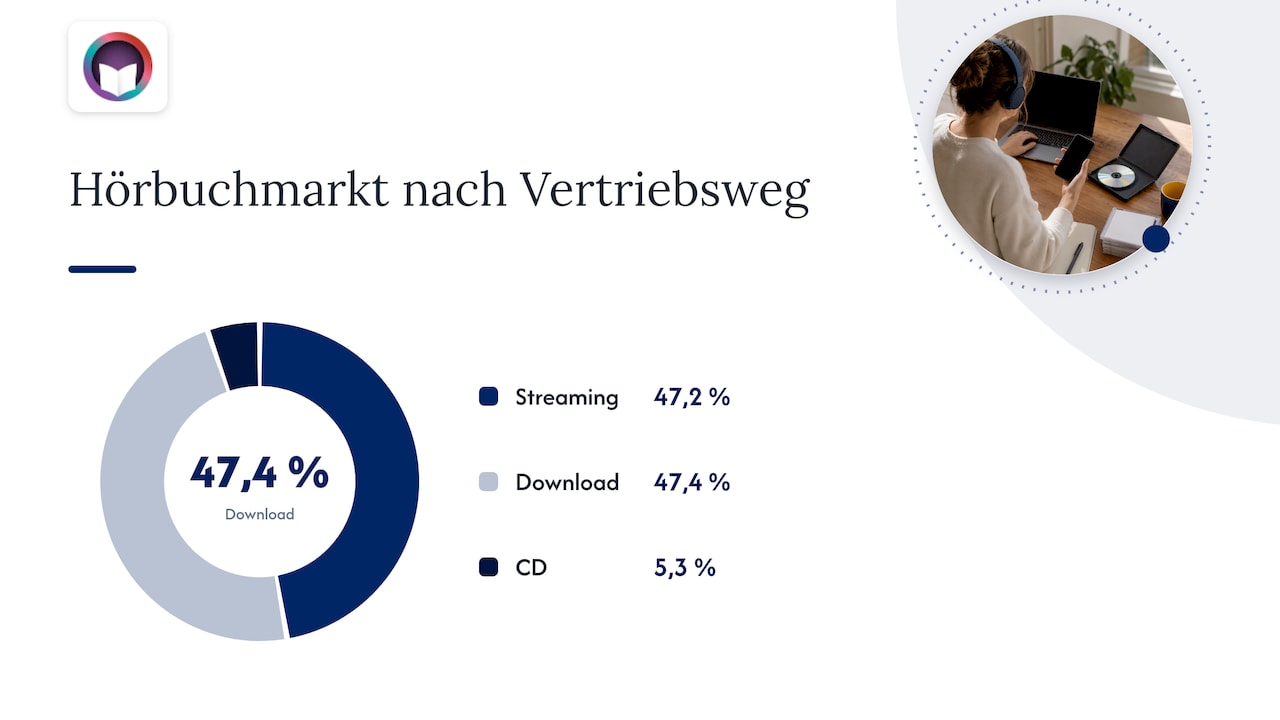
If you write, "Read or listen?" is not a matter of taste but of reach. The audiobook market in Germany has gone digital: according to the Börsenverein des Deutschen Buchhandels audiobook revenue rose by 13.2 percent in 2025. Streaming (47.2%) and download (47.4%) split the market almost evenly, CDs account for only 5.3%.
At the same time it is getting more crowded. In the DACH region about 14,900 new digital audiobooks were released in 2025, after roughly 13,500 the year before, and 36% were published serially. According to Börsenblatt the market after the boom phase sees hardly any new listener groups. Growth comes from more intensive use and format diversity. Particularly in demand were serial audiobooks in romance, suspense and fantasy.
What does this mean for you? Three levers:
- Offer both formats: A text that can only be read won't reach people who are standing on the train or lying in the dark.
- Publish chapter by chapter: Serial stories give your audience a reason to return. On OutaStory you can release a story chapter by chapter. How regular, ongoing content binds readers is also shown in this overview of high-quality blog content formats.
- Pay attention to the voice: Whether a professional voice or your own: it shapes how your story is received. How production works, from voice selection to upload, is described in the article How an audiobook is created.
On OutaStory you can publish a short story in minutes and participate in the revenue from your stories. The platform fee is 8%, find details on our page for narrators and writers.
Frequently asked questions
Does an audiobook count as reading?
Not in the literal sense, because reading means taking in text with the eyes. For understanding a story the difference is small, however, because the brain processes heard and read language in very similar areas. Someone who listens to an audiobook attentively has experienced the story in the same way.
Which is better, audiobook or book?
That depends on the text and the goal. For non-fiction, study material and anything you want to quote or look up, the book has the advantage. For novels and short stories, an audiobook with attentive listening is equivalent and often adds extra atmosphere through the voice.
Do you retain less when listening?
Not necessarily. Less is retained mainly when you do something at the same time that itself demands language or concentration. With routine tasks like walking or washing up and in short sessions you retain a lot when listening.
Is reading good for the brain?
Yes, reading trains concentration, vocabulary and careful thinking through of content, especially with demanding texts. That doesn't exclude listening: both forms complement each other, and those who alternate find the right format for every situation.
Are audiobooks good for children?
As a supplement to reading aloud, yes. Listening is the natural way into language for children, and audiobooks are ideal for car journeys or for falling asleep. They do not, however, replace shared reading with questions and conversations.
Sources
- SR Kultur: Reading or Listening? Interview with Fatma Deniz
- New Scientist: Books vs audiobooks
- The Conversation: What neuroscience says about reading versus listening
- Science Norway: Do you learn just as much from listening as from reading?
- University of Vienna: Digital Audiobooks, project report
- Goethe-Institut: Planning and implementing BOTO children's courses successfully
- Börsenverein: Book market compact 2025/2026
- Börsenblatt: After boom phase, audiobook market reaches plateau
- Börsenblatt: Audiobook market development 2025
Recommendations
- Three questions decide: audiobook or eBook for your everyday situation
- Podcast vs. Audiobook: Which audio format suits you?
Read and write on OutaStory
Thousands of short stories to read for free — or publish your own and find an audience.