AI voices in audiobooks: How well they sound and where you hear them
AI voices turn written text into an audiobook in a short time, and they play to their strengths especially with short stories: short listening times, clear story arcs, immediately available for the commute or the minutes before falling asleep. For you as a listener this means you don't have to wait for a studio production to hear a new story. For you as an author it means your story can be read and heard without booking a recording studio. That's exactly why we built OutaStory: every story on our platform can be read for free or played as an audiobook, with professionally produced voices or with the author's own voice.
In short
- AI voices are speech outputs learned by a neural network from many hours of real speech. They read any text aloud with emphasis, pauses and sentence melody.
- A good audiobook voice can be recognized by four things: a pleasant basic timbre, natural sentence melody, clear pronunciation of difficult words and endurance over longer passages.
- Short stories and AI voices fit particularly well together: short units, fast publication, ideal for on the go, for falling asleep and for reading aloud to children.
- Since August 2, 2026 transparency obligations for AI-generated content apply in the EU. Whoever clones a voice needs the consent of the person it belongs to.
- On OutaStory you can read and listen to stories for free, and authors publish in minutes and participate in the revenues.
Table of contents
- How an AI voice is created
- How to recognize a good audiobook voice
- Why AI voices and short stories fit so well together
- Professional voice or your own: the choice for authors
- How your short story becomes an audiobook
- What legally applies: labeling, voice rights, copyright
- Earning money with narrated stories
- Reading and listening to stories on OutaStory
- Frequently asked questions about AI voices in audiobooks
- Sources
How an AI voice is created
Behind every AI voice is a so-called text-to-speech model, or TTS for short: software that converts written text into spoken language. Modern models work with neural networks, i.e. computational models that learn from examples instead of fixed rules.
The path from text to voice runs, simplified, in three steps:
- Understanding the text: The model breaks the sentence down, recognizes punctuation, questions, exclamations and abbreviations and decides how a word is pronounced.
- Planning the sound: This creates a kind of acoustic blueprint with pitch, tempo and pauses. Here it is decided whether a sentence sounds curious, calm or threatening.
- Generating audio: From the blueprint the model computes the actual audio track you hear at the end.
The model learned all this from extensive recordings of real speakers. It therefore knows typical patterns: how the voice falls at the end of a sentence, where one breaths, how a question rises.
A special form is voice cloning, i.e. reproducing a specific voice. For that, a person records a speech sample from which the system learns the characteristics of their voice: timbre, pitch, speaking rhythm. Afterwards this voice can speak new texts the person never recorded themselves. For authors this is exciting, because a story can appear in their own voice without every chapter being recorded at the microphone. What happens to your recording in this process we explain in our help under Create a voice clone and your recording.
How to recognize a good audiobook voice
Not every AI voice is equally suitable for stories. A navigation device needs to be clear; a narrative voice must also carry you through a plot. The specialist site Hörbuch-Check therefore evaluates AI voices based on basic timbre, sentence melody, difficult words and endurance. These four points also help you when listening:
| Criterion | What to look for | Why it matters for stories |
|---|---|---|
| Basic timbre | Does the voice sound warm, clear and pleasant? | You often listen to it for 15 to 30 minutes at a time. |
| Sentence melody | Does the voice rise and fall naturally, with pauses in the right places? | Tension and punchlines live from timing. |
| Difficult words | Are proper names, numbers and foreign words pronounced correctly? | Fantasy and sci-fi are full of invented names and places. |
| Endurance | Does the voice remain pleasant even after ten minutes? | Especially when falling asleep nothing should disturb or tire. |
A tip from practice: don't just listen to the first paragraph, but also a dialogue passage. There it becomes clear whether a voice brings characters to life. Tempo also plays a big role. Many people listen to stories somewhat faster or slower than the standard speed, and a good voice sounds natural in both cases. How to find your comfortable speed we show in the article Set audiobook speed correctly.
Why AI voices and short stories fit so well together
A classic audiobook for a novel is a large production: actors, direction, recording studio, editing, often over weeks. For a short story of 3,000 words this effort rarely pays off, and so many good stories used to remain silent. AI voices change that calculation. A story can be published today and heard the same day.
For you as a listener this yields very concrete advantages:
- On the go: Audiobooks accompany many people in the car, on the train or on walks, as the FAZ describes the audiobook market. A short story fits exactly into a commute: get in, start, and when you get off the story is over.
- For falling asleep: A complete story with a calm narrative voice is a good evening ritual. You don't have to worry about nodding off in the middle of a chapter and losing the thread the next day.
- For fantasy and sci-fi fans: These genres produce particularly many short stories, and thanks to AI narration you don't have to wait for a publisher to send your favorite niche into the studio.
- For reading along: Reading and listening merge. With us you can listen to a story and follow the text at the same time. How this works we describe in the article about synchronized reading and seamless playback.
Bedtime stories for children
Parents know the situation: the child wants one more story and your own voice is tired after a long day. A well-narrated bedtime story is then not a replacement for reading together, but a nice addition. You can listen to it with your child, let the image form in their head and then talk about it. In our children's section you will find bedtime stories, animal adventures and first rhymes that can all be read or listened to. A good starting point to try in the evening: The spoon that knows the way home.
Professional voice or your own: the choice for authors
If you write a story, you have an idea of how it should sound. For narration you basically have two paths available, and both have their place.
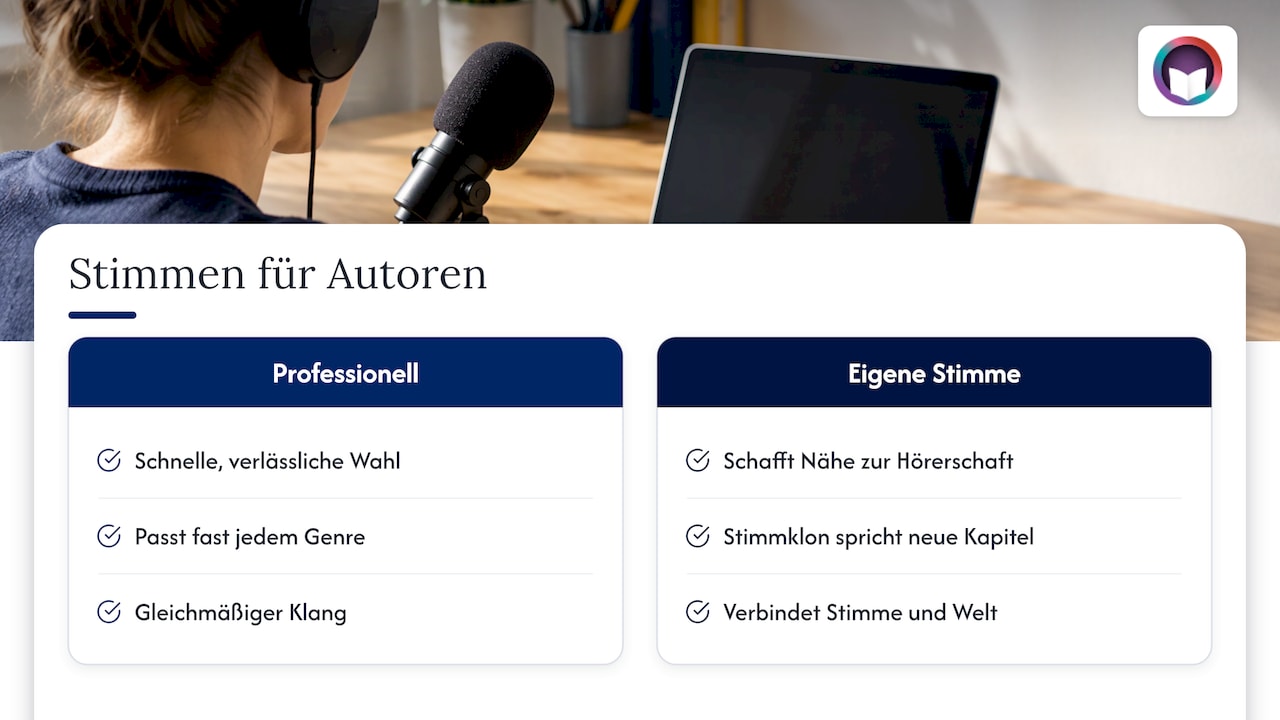
A professionally produced voice is the quick, reliable choice. It fits almost any genre, sounds consistent and is particularly suitable when you want to focus entirely on the text. For a dark thriller you choose a different coloration than for a romantasy story or an animal fable for children.
Your own voice creates closeness. Readers who like your style then also hear you. This is especially valuable if you write a continuing story and over many chapters build an audience that connects your voice with your world. With a voice clone you don't have to record every new chapter yourself.
OutaStory offers both: every story can be played as an audiobook with professionally produced voices or with the author's own voice. If you want to dive deeper into how a manuscript becomes a listening experience, you will find everything important in the article narrate your own story. How an audiobook production proceeds from casting the narrator to uploading is shown in our overview how an audiobook is created.
How your short story becomes an audiobook
The process is essentially always the same: upload text, choose a voice, generate audio, listen back. The SWR aptly describes the human role as that of a director who adjusts pronunciation and emotion. These steps are worthwhile:
- Prepare the text for listening. What works on paper sometimes stumbles when read aloud. Write out abbreviations ("for example" instead of "z. B."), put numbers in dialogues as words ("twenty-three") and remove special characters or formatting that should not be spoken. The most common mistake: italics for thoughts that simply disappear when heard. Reformulate such passages so it's clear who is thinking.
- Check invented names. Especially in fantasy and sci-fi, characters and places often have unusual names. Read critical names aloud and consider whether a spelling makes the pronunciation clearer.
- Choose a voice appropriate to the genre. A calm, warm voice carries bedtime stories; a darker coloration suits horror and dark fantasy. On OutaStory you choose between professionally produced voices and your own.
- Listen and revise. Hear the finished version once completely, preferably through headphones. Pay attention to misaccented words, pauses that are too short before punchlines and paragraphs that run into each other. An extra paragraph or a dash in the text often works wonders.
- Publish. On OutaStory a short story is published in minutes and is then available to read and listen to.
- Continue chapter by chapter. Longer stories can be released as a serial, chapter by chapter. This keeps your audience engaged and gives you time to keep writing between chapters.
The biggest advantage over a single production: text and audio version are in one place. Your readers don't have to switch between a reading app and a listening app, and you don't have to maintain a second publication.
What legally applies: labeling, voice rights, copyright
Anyone who uses AI voices or has a story narrated should know three topics. The good news first: for authors who narrate their own text with a licensed or their own voice, the rules are manageable.
Labeling under the EU AI Act
The AI Act is the European AI regulation that has been phased in since 2024. Since August 2, 2026 its Article 50 requires that artificially generated or altered content be labeled if it appears deceptively real. For fictional and artistic works the regulation, according to Bookmagazin, foresees an appropriate disclosure that should not impair the enjoyment of the work. A note that a story was narrated with an AI voice is therefore usually sufficient; a warning before every chapter is not intended.
The goal of the rules is summarized by the Bavaria Consumer Center as follows: create transparency and protect people from deception. A hidden reference in the fine print is not enough where the obligation applies. Bookmagazin also advises recording which AI tools were used for each project. A short note per story is sufficient.
Your voice belongs to you
German law does not explicitly recognize a specific "right to one's own voice." However, the voice can be protected by general personality rights, as the law firm TWW explains about voice cloning. Practically, this means: clone only your own voice or one for which you have express consent. Reproducing the voice of your favorite actor for your own story is taboo.
Copyright for the narrated text
Under German copyright law, purely machine-generated works without defining human creative input are not protected, while hybrid works with creative human contribution are protected, as IT-Recht.net explains about AI in media production. If you write your story yourself and only have it read aloud, the text remains your work. The voice is then the tool, like the printer used to be.
If you want to commercially exploit a story that is based on a third-party template, or are unsure whether consent for voice use is sufficient, clarify this with an attorney specializing in copyright and media law before publishing.
Earning money with narrated stories
Many authors write short stories out of passion and eventually ask: can this become an income? The audio version is an important lever because it opens your story to people who prefer listening to reading, for example on the way to work or in bed at night.
On OutaStory you pay nothing as an author for use. You publish your story and participate in revenue sharing from your story's earnings. The platform fee is 8%. You can find the details on our page for narrators and authors.
Three things typically help any narrated story find an audience:
- A strong first sentence. When listening, the decision to stay is made in the first seconds. Starting in the middle of a scene works better than a long description.
- Regularity. A continuing story with a fixed rhythm, e.g. one chapter per week, gives listeners a reason to come back.
- A clear genre. Someone looking for romantasy will find you more easily if your story is clearly placed there.
More background on how reading and listening interact on one platform can be found in our article about AI short stories for reading and listening.
Reading and listening to stories on OutaStory
Whether you're looking for a story for the train, a calm voice to fall asleep to, or an adventure to read aloud: on OutaStory you can read short stories for free or listen to them as audiobooks, from fantasy, romantasy and science fiction to crime, thrillers and horror and including the children's section. The platform is available in German and English.
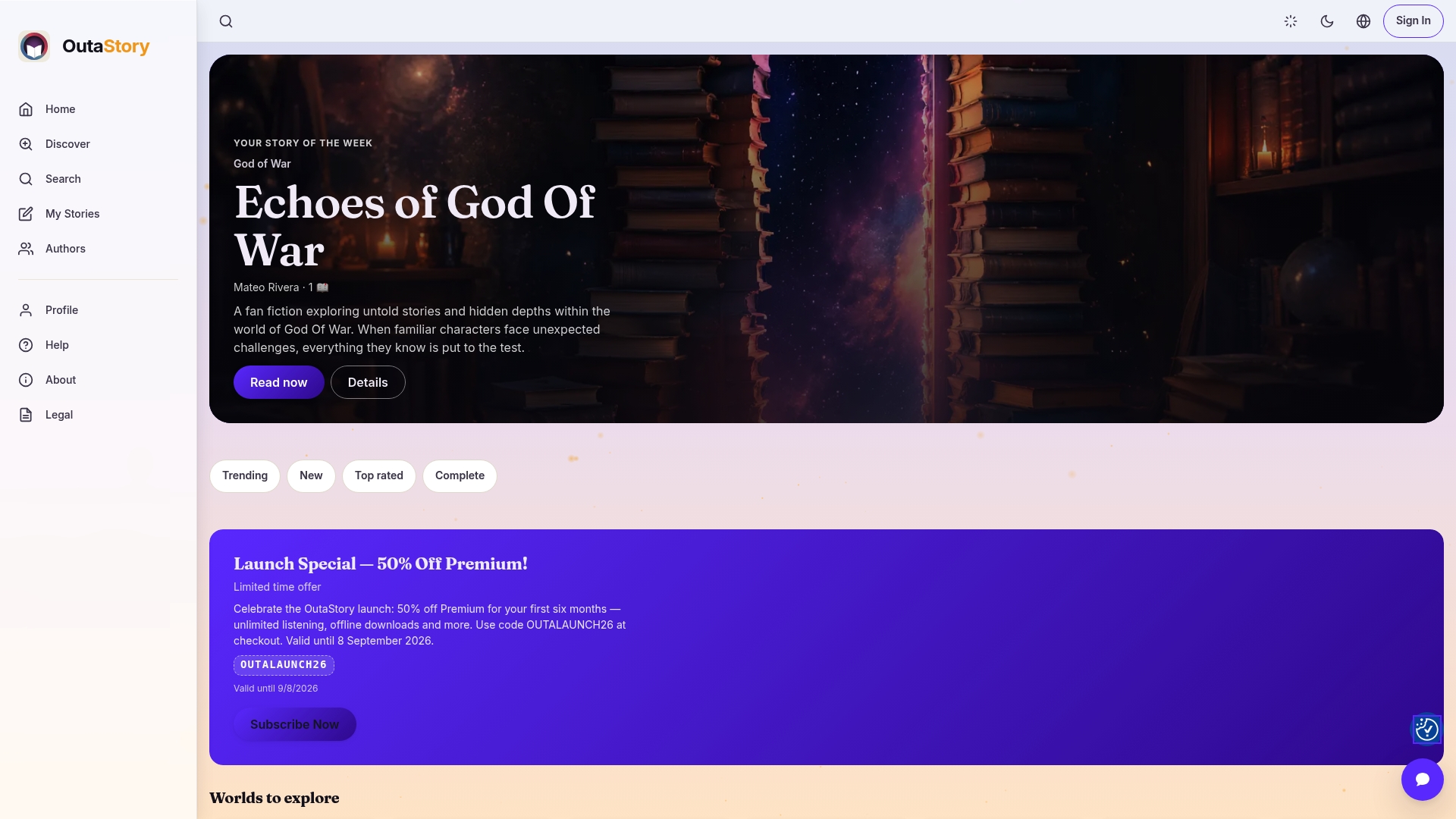
If you listen more than you read, it's worth taking a look at OutaStory Premium: unlimited listening, ad-free use and offline downloads for on the go. To get started, for example, try The Keeper of the Last Words for fantasy fans or House Whispers for those who prefer darker stories. And if you write yourself: your first story can be published in a few minutes.
Frequently asked questions about AI voices in audiobooks
Do AI voices today sound natural enough for audiobooks?
Modern AI voices reproduce emphasis, pauses and sentence melody in a way that makes them suitable for stories. Pay attention to basic timbre, natural sentence melody, clear pronunciation of names and endurance over longer passages. These strengths are especially apparent with short stories of manageable length.
Does an audiobook with an AI voice have to be labeled?
Since August 2, 2026, the EU AI Act requires labeling of AI content that appears deceptively real. For fictional works, an appropriate disclosure that does not disturb the listening experience is sufficient. A clear note about the narration usually fulfills this purpose.
May I have my own voice cloned?
Yes, you may use your own voice for your stories. You may only use other people's voices with their express consent, because the voice can be protected by personality rights. Our help article on voice cloning explains what happens to your recording with us.
Can I listen to AI audiobooks for free?
On OutaStory you can read and listen to stories for free. With Premium you get unlimited listening, an ad-free experience and offline downloads, useful for long trips or stretches without coverage.
Do I earn money as an author with narrated stories?
On OutaStory you participate in revenue sharing from the earnings of your stories; the platform fee is 8%. You pay nothing for publishing itself.
Sources
- Hörbuch-Check: How well do AI voices really sound?
- FAZ: How AI is conquering the audiobook market
- SWR: AI in audiobook production
- Bookmagazin: AI in books, what must be labeled from August
- Bavaria Consumer Center: AI labeling is now mandatory
- TWW: AI voices and voice cloning, who owns their voice?
- IT-Recht.net: AI in media production
Recommendations
- Tips to improve audiobook quality for listeners and narrators
- MP3 or streaming: which audiobook format suits you?
- How an audiobook is created: from choosing the narrator to uploading
Read and write on OutaStory
Thousands of short stories to read for free — or publish your own and find an audience.