Adjust audiobook speed: How to find your pace
The speed of an audiobook is almost always set in the player itself. In most apps and web players a small symbol like “1x” or “1,0×” shows the current speed. Tap it to choose a setting from about 0.5× up to 2× or 3×. Harder than the gesture is the question which speed suits you. A crime novel needs a different pace than a nonfiction text, and after a long day you listen differently than on the way to work. In this guide we show you where the setting is on each device, what research says about comprehension and speed, how much listening time you actually save, and how to find the right level for commuting, exercising and falling asleep.
In short
- The setting is in the player: Look for the symbol “1x” next to the playback controls or in the menu with the three dots.
- Moderate is usually ideal: According to Psychology Today, speech can be sped up by about 25 percent without comprehension noticeably suffering. At around 50 percent it typically decreases significantly.
- Genre matters: Lighter texts can take more speed; crime novels and thrillers with many details are better listened to more slowly.
- Saving time is simple math: Divide the runtime by the factor. Ten hours at 1.25x last eight hours.
- For falling asleep you should listen at the original speed or slightly slower, combined with a sleep timer.
Table of contents
- Change speed: the basic steps in every player
- Where to find the setting on each device
- Which speed preserves comprehension
- The right speed for each genre
- How much listening time you really save
- On the go, during sports and before falling asleep
- When speed bothers: typical problems and solutions
- In five steps to your comfortable speed
- Listening to short stories at OutaStory
- Frequently asked questions
- Sources
Change speed: the basic steps in every player
Interfaces differ, but the principle is almost the same everywhere. With these steps you will find the setting in nearly every audiobook app:
- Start the audiobook. In many apps the speed setting only appears in the full player window, not in the mini bar at the bottom of the screen. Tap the bar to open the full-screen player.
- Look for the speed symbol. Typical labels are like „1x“, „1,0ד or a speedometer icon. It usually sits under or next to the progress bar, often in a row with the sleep timer and chapter overview.
- Choose a level. Common presets are 0.75x, 1x, 1.25x, 1.5x and 2x. Some players additionally offer a slider for fine adjustments like 1.1x or 1.35x.
- Try listening. Listen for one or two minutes at the new setting. If you need to repeat sentences, go back one level.
- Check whether the speed is saved. Some apps remember the speed per title, others globally for all audiobooks. If you switch between a nonfiction book and a novel, a quick look to see whether the setting migrated is worthwhile.
If you can't find a symbol, look in the menu with the three dots (⋮ or …) or in the app settings under terms like “Playback”, “Playback speed” or “Speech rate”.
Where to find the setting on each device
Depending on the device the path looks a little different. The following overview shows where you typically should look:
| Gerät | Wo du die Einstellung meist findest | Hinweis |
|---|---|---|
| Smartphone-App (iOS, Android) | Symbol „1x“ im Vollbild-Player | Oft auch als Kurzbefehl auf dem Sperrbildschirm nicht verfügbar, dann App öffnen |
| Tablet | Wie auf dem Smartphone, häufig mit größerem Schieberegler | Feinabstufungen sind hier oft leichter zu bedienen |
| Webplayer im Browser | Zahnrad- oder Tempo-Symbol neben der Fortschrittsleiste | Nach einem Seitenwechsel kurz prüfen, ob das Tempo erhalten blieb |
| Desktop-Mediaplayer | Menü „Wiedergabe“ oder Rechtsklick auf das Wiedergabefenster | Häufig mit Tastenkürzeln für schneller und langsamer |
| Smarter Lautsprecher | Sprachbefehl, sofern die jeweilige App ihn unterstützt | Nicht jede Hörbuch-App gibt die Tempoeinstellung an Sprachassistenten weiter |
| Auto über Smartphone-Kopplung | Meist nur in der App auf dem Handy einstellbar | Tempo vor der Fahrt wählen, nicht während der Fahrt |
Two cases come up repeatedly in forums: Some services lack the speed setting for audiobooks entirely, and locally stored audio files often play only at the original speed in the default music app. In the first case you can only switch to a provider or player that exposes the speed. In the second case a media player that supports playback speed helps. Many free desktop and mobile players can do this.
Which speed preserves comprehension
How fast can you listen without the story rushing past you? Research gives a surprisingly clear orientation. A piece in Psychology Today summarizes studies like this: recorded speech is usually at about 165 words per minute. A comfortable range is about 10 percent above that, so roughly 1.1x. Speech can thus be sped up by about 25 percent without comprehension suffering substantially. If speed increases by around 50 percent, i.e. to 1.5x, comprehension typically drops significantly.
From this three zones emerge that you can orient yourself by:
- 1.0x to 1.1x, the comfort zone: Here you listen relaxed and fully get emphasis, pauses and mood. Ideal for novels, short stories and anything you want to enjoy.
- 1.15x to 1.25x, the efficiency zone: Noticeably faster, comprehension largely remains according to the studies. Good for familiar genres and clearly speaking voices.
- From 1.5x, the sprint zone: Many listeners use this speed, but research typically shows a clear loss of comprehension here. Suitable for skimming familiar content, less so for a new, dense story.
Also important is a second finding from the same source: fast speech can be more tiring and less pleasant for relaxed listening. Someone racing through an audiobook at 2x in the evening may save time but often loses what they started the audiobook for. The right speed is individual. It depends on your experience, your form that day, the narrator's voice and the content.
The right speed for each genre
Not every story tolerates the same speed. Psychology Today gives a illustrative example: simple news summaries you can listen to faster, a crime novel where every detail counts demands a slower pace. This logic transfers well to all genres. The following values are our recommended starting points, not fixed rules:
| Genre oder Inhalt | Empfohlener Start | Warum |
|---|---|---|
| Krimi, Mystery, Thriller | 1,0x bis 1,1x | Hinweise, Alibis und Wendungen verstecken sich in Nebensätzen |
| Horror | 1,0x | Spannung lebt von Pausen und Atmosphäre |
| Fantasy und Science-Fiction | 1,0x bis 1,15x | Neue Namen, Orte und Begriffe brauchen Zeit zum Ankommen |
| Romantasy und Liebesgeschichten | 1,0x bis 1,2x | Dialoge tragen viel Emotion, die bei hohem Tempo verflacht |
| Literarische Kurzgeschichten | 1,0x | Sprache und Rhythmus sind hier Teil der Geschichte |
| Kindergeschichten und Reime | 0,9x bis 1,0x | Kinder brauchen Zeit für Bilder im Kopf |
| Sachtexte, bekannte Themen | 1,2x bis 1,5x | Inhalte, die du teilweise kennst, verarbeitest du schneller |
Especially with suspense literature patience pays off. Try for example the mystery story Unter Verdacht or the thriller Dunkle Geschäfte: Listening at the original speed you notice the small contradictions that easily disappear at 1.5x.
The narrator's voice also plays a role. A calm, deep narrator voice often tolerates more speed than an already lively one. If an author reads their own story aloud, the reading often already contains a deliberate pacing. How much work goes into voice, pauses and emphasis we describe in our article about how an audiobook is created.
How much listening time you really save
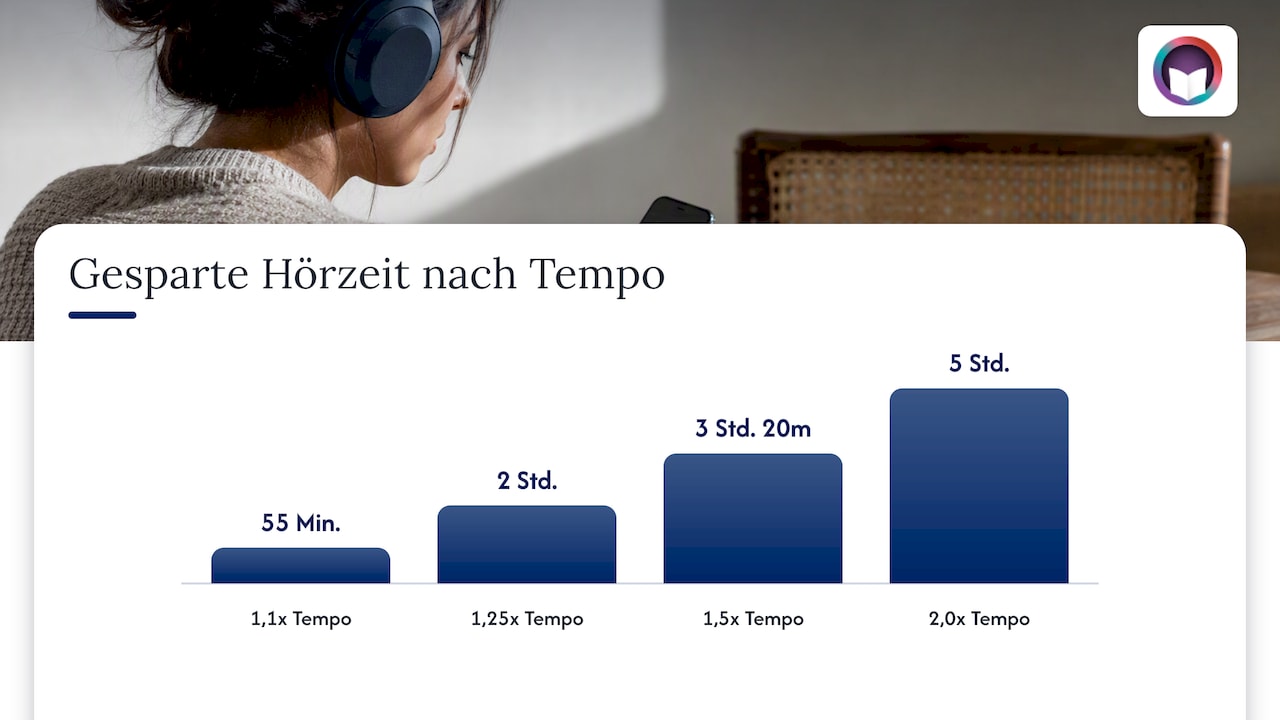
The math is simple: divide the original runtime by the speed factor. The saved time is the difference. For an audiobook with ten hours runtime it looks like this:
| Tempo | Neue Laufzeit | Gesparte Zeit |
|---|---|---|
| 1,0x | 10 Std. | 0 |
| 1,1x | 9 Std. 5 Min. | 55 Min. |
| 1,25x | 8 Std. | 2 Std. |
| 1,5x | 6 Std. 40 Min. | 3 Std. 20 Min. |
| 2,0x | 5 Std. | 5 Std. |
The effect is impressive for long audiobooks, for short stories it is small. A story with 20 minutes runtime still takes 16 minutes at 1.25x, so you save four minutes. For short formats it is therefore rarely worth sacrificing the experience for a few minutes. If a story doesn't quite fit into your commute, a slightly higher speed is an elegant trick to finish it in one go.
One more thought on efficiency: the saved time only counts if the story reaches you. If you have to rewind every other chapter at 1.5x, you'll end up listening longer than at the original speed.
On the go, during sports and before falling asleep
The same story sounds different on the subway than in bed. That's why it's worth adjusting the speed to the situation and not only to the text.
Commuting by train and bus
On the go the story competes with announcements, conversations and traffic noise. A slightly increased speed of 1.1x to 1.2x often keeps attention better than the original speed because fewer gaps open up for your mind to wander. Very high settings are risky in a noisy environment, because every missed syllable at 1.5x counts twice as much. Plan your speed so that a story or chapter roughly fits your travel time.
Jogging and walking
While running most people listen with a bit less attention than when sitting. Calm routes tolerate original speed, during intervals or demanding routes a slightly simpler text at a clear pace is often a better choice than a complex plot at high speed. Which formats fit which running route we have summarized in our guide to audiobooks while jogging.
For falling asleep
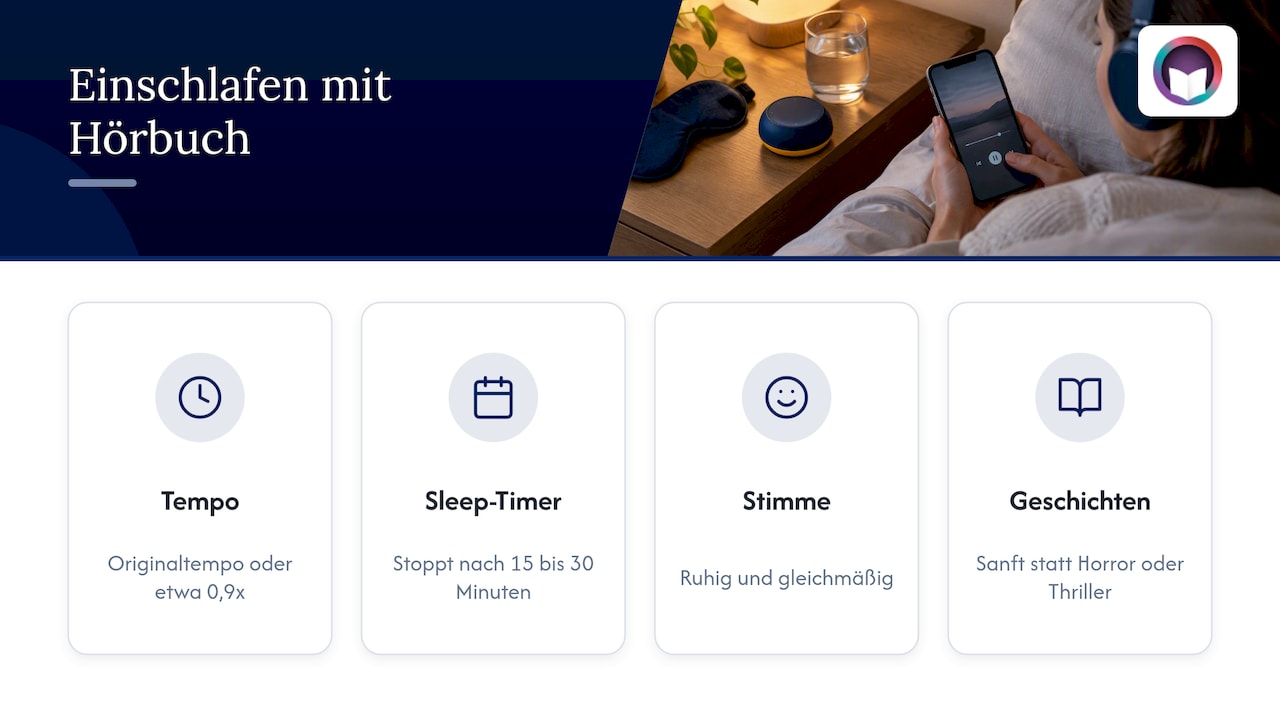
Here the opposite of saving time applies. For falling asleep you should listen at the original speed or slightly slower, about 0.9x. A calm voice, steady speed and a sleep timer that stops playback after 15 to 30 minutes are a good combination. That way you can more easily find the place where you fell asleep the next evening. Choose gentle stories rather than horror or thrillers that keep you awake.
Reading aloud and listening together with children
Children process language more slowly and need time for images to form in their heads. Bedtime stories, animal adventures and first rhymes you listen to with them best at the original speed. For younger children 0.9x can help, especially for rhymes whose rhythm they want to join in with. Ideas for shared listening time you can find in our article on audiobooks for families.
When speed bothers: typical problems and solutions
Sometimes an audiobook sounds odd after changing the speed, or the setting behaves differently than expected. These cases occur frequently:
- The voice sounds like Mickey Mouse: Good players adjust speed without changing pitch. If the voice sounds higher, the player uses a simpler method. Another player or a lower setting fixes this.
- The speed jumps back: Some apps save the level per title, others reset it after a restart. Check in the settings whether there is an option for a default speed.
- The setting is missing completely: Not every service exposes speed for audiobooks. Then you have to switch to an offering or player that supports it.
- Headphones or car do not adopt the speed: Speed is calculated in the player on the device, not in the headphone. So always set the speed in the app itself.
- You lose the thread: Go back one level or rewind 30 seconds. Fast listening is not a competition.
In five steps to your comfortable speed
Many experienced listeners report that they got used to higher speeds. Whether that applies to you is best found out with a small self-test:
- Start at 1.0x with a story you like, and listen to a chapter completely relaxed.
- Increase to 1.1x. This roughly corresponds to the range research describes as pleasant.
- Test 1.25x on the next listen. Then summarize in two or three sentences what happened. If you can do that effortlessly, this level is good for this genre for you.
- Watch for fatigue. If listening feels strenuous after 20 minutes, the speed is too high even if you understood everything.
- Set preferred levels per situation: e.g. 1.2x for the train, 1.0x for crime novels, 0.9x for falling asleep.
Whether listening or reading suits you better in a particular situation is a related question. Our article Audiobook or E-Book helps you decide with three questions.
Listening to short stories on OutaStory
We built OutaStory so you can read or listen to every story, for free. Every short story can be played as an audiobook, voiced by professionally produced voices or by the author themself. The range goes from fantasy, romantasy and science fiction to crime, thriller and horror, and our children's section with bedtime stories, animal adventures and first rhymes. Longer stories appear as serial installments chapter by chapter. That fits well with a fixed listening ritual on the commute or before sleep.
Your world, your stories: write, read, listen.
If you want more, for example unlimited listening, ad-free use and offline downloads for trips without a network, find the details about our Premium membership. How we further develop listening technically, for example with synchronized reading and seamless playback, we describe in our article Audio grows up. And if you voice stories yourself: under Information for speakers we explain how participation works and which platform commission of 8% applies.
Frequently Asked Questions
Is 2x speed too fast?
For most new content, yes. According to Psychology Today, comprehension typically decreases significantly at about a 50% increase; 2x is even higher. For familiar content or quick review it can work; for a new story we recommend about 1.1x to 1.25x.
Does the voice change when I listen faster?
Not in good players: they increase speed without shifting pitch. If the voice sounds higher after changing it, the player uses a simpler method. Then another player or a lower setting helps.
How do I calculate the new runtime?
Divide the original runtime by the speed factor. An audiobook with six hours lasts four hours at 1.5x, and four hours and 48 minutes at 1.25x.
Which speed is suitable for falling asleep?
Original speed or slightly slower, about 0.9x. Combine this with a sleep timer and a calm story so you can easily find your place again the next evening.
Can I get used to faster listening?
Many listeners increase their speed gradually. Proceed in small steps of 0.1 and after each chapter check whether you can effortlessly summarize the plot and whether listening remains comfortable.
Sources
Psychology Today: Is Speed Listening Right for You?
Recommendations
Read and write on OutaStory
Thousands of short stories to read for free — or publish your own and find an audience.