
Fantasy short stories: Where you read, listen, and share them
You can find the best German-language fantasy short stories immediately in three places: curated collections and literature archives, active community forums with reading recommendations, and platforms that combine text and audiobooks. Some offerings are completely free, others use a freemium model with premium features such as offline listening. The following sections show you where to search specifically and which titles are worthwhile as entry points.
In short:
- Curated sources offer quality-checked and subgenre-sorted fantasy short stories, while community platforms collect diverse, unfiltered texts.
- Audiobook platforms like Outastory expand the offering with professionally or self-narrated stories, including chapter-by-chapter continuations for long listening sessions.
- For getting started, short collections like Pratchett's humorous stories or Martin's „Das Lied des Eisdrachen“ are suitable, appealing to different audiences.
- Short stories rely on quick, in-the-middle-of-the-action openings and open endings to convey emotional and magical depth in a condensed form.
- Authors can easily post their stories online, writing, publishing, and monetizing on platforms like Outastory, especially for short, conflict-driven premises.
Table of contents
- Where can you find freely available fantasy short stories?
- Which fantasy short stories are worthwhile as an introduction?
- Where do you read, share, and discuss fantasy stories?
- How you collect and rediscover favorite stories
- How do you write and publish your own short stories?
- How has the genre of the fantasy short story developed?
- Which motifs and themes shape fantasy short stories?
- Which narrative techniques are typical for the genre?
- How do short stories differ from novels and novellas?
- Outastory: Reading, listening, and publishing in one place
- Sources
- FAQ
Where can you find freely available fantasy short stories?
Curated collections differ significantly from loose community postings. Literature archives and editorially managed sites select texts based on quality, sort them by subgenre, and usually provide a short context about the author or origin. Forums and open platforms, by contrast, collect everything that is submitted, from beginner texts to mature stories. Both have their place, but if you have little time and are specifically looking for good short fantasy stories, curated sources will get you there faster.
Platforms with an audiobook option expand the offering to a second level. For example, on Outastory every story can be both read and listened to, sometimes with professionally produced voices, sometimes with the voice of the author themself. Those who prefer to listen on the go instead of reading on a screen will also find there short audiobooks under five hours as an entry point. Chapter-by-chapter published serialized stories are another feature of such platforms: A short story grows into something larger over several weeks without you having to wait for a finished book.
To avoid a random search, a few fixed criteria help:
- Check tags and subgenres: High fantasy, urban fantasy, romantasy, or fairy-tale adaptation deliver completely different reading experiences under the same umbrella term.
- Pay attention to the publication date: Older collections are often more literarily mature, newer texts experiment more with form and tempo.
- Take author attribution seriously: A profile with multiple published stories is usually a better sign than a single text without context.
- Skim comments and reviews: They often reveal faster than the blurb whether a story delivers what the title promises.
For children there are dedicated sections that are clearly separated from fantasy literature for adults: shorter sentences, less violence, a gentler handling of loss and fear. This separation is worthwhile, because a fantasy short story intended for children about a talking fox needs a different pace than a dark novella about a fallen mage.
Which fantasy short stories are worthwhile as an introduction?
Not every short tale suits every reader type. Some want to be emotionally hit in three minutes, others look for an entire collection for a rainy afternoon. Three recommendations cover different needs and at the same time show how broad the genre is.
- Florian Meimberg's Tiny Tales. These texts often fit into a few lines and prove that entire world designs can be reduced to a single image. Literaturkritik describes how these very short formats show that complex ideas also work in the tightest spaces because readers actively fill in the gaps. Suitable for anyone who wants to experience a whole story between two subway stations.
- Terry Pratchett's short story collections. Those seeking humorous, literarily crafted fantasy will find this exact mix in collections like „Spitzer Stift schlägt stumpfes Schwert“. Even newer editions of unpublished Prangert texts show that the author's ideas, even decades old, still feel fresh and provide a good entry point for readers who don't take things too seriously.
- George R. R. Martin's „Das Lied des Eisdrachen“. This shorter tale is, as Literaturkritik notes, particularly suitable for younger readers or for anyone new to the genre. The tone is melancholic, almost fairytale-like, but without the brutality for which Martin is otherwise known.
With very short formats like Tiny Tales, you immediately notice whether the rhythm holds or whether the text feels too choppy to you.*
A look at the variety of formats shows how differently „short“ can fall in this genre: Tiny Tales are in the range of a few lines, classic short stories usually lie between 2,000 and 8,000 words, while collections like Pratchett's bundle individual tales that could also stand on their own. This range makes the genre so versatile, whether as a quick break in between or as evening reading over several days.
Where do you read, share, and discuss fantasy stories?
If you've read a story and want to talk about it, you'll find several online venues with very different characters. Topic forums usually focus on a particular subgenre or an author, reading circles organize fixed reading rounds with schedules, and competitive formats like writing challenges bring fresh texts into circulation that are then discussed directly. The Orkenspalter, for example, is among the better-known German-language places for fantasy discussions, similar to thematically relevant subreddits.
When sharing others' texts, a simple rule applies: never copy the full text without permission; instead link or quote with a clear source. Copyright protects even short texts fully, regardless of their length. Anyone who posts their own story should expect comments that are not always favorable, and that is part of the process.
A few habits make the difference between useless and valuable feedback:
- Ask specifically about one aspect, such as the opening or the ending, instead of asking generally "how was it".
- Choose two or three regular beta readers who already know your style, instead of approaching new forum members each time.
- Wait at least one day before reacting to harsh criticism. The first reaction is rarely the wisest.
How you collect and rediscover favorite stories
You can find a good fantasy short story easily, but you can just as easily lose track of it again. Browser bookmarks help in the short term, but fail once the list grows beyond twenty entries. Read-later services and RSS feeds from collection sites solve this problem more structurally, because new publications flow in automatically instead of you having to search for them manually.

For audiobook fans, a fixed playlist with offline downloads is worthwhile, especially for long train rides or commutes without stable network. Tags and subgenre labels are more than just an organizational system: if you consistently filter by „Urban Fantasy“ or „magical realism“, over time you will get significantly more fitting recommendations than by random browsing.
Pro tip: Keep a single note in which you record one-sentence impressions for each story you read. After twenty titles you will recognize your own reading pattern from this, often more clearly than expected.
- Sort bookmarks by subgenre instead of by date.
- Create a fixed playlist for audiobooks before the trip begins.
- Subscribe to newsletters of curated sites instead of searching anew each week.
How do you write and publish your own short stories?
Short form requires discipline that is less important in a novel. The first sentence carries more weight here than any flashback: professionals start in the middle of a scene with a clearly perceptible problem, not with a leisurely prologue. Whoever explains the world first and then starts the action often loses half of the reader's attention in a short story.
Magic should be effective but limited in short form. Three questions almost always help:
- Where does the magic come from? A source, no matter how fantastic, makes a system comprehensible.
- What does it cost? A price, such as lifetime, memory, or energy, provides real tension, according to Korrektur, because every magical action costs something.
- What is forbidden? A taboo gives the story a conflict as soon as someone crosses the boundary.
Subtle magic often works stronger in short prose than spectacular effects. Bookerfly describes how magical realism, especially in concise texts, creates emotional depth without the need for an elaborate worldbuilding chapter. Avoid omnipotence: a character who solves every problem with a spell robs the story of all tension.
Every line must carry action or meaning. Repetitions and unnecessary descriptions have no place in very short formats, because otherwise the reader will fall out of the story faster than it can be finished.
When publishing today, the classic publishing route counts less than it used to. Platforms like Outastory let you put a story online in minutes, publish it as a serial chapter by chapter, and even offer it as an audiobook with a professional voice or your own. Through the revenue sharing for authors, you can take part in the earnings from your own stories, which lowers the entry barrier especially for hobby authors.
How has the genre of the fantasy short story developed?
Fantasy tales in short form are older than the modern fantasy novel. Oral sagas, fairy tales, and folk narratives already provided the basic pattern centuries before Tolkien: concise action, clear characters, a magical element as the pivot point. Only with the pulp magazines of the early 20th century did the short story become its own literary format with fixed conventions, often around adventure and sword-and-sorcery motifs.
Authors like Pratchett later shifted the genre toward satire and social critique, without abandoning the fantastic frame. Parallel to that, distinct traditions established themselves in Germany, from fairy-tale adaptations to modern anthologies in literary magazines. The internet then fundamentally changed distribution: instead of waiting for an anthology in bookstores, authors today publish directly online, often chapter by chapter and with immediate reader feedback.
The most recent development goes in the direction of condensation. Formats like Tiny Tales show that fantastic ideas can even be reduced to a few lines, a counter-model to the sprawling worldbuilding of classic fantasy novels. At the same time, the range of audio formats is growing, which brings the short story closer to its oral roots again.
Which motifs and themes shape fantasy short stories?
Certain motifs recur in the genre because they can be particularly well condensed in short form. The price of magic is one of the strongest: a character gains power but loses something personal, memory, time, or a relationship in return. This motif works just as well in a few paragraphs as it does over 500 pages of a novel.
The transition between worlds is a second, very common theme: a door, a mirror, a forest that suddenly looks different. Short stories like to use such threshold moments because they immediately create tension without the need for long explanations about how the other world actually works.
Loss and transience also appear conspicuously often, for example in Martin's „Das Lied des Eisdrachen“, where cold and grief are closely linked. The motif of the outsider who possesses a special ability but is consequently ostracized also runs through many short fantasy stories. Subtle, everyday-like magic, as used by magical realism, increasingly replaces the big magical battle in modern texts. This suits the concise form: a single magical detail carries the whole story instead of explaining a complete system.
Which narrative techniques are typical for the genre?
Short fantasy stories work with different tools than novels, partly because there is no space to build characters over a hundred pages. The entry point in the middle of the action, in English often called „in medias res“, is almost mandatory: a character is already in conflict when the first sentence begins.
Suggestion often replaces explanation. Instead of unfolding a magic system completely, one detail, a forbidden word, a scar, a rule that no one breaks, is enough to create an entire worldview in the reader. This gap technique is one of the reasons why Tiny Tales, despite minimal word counts, still feel like complete stories.
The point of view in short form usually remains restricted to a single perspective, because perspective shifts cost space that simply isn't there. The ending also differs from a novel: instead of a complete resolution, an open or ambiguous conclusion often suffices, leaving the reader room to think further. It is precisely this openness that makes many magical short stories so memorable; they end before all questions are answered.
How do short stories differ from novels and novellas?
The difference lies not only in length but in the structure itself. A fantasy novel can afford multiple plotlines, a complete magic system, and a character arc over hundreds of pages. A short story must concentrate on a single conflict, often a single character and a clear moment.
Novellas lie in between: longer than a classic short story but more compact than a novel, usually with a plotline that unfolds over a limited period. Martin's „Das Lied des Eisdrachen“ moves exactly in this borderline area and shows how fluid the categories are in practice.
For readers, this primarily means one thing: if you have little time but want a complete experience, a short story serves you better than the first volume of a novel series. If, on the other hand, you want to immerse yourself in a world over weeks rather than minutes, you lean toward the novel. Both formats have their justification, but they demand completely different craftsmanship from authors, and precisely that makes the short story an independent art form, not an abridged novel.
Outastory: Read, listen, and publish in one place
For anyone who wants to switch between reading and listening, Outastory is a practical contact point: every story can be read for free or listened to as an audiobook, with professionally produced voices or the original voice of the author. The genre spectrum ranges from fantasy and romantasy to crime and horror, up to a dedicated children's section with bedtime stories.
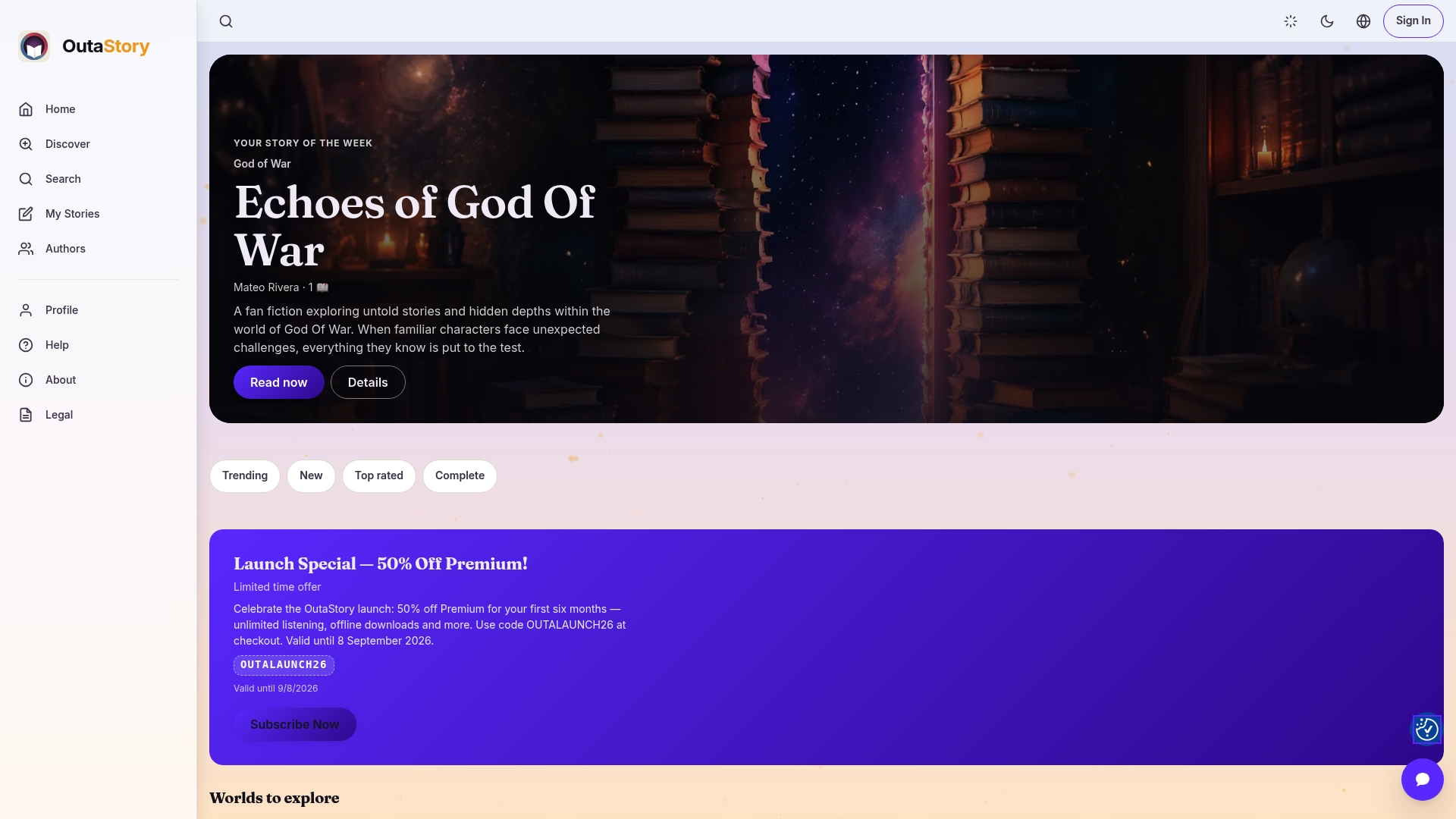
This is especially practical for commuters or voracious readers who want to start a story in the morning and finish it in the evening without switching formats. Serialized continuation stories appear chapter by chapter so you don't have to wait for a finished book to start a new tale. If you write yourself, you can publish your own short story and take part in the revenues generated via the platform. If, as a reader, you want to dive deeper, for example with unlimited listening or offline access, you'll find the details about the Premium membership directly on the site. For getting started, it's also worth taking a look at romantic short stories to read and listen to for free, which showcase Outastory's text-and-audio principle well.
Sources
- Between everyday life and apocalypse. Florian Meimberg: Tiny Tales
- Magic and reality in short stories: How to create stories with special depth
- Writing a fantasy novel: worldbuilding, magic, characters
- Spitzer Stift schlägt stumpfes Schwert: Stories | Terry Pratchett
FAQ
Which fantasy short stories are available to read for free?
There is a wide range, from Tiny Tales to classic anthologies to chapter-by-chapter serialized continuation stories on platforms like Outastory. Curated literature sites and community forums are good first stops to search specifically by subgenre.
Which 10 fantasy books of all time are considered the best?
There is no fixed, universally accepted list; tastes and the canon vary greatly by source. Within the short form, collections like Terry Pratchett's stories and George R. R. Martin's „Das Lied des Eisdrachen“ are considered particularly recommendable entry points.
Which short stories are considered particularly successful?
Successful stories are usually those with a clear conflict, a strong opening in the middle of the scene, and a magic system with recognizable limits. Tiny Tales by Florian Meimberg show how these principles work even in a few lines.
Which ideas are suitable for your own fantasy stories?
Proven motifs include the price of magic, the transition between two worlds, or a character with an ability that makes them both powerful and isolated. If you implement such an idea briefly and with a clear conflict, you can publish it directly via Outastory and also offer it there as an audiobook.
Recommendations
- Read and listen to romantic short stories for free
- Read and listen to horror short stories for free: the best sources
- Read and listen to short stories for free: the best overview
Read and write on OutaStory
Thousands of short stories to read for free — or publish your own and find an audience.