Short Christmas stories: instantly suitable by age and occasion
The quickest solution: Choose a short story by reading time and age, not by the size of the collection. Three to seven minutes are enough for most reading situations, whether kindergarten, Advent celebration or bedtime ritual. Further down you'll find lists by setting and age group, plus tips for reading aloud and formats for printing or listening. If you want to hear a story immediately, OutaStory offers text and audio in one.
In short:
- Stories for families in the evening should be about four minutes long and have a small punchline or plot, so they can be read aloud comfortably on the sofa.
- For groups during Advent, short stories under five minutes with recurring rhymes or interactive elements work well to keep attention.
- Children aged two to three need short, simple stories with familiar themes and lots of repetition, while primary school children can handle more complex plots with a small punchline.
- For adults, a short, reflective Christmas story is suitable, often ten minutes or shorter and focusing more on atmosphere and memory.
- The right format depends on the occasion: PDFs are ideal for reading aloud in groups, audiobooks for on the go, and short stories can be easily found and tried on OutaStory.
Table of contents
- Choose short Christmas stories by occasion
- Short Christmas stories by age group
- Selection criteria and reading tips for short Christmas stories
- Text, PDF or audio version: which format fits when?
- OutaStory as a quick source for short Christmas stories
- Origin and history of Christmas stories
- Suitable accompanying activities for story reading
- Try OutaStory: read or listen to short stories instantly
- Sources
- FAQ
Choose short Christmas stories by occasion
Not every short Christmas story fits every occasion. A group of twenty kindergarten children needs something different than a couple by the fireplace. The following four situations cover most reading occasions, with reading time and age suitability included.
For the family in the evening: Those reading together on the sofa usually have more time and quiet than in a group. Here, stories with a bit more plot and a small punchline at the end work well.
- The Shop of Magical Gifts: A small, self-contained tale about a mysterious shop that offers exactly what someone truly needs. Reading time about a few minutes, suitable for children of school age, available as full text with a PDF option.
- The Christmas Cookies: A warm, everyday story about baking together, which pairs well with an actual baking activity. About 4 minutes read time, from age 5.
- A Guest on Delicate Hooves: An animal story with a calm tone that also appeals to skeptical first-graders. Around 5 minutes, from age 6.
For the Advent celebration or group session: Here, speed matters. Children in groups often lose attention after five minutes if nothing happens. Interactive or easy-to-participate stories work much better in group settings than long, introspective tales, for example with short rhymes to speak along or a recurring question to the audience.
- Short animal stories with clear repetition, for example a reindeer that asks for directions three times.
- Stories with a song or verse to recite together.
- Texts under 5 minutes, so even the fourth group in the classroom still has patience.
For the bedtime ritual: In the evening, calm matters, not tension. Five-minute stories with an even pace and a gentle ending are better here than stories with cliffhangers or a loud climax. Those who read regularly will find a whole range of such calm texts in collections of bedtime stories, mixed Christmas and non-Christmas.
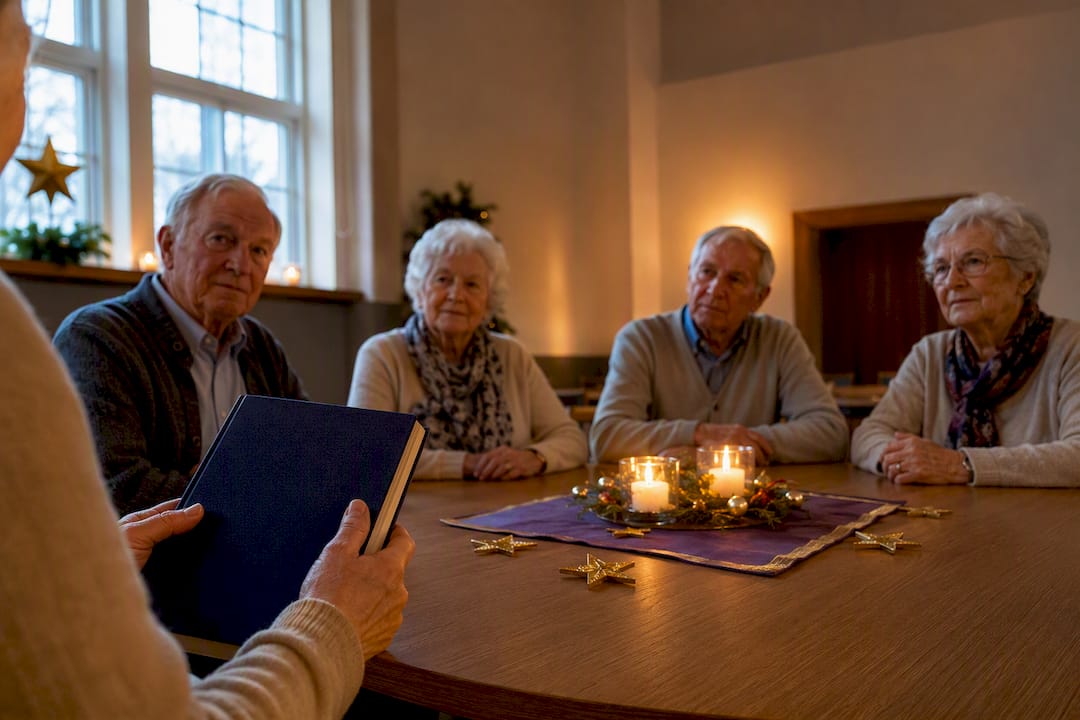
For senior groups: Reflective, short Christmas tales, often looking back at childhood or tradition, work better here than modern or ironic texts. Five to ten minutes in length, calm language, few changes of action. A story about an old Christmas tradition or a letter to Santa Claus from past times is usually well received by this target group.
For every story the same quick check applies: Does the reading time fit the available time? Does the language fit the age of the listeners? Many collections now sort their texts by mood, funny, reflective or Christian, which speeds up selection considerably. If you don't know the story beforehand, it's best to read the first two paragraphs yourself before presenting it to a group.
Short Christmas stories by age groups
The age indication has a greater influence on the success of a reading situation than any other criterion. A story with five supporting characters loses a three-year-old after the second character. A text without any punchline bores a nine-year-old. The following classification is based on language, pace and number of characters.
-
Toddlers, 2 to 3 years (1 to 3 minutes): At this age, very short, simple stories with familiar themes like snow, stars or Santa Claus are suitable. One character, a simple sequence, lots of repetition. Rhyming forms help because toddlers often pick up rhythm faster than narrative.
-
Preschool children, 4 to 5 years (3 to 5 minutes): From about four years on, children can already handle somewhat longer animal or traditional stories with two to three characters. A small challenge that gets resolved works well here, for example a snowman searching for his hat, or a reindeer that can't find the way to the sleigh.
-
Primary school children, 6 to 9 years (4 to 7 minutes): Here the story may already have a real punchline or a small moral twist. Short Christmas stories for children in this age group often last only a few minutes, which fits well into a lesson or morning circle. Animal stories with light humor are usually best received in this group.
-
Older children, 10 to 13 years (5 to 10 minutes): Now listeners can also tolerate more serious tones, for example a story about loss, friendship or an unexpected gesture. The language may become more complex, the plot may have more than one twist.
-
Adults, short Christmas tales (5 to 12 minutes): Short Christmas stories for adults often work through suggestion rather than explicit explanation. Thoughtful texts about family, memory or a gentle irony about Christmas stress usually resonate better with adult listeners than morally charged tales. Read-aloud texts of moderate length usually last a few minutes., depending on the depth of the story.
Pro tip: If reading to mixed age groups, read the shortest, simplest story first. Younger children will otherwise lose patience before the more interesting, longer story even begins.
Selection criteria and reading tips for short Christmas stories
You can recognize a good short story for the reading evening by a few simple features, even before you read the first sentence
reading.
- The reading time fits the actually available time, not the idealized expectation.
- The language is clear, without nested subordinate clauses, especially for children under seven years.
- The number of characters remains manageable, ideally two to three for younger children.
- The mood fits the occasion: funny for the group, reflective for the evening, Christian for an Advent celebration in the community.
- There is a place to join in or ask questions if the listeners are still young.
When actually reading aloud, often the voice, not the text, decides. Speak slower than it feels right. Pause briefly after exciting sentences before you continue. In dialogues, a slightly changed voice per character helps, even if it only sounds minimally different. Involve children by asking at key points: "What do you think will happen now?"
Children then wait more calmly because they know what to expect.* A short test read of the first 30 to 60 seconds before the actual reading situation quickly shows whether pace and language fit the group.
Text, PDF or audio version: which format fits when?
Each format has its own use case, and the choice depends more on the situation than on personal taste.
- PDF for printing: Ideal for groups because no screen distracts and the story is in the hand. Many collections now offer short stories directly with a PDF option, which is especially practical for kindergarten and school. Download the file in advance and print it in larger font; that makes reading aloud easier without searching for the passage.
- Christmas stories to listen to: Useful as an introduction before your own reading aloud, as a language model for children learning to read themselves, or simply when no one has time to read aloud. Christmas audiobooks are also suitable for the drive to the grandparents.
- Plain text on the screen: Most quickly available, but least suitable for groups because the device's light disturbs in the evening and quickly distracts.
- Prepare offline use: Save PDFs and audio files before the celebration, not during. A short offline playlist with three or four stories is usually enough for an entire evening.
A Christmas story audiobook solves a very practical problem: not every adult likes to read aloud; some stumble over unfamiliar words or feel insecure in front of groups. A professionally spoken version takes on this part while the family or group simply leans back.
OutaStory as a quick source for short Christmas stories
The platform collects short stories for free reading and listening, with a special section for bedtime stories, animal adventures and first rhymes. Each story can be played directly as an audiobook, either with professionally produced voices or with the author's own voice, which gives a personal tone especially for Christmas stories to listen to.
In practice this means:
- Use the filter for the children's category to quickly find age-appropriate texts instead of leafing through long collections.
- Test the audio function before you read live to a group, that way you get a sense of pace and emphasis.
- Check whether a story appears as a continuation in several chapters; this works well for multiple evenings during Advent.
Authors publish their stories in a few minutes and can participate in revenue sharing, which keeps the platform open to new, yet unknown Christmas tales, not just the same well-known classics. The offering is available in German and English.
Origin and history of Christmas stories
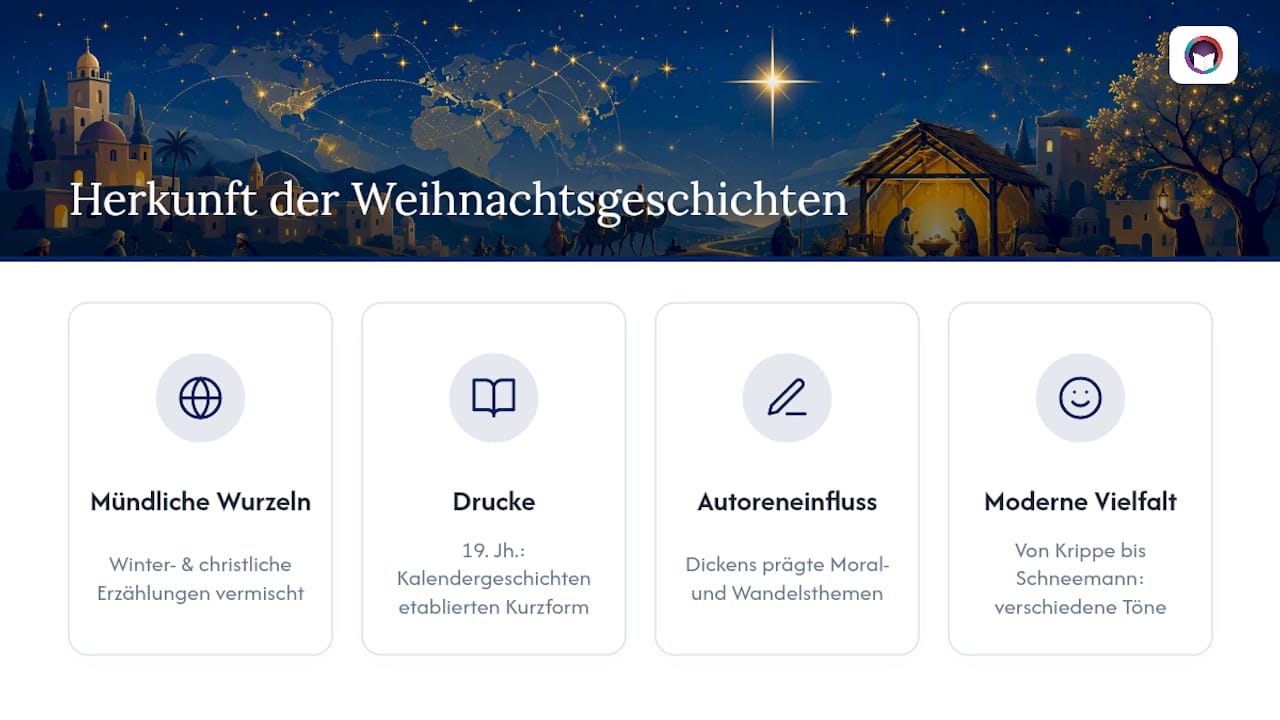
The tradition of reading stories at Christmas goes far back before modern children's literature. In the German-speaking area, orally transmitted legends around the winter solstice and the Christian nativity story mixed over centuries, long before anyone wrote them down. Only with the spread of printed calendar stories in the 19th century did the short Christmas tale become its own literary format, often with a moral twist at the end, intended for the reading evening by the fireplace.
Authors like Charles Dickens shaped an entire storytelling tradition with works about change and charity that still resonates today, even if modern short stories are usually much shorter. In parallel, the religious narrative of Jesus' birth lives on in nativity plays and children's stories, often heavily simplified for young listeners. This double root, half folkloric winter tale, half Christian tradition, explains why today's collections show such different tones side by side: from reflective nativity stories to funny snowman tales.
Suitable accompanying activities for story reading
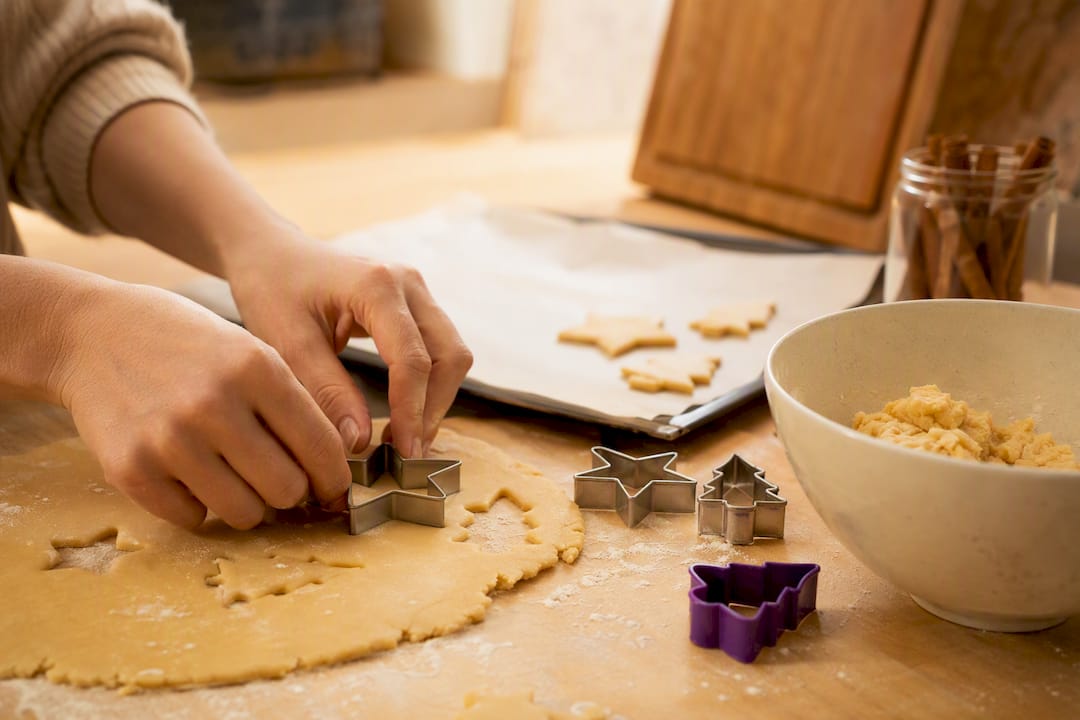
A short story often has more impact if something remains in the hands afterward. After a story about Christmas cookies, baking together almost suggests itself, with simple cookie cutters and little preparation. After an animal story, the animal can be recreated from paper or felt, for example a reindeer from a handprint or a simple snowman from cotton.
For Advent celebrations in groups, a short craft session immediately after the story works especially well because it catches the children's attention span before they get restless. A window picture related to the story just heard, a self-written wish list after a story about Santa Claus, or a little poem to repeat keep the topic alive without overwhelming the children.
If you use the story as a bedtime ritual, you should consciously omit the accompanying activity. After reading aloud here, only the light goes out, no more activity, otherwise the story works against its actual function.
Try OutaStory: read or listen to short stories instantly
If you don't want to search for a long time, you will find on OutaStory immediately a selection of short, free stories to read or listen to, without any registration required for the first test. Unlike a pure text collection, the platform offers both at the same time: the text for your own reading aloud and the audio version when no one feels like it or has time.

Open the children's section, choose a short story by reading time and test the audio function directly before you read it live in the evening. If you write yourself, you can publish your own Christmas story in a few minutes and participate in the revenue sharing of the proceeds. The quickest next step: open a short story on OutaStory and simply listen.
Sources
If you want to browse beyond the lists presented here, you will find at www-weihnachten.de a wide collection of short texts with age indications, on the same site specially age-appropriate recommendations for children from toddler age, and at Viabilia a complete story with a PDF option to print.
- Short Christmas stories for children & adults — small Christmas stories
- Short Christmas stories children — age-appropriate recommendations
FAQ
Which are the most well-known Christmas stories?
Among the most well-known are Charles Dickens’ "A Christmas Carol", the biblical story of the birth of Jesus, and numerous modern short stories about Santa Claus, reindeer and Christmas miracles, which collections like OutaStory are constantly expanding with new texts.
What mini Christmas stories are there?
Mini-Christmas stories are usually one to three minutes long and intended for toddlers from two to three years old, with one character and a simple, recurring sequence around snow, stars or Santa Claus.
What short stories are there for adults?
Short tales for adults usually last five to twelve minutes and often deal with contemplative themes like family, memory or a gentle irony about Christmas stress, rather than a clear moral message.
How is the story of Jesus' birth told briefly?
In the short version, Mary and Joseph travel to Bethlehem, find no lodging there and give birth to their child in a stable, where shepherds and later the Three Wise Men visit, guided by the Star of Bethlehem.
Recommendations
- The best bedtime stories for children from 0 to 8+
- 5-minute stories: ready-to-read ideas for parents
- Short stories for beginning readers: Where to find suitable reading material immediately
Read and write on OutaStory
Thousands of short stories to read for free — or publish your own and find an audience.