
Show, don’t tell: Examples that make the difference visible immediately
“Show, don’t tell” means making an emotion or situation tangible through concrete action, bodily reaction and sensory perception, instead of merely naming it. Tell: “She was angry.” Show: “She slammed the cup onto the counter so hard the handle snapped off.” The second sentence shows anger without using the word, and that is precisely where the effect comes from.
In short:
- Replace feeling words with visible actions, bodily reactions or sensory impressions so the audience infers the emotion themselves, for example a clenched jaw instead of “anger.”
- Check important scenes with the camera test: what a camera couldn't capture usually needs a concrete action, a sensory anchor or a more immediate perception.
- Summarize time jumps, unimportant subplots and backstory briefly; elaborate showing is worthwhile mainly for scenes that decisively change a character.
- Strong verbs, dialogue with subtext and free indirect discourse make scenes more immediate; remove frequent filter words that create distance from the character.
Table of contents
- Where does the principle come from and what is behind it?
- Show examples: Anger, fear, sympathy and space rewritten
- Which techniques make a scene truly visible?
- How do you check your text for genuine showing?
- When is it okay to tell instead of show?
- Why regular publishing helps with showing
- FAQ
- Sources
Where does the principle come from and what is behind it?
The distinction is older than many writing guides suggest. In 1921 Percy Lubbock described in his work \"The Craft of Fiction\" the separation between Picture and Drama: Picture tells the reader something, Drama lets them experience the action. This distinction still forms the foundation of what we know as Show and Tell today, as documented by the Modernism Lab at Yale University. The concrete formulation \"Show, not tell\" can also be traced back to theater tradition, where playwrights like Mark Swan were already working with it in the 1910s.
Why does showing feel stronger? Because it forces the reader to take an active role. They don't just read a piece of information; they draw the conclusion themselves that the character is angry, in love, or frightened, and that small thought process binds them to the text.
- Picture (Tell) reports, Drama (Show) lets you experience.
- Showing activates independent inference instead of passive consumption.
- The technique doesn't come from modern writing-guide culture, but from over a hundred years of narrative theory.
Show examples: Anger, fear, sympathy and space rewritten
The difference becomes clearest in direct contrasts. The following four examples take typical Tell sentences and turn them into scenes that show the same information without stating it.
- Anger: Tell: “Markus was angry at his brother.” Show: “Markus clenched his teeth until his jaw ached, and put the receiver down so hard the phone slid off the table.” The physical reaction and the small destruction replace the adjective completely, and exactly such concrete reactions are recommended by the OzLit editorial guide as more effective than a simple naming of the feeling.
- Fear: Tell: “She was afraid of the dark.” Show: “Her fingers couldn't find the light switch, and every creak of the old floorboards made her hold her breath.” Here free indirect discourse—that is, the rendering of her immediate perception without explanatory addition—does the work that a mere “fear” could never do.
- Sympathy: Tell: “He was a friendly person.” Show: “He held the door open for the old woman even though the bus was already pulling away, and he waved to her as she walked on.” The small, unobserved gesture shows character more convincingly than any ascribed trait.
- Space and atmosphere: Tell: “The room felt oppressive.” Show: “The wallpaper peeled off the wall in long strips, and the smell of damp paper hung so heavily in the air that she breathed through her mouth.” Sensory details like smell and touch create the mood here instead of asserting it.
Each of these examples uses a concrete action or an action beat as the carrier for the emotion. The trick is not to use more words, but more precise ones: a clenched jaw says more than three paragraphs about anger.
Which techniques make a scene truly visible?
Showing arises from a combination of few but repeatable tools. Vanderbilt University names three central levers: choose concrete rather than vague words, illustrate abstract concepts through scenes and use the senses deliberately.
- Set sensory anchors: Instead of “it smelled bad” prefer “the smell of old grease clung to the curtains,” as smell and touch often convey mood more strongly than mere visual description.
- Strong verbs instead of adverb crutches: “He walked quickly” becomes “He hurried,” “she spoke quietly” becomes “she whispered.” A precise verb replaces an entire adjective-adverb combination.
- Subtext in dialogue: Characters rarely say directly what they feel. A character who answers “Are you okay?” with “The food got cold” shows repression without naming it.
- Use free indirect discourse: A character's thoughts and perceptions flow directly into the narrative without prefacing with “she thought that,” which makes the perspective more immediate.
A small exercise: Write an argument between two characters using only what they do and say, without a single feeling word. The tension arises solely from action and dialogue.
Pro tip: Scan your text specifically for filter words like “she felt,” “he noticed” or “she thought”: each of these so‑called thought verbs inserts itself between the reader and the scene and can almost always be removed.
How do you check your text for genuine showing?
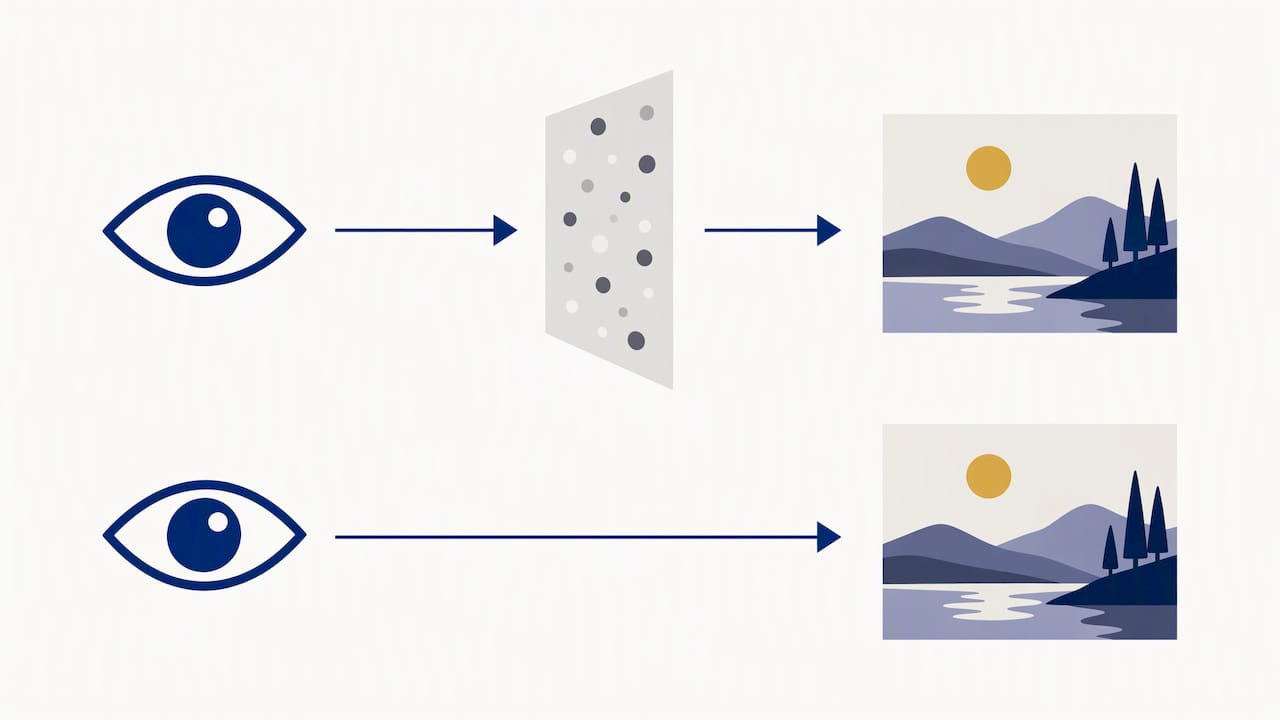
A simple test question helps during revision: Could a film camera capture this scene exactly as written? If not, there's probably too much telling in the text at that point, as the camera test method from the OzLit editorial guide suggests. The same applies to landscape and weather: instead of “it was stormy” show how the wind bends the branches and rips the coat from the character's hand.
For systematic revision, a short checklist is useful:
- Are abstract terms like “sad” or “beautiful” left untranslated in the text?
- Are passive constructions hiding the action?
- Do filter words like “she saw” or “he felt” appear unnecessarily often?
- Is there at least one sensory anchor per important scene?
- Does the scene show a clear, comprehensible action?
- Does the dialogue carry subtext or state everything outright?
As an exercise, it's worthwhile to write three short passages: show a scene purely through action, write a dialogue with subtext without stated feelings, and a short passage in free indirect discourse. 50 to 150 words each are enough to feel the principle in your own hands.
When is it okay to tell instead of show?
Showing is not an end in itself, and keeping everything as show would bloat every text tiresomely. Telling has its firm place, especially for time jumps, summarizing unimportant subplots or when speed is needed.
- Time jumps: “The next three years passed without incident.”
- Compression of side information that is not meant to carry emotional weight.
- Fast information flow, for example for necessary facts of the backstory.
The decision rule is simple: If the scene or emotion is central to the character's development, show it. If it's merely a link between two important moments, you may tell. Professional writers use telling deliberately for compression and reserve the detailed show technique for the scenes that truly matter, as the Modernism Lab's analysis of established storytellers' practice notes.
Why regular publishing helps with showing
I publish my own short stories, and that exact rhythm—finish a text, publish it, read reactions—sharpens the eye for Show and Tell faster than theory alone. Each new story is another opportunity to convey an emotion through an action rather than an adjective, and feedback quickly shows which scenes really work.
FAQ
What does „show don’t tell“ mean?
"Show, don't tell" means making an emotion, a character trait or an atmosphere perceptible through concrete action, bodily reaction or sensory impression, instead of naming it directly. The reader draws the conclusion themselves, rather than being handed it, which makes the text feel more vivid.
How do I write Show?
Replace abstract feeling words with a concrete action or bodily reaction that expresses that feeling, for example clenched fists instead of “angry.” Use targeted sensory details, strong verbs and dialogue with subtext, as Vanderbilt University describes in its revision guide.
What does show and tell mean?
"Show and tell" is a term from the English-speaking school context where children bring an object and tell the class about it. It has nothing to do with the literary principle "Show, don't tell", even though the terms sound similar.
Where does the principle „Show, don't tell“ come from?
The distinction goes back to Percy Lubbock's work "The Craft of Fiction" from 1921, in which he distinguished between Picture and Drama, supplemented by earlier mentions from the theater tradition. The concrete wording can be traced back to the playwright Mark Swan in the 1910s, as documented by Yale University's Modernism Lab.
Do I have to show every scene instead of telling?
No, telling is perfectly legitimate for time jumps, summarizing unimportant subplots and for deliberate tempo changes. Showing pays off especially where a scene or emotion is central to a character's development.
Sources
Recommendations
- The Grammar of Pressure
- The Scribe Who Counted Twice
- Progression Fantasy: The Quiet Rise
- Undeliverable, Yet Present
Read and write on OutaStory
Thousands of short stories to read for free — or publish your own and find an audience.