
Short story contests 2026: Deadlines and opportunities
The most important short story contests of 2026 that are currently open are the Autorenkreis-Ruhr-Mark literature contest, the Kurzgeschichtenwettbewerb Havelland, the VFR SF contest, "Sound der Finsternis" and the Walter-Serner-Preis. The tightest deadline is 15 June 2026 at the Autorenkreis Ruhr-Mark, followed by Havelland on 30 June. All details about themes, text lengths and submission methods can be found in the section "Detailed contest overview". Check the exact submission format with the respective organizer now before you start writing.
In short:
- Applications for the Walter-Serner-Preis are only possible if you reside in Berlin or Brandenburg, with a deadline of 12 October and a prize of 4.000 euros.
- The VFR contest is open to all; it requires timely email delivery via Outlook because the reception timestamp is decisive.
- Autorenkreis Ruhr-Mark explicitly excludes AI-generated texts, while other contests handle work with writing assistants differently.
- A regional connection is a basic requirement for the Havelland contest; youth participation is enabled through explicit age rules.
- If you want to reach readers immediately, you can publish texts on platforms like Outastory without having to wait for jury decisions.
Contents
- Overview: These short story contests in 2026 are worth it
- Detailed contest overview: fact sheets for each call
- Entry requirements, rights and formatting rules: what will decide success in 2026
- Practical submission tips and scheduling for 2026
- Publish your short story immediately instead of waiting for a jury
- Sources
- FAQ
Overview: These short story contests in 2026 are worth it
Seven calls form the backbone of the German-language short story contest landscape in 2026. Some target a nationwide audience, others are tied to a place of residence or a genre. If you want to allocate your time sensibly, you should go through this overview first before diving into the full entry requirements.
- Walter-Serner-Preis 2026: Only for authors residing in Berlin or Brandenburg, submission deadline 12 October, prize money up to 4.000 €.
- VFR SF short story contest: Open to all, focus on science fiction, deadline 31 July, the Outlook reception timestamp is decisive.
- Autorenkreis Ruhr-Mark literature contest: Open to all, categories prose and poetry, deadline 15 June, AI texts explicitly not permitted.
- Short story contest Landkreis Havelland: Regional connection mandatory, deadline 30 June, minors require parental consent.
- zeilen.lauf short story and poetry contest: Open to all, Austrian organizer, deadline 23 August, tiered prize money from 500 € for first place.
- 'Sound der Finsternis' (muc Verlag): Horror and mystery, deadline 1 October, the prize is publication in an anthology rather than money.
- Grusel-Wusel contest: Focus on horror and fantasy, aimed at a broader beginner audience, details vary by year and should be checked with the organizer directly.
When it comes to eligibility, one thing matters above all: residence and genre often decide before text quality whether a submission is even admissible. The Walter-Serner-Preis, for example, is not accessible without a Berlin or Brandenburg registration address, as the announcement from radio3 and the Literaturhaus Berlin makes clear. Havelland requires a content-related tie to the region, not just a residence there.
It's worth taking a second look at the form when it comes to prizes. Some contests pay cash, others reward publication, which is often equally valuable for your bibliography. 'Sound der Finsternis', for example, awards no cash prize but grants a fixed place in the anthology of muc Verlag. If you want both prize money and visibility, the Autorenkreis Ruhr-Mark offers a combination of tiered prize money and inclusion in a collection.
One point runs through almost all current calls: the clause against artificial intelligence. Both the Autorenkreis Ruhr-Mark and the muc Verlag explicitly exclude AI-generated texts. If you work with writing assistants, read carefully how the individual formulation is framed, because some organizers mean pure AI texts while others also prohibit AI-assisted revision.
Detailed contest overview: fact sheets for each call
Each call has its own logic, its own formatting rules and its own trap. The following fact sheets summarize what really matters for a successful entry in 2026.
Walter-Serner-Preis 2026
The main prize endowed with 4.000 € makes the Walter-Serner-Preis one of the most financially attractive contests in the German-speaking area, albeit with a strict regional limit.
- Theme: open, literary ambition in the sense of Walter Serner's short prose tradition.
- Submission deadline: 12 October 2026.
- Eligibility: only persons residing in Berlin or Brandenburg.
- Prize: 4.000 € for first place, 500 € each for the further placings.
- Organizer: radio3 from rbb together with the Literaturhaus Berlin.
- Submission method: Details on the exact format are governed by the official announcement; registration via the contact routes named there is binding.
- Anonymity: Evaluation procedures for literary prizes of this size often run anonymized. If you're unsure whether metadata in the filename or the document itself reveals the name, you should, according to the participation notes for the prize, check before sending whether Word or PDF metadata contains the author's name.
If you don't live in Berlin or Brandenburg, you can save yourself the application. That may sound harsh, but it spares you unnecessary effort for a text that won't be considered anyway.
VFR SF short story contest 2026
The Verein zur Förderung der Raumfahrt is running a contest that explicitly targets science fiction authors, regardless of residence.
- Theme: science fiction in a broad sense; a spaceflight connection is welcome but not mandatory.
- Submission deadline: 31 July 2026.
- Eligibility: open to all, no regional restriction.
- Prize: Details on the exact prize amounts are given in the original announcement by the association.
- Submission method: electronic submission, with the association explicitly declaring the reception timestamp shown by Microsoft Outlook as decisive for meeting the deadline.
- Formal pitfall: If you send your email via another program or your provider delays delivery, your entry may arrive too late despite being sent on time. The reception time counts, not the send time.
This Outlook rule is one of the most concrete stumbling blocks of the contest year. If you submit at 23:50 on the last day and the server needs seven minutes, you're out.
Autorenkreis Ruhr-Mark literature contest 2026
With the earliest deadline in the calendar year, the Autorenkreis Ruhr-Mark opens the season and at the same time demands one of the clearest AI exclusion clauses.
- Theme: open, two separate categories for prose and poetry.
- Submission deadline: 15 June 2026.
- Eligibility: open to all, no regional restriction mentioned.
- Prize: tiered prize money per category: 300 € for first place, 200 € for second, 100 € for third.
- AI clause: texts generated with AI are explicitly not permitted.
- Submission method: information on formats can be found in the original announcement of the Autorenkreis.
If you write both prose and poetry, you can in theory enter both categories, but you should clarify in the announcement beforehand whether multiple submissions per person are allowed.
Short story contest Landkreis Havelland 2026
The Landkreis Havelland is staging its short story contest in 2026 for the first time with a clear regional claim that goes beyond mere residence.
- Theme: The submitted text must have a content-related connection to the Havelland region; a place name alone is usually not sufficient.
- Submission deadline: 30 June 2026.
- Eligibility: Participants under 18 require parental consent.
- Prize: 250 € for first place, 200 € for second, 150 € for third.
- Submission method: The county PDF lists the exact format requirements, including likely details on file format and contact address.
- Special feature: This call is well suited to young people and young adults because the administration explicitly considers guardians, which suggests an open age structure.
The regional connection here is not a bonus point but a basic requirement. A text with no Havelland tie will probably be eliminated in the first screening.
zeilen.lauf short story and poetry contest 2026
The Austrian organizer zeilen.lauf brings a welcome complement to the field, especially because the announcement serves both prose and poetry at once.
- Theme: open, both short stories and poems are accepted.
- Submission deadline: 23 August 2026.
- Eligibility: open to all; however, with an Austrian organizer, participants from Germany should check the exact conditions regarding rights and taxes on prize money.
- Prize: 500 € for first place, further prizes tiered below.
- Submission method: Details on the format are provided directly on the organizer's website.
If you already have experience with the Autorenkreis Ruhr-Mark, you'll find a similar two-category structure at zeilen.lauf, only under Austrian law.
"Sound der Finsternis" (muc Verlag) 2026
If you write horror or mystery, you’ll find in "Sound der Finsternis" as one of the best dystopian short stories one of the few calls in the German-speaking market tailored precisely to that.
- Theme: horror and mystery; the title sets the dark tone.
- Submission deadline: 1 October 2026.
- Eligibility: open to all.
- Prize: publication in an anthology, no cash prize. According to the publisher, those who order receive a discount.
- AI clause: AI-generated texts are excluded.
- Rights: Inclusion in an anthology usually means granting usage rights for that publication. How far these rights extend should be read carefully in the muc Verlag's participation conditions before submitting, since inclusion can have consequences for later self-publication of the same text.
Grusel-Wusel contest 2026
The Grusel-Wusel contest regularly appears in aggregator lists like kreativ-schreiben-lernen.de and targets a broader, more beginner-friendly audience with a focus on horror and fantasy themes. The exact conditions for deadline, prize money and format change from year to year, so checking the organizer's current announcement before submitting is mandatory. If your theme oscillates between horror and light fantasy, you'll often find a lower entry barrier here than with established literary prizes.
Entry requirements, rights and formatting rules: what will decide success in 2026
A literarily strong text fails surprisingly often not because of content but because of formalities. If you clarify the following points beforehand, you will spare yourself disappointment after the deadline.
- Check whether your text counts as "published". Many organizers exclude already published texts. A text that is accessible online on a platform is often considered published in such cases and therefore no longer eligible, even if no publisher was ever involved. Clarify this before uploading a new text, not afterwards.
- Distinguish between non-exclusive and exclusive usage rights. A non-exclusive right allows the organizer to print or post your text online without you losing your rights. An exclusive right can mean that you are not allowed to publish the text anywhere else afterwards, at least for a certain period. Read this paragraph of the terms twice.
- Take AI clauses literally. Wording varies significantly between organizers. Some exclude only fully AI-generated texts, others are stricter and also exclude AI-assisted revision. Quote the exact wording from the participation conditions for your own reference instead of relying on a general memory.
- Ensure real anonymity if a blind procedure is required. Word and PDF files often store author names in metadata even if the name is missing from the visible text. An anonymized procedure requires that these metadata be removed before sending, otherwise you risk formal exclusion despite a good text.
- Strictly follow technical requirements. File format, maximum character count or standard pages, correct subject line and allowed attachments differ from call to call. A wrong file extension or a missing subject line can in the worst case cause the email to land in the jury's spam folder.
Pro tip: Create a short checklist for each contest before you even start writing. If you only notice after finishing the text that publication on your own platform disqualifies participation, you've lost valuable time.
Anonymized evaluation procedures are not a marginal detail of literary prizes but often a central quality promise of the jury to all participants. A blind jury is intended to prevent well-known names from having an advantage over unknown authors. That is exactly why many organizers react strictly if the name inadvertently appears in the filename or the header.
Practical submission tips and scheduling for 2026
If you only start the final polishing on the day of the deadline, you've created an unnecessary risk for yourself. A fixed schedule protects both against textual errors and technical mishaps.
- About two weeks before the deadline: finish editing, read the text aloud or have a second person read it.
- About one week before: final proofreading round, focus on spelling, punctuation and consistent formatting.
- 48 hours before: produce the final PDF or Word document, check and remove metadata for anonymized procedures, choose a neutral filename, for example using a code instead of your own name.
- 24 hours before: send a test email to yourself or a trusted person to ensure attachments arrive correctly and no formatting errors occur.
- On the day of submission: send the actual application, by no means wait until the last hours before the deadline.
The 24-hour buffer is not excessive paranoia but a direct response to rules like the VFR SF contest, which explicitly declares the Outlook reception timestamp as binding. If you submit only minutes before midnight, you leave deadline compliance to the chance of an email server.
A checklist for the mail itself saves additional nerves. Form the subject exactly as required, attach all requested documents in the correct format, add a short cover note with title and, if applicable, word count, and if required attach a brief bio separately from the manuscript so the anonymized file stays clean.
Publish your short story immediately instead of waiting for a jury
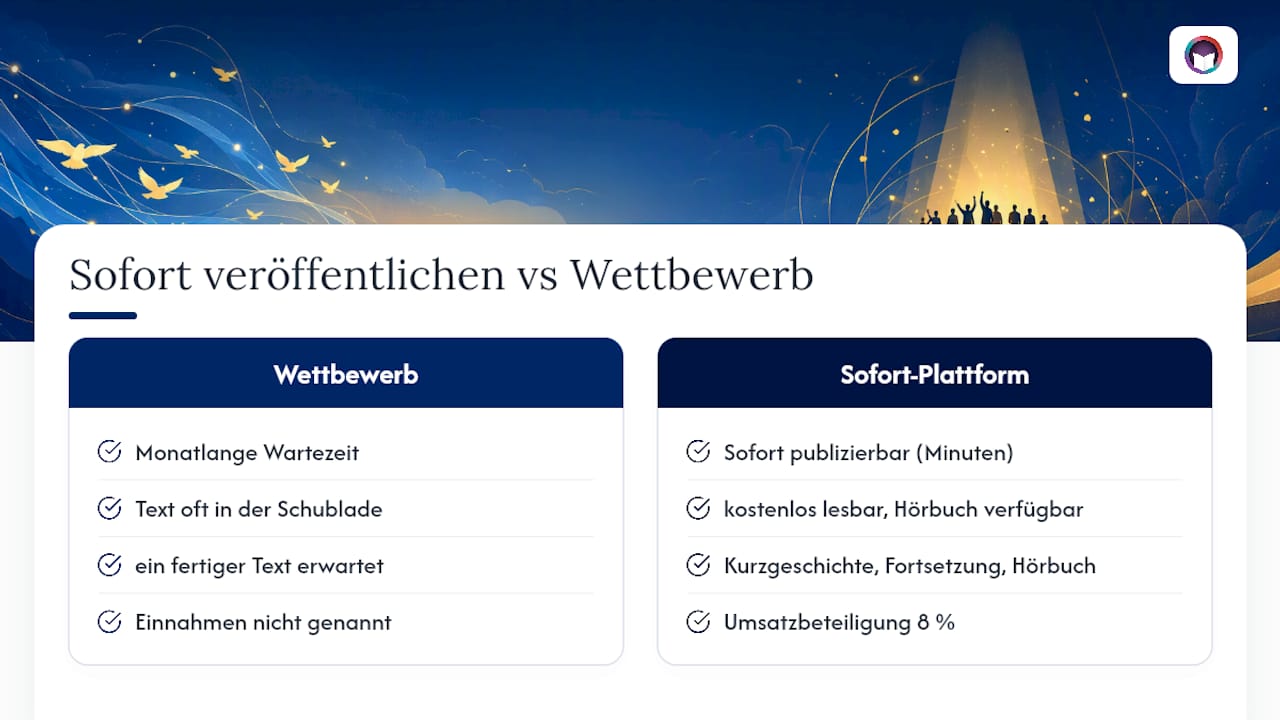
Calls like the Walter-Serner-Preis or the Autorenkreis-Ruhr-Mark contest are valuable, but they take time. Between the submission deadline and the result, months often pass in which a finished text simply waits in the drawer.
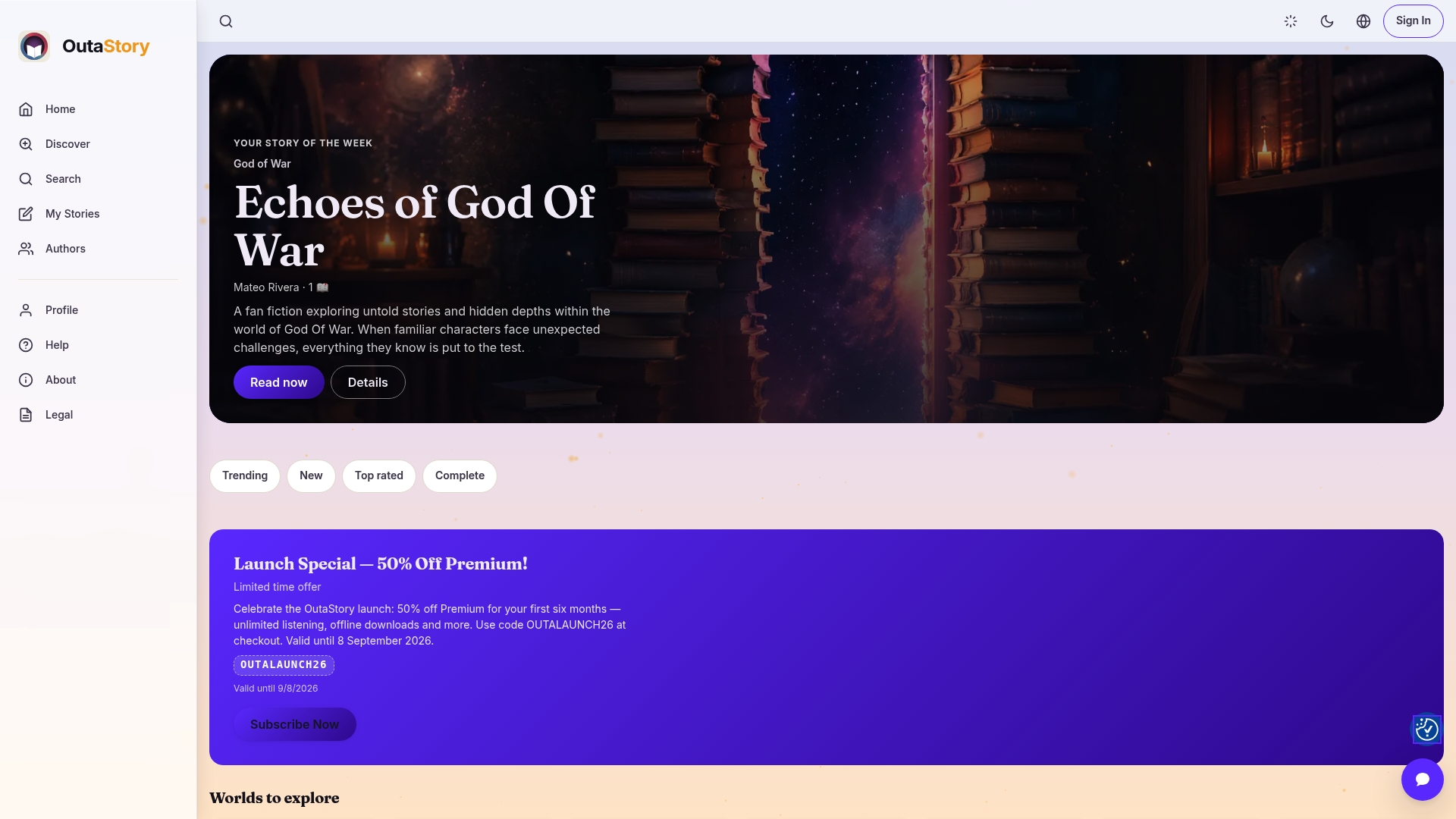
There are platforms where you can publish short stories in minutes, make them freely readable for everyone and optionally available as audiobooks, either with professionally produced voices or your own voice. Genre variety from fantasy and romantasy to crime and thriller and horror is represented, as is a dedicated children's section with bedtime stories. If you have a longer idea, you can publish it chapter by chapter as a serial instead of waiting for a single finished text.
Who is this useful for? For everyone who does not want to wait months for a jury decision but prefers to reach readers immediately. Through a revenue share of 8% of the earnings from your own stories, authors benefit directly from their reach, as explained on the page for narrators and authors. If you want to get more out of your publication, you'll find additional features for readers on the page for premium membership. A contest does not automatically exclude publication on Outastory, however — the decisive factor is always the exact wording in the respective participation conditions, which is why it's worth checking the guide to writing contests before you use the same text twice.
Sources
The following direct links lead to the binding terms of the named contests. The T&Cs and announcement texts of the organizers take precedence over any summary.
- Application until 12 October 2026 - radio3 from rbb and the Literaturhaus Berlin announce the Walter-Serner-Preis for short stories 2026
- SF contest 2026 – Verein zur Förderung der Raumfahrt e.V.
- Literature contest 2026 – Autorenkreis Ruhr-Mark e.V.
- Short story contest 2026 — Landkreis Havelland
- Call 2026 — muc Verlag (Sound der Finsternis)
FAQ
Is there a short story writing contest in 2026?
Yes, several. The Autorenkreis Ruhr-Mark, the Landkreis Havelland, the VFR-Verein, the muc Verlag and the Walter-Serner-Preis are each running their own short story contests in 2026 with varying deadlines between June and October.
Are there calls in 2026 specifically for short stories with a genre focus?
Yes, "Sound der Finsternis" specifically targets horror and mystery pieces, and the VFR contest is aimed at science fiction. Both calls are open to participants without regional restrictions.
Which calls does the Schreiblust Verlag currently have?
There are no definitive details here about current calls from Schreiblust Verlag. For up-to-date information, check the publisher's website directly or aggregator lists like kreativ-schreiben-lernen.de.
Is there a writing contest with prize money?
Yes, the Walter-Serner-Preis pays up to 4.000 € for first place, the Autorenkreis Ruhr-Mark up to 300 € per category, and the Landkreis Havelland up to 250 €. Those who prefer to publish immediately instead of waiting for a jury decision can upload their story to Outastory for free and share in the revenue via the platform's revenue share.
How can I anonymize my short story before submitting it?
Before sending, remove all metadata from Word or PDF documents — where your name is often stored automatically — and choose a neutral filename without your name. This step is especially important if an organizer requires an anonymized evaluation process with a blind jury.
Recommendations
- Writing contests – how they work
- Length of short stories: 1.000–10.000 words, tips for trimming for authors
Read and write on OutaStory
Thousands of short stories to read for free — or publish your own and find an audience.