Short children's rhymes: ready-to-use verses for daycare and home
Yes, short children's rhymes can be used immediately. Below you will find copyable rhymes sorted by category, along with age recommendations and practical tips for direct use. Spoken briefly and rhythmically, they also promote phonological awareness — the sensitivity to sounds and syllables — which later helps with reading and writing.
In short:
- Finger rhymes and lap rhymes are suitable from one year, nonsense rhymes from two, counting rhymes from three and tongue twisters from four years, especially for preschoolers.
- For transitions like handwashing two lines are enough, while rhymes for circle time may have four to six lines so children can follow.
- First model the rhyme slowly, repeat it over several days and add gestures before changing individual words.
- A meta-analysis found a moderate effect on phonological skills and short-term transfers to reading and spelling; however, rhymes do not replace structured intervention programs.
- Audio offerings make repetition easier, but they do not replace speaking together or the movement in finger rhymes and lap rhymes during direct contact with the child.
Table of contents
- 1. Ready-to-use short children's rhymes
- 2. Why short rhymes work: benefits for language and concentration
- 3. Types of short rhymes and how to choose them
- 4. Practical guide: introducing rhymes and using them daily
- 5. Short resource from OutaStory: children's rhymes, reading aloud and audio forms
- 6. Origin and history of children's rhymes
- 7. Use of children's rhymes in kindergartens and preschools
- 8. Integration of short children's rhymes into digital learning media
- 9. Gentle note: OutaStory as a complement for audio and short texts
- FAQ
- Sources
1. Ready-to-use short children's rhymes
A good collection of rhymes doesn't have to be long. It must be catchy, have a clear rhythm and be retrievable in seconds, whether waiting at the checkout or transitioning from circle time to breakfast. The following selection covers the most important categories.
- Counting rhyme (from 3 years): “Eeny meeny, something's rattling in the box. Eeny meeny, and you're out.” Suitable for playfully deciding who starts.
- Finger rhyme (from 1 year): “This is the thumb, it shakes the plums. It picks them up, carries them home, it eats them all up.” Each finger is moved individually, ideal for nursery care.
- Lap rhyme (from 1 year): “Hop hop rider, when he falls he cries. If he falls into the ditch, the ravens will eat him.” The child sits on the lap and is gently moved up and down in rhythm.
- Tongue twister (from 4 years): “Fisher Fritz fishes fresh fish.” Challenges articulation and makes preschoolers laugh when it goes wrong.
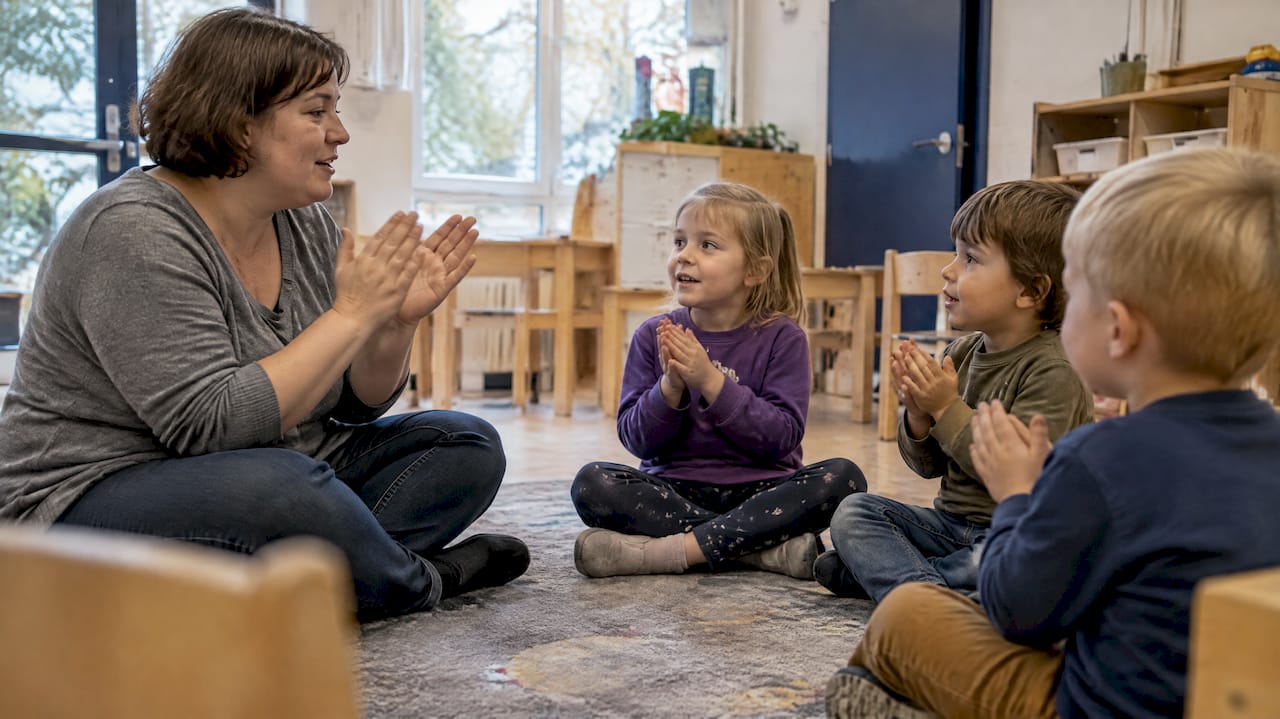
- Clapping rhyme (from 3 years): “Bake, bake a cake, the baker has called.” Said while clapping hands together and trains the sense of beat.
- Nonsense rhyme (from 2 years): “Once upon a time there was a man who had a sponge. The sponge was too wet, so he threw it into the grass.” The nonsense makes children curious about language itself.
- Routine rhyme for handwashing (from 2 years): “Soap, soap, lather up nice, water, water, let's go.” Two lines are exactly enough for the recommended wash time.
- Greeting rhyme for circle time (from 3 years): “Good morning, dear sun, good morning, dear world, today is a lovely day that makes us all happy.” Creates a fixed start to the day.
These rhymes are deliberately kept short. Two to six lines are enough so that even two-year-old children can join in without losing the thread.
2. Why short rhymes work: benefits for language and concentration
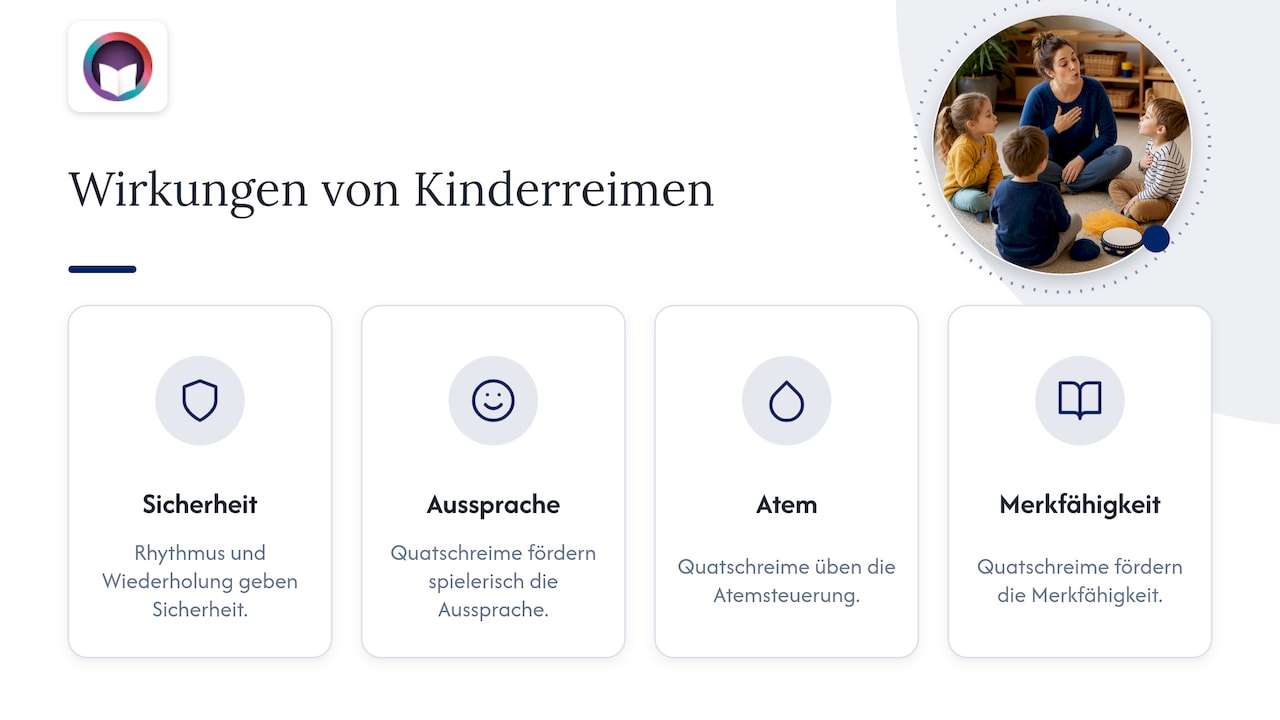
Rhymes are not mere pastime. They train phonological awareness — the ability to recognize sounds, syllables and rhyme pairs in words — and this ability is considered an important foundation for later reading and writing. A meta-analytic study for the German-speaking area shows a moderate effect of such training on phonological competence, with short-term transfer effects to reading and spelling.
Statistics: Trainings for phonological awareness show, according to the Bamberg University meta-analysis, a moderate effect on phonological competence. Rhymes are a low-threshold element of such trainings that can be integrated into everyday life without materials or preparation.
Educational practice sources complete the picture: rhythm and repetition give children security, and nonsense rhymes playfully promote articulation, breath control and memory.
3. Types of short rhymes and how to choose them
Not every rhyme fits every moment. The choice depends on age and the desired effect.
- Finger rhymes are suitable for infants and toddlers because the movement accompanies the language and supports understanding before words are understood.
- Lap rhymes work best for one- to three-year-olds because the physical movement makes the rhythm tangible.
- Counting rhymes are particularly suitable from three years old for transition situations, such as assigning roles in play.
- Tongue twisters challenge preschoolers articulatorily and are suitable for circle time when older children need a challenge.
- Nonsense rhymes fit wherever motivation is lacking, for example during tidying up or before nap time.
For transitions like handwashing two lines are enough; for circle time a rhyme may well be four to six lines long.
4. Practical guide: introducing rhymes and using them daily
Rhymes are best learned in four steps: first model, then repeat together, then link with movement and finally vary.
- Modeling: Say the rhyme yourself slowly and clearly before involving the child.
- Repeat: Let the rhyme run several times in a row, preferably over several days, so the rhythm becomes established.
- Movement: Link words with gestures, clapping or rocking; this makes it much easier for younger children to join in.
- Vary: Swap individual words once the rhyme is in place; this keeps curiosity alive and deepens the sense of language.
For nursery children a particularly slow speaking tempo is recommended; the beat matters more than the vocabulary. Rhyme cards or a small box with favorite rhymes help structure regular routines like circle time or handwashing.
Pro tip: Include older siblings by having them recite the rhyme and letting the little ones only add the last line.
5. Short resource from OutaStory: children's rhymes, reading aloud and audio forms
Rhymes are a good entry point, but children also need quieter moments with longer stories. In a special section of a short story platform you can find bedtime stories and animal adventures that pair well with an active rhyme moment: a rhyme to warm up, an audio story to calm down afterward. A writer of short children's stories looks after exactly such formats that can be read or listened to in a few minutes.
If you are looking for further examples of how short audio pieces can be incorporated into fixed rituals, see our overview of bedtime stories with suggestions for different age groups.
6. Origin and history of children's rhymes
Children's rhymes are among the oldest forms of oral tradition. Long before they were written down, mothers, grandmothers and nurses passed verses from generation to generation, often in sing-song and without a fixed melody. Many of the well-known German rhymes today, such as “Hoppe hoppe Reiter” or “Backe, backe Kuchen”, come from rural everyday life of the 18th and 19th centuries and reflect the occupations, animals and household scenes of the time.
Characteristic of this tradition is the typical length of four to twelve lines: long enough to tell a small scene, short enough to remember without writing. Collections like “Des Knaben Wunderhorn” from the early 19th century helped to record such verses systematically for the first time, although oral transmission in families and later in kindergartens remained the real lifeline.
The reason rhymes have been passed on with little change to this day lies in their function: they were never only entertainment but also a tool with which children practiced language, rhythm and social rules simultaneously, often embedded in games like counting or clapping.
7. Use of children's rhymes in kindergartens and preschools
In daycares rhymes are now part of the standard toolkit for language promotion. Practical sources like the ProKita-Portal article on children's rhymes describe how rhymes give children reliable rhythm and structure while strengthening articulation and breath control. Fixed rhyme rituals are especially helpful for children learning German as a second language, providing a dependable anchor in the daily routine.
Many institutions use rhymes deliberately for recurring transitions: tidying up, washing hands before eating, or moving from free play to circle time. The advantage is the lack of preparation: a rhyme needs no material, no technology and no long explanation — it works through voice and repetition alone.
Structured support programs also make use of such elements. The education server lists programs like “Listen, Tune In, Learn” and the Würzburg training, which systematically combine rhyme and sound games with screening instruments to specifically support children before school entry. Rhymes are not a replacement for such programs, but a low-threshold, daily-repeatable element that can be used alongside them without difficulty.
8. Integration of short children's rhymes into digital learning media
Rhymes are increasingly moving from the printed page to screens and headphones. For families this means: a rhyme a child learned at daycare can be replayed at home as an audio file, often with music or sound effects that further encourage participation. For language acquisition this can be helpful because children hear the same rhyme in the same intonation repeatedly and thus internalize the rhythm.
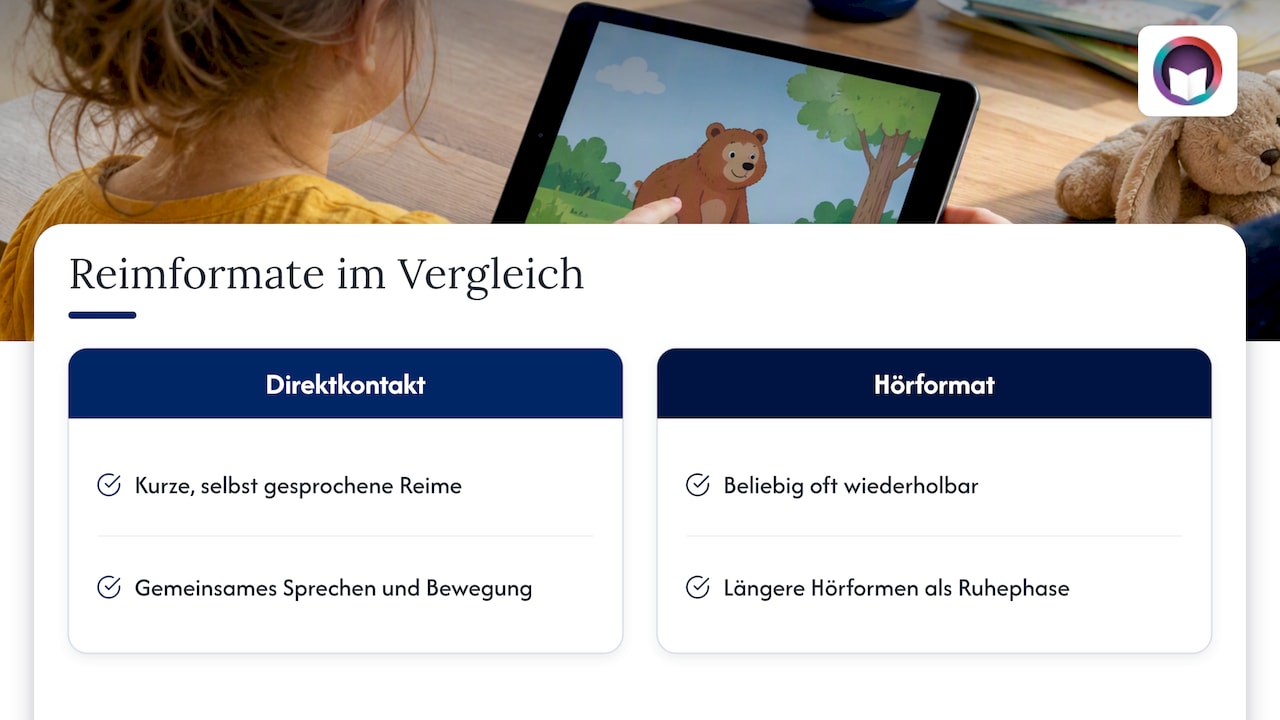
Digital formats bring a practical advantage: they can be repeated as often as needed without an adult having to recite them each time. This is a relief especially in moments when several children need attention at once. At the same time, no audio format replaces speaking together and the movement that makes lap rhymes and finger rhymes so effective, which is why both complement each other best: short, self-spoken rhymes in direct contact, longer audio forms as a calming phase afterward.
9. Gentle note: OutaStory as a complement for audio and short texts
If you are looking for a calm story to finish after the rhyme moment, our offering at OutaStory complements the routines mentioned above well. We provide short stories to read and listen to, including a children's area with bedtime stories and animal adventures.
- Stories can be listened to either as audiobooks or in the voice of the respective author.
- Longer narratives are released in chapters as serials, suitable for recurring evening routines.
- With Premium you can listen unlimited and offline, practical for on the go or when there is no network.

Check out our Premium membership directly if you are looking for a calm audio story for winding down in addition to the rhymes.
FAQ
What is a rhyming word?
A rhyming word is a word whose ending sounds match the ending of another word, for example “mouse” and “house”. Children often recognize such sound pairs before they can name the individual sounds, which makes them an important entry point into phonological awareness.
What simple songs are there for children?
Simple children’s songs like “Alle meine Entchen” or “Backe, backe Kuchen” pair a clear melody with short, repeating lines. They work similarly to rhymes: rhythm and repetition make it easier to sing along even in toddlerhood.
What short, funny poems are there for children?
Nonsense rhymes like “Once upon a time there was a man who had a sponge” are especially popular with children because the silliness makes them laugh and at the same time stimulates imagination. Such rhymes are suitable from about two years and can easily be expanded with your own wordplay.
Which 3 types of rhymes are there?
Commonly distinguished are counting rhymes, lap rhymes and finger rhymes, which differ by function: counting rhymes structure games, lap rhymes accompany physical movement, finger rhymes link speech with gestures. Tongue twisters and clapping rhymes also belong to the common short forms.
Sources
- How effective are measures to promote phonological awareness? A meta-analytic study
- Children's rhymes in kindergarten and daycare: language support with fun
- Promotion of written language - preschool support and preventive programs
Recommendations
- The best bedtime stories for children ages 0 to 8+
- Short Christmas stories: immediately suitable by age and occasion
- 5-minute stories: ready-to-read ideas for parents
Read and write on OutaStory
Thousands of short stories to read for free — or publish your own and find an audience.