
Audiobook vs Audio Drama: The difference explained in one sentence
In short: an audiobook is predominantly a reading, usually performed by a single voice. An audio drama, by contrast, is a staged production with multiple roles, music and sound effects that builds an entire sonic world. One performance is spoken text. The other is theater you listen to.
In short:
- An audiobook is a single-voice reading without extensive sound design, while an audio drama is a staged production with multiple actors and sound effects.
- In an audiobook, usually one narrator reads the entire text, whereas an audio drama uses several voices and sound effects to create an atmospheric scene.
- An audiobook is often sold alongside the printed edition, while an audio drama is staged independently with higher production effort.
- For longer, calmer listening sessions an audiobook is suitable, while an audio drama allows deep immersion into scenes and atmosphere.
- Legally, audio dramas are more complex because more rights for music, effects and multiple performers must be clarified.
Table of contents
- What is an audiobook? Typical features and production forms
- What is an audio drama? Typical features and production forms
- Audiobook or audio drama: The key differences in direct comparison
- When is which format worthwhile? Use cases and target groups
- Advantages and disadvantages: reception, learning effects and immersion
- Practical example: How Outastory makes short stories listenable
- Historical development and origin of audiobooks and audio dramas
- Legal aspects and copyright differences between audiobook and audio drama
- Listen to your next story on Outastory
- Sources
- FAQ
What is an audiobook? Typical features and production forms
An audiobook is the spoken version of a novel, nonfiction book or short story. A narrator reads the text aloud, usually without role distribution, sometimes with subtle musical underscoring at chapter beginnings. That's exactly the appeal: you hear a reader's interpretation, not a staged production with distributed roles.
In retail, however, the term “audiobook” is defined more broadly than the pure definition might suggest. Publishers often list elaborately staged productions under this umbrella term, which causes confusion for buyers, as the editorial team at Ohrenblicke notes. On the book market an audiobook often has its own ISBN, as the overview article on Wikipedia also describes. It is therefore treated formally like an independent book product, not just as an add-on to the printed title.
Typical features of an audiobook at a glance:
- A single narrator performs the entire text.
- Chapters follow the structure of the text source, usually unchanged.
- Music, if present at all, is used sparingly as transitions.
- The focus is on the narration performance, not on sound design.
- Sales often run parallel to the printed or digital book edition.
What is an audio drama? Typical features and production forms
An audio drama is a dramaturgically staged audio production. Multiple speakers take on individual roles, a director leads the recording, and sound effects and music build an independent soundscape. The result sounds like a small film without picture. The Springer specialist publication on audio drama and audiobooks describes this difference precisely: audio dramas are clearly distinguished from plain readings by voice, sound, music and audio engineering.
Within the genre, a further distinction is worthwhile. The radio audio drama emerged as an independent broadcast format for radio and is often produced live or for a specific broadcast time. The commercial audio drama, by contrast, is intended from the start as a product for sale, usually more elaborately edited and equipped with a larger production budget.
Typical features of an audio drama:
- Several actors portray different roles in dialogue.
- A director leads the recording and editing.
- Sound effects create spatial depth and atmosphere.
- Music underscores tension arcs and scene changes deliberately.
- The dialogue portion is significantly higher than in a plain reading.
Audiobook or audio drama: The key differences in direct comparison
If you need to decide quickly which one you're looking at, you can usually find the answer in a few keywords on the product page. If it says “read by” with a single name, it is an audiobook. If terms like “staged”, “with sound design” or “multiple performers” appear, you have an audio drama.
| Feature | Audiobook | Audio drama |
|---|---|---|
| Narrator setup | Usually one narrator for the entire text | Multiple actors with fixed roles |
| Sound design / music | Sparse, usually only transitions | Continuous, with effects and score |
| Dramaturgy / dialogue share | Narrator voice, few direct dialogues | High dialogue share, staged structure |
| Length / production effort | Often text-faithful, lower effort | Often abridged, significantly higher effort |
| Typical use | Novels, nonfiction, long trips | Crime, fantasy, children’s formats, atmosphere |
If you want to experience the full length of the text and the voice of a particular author, choose the audiobook. If you want to dive into a scene where rain pelts on sheet metal and two characters shout at each other, the audio drama is the right choice. This distinction also helps with the decision between audiobook and e-book when considering which audio format suits your situation.
When is which format worthwhile? Use cases and target groups
The choice depends less on taste and more on the situation in which you listen. Three scenarios show how differently the two formats work.
- In the car or commuting, an audiobook works almost always reliably: you can follow the story again even after short lapses in attention because a single voice leads you.
- As a bedtime ritual with children, the audio drama unfolds its strength because sounds and multiple voices stimulate the imagination more than a single reading voice.
- For learning or passive listening while doing housework, the audiobook is better suited because fewer acoustic stimuli distract from the main content.
Those who cook, clean or jog in the background benefit from the straightforward structure of an audiobook. Those who deliberately take time and can listen undisturbed, for example in the evening on the sofa, will get much more atmosphere out of a well-produced audio drama. For families who want to listen together, it’s worth taking a look at audiobooks for family listening, since both formats work differently well depending on the children's ages.
Advantages and disadvantages: reception, learning effects and immersion
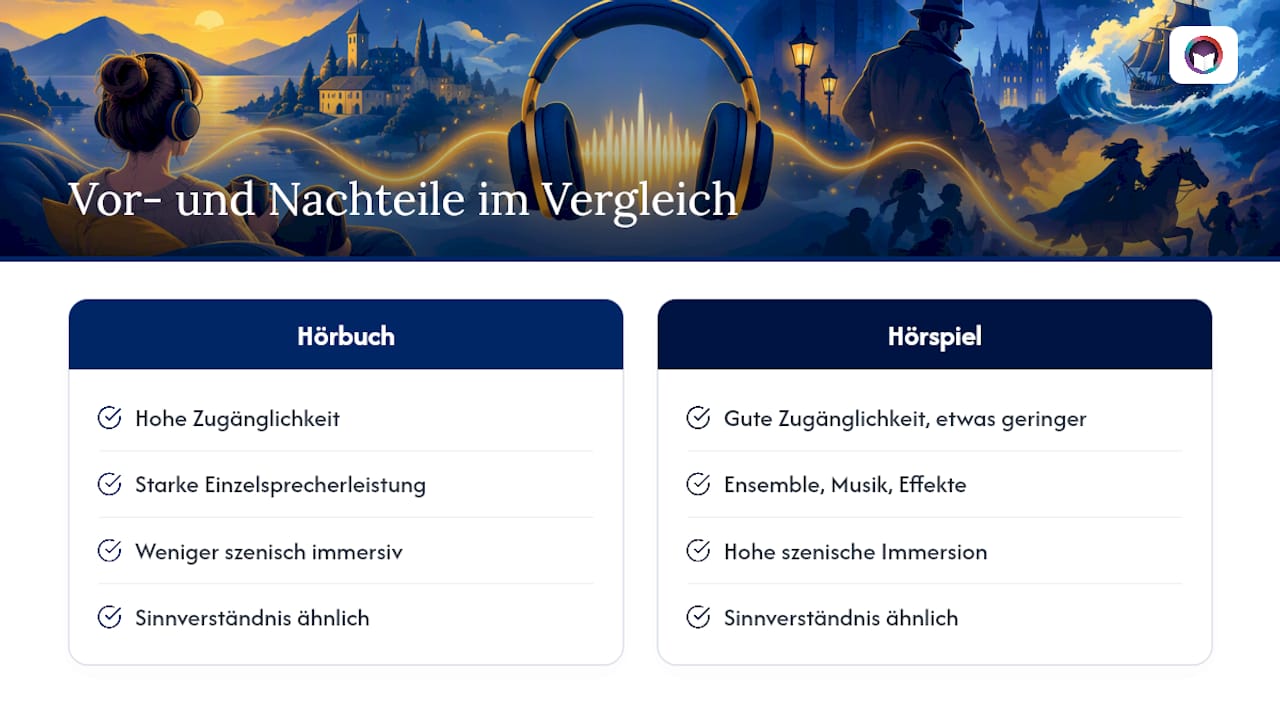
Audiobooks score mainly through accessibility. They also work for reading difficulties or visual impairments and can be consumed almost anywhere without requiring visual concentration. A strong narration performance often carries a text further than reading alone might.
Audio dramas, on the other hand, play to their strengths in immersion. The combination of multiple voices, music and sound effects creates an immersion that a single narrator’s voice can hardly achieve, especially for scenically conceived stories.
Scientific fact: research on language processing shows that reading changes how the brain later processes heard sentences; experienced readers perceive spoken sentences more differentiatedly. At the same time, reading and listening activate very similar brain regions when grasping meaning, as Ad-hoc-News reports. In practice this means: neither format is fundamentally inferior to the other in terms of understanding.
One disadvantage remains for both formats: if you are highly distracted, you miss details — with audio dramas perhaps even faster because of the sensory density than with the calmer audiobook. And the narrator's interpretation, whether a single voice or an ensemble, always constrains your own imagination to some extent.
Practical example: How Outastory makes short stories listenable
As a listener you can hear short stories with different voices, including professionally produced ones or the author's voice. The genre range extends, for example, from fantasy and crime to stories for children.
The player offers features such as chapter structure for serialized stories, choice between different voice options, offline playback and seamless playback.
Pro tip: For short, serial stories a well-spoken, clear reading is often sufficient and saves production time. If you want to create strong atmosphere, for example in horror or fantasy, a small staging with additional voices or sound elements is worthwhile.
Historical development and origin of audiobooks and audio dramas
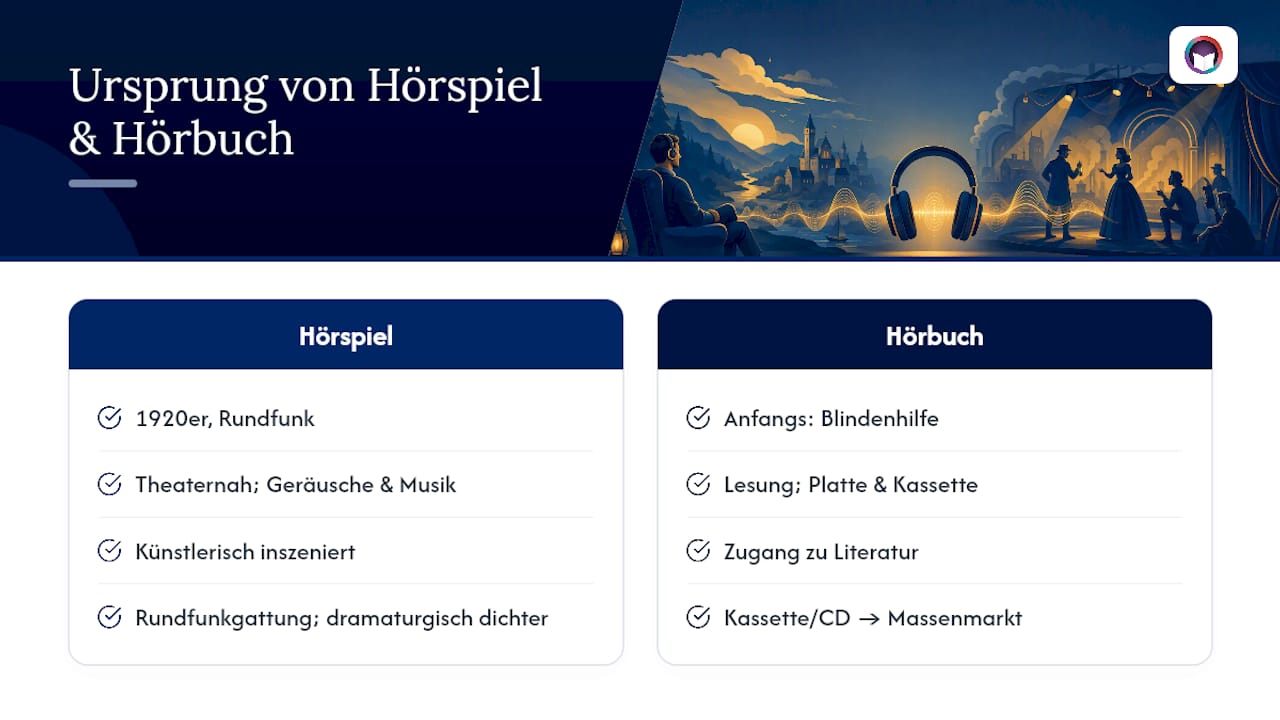
The audio drama is older than many assume. It emerged in the 1920s with the advent of broadcasting, when stations were looking for an independent artistic form for the new medium. The first productions were strongly oriented to theater, but quickly developed their own means such as soundscapes and musical underscoring that only work in the audio format. This emergence as an independent radio genre also explains why audio dramas still often feel dramaturgically denser than audiobooks: they were conceived from the start for an ear without picture, as specialist literature on audio drama and audiobooks describes.
The audiobook, by contrast, initially developed from a very different need: associations for the blind and visually impaired had books recorded on records and later tapes to make literature accessible. Only with the spread of cassette recorders and CD players did the audiobook become a mass product for a wide audience, no longer just for people with reading impairments.
Both formats have since developed in parallel, often without a clear terminological separation in retail. The streaming era has intensified this blending because platforms classify both product types under the same category. But knowing the roots helps to understand why an audio drama sounds so much more elaborate: it never came without staging.
Legal aspects and copyright differences between audiobook and audio drama
From a copyright perspective, audiobooks and audio dramas are products of different legal complexity. For an audiobook, a publisher or platform usually needs two bundles of rights: the rights to the literary source and the neighboring rights of the narrator to their performance. The author of the source remains the copyright holder of the text; the narrator acquires neighboring rights to the specific recording.
An audio drama adds another layer. Because multiple performers, a director, often a composer for the music and a sound designer are involved, many more individual legal claims arise from the same production. Music must be licensed separately if it was not composed specifically. Sound effect libraries often have their own licensing terms, especially if they come from commercial sound libraries.
For authors who want to have their short stories produced as audio, this means in practice: a simple reading by a single narrator is usually legally easier to clarify than a multi-voice staging with music. Anyone who plans to publish a staged production commercially on a platform should clarify the rights to music and sound design in writing from the start, not after production. This is especially true if the production is to be distributed commercially later.
Listen to your next story on Outastory
Whether you prefer a calm reading or a small acoustic staging: on Outastory you can read and listen to short stories for free, from fantasy and crime to bedtime stories for children. Those who want more listening time without ads and with offline access can find details about the premium membership on the platform.
Do you write yourself? Authors publish their stories in minutes and receive an 8% revenue share of the earnings; details can be found on the page for narrators and authors. For parents looking for suitable bedtime stories, it is also worth taking a look at the comparison between personalized bedtime stories and classic formats.
Sources
Those who want to delve deeper into the history of the terms will find a practical classification of the market confusion between the two terms at Ohrenblicke. The Springer professional publication provides the academic basis for the production form of the audio drama. For pedagogical questions about children and audio media, the handout from the University of Hamburg is recommended.
- Ohrenblicke – Audiobook and audio drama: Terms
- Springer: Audio drama and audiobook
- Ad-hoc‑News – Reading reshapes the brain — even when listening
FAQ
What is the difference between an audio drama and an audiobook?
An audiobook is a reading, usually performed by a single voice. An audio drama is a staged production with multiple performers, music and sound effects, as specialist literature on audio drama and audiobooks describes.
Is an audio drama an audiobook?
In the narrow sense, no, because they are different production forms. In retail, however, the term “audiobook” is often used as an umbrella term for all audio productions, which, according to Ohrenblicke, regularly leads to confusion.
What is better for the brain, reading or listening to an audiobook?
Neither is fundamentally superior: when grasping meaning, reading and listening activate very similar brain regions. However, reading additionally changes how the brain later processes heard sentences, as Ad-hoc-News reports.
What are the advantages and disadvantages of audiobooks?
Audiobooks are easily accessible, work alongside other activities and also support those with reading difficulties. The drawback: a single narrator's voice constrains one's imagination more than the plain text, and details are quickly lost if you are very distracted.
What is an audio drama compared to a traditional reading?
An audio drama relies on multiple speakers, direction, sound effects and music to create a staged sonic world. A traditional reading, by contrast, remains a single presenting voice without additional staging.
Recommendations
- Three questions decide: audiobook or e-book for your everyday situation
- Reading along with an audiobook: how the method improves reading
Read and write on OutaStory
Thousands of short stories to read for free — or publish your own and find an audience.