
Four ways to make money with short stories using OutaStory
In short: yes, but rarely as a sole source of income. Four practical routes work: revenue sharing on platforms, self-publishing, competition prize money and commissioned work. If you want to get rich quickly, you should rethink your approach. If you pursue making money with short stories strategically and combine several channels, you can build a predictable side income over months. The following sections show what that looks like in practice.
In short:
- Platforms with revenue sharing pay out fastest, but often only small amounts per story, so combining them with other channels is worthwhile.
- Self-publishing offers higher margins but requires time for production, marketing and building a readership.
- Competitions pay irregularly, but participation increases visibility and strengthens your author credentials.
- Multiple channels, including commissioned work, are necessary to achieve a predictable long-term side income from short stories.
- Early serialization and a strategic approach to distribution and monetization are crucial for success.
Table of contents
- Making money with short stories: The main routes at a glance
- How do platforms pay authors?
- How do you publish short stories in self-publishing?
- How do you find reputable competitions and magazines?
- Which sequence leads to recurring income?
- What should you watch for in publishing contracts?
- OutaStory in practice: From upload to revenue sharing
- What are the tax rules when earning with short stories?
- What do real experiences of successful authors show?
- Start now: Publish your first short story on OutaStory
- Sources
- FAQ
Making money with short stories: The main routes at a glance
Four models dominate the market for short prose, and each comes with a different time horizon. Platforms with revenue sharing pay out fastest, but rarely much per story. Self-publishing requires more lead time, but margins remain higher. Competitions pay irregularly but sometimes well. Commissioned work is the most predictable pillar, but requires negotiation skills.
- Platform models: Authors upload short stories, readers consume them for free or via subscription, and compensation is via revenue sharing of advertising or subscription income. Low startup effort, but payouts depend heavily on reach.
- Self-publishing: The story is distributed as an e-book, collection or ongoing serial through your own or retailer channels. Higher royalties per sale, but marketing and investment effort is entirely on the author.
- Competitions and calls: Literary magazines and prizes pay fees or prize money for individual submissions. Not a recurring income, but good for visibility and a résumé boost.
- Commissioned work: Ghostwriting, client projects or commercial short prose for magazines and companies. More predictable than fiction sales, but less creative freedom.
On platforms, the first payout often takes only weeks; for self-publishing it tends to take months, because cover design, editing and market launch take time. You rarely make big money with short stories, but they are an excellent testbed for new ideas and a door opener to larger projects.
How do platforms pay authors?
Three billing models shape the platform market for short stories. Some providers share advertising or subscription revenue based on reading or listening time, others pay per published story, and others tie compensation to a tiered bonus system for top content. Which model pays off depends heavily on your writing speed and genre niche.
Before you choose a platform, check solid criteria:
- What is the minimum payout threshold, and how often are payouts made?
- Does the platform support multiple languages, or are you restricted to one market?
- Is there an audiobook option that can provide additional reach and income?
- What do the rights clauses look like — does the platform demand exclusivity or only a simple usage right?
An optimized author profile with a clear genre tag, an appealing blurb and complete metadata ensures that readers can even find your story. Publishing a story chapter by chapter as a serial keeps readers on the platform longer and thereby increases the listening time or reading time that many revenue-sharing models are based on.
Pro tip: Don't publish your first story as a finished standalone; instead test a serialization in three to four chapters. This immediately shows whether your readership sticks around before you invest weeks in a long project.
How do you publish short stories in self-publishing?
Format choice determines effort and return. A single short story can be finished in hours, but rarely brings enough revenue to stand on its own. A thematic collection of multiple stories increases perceived value and justifies a higher price. A serialization with regular new chapters, on the other hand, builds a core readership that pays or streams repeatedly.
- Decide on the format: Weigh whether a single story serves as a hook, a collection as the main product, or an ongoing series suits you.
- Choose a distribution channel: Use large retailer networks with high reach or direct sales via your own website or author page if you want full price control.
- Professionalize cover and blurb: A generic cover costs you clicks; a precise blurb with a clear genre promise increases conversion.
- Set a pricing strategy: Individual short stories are usually priced low; collections justify a higher price. A limited-time introductory price can speed up the launch.
- Prepare the launch: Inform your existing readership in advance, collect initial reviews and plan the release date deliberately, for example on a weekend with more reading time.
Self-publishing brings higher margins per sale but requires that you handle marketing yourself. If you shy away from that effort, combine self-publishing with a platform that takes on part of the reach work.
How do you find reputable competitions and magazines?
Directories of established literary magazines are the most reliable starting point because they list submission deadlines, genre requirements and fees in one place. Magazines like Boulevard publish their calls publicly, as do smaller and larger literary journals worldwide. Before you submit, check the submission guidelines closely; reputable magazines like The Sun Magazine disclose which rights they acquire and how they pay.
- Reputable competitions rarely charge high entry fees; if they do, the prize money should significantly exceed the fee.
- Read the fine print on rights — some calls demand first-publication rights that can restrict you for later book publication.
- Have your text proofread by a second person before submitting; many rejections are due to avoidable errors, not the idea.
- A concise, professional cover letter without exaggeration is better received by editors than a long self-promotion.
- Keep a list of deadlines so you don't miss a call and can manage multiple submissions cleanly.
The Iowa Review's submission guidelines are an exemplary demonstration of how professional magazines formulate their requirements, from word count to formatting rules.
Which sequence leads to recurring income?
If you want to monetize short stories, don't try to play all channels at once; build them in a sensible sequence. Visibility comes before revenue, revenue comes before a core readership.
- Build visibility: Publish several free or cheap short stories on a platform with an existing readership to be found in the first place.
- Generate first sales or streams: Observe which genres and formats work for your target audience, and repeat the success pattern.
- Build subscribers and series: Turn single successful stories into ongoing series that bring readers back regularly.
- Combine channels: Complement platform income with self-published collections and take on commissioned work or run a newsletter for predictable extra income.
Diversification is considered by experienced authors to be the most reliable path to predictable earnings, because creative writing alone rarely suffices. Those who also take on commercial text assignments like ghostwriting or copywriting balance out the irregular income from fiction sales.
Useful metrics are sales per title, streaming numbers or listening time on platforms, and the conversion rate of one-time readers into newsletter subscribers. Short stories often function as taste samples that lead readers to a series or collection, making recurring income more likely than a one-off sale of a single story.
Pro tip: Build an email list early, even if it's small. A reader who gives you their address is worth more economically than ten anonymous clicks because you can notify them directly about new chapters.
What should you watch for in publishing contracts?
Before signing any rights contract, clarify four points: exclusivity, term, scope of license and compensation model. Some platforms demand time-limited exclusivity, others are satisfied with a simple non-exclusive license — a difference that determines your exploitation options.
- How long does exclusivity last, and what happens to the rights after the contract ends?
- Does the license cover only text, or does it automatically include audio productions as well?
- Is compensation a one-time payment, ongoing revenue share, or a combination of both?
- Are you allowed to exploit the story on other platforms or in your own collections at the same time?
Be especially cautious with audio formats: some contracts transfer rights to a professionally produced version without separately regulating the use of your own author voice. Clarify before signing whether you can choose between a professional voice and your own, and whether that choice affects your compensation.
OutaStory in practice: From upload to revenue sharing
OutaStory lets you publish a short story in minutes, release it chapter by chapter as a serial and participate in the revenue from your stories through revenue sharing. The process is straightforward: create an account, upload your text, add genre and description as metadata and then choose audiobook production, either with a professionally produced voice or your own.
This combination of text and audio increases reach because readers can either read or listen to the same story depending on their preference. Still check the applicable rights clauses before each publication, especially before choosing an exclusivity model that could restrict you later.
What are the tax rules when earning with short stories?
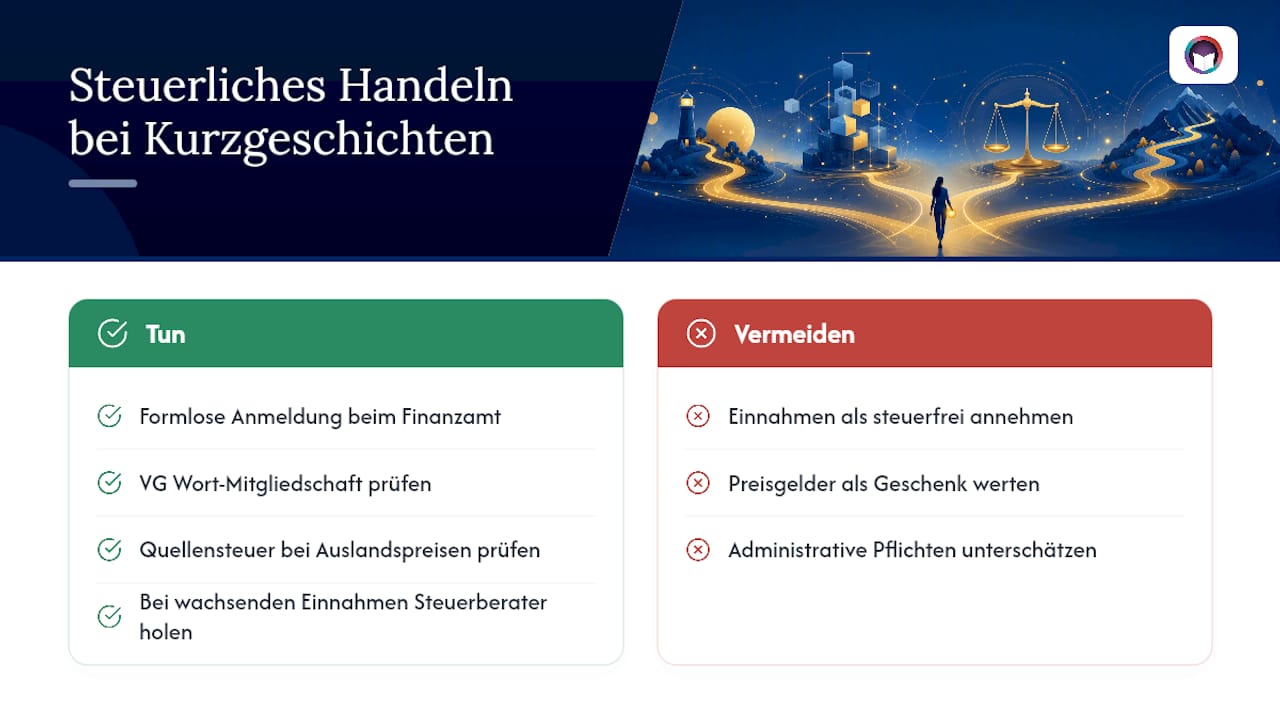
Income from short stories is generally taxable in Germany, regardless of whether it comes from revenue sharing, self-publishing, prize money or commissioned work. Those who publish regularly and earn income are generally considered freelance writers by the tax office, which requires an informal registration with the responsible tax office.
For authors who also publish with publishers or larger magazines, membership in VG Wort can become relevant, through which additional disbursements for certain uses are possible. Many underestimate this administrative part, although it directly affects actual net earnings because payout thresholds, processing times and reporting obligations can delay or reduce the actual available amount.
Important regarding prize money from competitions: these are generally considered taxable income, not a tax-free gift. If you submit internationally, you should also check whether foreign organizers withhold withholding tax before transferring the prize money. Because tax details depend on total individual income and legal form, it is worth consulting a tax advisor specialized in freelance creative activities as your earnings from short stories grow.
What do real experiences of successful authors show?
Looking at the paths of successful authors reveals a recurring pattern: no single channel carries it alone. Those who rely solely on a revenue-sharing platform often remain dependent on algorithmic visibility, while authors with multiple pillars report much more stable monthly income.
A typical pattern looks like this: an author starts with free short stories on a platform to build reach. Once regular readers return, she turns successful single stories into an ongoing series and adds a self-published collection. In parallel she takes on small commissioned jobs, such as ghostwriting projects, which pay more predictably than individual story sales. Experienced authors repeatedly cite this diversification between creative and commercial writing as the decisive factor for a sustainable income.

Genre diversification also plays a role. Those who, in addition to fantasy or crime, offer short stories for other target groups, for example for early readers, tap into additional reader segments without having to learn completely new skills. Realistically, most routes take several months before individual sales turn into a noticeable side income; those who accept that rather than expect quick success are more likely to persevere.
Start now: Publish your first short story on OutaStory
You now know the main ways short stories can generate income, from revenue sharing to self-publishing to competitions. OutaStory consolidates one of the most practical of these routes in one place: you publish your text and additionally decide whether your story should also be available as an audiobook, with a professionally produced voice or your own. That gives you double reach across reading and listening audiences without having to set up two separate production processes.

Unlike pure self-publishing through retailer networks, you don't have to shoulder a complete marketing machine here — the platform already brings a readership actively searching for fantasy, romantasy, crime, thriller, horror or children's stories. Before you start, think about genre, length and whether you want to publish your story as a standalone work or as a continuing series. A niche like romantic short stories can also help build a dedicated readership.
Create an account, upload your first text, and watch how your story generates initial income through revenue sharing. The entry on OutaStory only costs you the time to upload, not weeks of technical preparation.
Sources
Those who want to go deeper into practice will find the Iowa Review's submission guidelines a good example of how professional literary magazines communicate their requirements for word count, format and genre. The Sun Magazine also shows how rights clauses and payment models are made transparent in submission guidelines before you even submit.
For a broader overview of competitions and calls, check magazines like Boulevard that regularly publish new calls. And if you want to understand how creative and commercial writing can be combined, Bettina Ramm offers practical ways that go beyond pure short stories.
- Publishing short stories: These options are available - CHIP
- 8 proven ways to earn money from writing (+ how to find the one that suits you) | Bettina Ramm
FAQ
Can you make money with short stories?
Yes — through revenue sharing on platforms, self-publishing, competition prize money and commissioned work, but rarely as a sole full-time source of income. You usually don't earn large sums from individual short stories, but diversifying across several channels provides a more predictable side income.
Such a daily revenue is unrealistic with single short stories; such sums are more likely to arise from a built-up portfolio of series, collections and commissioned work over a longer period. A more realistic approach is a buildup process over months in which platform income, self-publishing and ghostwriting assignments together create a stable income.
As a consistent daily income, this is rarely realistic with short stories alone, especially at the start. Instead combine multiple income sources such as revenue sharing on platforms like OutaStory, collections in self-publishing and regular commissioned work to reach a comparable monthly target over time.
A quick, legitimate way is to submit a finished short story to a competition or literary magazine with prize money or a fee, though the outcome is uncertain and there is a waiting time for a decision. More predictable is a small, clearly defined commissioned job, for example a short commissioned story for a client that is paid immediately upon completion.
Recommendations
- Read and listen to romantic short stories for free
- Read and listen to short stories for free: The best overview
- Get started now: Free science fiction short stories on Outastory
Read and write on OutaStory
Thousands of short stories to read for free — or publish your own and find an audience.