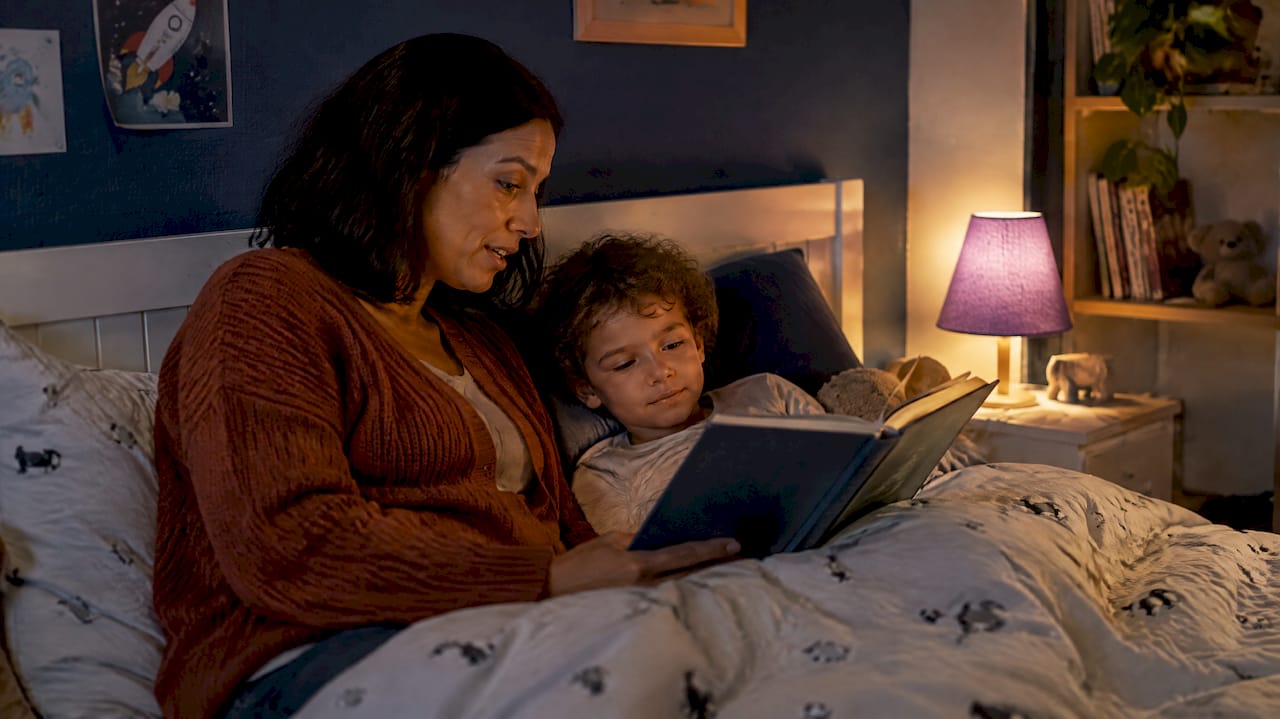
Bedtime ritual with stories: How to make the evening calm
A good bedtime ritual with stories is short, the same every night and ends with a calm tale that is read aloud or listened to. Ten to fifteen minutes are enough for this, and it's easiest to keep the ritual going if you don't have to look for reading material every night. That's exactly why we built OutaStory: short stories you can read for free or play as audiobooks, with professionally produced voices or the author's own voice, plus a dedicated children's area with bedtime stories, animal adventures and first rhymes. In this article we show you how to build the ritual step by step, which stories are suitable and how it also works for adults.
In short
- A bedtime ritual lives by repetition: the same sequence, the same time, a story as a fixed endpoint.
- Stiftung Lesen recommends the sequence bath, book, bed; just ten to fifteen minutes of reading aloud are enough to establish a ritual.
- Good bedtime stories are short, calm in tone, and end reassuringly, without a cliffhanger that keeps them awake.
- Reading aloud and listening complement each other: on tired evenings an audiobook voice takes over without the ritual failing.
- For adults the principle works the same, for example with a calm short story as an audiobook instead of the phone in bed.
Table of contents
- Why a story helps at bedtime
- How to build the bedtime ritual
- How to recognize a good bedtime story
- Reading aloud or listening? Best to do both
- Serial stories: one chapter per evening
- Bedtime ritual for adults
- How to tell that the ritual is working
- Your evening ritual with OutaStory
- For authors: writing bedtime stories
- Frequently asked questions
- Sources
Why a story helps at bedtime
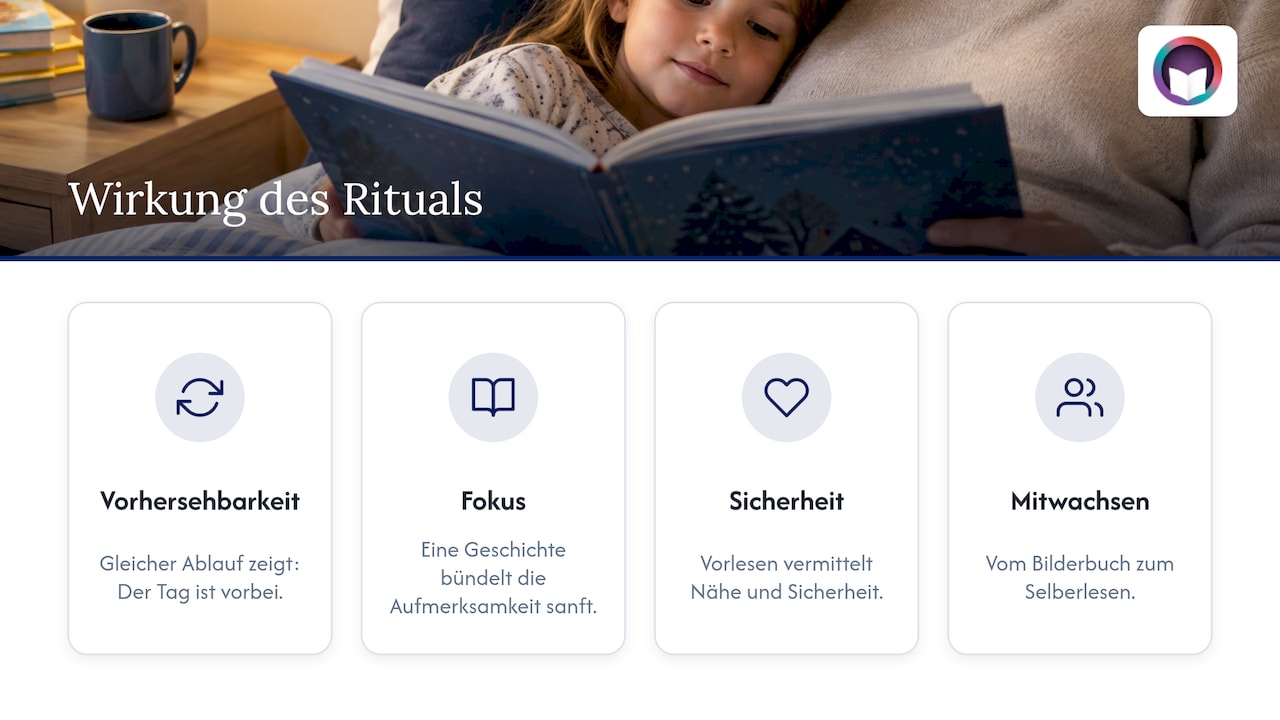
Children love predictability, and adults benefit from it more than they usually admit. A ritual tells the body: the day is over, nothing new is required now. A story is ideal for this because it gently focuses attention. Thoughts drift away from homework, playground fights or tomorrow's to-do list and toward a character, a place, a small action.
The Stiftung Lesen describes evening reading aloud as calming and as an opportunity to convey closeness and security. The ritual can grow with the child: the picture book eventually becomes a longer narrative, reading aloud becomes shared listening or the first independent reading.
Also the parenting coach of ADHS Deutschland gives tips for going to bed, advising to keep the routine the same every day and to include a pleasant, time-limited ritual, for example shared reading time, cuddling or an audio play. Shortly before sleep, stimulating media and games should rather be avoided; calmer activities like reading fit better.
The core is therefore simple: not any story at any time, but the same form every evening so the child knows what is coming and can let go.
How to build the bedtime ritual
The following steps work for children from preschool age and can be easily adapted for younger or older ones. How the evening routine can already be built step by step in infancy is shown in this overview of the bedtime routine for babies by age.
1. Choose a fixed time
Decide when the ritual begins, and stick to it as closely as possible even on weekends. A common stumbling block: the start slips later because something is done "quickly." Then the child is overtired, and the story has to fight against whining.
2. Put the routine into a consistent sequence
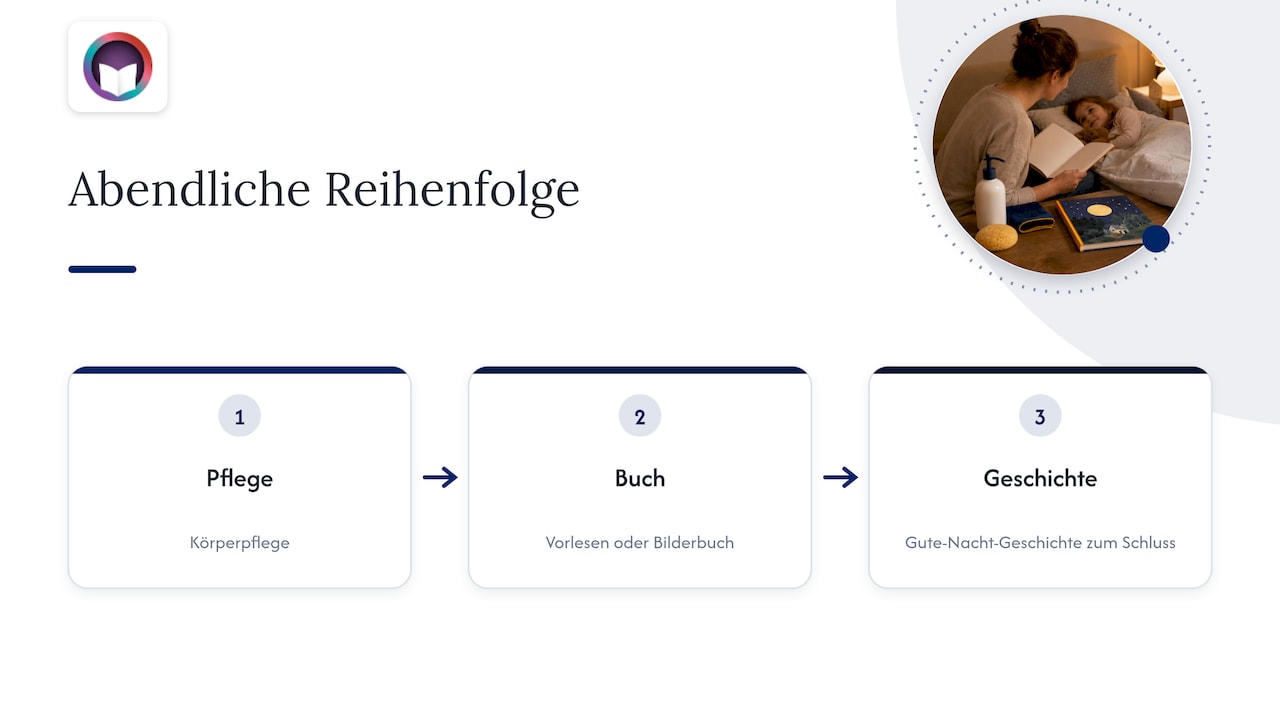
Stiftung Lesen suggests the sequence bath, book, bed: body care, then reading aloud or looking at a picture book together, and finally a bedtime story. Whether brushing teeth comes before or after pajamas doesn't matter. What's important is that the order stays the same every night and the story is always the last item.
3. Limit the duration
Ten to fifteen minutes of reading aloud are enough according to Stiftung Lesen to establish a ritual. Say beforehand what will come: "a story" or "a chapter." Where it goes wrong: the negotiation about "just one more" becomes a ritual itself. Short stories help here because they fit exactly into this time window and have a clear ending.
4. Choose the story together, but beforehand
Let your child have a say, but not in bed. Whoever scrolls through twenty titles there ends up more awake than before. Better: preselect two or three stories during the day; in the evening the child may choose between them. On OutaStory you'll find in the children's area bedtime stories, animal adventures and first rhymes in one place; we've collected age-sorted suggestions in our post about the best bedtime stories for children from 0 to 8+.
5. Make the environment quiet
Dim the lights, turn off screens, keep your phone out of reach. If you play a story as an audiobook, place the device so that no one looks at the screen. It's about listening, not watching.
6. Find a fixed closing sentence
An always identical ending, for example "And now the story is asleep too," marks the end. After that nothing more is told, only cuddling or turning off the light. How such a shared wind-down can work in a larger group is described in this guide for a family story night at home.
How to recognize a good bedtime story
Not every lovely story is a good bedtime story. An exciting chase can be wonderful during the day and still keep you awake at night. These features have proven effective:
| Feature | Why it matters | What to look for |
|---|---|---|
| Short length | Fits the time window of 10 to 15 minutes | One story or one chapter per evening |
| Calm tone | Focuses attention without agitating | Few rapid dialogues, many images and descriptions |
| Reassuring ending | Leaves the child with a good feeling | No unresolved conflict, no cliffhanger |
| Familiar characters | Recognition is calming | Favorite characters may appear more often |
| Appropriate themes | Do not rekindle fears | Monsters and storms better during the day |
| Repetition in the text | Rhythm works like a lullaby | Rhymes, refrains, recurring sentences |
For the very little ones, short rhymes and simple animal stories are ideal. Elementary school children like imaginative worlds as long as they remain friendly, for example a cloud that searches for a home, or a library where something wondrous happens at night. Two examples from our collection that already convey this gentle tone in the title: The cloud that rents itself out for a nap and The spoon that knows the way home.
If you choose yourself, you'll find further criteria in this guide to choosing the right book for read-aloud, such as how well a text reads aloud and whether language and length suit the child.
Reading aloud or listening? Best to do both
Reading aloud creates closeness, that's undisputed. But there are evenings when the voice doesn't want to after a long workday, one parent is traveling, or a sibling needs attention at the same time. That's exactly when a ritual is likely to fall apart. And a ritual that fails twice a week is no longer a ritual.
The solution is to plan listening as an equal part. The parenting coach of ADHS Deutschland explicitly names the audio play alongside reading time and cuddling as a possible evening ritual. It can look like this:
- Reading-aloud evenings: You read yourself, your child looks at the pictures or cuddles up.
- Listening evenings: You listen to a story together as an audiobook, you lie beside them instead of reading aloud.
- Mixed evenings: You read the first half, the audiobook voice takes over the rest while you dim the light.
On OutaStory every story can be played as an audiobook, read by professionally produced voices or by the author themself. That means: the story you read yesterday can be the same story today, only heard. For many children this repetition is precisely the appeal. More ideas on how reading aloud and listening can work together can be found in our post with tips for bedtime stories for reading aloud and listening.
Serial stories: one chapter per evening
Older children often want more than a self-contained short story. Serial stories are a powerful tool for the ritual: one chapter per evening gives a clear frame, and the anticipation of the next chapter makes going to bed more attractive.
For this to work, each chapter should come to rest on its own. A chapter that ends with an open question that keeps a child awake half the night belongs more in the afternoon. A chapter that ends with "And everyone was happy to be back home" fits the evening.
On OutaStory authors can publish their stories as serials chapter by chapter. For your ritual this means: you have a thread that carries over many evenings, and each evening still has its own ending.
Bedtime ritual for adults
The principle is the same for adults, only often someone to read aloud is missing. The typical alternative is the phone in bed: messages, emails, endless scrolling. Those are precisely the stimulating media that should be avoided first before bedtime, even for children.
A calm short story as an audiobook is the counter-model. You put the device away, close your eyes and follow a voice. To make it work:
- Same time, same routine: Brush your teeth, lights out, story on. After a few weeks the brain responds to the signal.
- Choose calm genres: Gentle fantasy, quiet everyday stories or dreamlike science fiction are better suited than thrillers or horror, which you can save for the afternoon.
- Repeat the familiar: A story whose ending you already know lets you drift off more easily than a new one where you want to know how it ends.
- Choose the voice deliberately: Some sleep better to a professional narrator's voice, others prefer the personal tone when an author reads their text themselves.
If you love fantasy and science fiction, you'll find stories with us that open a foreign world without straining the nerves, for example The library where the books talk back at night. More on what really helps adults fall asleep with stories is in our post about bedtime stories for adults.
Also for older relatives a read or listened-to story can be a nice end to the day. It's important then to adapt the ritual to their strength: listening is often less tiring than reading oneself.
How to tell that the ritual is working
A bedtime ritual needs time. Allow a few weeks for it to settle in. Good signs are:
- Your child asks for the story on their own or reminds you about it.
- The arguments at bedtime become shorter.
- The transition from playing to sleeping succeeds without long negotiations.
- After the closing sentence calm returns, instead of new wishes appearing.
If it stalls, a closer look is worthwhile. ADHS Deutschland recommends in its tips to consider possible reasons such as fears, worries or lack of tiredness and still stick to the consistent routine. Sometimes a different story, an earlier start time or more movement in the afternoon is enough. If falling-asleep problems persist for weeks or your child seems persistently exhausted during the day, speak with your pediatrician. For adults with persistent sleep disorders the family doctor is the first point of contact.
Your evening ritual with OutaStory
We built OutaStory so that stories don't fail because of the question who still has the energy to read aloud tonight. You can read every story for free or listen to it as an audiobook, with professionally produced voices or the author's own voice. In the children's area you'll find bedtime stories, animal adventures and first rhymes; for yourself the full range from fantasy and romantasy to science fiction. And all this in German and English, which is a nice bonus for bilingual families.

If listening becomes a fixed part of your ritual, it's worth taking a look at OutaStory Premium: unlimited listening, without ads and offline, for example on vacation, on the train or at the grandparents' without Wi-Fi. Read, listen, fall asleep: your story for every evening.
For authors: writing bedtime stories
Maybe you've already thought while reading aloud: I would tell this story differently. Many good bedtime stories are created exactly like that, at the bedside. On OutaStory you can publish your short story in a few minutes, release it chapter by chapter as a serial story and participate in the revenue share of your stories' earnings. If you like, record your text yourself so families can hear your voice at bedtime.
What makes a good bedtime story you've seen above in the table: short length, calm tone, reassuring ending, recurring sentences. Write for the ten to fifteen minute time window, read the text aloud before publishing it, and cut every sentence your tongue stumbles over.
Frequently asked questions
How long should a bedtime story last?
Ten to fifteen minutes are enough according to Stiftung Lesen to establish a reading-aloud ritual. More important than the exact duration is that it is similar every evening and decided beforehand. Short stories or individual chapters fit exactly into this time window.
From what age is a story ritual worthwhile?
A consistent routine with voice and closeness can begin in infancy, even if plot doesn't yet play a role. From toddler age, short rhymes and picture books are added; in preschool age, real bedtime stories. The ritual grows with the child, up to continuing stories for schoolchildren.
Is an audiobook just as good as reading aloud?
Both have their place. Reading aloud creates special closeness; an audiobook ensures the ritual still takes place on tiring evenings. Many families alternate or listen together, and the parenting coach of ADHS Deutschland explicitly names the audio play as a possible evening ritual.
Can it be the same story every evening?
Yes, especially younger children love repetition because they know what is coming and can let go more easily. If your child has a favorite story, that is a good sign. You can introduce new stories during the day and then add them to the evening repertoire.
Sources
- Stiftung Lesen: Bath, Book, Bed: ending the day relaxed with reading-aloud rituals
- ADHS Deutschland, parenting coach: Tips for going to bed
Recommendations
- The best bedtime stories for children from 0 to 8+
- The best bedtime stories for children from 0 to 8+
- Bedtime stories for children: free reading-aloud and listening tips
- Bedtime stories for adults: what really helps
Read and write on OutaStory
Thousands of short stories to read for free — or publish your own and find an audience.