Author Reading Tips: Checklist for Planning, Procedure and Follow-up
A successful author reading rests on five pillars: suitable text selection, early-planned timing, tested equipment, active promotion and thorough follow-up. Plan for 60 to 90 minutes total duration, with reading blocks of no more than 8 to 15 minutes. Also clarify early on whether the Künstlersozialkasse (KSK) plays a role for your event. We at OutaStory will show you how it all fits together.
In short:
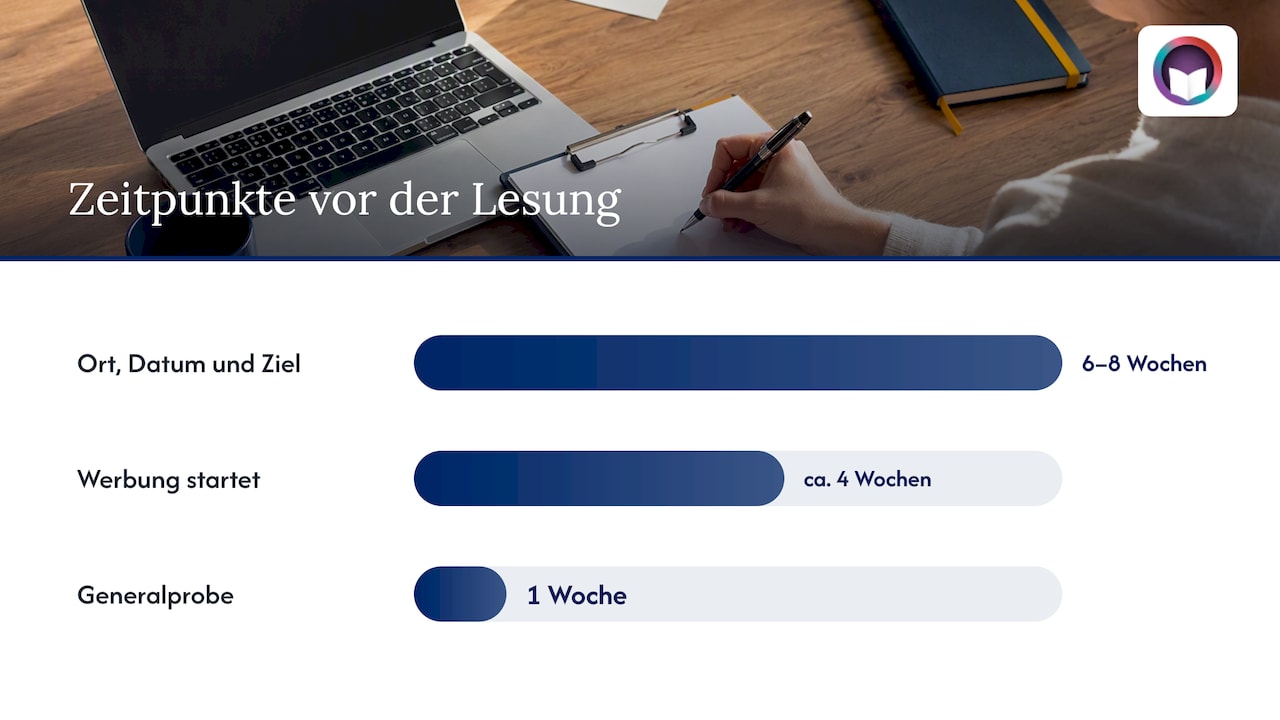
- Confirm venue, date and objective six to eight weeks beforehand; start promotion four weeks beforehand and test the equipment one week beforehand.
- Choose two to three passages that are understandable without much prior knowledge, and stop before the climax so the ending piques curiosity.
- From around 30 guests you should plan for a microphone and check the sound at the back of the room; a small, full room looks better than a half-empty hall.
- Limit reading blocks to 8 to 15 minutes, reserve at least 30 minutes for signing and allow time for technical hiccups.
- Put fee, travel expenses and sales rules in writing; organizers should check whether the artists' social contribution applies, which has a rate of 4.9% in 2026.
Table of contents
- The Quick Checklist: Ten To‑Dos to Tick Off
- How to organize concept, venue and promotion before the reading
- Text selection and dramaturgy: passages, cliffhangers and reading manuscript
- Equipment and space: checklist for sound, lighting and seating
- Procedure and time management: sample schedule for 60 to 90 minutes
- Audience interaction: Q&A sessions, moderation and joint readings
- Fees, financing and the artists' social contribution in practice
- Practice, voice and stage fright: rehearsal routines that work
- Follow-up: photos, press, contacts and numbers
- Practical templates: download checklist and sample texts
- OutaStory as a supplement: publish and voice short stories
- FAQ
- Sources
The Quick Checklist: Ten To‑Dos to Tick Off
This list is deliberately concise. Print it out, pin it to the noticeboard and tick off the items.
- Set the goal and date: Do you want reach, book sales or simply contacts? The goal determines the venue, format and publicity.
- Request a venue: Bookshop, library, café or an unusual space. Inquire early, as popular dates can be booked quickly.
- Clarify equipment: Microphone, reading light, power outlets, spare batteries. Meeting point, equipment, travel and room requirements should be discussed early by email or phone.
- Create a publicity plan: Poster, press release, social media, partners.
- Select texts: Two to three passages, no more.
- Create a reading manuscript: Large print, markings, breathing pauses.
- Arrange rehearsals: At least two run-throughs, one of them with a stopwatch.
- Make a written agreement: Fee, sales, travel expenses, photo and video permissions.
- Plan helpers: One person for equipment, one for the book table.
- Schedule follow-up: Thank-you messages, photos, press, record the numbers.
When do you do what? Six to eight weeks before, the venue, date and goal are set. About four weeks before the promotion begins, at the latest three to four weeks before the date. A week before comes the dress rehearsal with equipment, and on the day itself arrive one hour earlier.
Pro tip: Create a single emergency folder: manuscript, spare pens, business cards, receipt pad and the organizer's telephone number. Whoever has everything in one place stays calm in case of mishaps.
How to organize concept, venue and promotion before the reading
At the beginning stands an honest question: What should this reading achieve for you? Location, format and promotion depend on the defined goal, whether visibility, sales or contacts are the focus. Those who want book sales need a location with foot traffic and a well-visible book table. Those seeking visibility go to the local press and to spaces that are talked about anyway.
A few sober criteria matter when choosing a venue: Does the expected number of guests fit in the room without it looking empty? Is there good acoustics, power, a table for signing? Bookshops bring a regular audience, libraries reliability, cafes a relaxed atmosphere. Unusual spaces like a workshop, an atelier or a cinema foyer are also worth it if they fit the book.
Here is a step-by-step approach:
- Write down the goal, one sentence is enough.
- Contact three possible venues with suggested dates.
- Work back from the schedule: Plan at least two months ahead, agree venue, time, fee and sales in writing.
- Create poster and invitation text: title, date, time, venue, admission, one sentence about the book.
- Target local press, social media and partners, the most effective channels are local press, posters and social media.
- Send reminders one week before, and again the day before.
About publicity: the poster doesn't need a design studio, but should be easy to read. Contact the local editorial office personally, with a photo and two sentences why your reading is interesting for the region. Cooperations with bookshops, clubs or writing groups can increase reach, because each side activates its own network.
And one more observation: A reading is a traditional marketing instrument, because personal encounter brings the book to life. Your invitation should fulfill this promise, not just state date and place.
Text selection and dramaturgy: Passages, cliffhangers and reading manuscript
Less is more. Choose some suitable passages that together carry the evening. Choose scenes that work without long background knowledge: a clear opening, a character, a twist. Long landscape descriptions and convoluted dialogues can be hard to perform aloud.
This framework helps with the selection:
- Awaken desire, don't reveal too much: An open ending encourages purchase, a fully resolved plot does not.
- Introduce variety: A thrilling, a quiet, a humorous passage keep attention. Also scene selection, performance and personal stories are proven keys.
- Think about the audience: A crime evening in a bookshop can handle goosebumps, a family reading requires more pace and wit.
- Take the genre seriously: Fantasy lives on atmosphere and names which you should pronounce slowly and clearly. A thriller needs short sentences and pauses.
- Stop the passage before the climax: The cliffhanger happens in the performance, not only in the book.
Your reading manuscript is its own document, not an excerpt from the book layout. Professionals prepare the text specially: double line spacing, marked emphases and stage directions. Choose a readable large font and wide margins for notes. Mark pauses with a slash, important words in bold and voice changes with an initial at the margin. Number the pages so you don't have to search if the sheets fall.
For inspiration, take a look at short texts that work read aloud. On our site you will find, for example, The Ink Runner as a genre example with strong scene construction, or The Keeper of the Last Words with a calm, measured tone.
Pro tip: Read your chosen passage aloud to someone who hasn't read the book. Where they frown, the text needs shortening or an introduction.
Equipment and space: Checklist for sound, lighting and seating
Equipment is what nobody notices as long as it works. That's why it belongs in the planning, not improvisation. Clarify with the organizer what is available on site, and bring spares yourself.
- Sound: Plan a microphone for around 30 people. Even in smaller groups a mic helps if the room echoes. Do a soundcheck beforehand with someone seated at the very back.
- Lighting: You need your own reading light so you can see your manuscript without squinting. The audience should not be dazzled; a spot from above at an angle is better than one from the front.
- Seating: Prefer a small, full room to a large, half-empty hall. Set out too few chairs and fetch more if needed. A slight semicircular arrangement creates closeness.
- Backup devices: Second microphone or spare batteries, an extension cable, charger and printed copy of the manuscript in case the tablet fails.
- Small items: Watch in sight, water with glass, tissues, pens. Spare pens for signing, comfortable clothing and a designated person for photos make the evening more relaxed.
- Signing table: Clearly visible, with space for books, cash box and card reader. Signs with price and payment methods avoid questions.
Inspect the room well before the event. Sit once in the worst seat and check sightlines, sound and drafts.
Procedure and time management: Sample schedule for 60 to 90 minutes
A typical program includes author introduction, excerpts, Q&A and signing, around 60 minutes plus conversation. An appropriate duration helps keep the audience's attention. Keep reading blocks to 8 to 15 minutes and insert conversation or a break in between.
A tried-and-tested schedule looks like this:
- 0 to 5 minutes: Welcome by the moderator, brief introduction of the author.
- 5 to 20 minutes: First reading block, then a sentence about the book's origin.
- 20 to 25 minutes: Short conversation, one opening question from the moderator.
- 25 to 40 minutes: Second reading block, preferably with a different mood than the first.
- 40 to 45 minutes: Pause or music, time for the book table.
- 45 to 55 minutes: Short third block or a joint reading.
- 55 to 75 minutes: Moderated Q&A session.
- 75 to 90 minutes: Thanks, note about the book and upcoming dates, transition to signing.
Allow at least 30 minutes afterwards for signing and plan buffers. If the equipment fails for ten minutes, an open time block can save the evening. Assign roles beforehand: a moderator keeps time and hands over, a helper looks after equipment, a helper handles sales and cash. That way you can focus on your text.
Audience interaction: Q&A sessions, moderation and joint readings
An audience that only listens goes home politely. An audience that participates buys books. Therefore build in small touchpoints without turning the evening into a talk show.
- Opening questions: Start with an easy question to the room: “Who reads fantasy?” A hand movement suffices, and the mood relaxes.
- Active moderation: The moderator poses the first question themselves so nobody has to prod after silence. Good starter questions are: Where did the idea come from? Which character is closest to you?
- Short interactions: Let the audience vote between two scenes or guess how it continues. It costs little time and engages the audience.
- Dealing with indifference: If someone whispers or looks at their phone, speak a little more quietly or take a short pause. Often eye contact helps more than any announcement. Stay friendly; authenticity is often more important than perfection.
- Interruptions: End long monologues from the audience with a polite “We can talk about that afterwards.”
- Joint readings: They reduce organization effort and often increase the audience, because each participating person activates their own network.
For a first reading, a duo or trio is worthwhile. The load is shared, and the variety between voices keeps the evening lively.
Fees, financing and the artists' social contribution in practice
Talk about money early and in writing. It sounds dry, but it saves the most awkward conversations. Record: fee, travel expenses, accommodation, sales rules at the book table, photo and video permission. Written agreements on venue, time, fee and sales are standard. The norm contracts and sample contracts of the Börsenverein provide orientation for agreements. If in doubt, seek legal advice.
Where does the money come from?
- Admission: Even a small fee increases the commitment of attendees.
- Sponsors and local partners: Bookshops, utility companies, clubs.
- Funding programs: Programs like “Kultur macht stark”, cultural offices, foundations and support associations can be possible funders.
- Association recommendations: Orient yourself on the fee recommendations of authors' associations before naming a sum.
- Book table: Sales proceeds supplement the fee if you clarify discounts in advance.
Something else is the artists' social contribution. Organizers who book fee-based artistic services should check their reporting obligations. The Börsenverein also describes under which conditions organizers may be liable to pay the contribution.
The reference value for 2026: 4.9% contribution rate. Clarify with the organizer who reports this contribution, and if in doubt have the KSK or an advisory service confirm whether your case is covered.
Practice, voice and stage fright: Rehearsal routines that work
Good reading aloud is a craft. Those who practice appear more relaxed, and that calm transfers to the audience. Read the text aloud several times, record it on your phone and time it so you find a natural speaking tempo and take the fear out of stage fright.
- Listen to the recording: On the recording you immediately hear where you rush, mumble or become too quiet.
- Time it: Plan rather one minute of reserve per block, because live readings are always slower than at home.
- Distribute rehearsals: Three short run-throughs over several days stick better than one long one the night before.
- Format the manuscript: Double line spacing, stage directions, pause markers.
- Warm up: A few deep breaths, lip trills and tongue twisters like “Fischers Fritz fischt frische Fische” loosen voice and mouth.
Agreeable insecurity does no harm. Someone who stumbles and laughs appears more human than someone who reads stiffly and flawlessly.
Pro tip: Do the last rehearsal standing and in the shoes you will wear in the evening. Posture and breathing change as soon as you stand.
Follow-up: Photos, press, contacts and numbers
The reading does not end with the applause. A few steps in the days after decide whether the evening has a lasting effect.
- Share photos and clips: Post the best pictures the same day or the next day, with thanks to the venue and audience.
- Follow up with the press: Send the local editorial office two or three photos and a short report if no one from the press was present.
- Newsletter update: Inform your readership about the evening and announce upcoming dates.
- Secure contact data: Enter sign-ups for newsletters or future invitations directly while the memory is fresh.
- Send thank-you messages: To the organizer, moderator, helpers and partners, short and personal.
- Document results: Number of visitors, books sold, questions from the audience, what went well, what didn't. These notes make the next reading easier.
Especially for self-publishers this is worthwhile, because readings provide direct feedback and local visibility. Whoever evaluates the evening properly really uses this feedback.
Practical templates: Download checklist and sample texts
So you don't start from zero, you can adapt three templates to your needs:
- Checklist: A ten-point printable version with boxes and deadlines.
- Sample email to organizer: A short request with book title, preferred date, format, equipment needs and fee question.
- Social post template: An invitation text with space for date, venue, reading-sample quote and link.
Adapt each template to venue and audience: For the library write more factually, for the café more personally, for the school with a clear link to the curriculum. Remove clichés, add a concrete detail about your book.
| Template | What for | When to use |
|---|---|---|
| Checklist | Overview and deadlines | At the start of planning |
| Sample email | Initial inquiry to organizer | Early in planning |
| Social post | Invitation and reminder | In good time before the event |
Download the files, copy them into your planning document and work through them step by step.
OutaStory as a supplement: publish and voice short stories
A reading reaches the people in the room. With OutaStory you additionally reach everyone who couldn't attend. We are a platform for short stories that can be read or listened to for free, and we do not replace a live reading. We complement it.
- Publish: You upload your short story, optionally chapter by chapter as a serial.
- Voicing: Each story can be voiced as an audiobook, with professionally produced voices or your own.
- Audio sample for your reading: Refer in the invitation text or at the book table to a story so interested people can listen beforehand.
- Revenue share: On our page for authors it states how the platform participation works: 8 % platform commission.
- More reach: Your texts remain findable after the evening, in German and English.
Take a look at how other texts sound, for example Die Grammatik des Drucks. If you want to get started right away, you'll find everything else on our page for authors.
FAQ
How much does an author get for a reading?
The fee depends on the organizer, venue and notoriety; there is no fixed amount. Use the recommendations of authors' associations as a guide and record the agreement in writing. Whether the organizer must also pay the artists' social contribution should be clarified by both parties in advance.
What tips are there for authors?
Test the equipment beforehand and start publicity early. Afterwards, allow time for signing and conversations.
What is an author reading?
At an author reading, a writer presents their work live, usually with excerpts, a discussion and a signing session. It is a classic way to gain new readers through personal encounters.
Should one read the book before a reading?
As a guest of the evening it helps to at least start the book, because you can then ask better questions. As a moderator you should be familiar with it. As an author you know your text, but still practice the chosen passages aloud.
Sources
Recommendations
Read and write on OutaStory
Thousands of short stories to read for free — or publish your own and find an audience.