
Writing a twist: 2–3 clues that work, with OutaStory Test
An effective twist combines three things: preparation, a surprising turn, and comprehensible consequences. If any of these are missing, the story tips into being either predictable or arbitrary. The core rule is: the twist must feel logical in retrospect, even though no one expected it on the first read. That is exactly what distinguishes a successful plot twist from a cheap gimmick.
In short:
- A successful twist requires careful preparation with unobtrusive clues on different levels, while too many clues dilute the effect.
- The twist should change several scenes at once while consistently developing the genre logic and the plot.
- Clues must be cleverly distributed so that readers have no clear premonition on the first read, but can understand everything on a second pass.
- After a twist, consequences are necessary that meaningfully affect plot, character motivations, and the story's central theme.
- Beta readers and modern platforms like OutaStory help verify a twist's effectiveness and optimize timing and fairness.
Table of contents
- What makes a good twist ending?
- The three core elements of a twist ending: preparation, turn, consequences
- Types of twists with concrete examples and design tips
- How to construct and test a twist step by step
- Common mistakes with twist endings and how to avoid them
- OutaStory as a practical place to test and publish twist short stories
- Psychological effect of a twist ending on readers
- How to use twists effectively in different genres
- Sources
- FAQ
What makes a good twist ending?
A twist is a turn that gives the reading experience a new meaning without revealing the previous plot. The technical term is plot twist, sometimes called Handlungswende in German. Both terms mean the same thing: a moment that makes the story appear different in retrospect.
Anyone who wants to write a twist ending must understand that the effect does not come from surprise alone. It arises from the tension between two perceptions: what readers believed up to that point and what turns out to be true. This tension cannot be improvised. It must be laid down from the first page, even if you as the author do not yet know exactly where the story is going.
The three core elements of a twist ending: preparation, turn, consequences
Every functioning twist follows the same structure, regardless of genre. Preparation, turn and consequences form the framework, and those who neglect one phase usually only notice it with beta readers.
Preparation means placing clues so they remain unobtrusive on the first read. Three levels work particularly well for this, as Novum Verlag describes in its guide to plot twists:
- Dialogue level: A character says something seemingly trivial that only gains weight later.
- Descriptive details: An object, a gesture, a location description that hardly stands out on the first read.
- Plot points: Small decisions by a character that in retrospect take on a completely different meaning.
Dosage decides success. Too many clues act like a signpost; too few make the twist seem arbitrary. A proven rule of thumb is to plant several independent clues throughout the story, ideally in different forms.
The turn itself is about how much information you reframe. A strong twist changes not just a detail but the meaning of several previous scenes at once. It may surprise, but should never violate the genre or the logic of the story world.
The consequences are the most underestimated part. A twist without aftermath is just a trick. It must genuinely change the plot, the characters' motivations, and the story's thematic concerns. If everything continues as before after the revelation, the turn has not fulfilled its purpose.
Types of twists with concrete examples and design tips
Not every twist works equally well in every story. Common forms include identity revelations, unreliable narrators, betrayal by allies, sudden changes of course, and reversals of expectations. Here is a practical classification of when which type is worthwhile:
- Identity revelation: A character is not who they appear to be. Works best when the true identity has plausibly left traces beforehand, for example through knowledge only that person could have.
- Unreliable narrator: The entire perspective of the story is called into question retroactively. This technique requires a delicate touch, because the narrative voice must not lie; it may only tell selectively or deceive itself.
- Red herrings: Three rules ensure fair misdirection: the red herring must be plausible, it must not contain invented facts, and the true solution must be recognizable on careful reading.
- Sudden death or reversal of expectations: Works only if the death or reversal serves a thematic function, for example by showing a consequence of earlier choices rather than merely shocking.
- Small scene twists vs. big plot twists: Small turns keep the pace high and suit short stories well; big twists change the entire story but require much more preparation.
Pro tip: Write the reveal scene first as a reader would read it on a second pass. If you find earlier scenes taking on a completely new meaning, you've hit the right balance between clue and camouflage.
How to construct and test a twist step by step
The path to a twist varies greatly depending on your work style. Some authors plan every detail in advance, others discover the story while writing. Both routes lead to the goal; only the order of steps changes.
For plotters: from consequence to turn
- Define the consequence first: What should change for the characters or the theme because of the twist?
- Design the turn itself backwards from that consequence.
- Then work the clues into the first draft, spread across several chapters or scenes.
For discoverers: from turn to foreshadowing
- Record the twist as soon as it emerges while writing, even if it's not fully worked out yet.
- Go through the earlier scenes and plant clues retrospectively in places that feel organic.
- Adjust the timeline so that the newly added details fit temporally and logically with the rest of the plot. This retroactive foreshadowing is possible but requires more revision effort than planning ahead.
The same tools help both approaches: a timeline with all events, a mind map for character knowledge (who knows what, and when?), and a checklist where you note each placed clue with the chapter number. This system pays off especially for shorter texts, because short stories often demand different timing than novels: smaller, sharper twists usually work better in short formats than complex multi-twists.
Once the draft exists, the most important test follows: real beta readers. Ask them targeted questions instead of only for a general impression:
- Did you have any inkling before the reveal which direction it was going?
- Did the twist feel logical on second thought or contrived?
- Which earlier scene did you mentally re-evaluate after the twist?
- Did the resolution feel fair, or did you feel cheated?
Feedback like "I never saw that coming!" is a reliable indicator for an effective twist, provided readers can also explain afterwards why it still makes sense. If that second part of the answer is missing, the twist was probably not sufficiently prepared.
Common mistakes with twist endings and how to avoid them
Most twist problems arise not from lack of creativity but from missing discipline in revision.
- Twist for the sake of a twist: If the turn has no thematic function, it reads as a pure effect. Ask yourself before each revision: Does this twist reinforce the story's message, or is it merely a shock moment?
- Too many or too strong twists: A story with too many turns exhausts readers instead of captivating them. Usually one central twist, complemented by smaller side turns, is enough.
- No or too obvious clues: Both break the balance. Read your draft a second time focusing only on the clue level, not the plot.
- Timing errors: A twist that comes too early leaves no room for consequences. If it comes too late, the resolution feels rushed.
This is exactly where external readers prove indispensable: authors already know the resolution and can hardly assess their own effect objectively. A twist that feels elegant when reading your own text may work completely differently for someone reading the story for the first time.
OutaStory as a practical place to test and publish twist short stories
Twists can be planned in theory, but their effect only becomes apparent with real readers. OutaStory offers a direct route: short stories can be published within minutes, unlocked chapter by chapter, and additionally listened to as audiobooks, either with a professional voice or your own.
This opens three concrete testing possibilities for your next twist:
- Chapter serializations show you in real time whether readers develop their own theories between releases, a direct indication of whether your foreshadowing works.
- The audiobook version often makes timing errors audible that are overlooked in silent reading, for example when a turn feels too abrupt.
- Revenue sharing from your story’s earnings gives you an incentive to craft the twist so readers will recommend the story to others.
If you work on building tension in parallel, Thimo's guide to cliffhangers in Thimo’s guide to cliffhangers offers techniques to maintain suspense between chapters before the actual twist strikes.
Psychological effect of a twist ending on readers
A twist works psychologically through an effect cognitive scientists call retrospective re-evaluation: the brain must reclassify earlier information as soon as new facts appear. This moment of re-evaluation creates the satisfying "aha" feeling that good twists trigger.
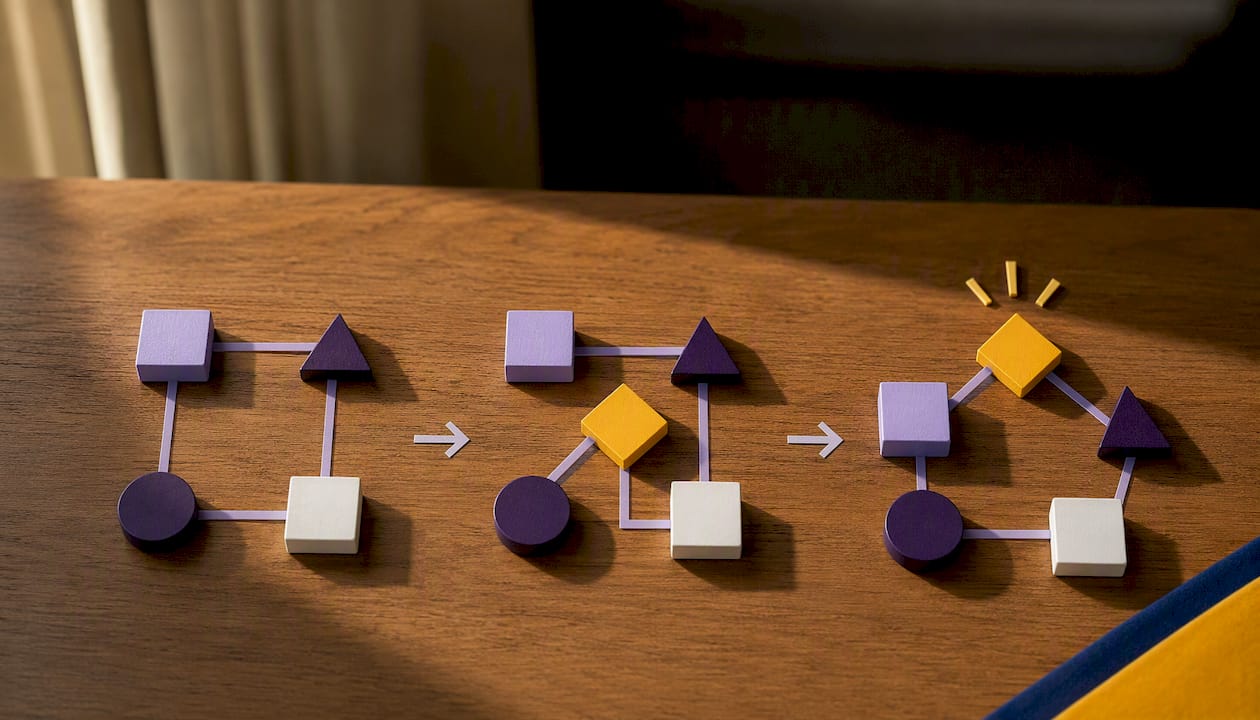
Interestingly, the emotional effect does not come from the surprise itself but from the contrast between the original expectation and the new insight. The more confident readers felt beforehand, the more powerful the turn. That explains why shallow preparation rarely satisfies: without a firm expectation there is nothing to break.
At the same time, this effect carries a risk. If the re-evaluation is perceived as unfair because important information was deliberately withheld, satisfaction turns into frustration. Readers forgive surprise but rarely the feeling of having been deceived. Therefore fairness toward the audience is not a moral detail but a functional necessity for the emotional effect itself.
How to use twists effectively in different genres
Each genre brings its own expectations for a twist, and knowing these expectations lets you break or confirm them deliberately.
In crime and thriller readers almost automatically expect a twist, usually related to the perpetrator question. The challenge here is not to provide a twist at all but to provide one that surprises despite the expectation. Red herrings are standard tools in this genre but must be played especially fairly because experienced crime readers actively guess along.
In fantasy and romantasy twists often work through world rules: a prophecy that meant something else, a character with hidden power or heritage. It is important here that the twist stays within the established rules of the story world, otherwise it reads as a rule break rather than a revelation. If you want to play with genre expectations deliberately, the overview of romantasy tropes shows which patterns readers expect and where deviation is especially rewarding.
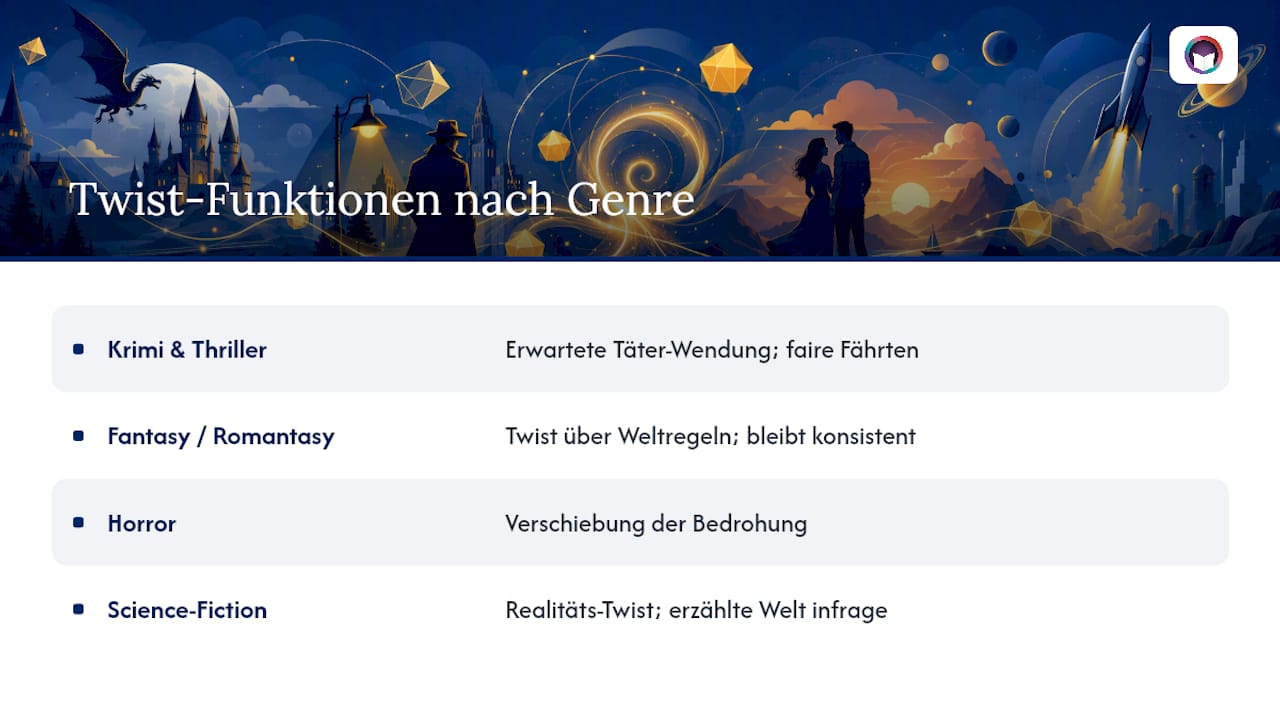
In horror twists often work by shifting the threat itself, for example when it turns out that the real danger lay elsewhere. Science fiction likes twists that call the narrated reality itself into question. In all genres the same limit applies: the twist may expand the world's rules but must never contradict them retroactively.
Sources
- Plot twist — Wikipedia (EN)
- Let’s twist – How to write a surprising turn — Selfpublisherbibel
- Writing.StackExchange — Discussion on foreshadowing and twists
- Surprising turn and plot twist — Schreibzeiten
FAQ
What is a synonym for "Plot-Twist"?
In German, "Handlungswende" is often used; in common speech people often say "Twist". Both terms mean the same unexpected but retrospectively logical turn in the story.
What is a plot twist in youth slang?
Colloquially, even outside literary contexts, "Plot-Twist" denotes any unexpected turn in real life, such as surprising news or an unexpected outcome of a situation. The term has spread from narrative theory into everyday language.
What does "Twist" mean?
"Twist" generally denotes a turn or change; in the context of stories the word refers to the moment when the plot changes unexpectedly but plausibly. The term is used for small scene turns as well as for the big twist at the end of a story.
Does a twist always have to be prepared?
Yes, without preparation a turn feels arbitrary rather than surprising. Even authors who write discoveringly should retroactively insert clues into earlier scenes before publishing the text.
How many clues does a fair twist need?
There is no fixed number, but two to three independent clues on different levels—such as dialogue, detail and action—are a good rule of thumb for most short stories and novels.
Recommendations
- Say hello to Outa – an assistant that listens, widgets for your home screen, and a stage for stories
- Install OutaStory on Windows
- Read and listen to romantic short stories
Read and write on OutaStory
Thousands of short stories to read for free — or publish your own and find an audience.