MP3 or Streaming: Which Audiobook Format Suits You?
An MP3 audiobook is a file that sits on your device and plays on almost any player. A streamed audiobook is access: the app loads the recording from the internet while you listen, and many apps also let you save titles offline for on-the-go. In terms of sound both approaches are close for spoken language. The difference is made by three practical questions: Do you have reliable network access on the go? Do you want to own individual titles or rather choose from a large selection? And on which device do you listen? Here you’ll find the comparison with recalculated numbers for data usage, the legal situation in Germany and a recommendation for each typical listening situation.
In short
- MP3 means: you have a file. It plays offline, on old players and in the car radio, but it takes up storage space and usually requires a separate purchase per title.
- Streaming means: you have access to an entire library, start listening immediately and don't have to manage anything. Without a network you need the app's offline function.
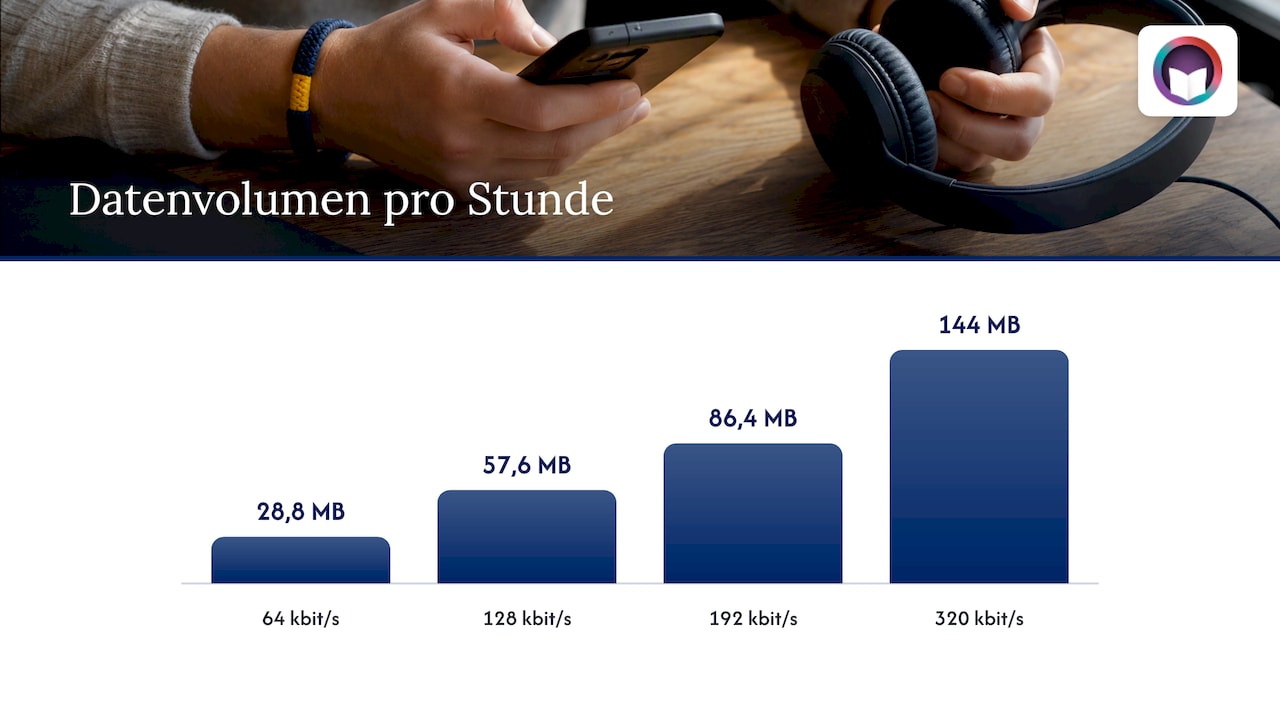
- Data usage: At 128 kbit/s it's roughly 58 MB per hour. A 20-minute short story is under 20 MB.
- Rights: Whether bought or streamed, you generally acquire a usage right, not the work itself. The provider's terms decide what you are allowed to do with it.
- For everyday use streaming with offline download is usually the most convenient solution: selection like streaming, independence like a file.
Table of contents
- What MP3 and streaming mean for audiobooks
- The comparison at a glance
- Sound and data usage: What speech really needs
- Offline, Internet connection and devices
- Ownership, usage rights and what remains after the subscription
- Costs: single purchase or access
- Which format suits which listening situation?
- Read and listen to short stories on OutaStory
- Frequently Asked Questions
- Sources
What MP3 and streaming mean for audiobooks
The comparison reflects two different ideas of how an audiobook reaches you.
The MP3 audiobook is a compressed audio file, often split into many individual tracks or chapters. You download it once, copy it to a smartphone, laptop or a classic MP3 player and play it whenever you want. The format is old, widespread and understood by nearly every device, from children's players to a USB stick in the car radio. The typical bitrate range for MP3 is, according to an Audio file size calculator, between 128 and 320 kbit/s.
The streamed audiobook resides on the provider's server. When you press play, the app sends the recording to your device in small chunks, and you listen while the rest is loaded. Technically this often works via methods like HLS, where the audio file is split into segments. Such streams, as this comparison of streaming and download explains, are harder to download as a whole than a standard MP3. For you as a listener this mainly means: no file management, no folders, no copying. The app remembers where you left off.
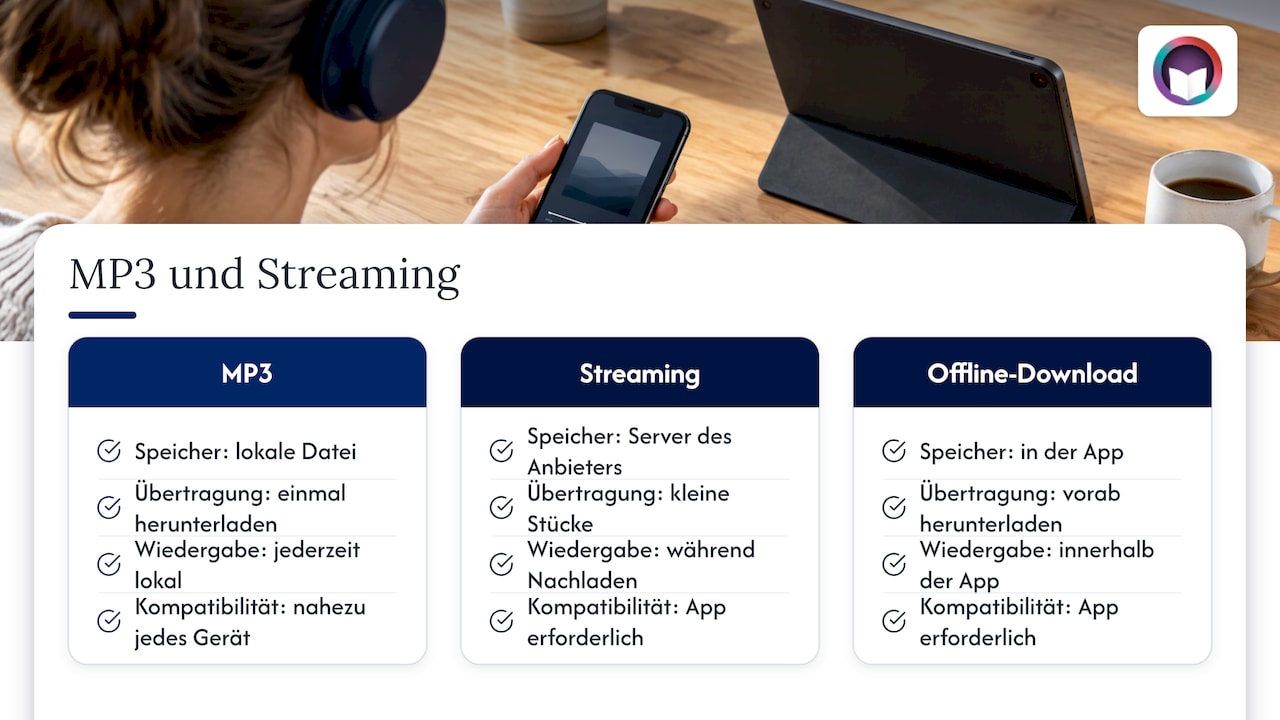
There is a hybrid form between them that most apps offer today: the offline download within the app. You download a title in advance, but it stays in the app and is played there. This combines the independence of a file with the convenience of streaming.
The comparison at a glance
| Criterion | MP3 file | Streaming (with offline function) |
|---|---|---|
| Internet needed | Only when downloading | While listening or beforehand when saving |
| Selection | What you purchased or saved | Entire catalog of the platform |
| Storage space | Permanently occupied | Only for titles saved offline |
| Devices | Almost any player, car radio, computer | Smartphone, tablet, browser with app or web player |
| Remember progress | Depends on the player | Automatically, often across devices |
| Management | Folders, tracks, sorting by yourself | Handled by the app |
| Cost model | Usually single purchase per title | Free with ads, subscription or hybrid |
| New content | You have to actively buy and download it | Appear directly in the app |
The table already shows the general direction: MP3 scores for independence from device and platform, streaming for selection, convenience and the quick switch between titles. If you listen a lot and with variety, you benefit from access. If you want one favorite title and listen to it repeatedly on a simple player, a file suits you well.
Sound and data usage: What speech really needs
Music sparks passionate debates about bitrates. For audiobooks the situation is more relaxed: a voice has a much narrower frequency range than an orchestra, and differences between good bitrates are hardly noticeable for speech. Much more important for your listening experience are the recording itself, the narrator and a clean production. A poorly recorded MP3 at 320 kbit/s can sound worse than a professionally produced stream at a lower bitrate.
More interesting is the question of data usage, especially if you stream on mobile. The math is simple: bitrate in kilobits per second times 3,600 seconds, divided by 8, gives kilobytes per hour. Divided by 1,000 that is megabytes.
| Bitrate | Data per hour | 20-minute story | 10-hour audiobook |
|---|---|---|---|
| 64 kbit/s | approx. 28.8 MB | approx. 9.6 MB | approx. 288 MB |
| 128 kbit/s | approx. 57.6 MB | approx. 19.2 MB | approx. 576 MB |
| 192 kbit/s | approx. 86.4 MB | approx. 28.8 MB | approx. 864 MB |
| 320 kbit/s | approx. 144 MB | approx. 48 MB | approx. 1.44 GB |
What does that mean in practice? A short story on the way to work is not an issue even with a small mobile plan. A long novel that you stream over several weeks, however, adds up noticeably. This is exactly where offline download helps: you download at home on Wi‑Fi and listen on the go without using a single megabyte of mobile data.
The same calculation applies in reverse for storage. A collection of MP3 audiobooks permanently takes up space; an offline-stored title in an app can be removed with a tap after listening.
Offline, Internet connection and devices
The most common reason to choose MP3 is fear of a dead zone: on the ICE, on a plane, in a tunnel or on holiday without roaming. That concern is justified but only affects pure streaming. With an offline function you listen just as uninterruptedly as with a file. How that works in everyday life and what to watch out for when preparing a trip is shown in our practical guide to offline listening. The advantages for commuting, travel and evenings are described in our article on the benefits of offline audiobooks.
In device compatibility the MP3 file has a real advantage: it runs on old MP3 players without Wi‑Fi, on many children's audio players with USB connection and in the car radio via stick or CD. If you can't install apps on a device, the file is the way to go. Streaming, on the other hand, requires a smartphone, tablet or browser, but offers functions a simple player doesn't know:
- Sync progress: You listen in the morning on your phone and continue in the evening on your tablet at the same spot.
- Sleep timer: Playback stops after a chosen time, useful for falling asleep.
- Playback speed: Listen faster for familiar passages, slower for complex texts.
- Chapter navigation: No searching through 40 numbered tracks, but direct jumps.
A typical annoyance with MP3 audiobooks is known to anyone who has them on a music player: chapters appear in shuffle mode between songs. If you listen to audiobooks in a dedicated app you don't have this problem because music and stories remain separate.
Ownership, usage rights and what remains after the subscription
Many believe that buying an MP3 means they own the audiobook and that streaming is only a loan. Legally it's more nuanced in both cases. Under § 31 of the Copyright Act the rights holder grants usage rights, which can be non-exclusive or exclusive, and can be limited spatially, temporally and in content. So when you buy an MP3 file you don't buy the work itself but a right to use it in certain ways. Exactly what is allowed is stated in the terms of use of the respective offer.
With purchased files the recording usually remains on your devices, even if the shop later changes its offering, provided the file is not tied to an account or specific software. For private copies, for example on your second player, Germany's rule on reproduction for private use in § 53 UrhG applies. It does not apply to sources that were obviously produced or made publicly available unlawfully.
With streaming the model is access from the start. Offline stored titles remain bound to the app and can be played there as long as the offer's conditions allow it. If a paid subscription ends, further access is governed by the rules of the respective platform. That's why it's worth taking a look at the terms of use when signing up. Circumventing technical protection measures to convert streams into files is not allowed under § 95a UrhG, even for personal use.
Our advice: don't view streaming as a replacement for an archive, but as a library with an open door. You discover more, try genres and listen to stories you would never have bought individually.
Costs: single purchase or access
With an MP3 audiobook you typically pay per title. That's clear if you listen to a few selected books, and it becomes expensive if you listen a lot or like trying new things. Every wrong purchase costs the full price, whether you don't like the narrator or the story doesn't catch on after ten minutes.
Streaming models work differently. Three variants are common:
- Free with ads or limited features: You listen without a contract and can try things out at your leisure.
- Subscription: A monthly fee opens the catalog, often with extras like offline listening.
- Freemium: Reading and listening are generally free; a premium subscription unlocks convenience features.
The hidden costs lie elsewhere for both approaches: for MP3 in storage space and the effort of maintaining a collection, for streaming in mobile data if you listen without offline download. With the table above you can estimate for your plan how much your listening behavior actually consumes.
Which format suits which listening situation?
Instead of a blanket answer, look at your daily life:
- Commuting by bus and train: Streaming with offline download. You choose spontaneously in the morning what to listen to and are covered in dead zones.
- Long trip or flight: Store several titles offline in Wi‑Fi beforehand. Short stories are especially suitable because you have something complete after each stage.
- Falling asleep: An app with a sleep timer and resume function. The next evening it continues at the right spot without searching tracks.
- Bedtime stories for children: Short stories that fit into an evening routine and can be chosen together. A playful example is Die Wolke, die sich zum Mittagsschlaf vermietet.
- Sports and household chores: Streaming, because you start without preparation and jump between genres, from a thriller like Dunkle Geschäfte to a quiet drama.
- Device without apps or internet: Here the MP3 file remains the suitable solution.
And if you want to decide quickly, go through these three steps:
- Check your device. Can it run apps? If not, the MP3 file is the way to go. If yes, both ways are open to you.
- Check your listening habits. Do you listen to a title repeatedly or prefer constantly new ones? Repetition speaks for the file, variety for access to a catalog.
- Check your connection. Do you mainly listen where there is no network? Save titles offline beforehand. Then the dead zone no longer matters, and you still keep the convenience of an app.
If you're still unsure whether listening or reading fits better into your day, our three questions about audiobook or e-book can help.
Read and listen to short stories on OutaStory
On OutaStory you can read or listen to short stories for free. Each story can be played as an audiobook, voiced by professionally produced narrators or by the author themself. The range spans fantasy, romantasy and science fiction to crime, thriller and horror, plus a dedicated children's section with bedtime stories, animal adventures and first rhymes, in German and English.
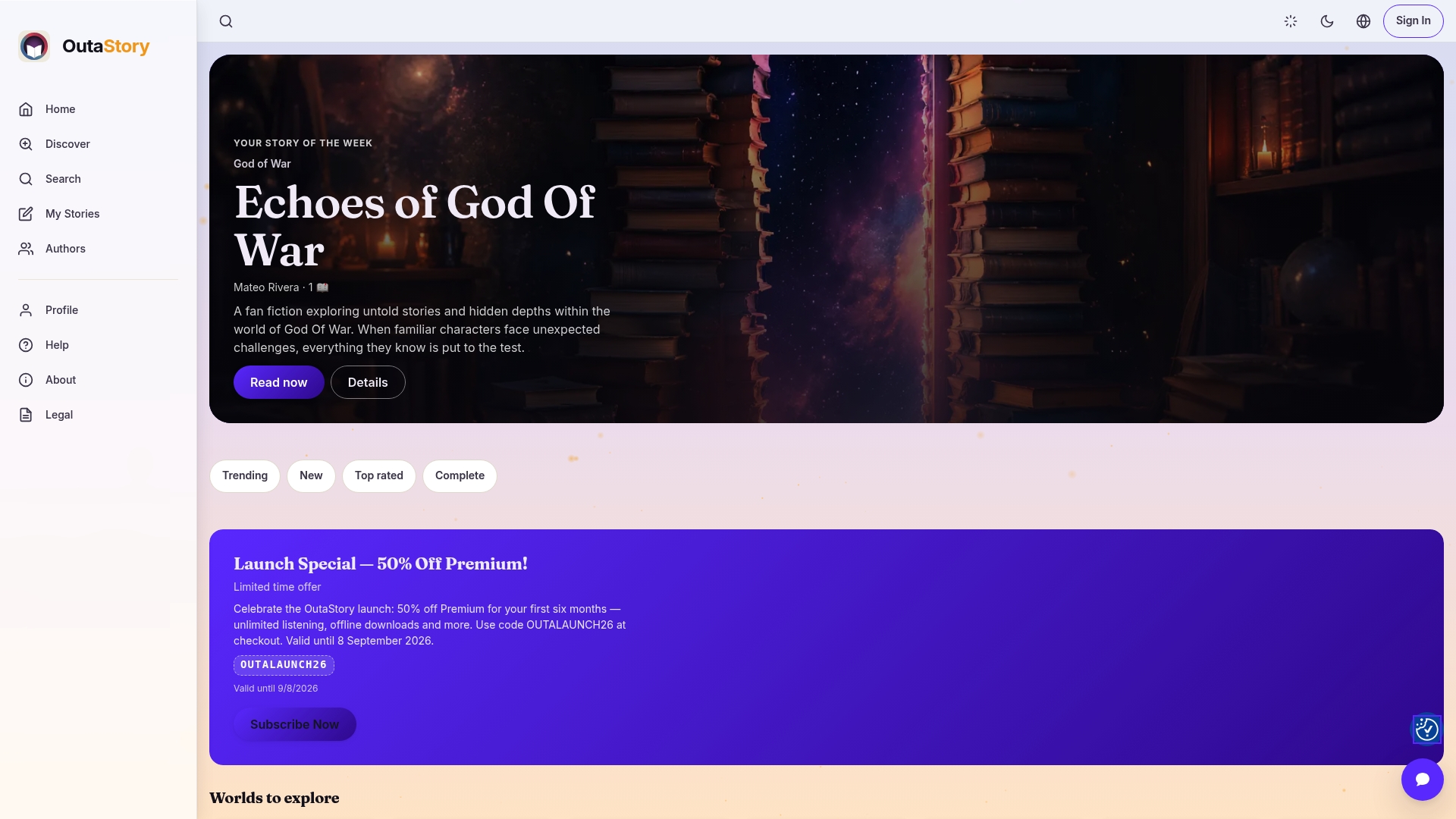
With OutaStory Premium you can listen without limits, ad-free and offline. That's exactly the blend of streaming comfort and file independence this comparison is about. How to save stories for on the go is explained in our help article on offline listening. Your world, your stories: write, read, listen.
Frequently Asked Questions
Is the sound quality of MP3 better than streaming?
Not automatically. Both approaches use compressed audio, and for spoken language differences between good bitrates are hardly noticeable. What matters are the recording, the voice and the production, not whether the file is loaded in advance or while listening.
How much data does a streamed audiobook use?
It depends on the bitrate. At 128 kbit/s it's roughly 58 MB per hour, at 64 kbit/s about half that. If you save titles offline in Wi‑Fi beforehand, you use no mobile data on the go.
Am I allowed to convert streamed audiobooks to MP3?
If the stream is technically protected, § 95a UrhG prohibits circumventing that protection, even for private use. Instead use the app's offline function, which is designed for listening without a network.
Can I listen to audiobooks on an old MP3 player without the internet?
Yes, provided you have the titles as MP3 files and the terms of use allow copying. For streaming content you need a device that can run the app or a browser, for example a smartphone or tablet.
Is streaming worthwhile for short stories as well?
Streaming shows its strengths especially for short stories. You can try a new genre or a new voice in a few minutes without buying anything or managing files. And because a story needs little data, it also loads quickly on mobile.
Sources
Recommendations
- Three questions to decide: Audiobook or eBook for your everyday situation
- Audiobooks while jogging: The right format for every running route
- Adjust audiobook speed: How to find your pace
- Podcast vs. Audiobook: Which audio format suits you?
Read and write on OutaStory
Thousands of short stories to read for free — or publish your own and find an audience.