Free short crime stories: format guidance for solve-along mysteries, incl. tip
If you want to start a puzzle round quickly, reach for a puzzle book with short cases. If you seek immersion, listen to a crime audio drama or a solve-along podcast. Families with children are best served by age-appropriate beginner detective stories. For short, listenable cases in between, it's worth checking platforms like Outastory that offer short crime stories for free to read and listen to.
In short:
- For short, practical solve-along formats, puzzle books, interactive activity books, as well as audio dramas and podcasts with varying moods are suitable.
- Active participation is necessary when puzzling; marking the text, creating a timeline, and forming hypotheses help identify clues deliberately and avoid mistakes.
- Children's puzzle crime stories are intentionally kept short, increase in difficulty with grade level, and simultaneously promote reading skills and logic.
- Digital offerings like Outastory provide flexible, free short crime stories to read or listen to, ideal for short breaks or regularly repeated puzzle rounds.
- Solving together in a group requires clear role distribution, short breaks, and focused discussions to analyze clues deliberately.
Table of contents
- Which formats are suitable for a solve-along crime story?
- How do you actually puzzle a criminal case correctly?
- Where can you find solve-along crime stories and their solutions?
- How suitable is Outastory for solve-along crime stories?
- How does successful group solve-along work?
- How do book, audio drama and interactive formats differ when puzzling?
- Print, audio or interactive: what fits which situation?
- Outastory: short crime stories to puzzle at any time
- Sources
- FAQ
Which formats are suitable for a solve-along crime story?
A puzzle crime story lives from the balance between suspense and solvability. Too easy and the case bores. Too cryptic and no one participates anymore. Three formats have become established, and each serves a different mood.
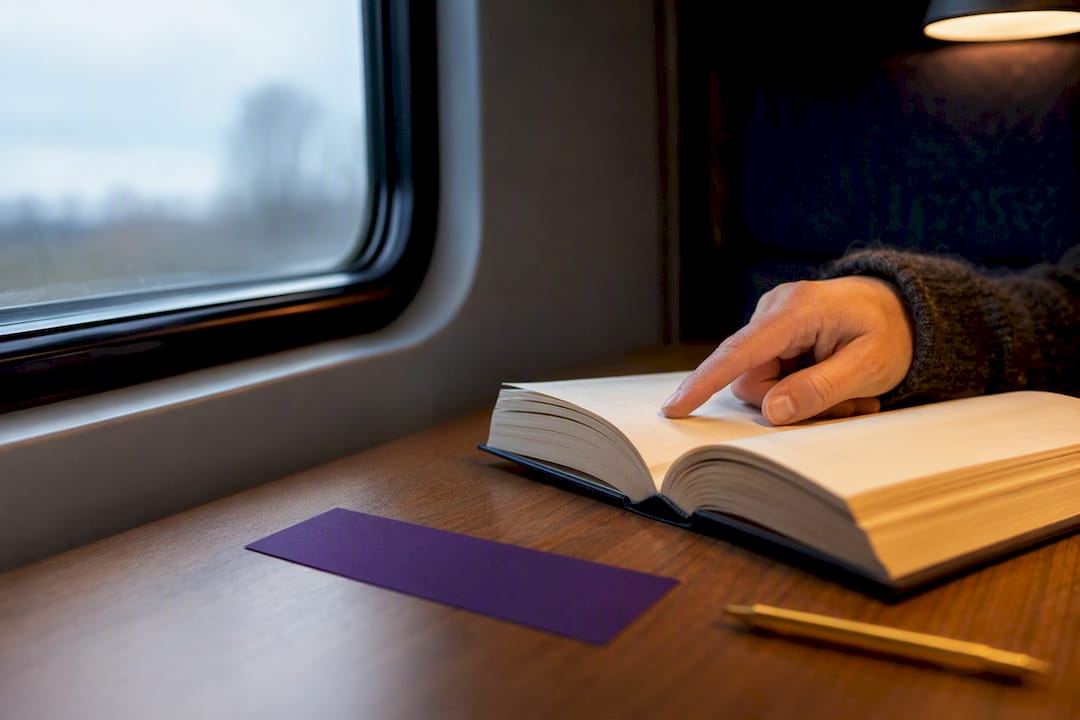
Puzzle books work like a kit of short crime stories. Each story stands on its own, usually between two and ten pages, with a solution at the end or on a separate page to turn to. That makes them ideal for short sessions, for example on a train ride or as an introduction to a game night. Puzzle crime stories combine narrative brevity with logic tasks and are used both privately and in teaching.
Interactive activity books go one step further. Reclam's Rätselabenteuer, for example, uses branching decision paths so you control the course of the story yourself, similar to a gamebook. You don't just read along, you actively decide which clue to follow.
Audio dramas and podcasts add the third dimension: voice, pace, atmosphere. The ARD series Das Geheimnis integrates solve-along elements directly into short episodes, often underscored with musical clues. If you prefer listening to reading, this is the most concentrated form of solve-along detective stories.
There are dedicated formats for children with clear age labeling:
- Detective stories to solve along by Anna Lott (ISBN 9783401717777) are aimed at beginner readers from grades 1 to 2, with syllable highlighting to promote reading.
- Ravensburger's Spannende Krimis zum Mitraten additionally relies on the Mildenberger syllable method.
- Finken Verlag offers with Kommissar Knocke ten puzzle crime stories along with worksheets for classroom use.
Difficulty usually increases with grade level, not with length. A good children's crime story stays short but delivers real clues instead of mere guessing tasks.
How do you actually puzzle a criminal case correctly?
Most readers fail not because of the logic of the case, but because of their own reading stance. Those who consume passively overlook clues. Those who think actively almost always solve it earlier than expected.
- Mark names, times and contradictions directly in the text or on a notepad. An alibi that gives two different times is rarely a coincidence.
- Build a timeline. Who was where and when? Crime writers like to hide contradictions in chronology, not in the act itself.
- Formulate a hypothesis early, even if it's still thin. Then actively look for clues that disprove this hypothesis, not just those that support it.
- Pay attention to language. Unusually precise phrasing, striking repetitions or a detail mentioned casually are almost always leads.
Those who only want to confirm their hypothesis fall into the most common trap: the confirmation trap. They then overlook exactly the sentence that topples their theory. A hypothesis list with motive, opportunity and contradiction per suspect protects against this quite reliably.
Pro tip: Write one sentence for each suspect that argues against them and one that clears them. As soon as one of the two sentences is empty, you know where to continue reading.
For children a simpler rule applies: ask why, not who. Whoever actively analyzes clues instead of merely guessing retains language and logic much better in memory than with passive reading. That is precisely the educational value of these books, far beyond pure puzzle fun.
Where can you find solve-along crime stories and their solutions?
Print and audio lead to different places. Puzzle books are found in bookstores, online shops and libraries, often sorted in the beginner reader or puzzle section. Audio dramas and solve-along podcasts, on the other hand, run via streaming platforms and broadcaster media libraries.
- Bookstores and online shops: Marketplaces like Amazon list hundreds of titles under “Ratekrimi für Erwachsene,” a sign of the format's broad demand.
- Libraries: Many public libraries carry puzzle crime stories in their youth or crime sections, often available to borrow without waiting lists.
- Free archives: Sites like RätselDino provide printable short crime stories with solutions, ideal for spontaneous puzzle rounds without purchase.
- Streaming and media libraries: ARD Sounds and similar services feature audio drama series with solve-along structures, usually episodic with their own resolution at the end.
The solution itself comes in three forms: directly in the book to turn to, as a separate website or PDF to look up, or as the final minute of a podcast episode. In children's books, the solution is almost always on the last page, often with a small illustration as a reward for sticking with it.
How suitable is Outastory for solve-along crime stories?
If you're looking for short solve-along crime stories without searching long for the right book, Outastory offers an uncomplicated entry point. The platform provides short stories across multiple genres, including crime and thrillers, free to read or listen to.
- Each story can be played as an audiobook, either with professionally produced voices or with the author's own voice.
- Cases sometimes appear as serial stories, published chapter by chapter, which is suitable for repeated solve-along over multiple sessions.
- Authors publish their stories in minutes and participate in revenue through a profit share.
- The platform is available in German and English, which also makes it interesting for bilingual reading groups.
For a short case between appointments, a single short story is suitable. For a whole crime evening, a continuing series with multiple chapters is worthwhile, where each episode provides a new clue. If you prefer listening to reading, simply switch to the audio version of the same story without leaving the platform.
How does successful group solve-along work?
A solve-along crime story changes completely in a group. Alone you read at your own pace; in a group friction arises, and that is usually what makes the evening exciting.
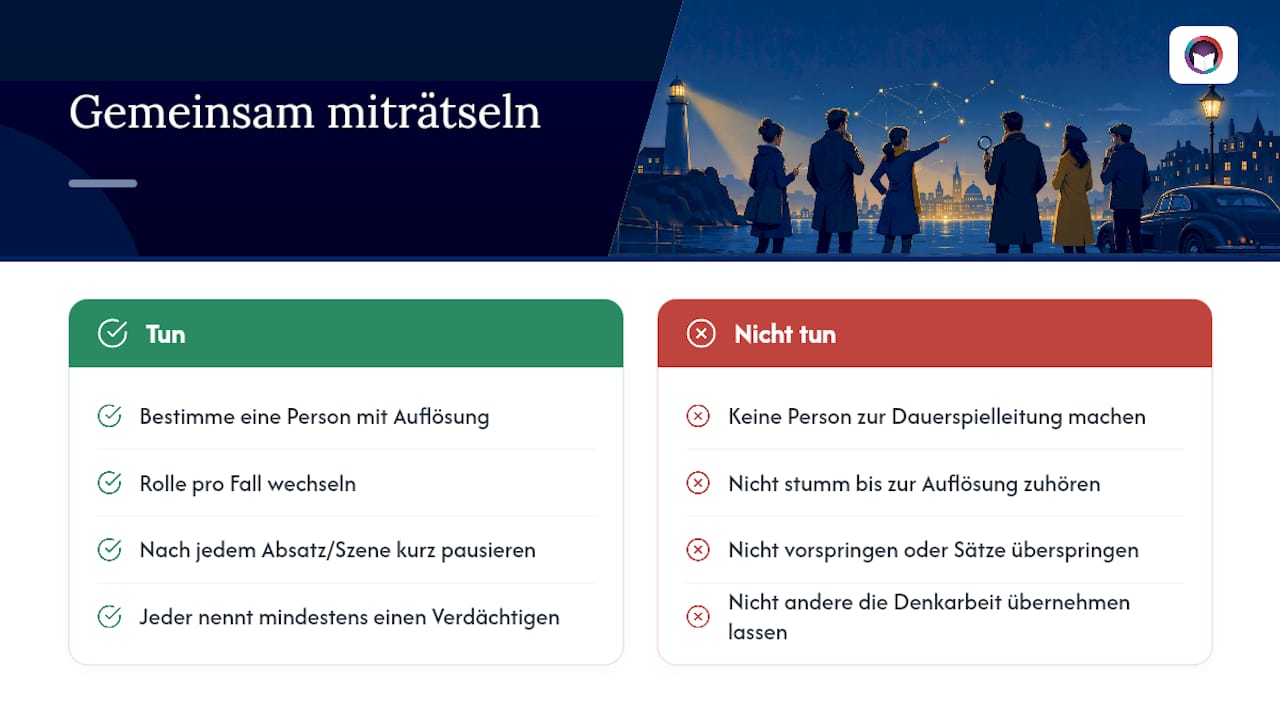
Appoint in advance a person who knows the solution or reads along without revealing it. This role should ideally rotate from case to case, otherwise one person becomes pure game master and never actually participates. Reading circles that take turns reading puzzle crime stories aloud should pause briefly after each paragraph and voice suspicions before the next section. Those who read on too early often skip exactly the sentence that later explains everything.
For listening rounds it helps to stop playback briefly after each scene. Discuss who might have lied and why. Groups that listen silently until the resolution almost always miss half the clues because hearing works differently than the eye when reading: you cannot re-read a sentence without losing the thread.
A small rule proven at many puzzle evenings: everyone must name at least one suspect out loud before the solution is revealed. This prevents individual participants from leaning back and only listening while others do the thinking. If children are involved, consciously mix the roles. A child as \"witness interviewer\" paired with an adult as note-taker distributes the task fairly and keeps everyone active.
How do book, audio drama and interactive formats differ when puzzling?
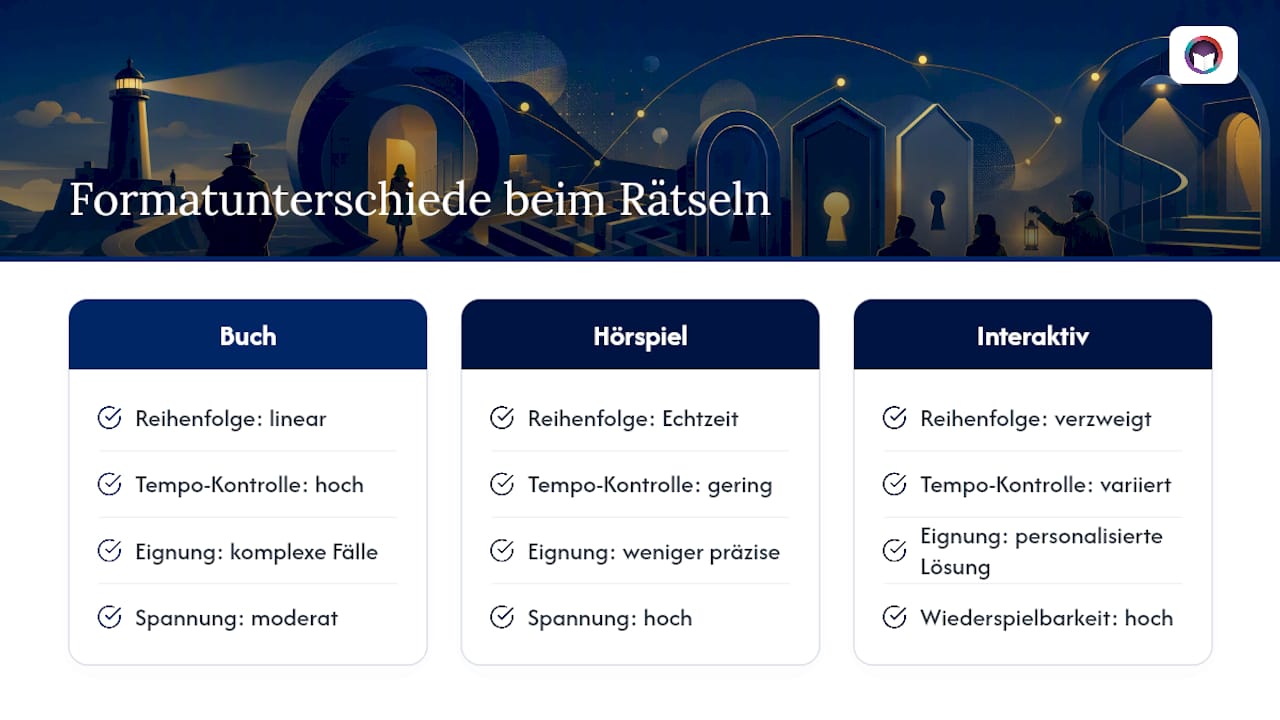
A book forces a linear order. You read page by page but can always flip back, re-read a paragraph or compare a margin note with an earlier chapter. This control over your own pace makes books the most reliable format for complex cases with many suspects.
An audio drama or podcast runs in real time. You can rewind, but rarely do because that interrupts the narrative flow. That creates more tension but costs precision. If you get briefly distracted while listening, you miss a clue for good unless you actively jump back.
Interactive activity books like Reclam's Rätselabenteuer stand out because branching decision paths force the reader to co-create. You decide which clue to follow and thus get a personal outcome instead of a single fixed solution. This mechanic significantly increases replayability, since a second run with different choices often leads to a different case.
Apps and digital puzzle formats go even further: clues can be clicked, evidence enlarged, sometimes even suspects questioned directly. This interactivity comes closer to investigative work than any linear format but also requires more technical equipment. For a spontaneous crime evening without preparation, a printed puzzle book or a single short story to listen to remains the simplest choice.
Print, audio or interactive: what fits which situation?
The decision between print, audio and interactive format depends less on taste than on the situation in which you puzzle. A puzzle book needs light, quiet and both hands free, so it's suitable at the kitchen table or on the train, but poorly suited while driving.
Audio formats like audio dramas work almost anywhere: while cooking, commuting, or walking. The drawback is the lack of the ability to quickly flip back to check a name. Those who want to think through a case thoroughly often combine both: listen to the story and make written notes in parallel.
Interactive formats demand the most attention but reward with real co-creation. They are best for a planned evening rather than a spontaneous break. When buying, check how the solution is provided: some books print the solution immediately after the story, others refer to a companion website or a separate PDF. If you want to puzzle undisturbed without accidentally flipping forward, choose books with a clearly separated solution page at the end, not embedded in the running text.
Outastory: short crime stories to puzzle at any time
A book needs a sales table, an audio drama a fixed broadcast time. Outastory needs only a few free minutes. Instead of buying an entire puzzle book, open a single short story from the crime or thriller section and decide whether to read or have it read to you.
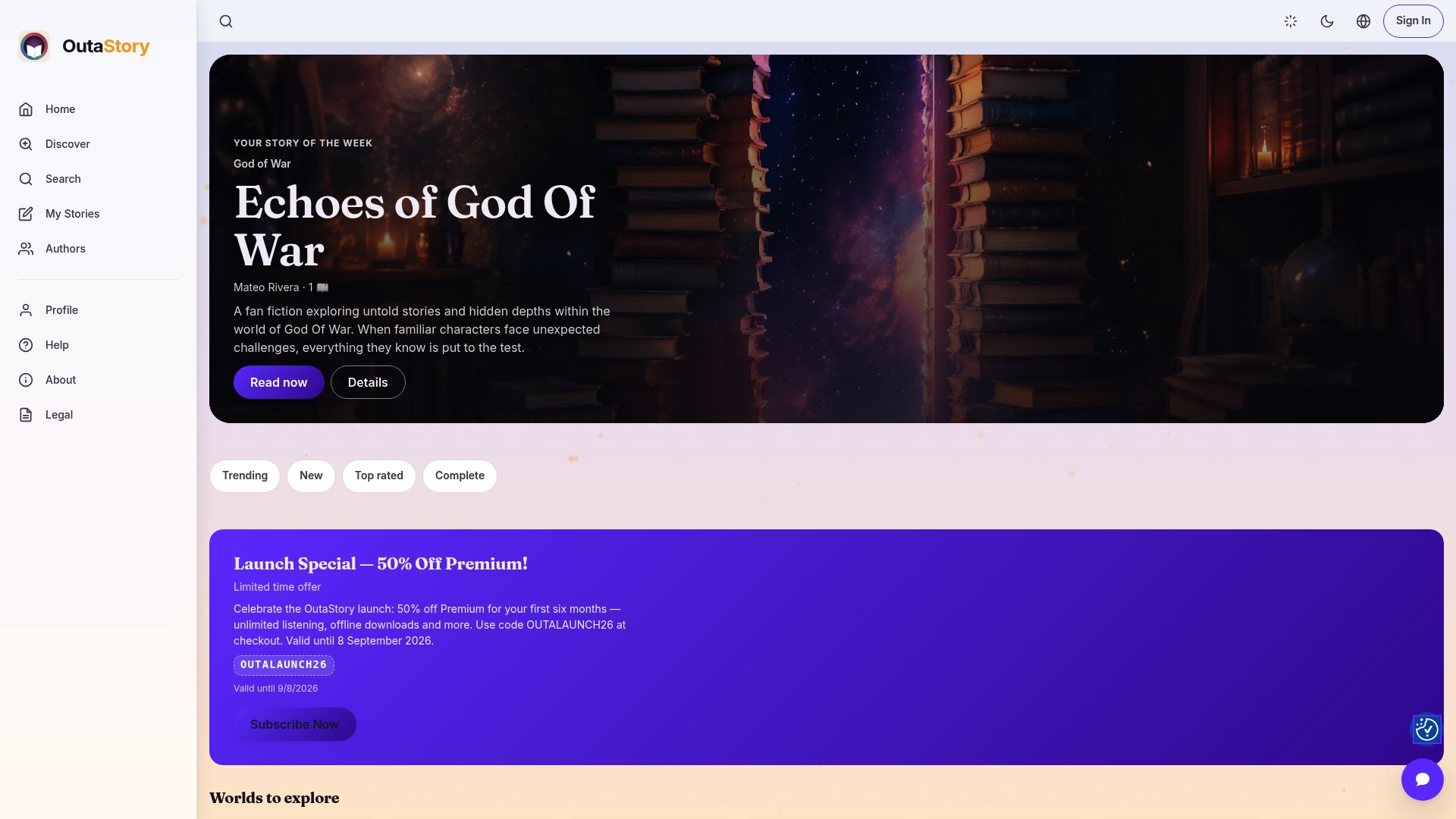
The principle is deliberately lean: free access to stories across several genres, with the option to play any of them as an audiobook, either with professionally produced voices or with the author's own voice. If you find a case particularly exciting, you don't have to wait for the next bookstore. Some stories are released chapterwise as serials, which suits a regular solve-along group that discusses a new episode each week. If you write crime stories yourself, you can publish your own story on the platform and take part in the revenue share.
Start best directly on the Outastory homepage, choose a short story from the crime section and try a sample listen before deciding whether to read or listen.
Sources
If you want to dive deeper into individual titles or series, here are direct points of contact:
- Reclam's Rätselabenteuer — Reclam Verlag
- Puzzle stories and short crime tales for adults — RätselDino
FAQ
Which solve-along crime stories are particularly recommended?
For adults, puzzle-crime series with logic tasks and interactive activity books like Reclam's Rätselabenteuer are among the best-known formats. For children, detective stories to solve along by Anna Lott and Ravensburger's \"Spannende Krimis zum Mitraten\" are established titles.
Are there crime-puzzle stories for adults that include the solution?
Yes, most puzzle books and many online archives like RätselDino provide the solution immediately after the story, either on a dedicated page or as a separate PDF.
Which humorous solve-along crime stories are available?
Some puzzle-crime series deliberately use a light, wink-at-the-reader narrative style instead of dark suspense, especially in children's formats with exaggerated suspects and punchy dialogue. Those looking for humorous short crime stories will find individual tales on Outastory that combine crime and a lighter tone.
How do I find currently popular puzzle crime stories?
A look at marketplace categories like “Ratekrimi für Erwachsene” shows which titles are currently in high demand, supplemented by new library arrivals and radio drama series from broadcaster media libraries.
How does a participation-style crime book differ from a classic crime novel?
A classic crime book tells a fixed narrative without the possibility of intervention, whereas an activity book incorporates branching decision paths or direct puzzle tasks that can influence the story's outcome.
Recommendations
- Read and listen to romantic short stories for free
- Read and listen to short stories for free: the best overview
- Free horror short stories to read and listen to: the best sources
Read and write on OutaStory
Thousands of short stories to read for free — or publish your own and find an audience.