
Flash Fiction in definition, examples, writing tips
Flash Fiction is an extremely short tale that achieves a complete effect in a few sentences up to around 1,000 words. Forms range from the Six-Word Story to texts of around 1,000 to 1,500 words, with many German-language definitions orienting themselves to a span of 250 to 1,000 words. For writers the genre is a training field: it forces clear language, compression and a single, sharply defined moment.
In short:
- Flash Fiction typically includes texts between 250 and 1,000 words, with extreme compression, implicit hints and a surprising twist characterizing the genre.
- The shortest forms like nanofiction, microfiction and the drabble follow clear word-count limits, but should be seen as orientation rather than rigid rules.
- Famous examples like the Six-Word Story or „Knock“ demonstrate how a complete world can emerge in a few sentences, with the focus on a single meaningful moment.
- When writing, one should capture a core idea in a rough draft without filtering, then cut it radically and focus on strong verbs and a crisp twist.
- Platforms like Outastory allow authors to publish flash fiction quickly and produce audiobooks to reach an audience and generate revenue directly.
Table of contents
- What distinguishes flash fiction as a text genre?
- Where does very-short prose come from and how has it developed?
- Where can you find good examples of flash fiction?
- How do you write a good flash fiction story?
- How does Outastory support publishing flash fiction?
- Publish and make your own flash fiction audible now
- Sources
- FAQ
What distinguishes flash fiction as a text genre?
Word limits are softer than many guides suggest. Wikipedia names 250 to 1,000 words as a common range, but there are established subforms both below and above that with their own rules.
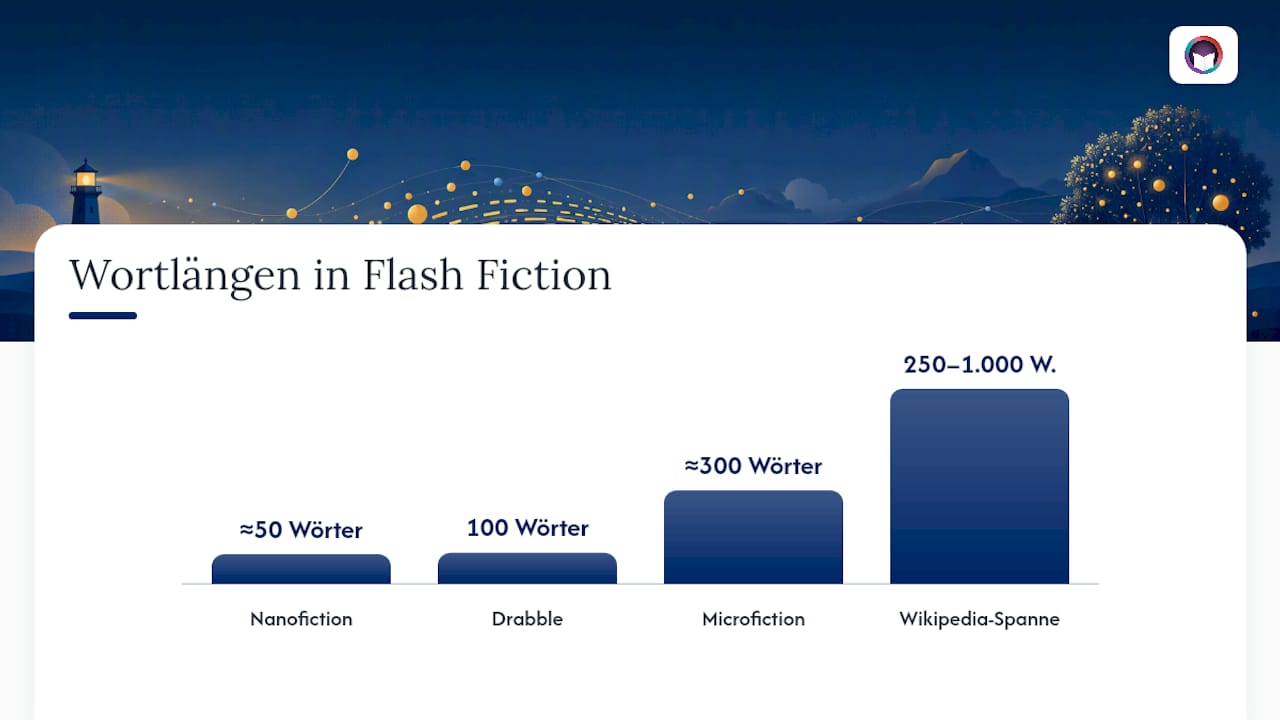
Three terms constantly appear in practice. Nanofiction ranges from a few words up to about 50, microfiction goes up to around 300 words, and the drabble is fixed at exactly 100 words, no more, no less. Treffpunkt Schreiben recommends treating these limits as orientation rather than strict law and instead focusing on a single moment.
What defines the form beyond length:
- Extreme compression: Every sentence must serve multiple functions at once — for plot, character and atmosphere.
- Suggestion instead of explanation: Much remains implicit; readers fill the gaps themselves.
- A twist or peripety: Meaning often shifts in the final sentence or word.
- The title as a tool: It often carries information for which there is no room in the text.
Flash fiction is distinguished from the short story by its radically reduced cast and lack of room for subplots. Its boundaries toward poetry intentionally blur: Sela Miller aptly describes flash fiction as a kind of luminous poetry that in German benefits more from its proximity to lyric than from imported Anglo-American word limits.
Where does very-short prose come from and how has it developed?
Predecessors of the genre existed long before the term itself. Fables have always conveyed maximum meaning with minimal text, and authors like Chekhov, O. Henry and Kafka prepared the art of compressed storytelling in the 19th and early 20th centuries.
The term “Flash Fiction” itself only established later, mainly through anthologies of the 1990s in the English-speaking world. These collections named the genre and gave it literary legitimacy, as Wikipedia documents.
The internet then accelerated this development:
- Twitterature emerged as a narrative form adapting to the character limits of social networks.
- Postcard stories use the physical space of a postcard as a form constraint.
- German-language communities increasingly experiment with their own adaptations, etc.
- Contests and online magazines have developed submission rhythms for extremely short forms.
Digital archives now preserve this development in both directions: they show both the historical roots and current German-language practice.
Where can you find good examples of flash fiction?
A few very short stories have achieved literary fame, even though they rarely exceed a few sentences. The so-called Six-Word Story, „For sale: baby shoes, never worn“, is often attributed to Ernest Hemingway, although this is not absolutely certain. Fredric Brown's story „Knock“ is considered a classic of extremely short science fiction: “The last man on Earth sat alone in a room. There was a knock on the door.” Two sentences, a complete world. Augusto Monterroso's „Der Dinosaurier“ consists of a single sentence and is still cited as a prime example of maximum compression.
In the German-speaking world, anthologies like „Erzählte Zeit“ collect contemporary short prose and demonstrate a lively publishing practice outside the classic novel. Those who want to start themselves can find on OutaStory, among other things, romantic short stories to read and listen to as well as a collection of simple short stories for beginning readers, which show how compact narratives work for different audiences.
How do you write a good flash fiction story?
The path from idea to finished text follows the same pattern in almost all successful very-short stories.
- Find the core idea. A single image, a conflict, a sentence — that is all the starting point needs.
- Write a rough draft. Put down everything related to the idea without worrying about length.
- Cut radically. Examine every subordinate clause, question every adjective, remove any character that isn't strictly necessary.
- Polish. Revise rhythm, sound and the final sentence until the twist lands.
Kiki Sieg recommends starting in the middle of the scene — in medias res — rather than beginning with backstory. One or two characters are almost always enough; a third character usually only dilutes the effect. Strong verbs carry a short story further than any adjective, and the title may well take on part of the meaning for which there is no space in the running text.
Four exercises are particularly suitable for getting started.
- The Six-Word Challenge: tell a complete story in exactly six words.
- The 100-Word Drabble: shape a scene to exactly 100 words, no more.
- The 5-Minute Flash: write a rough draft in five minutes without interruption, then revise.
- The Cutting Checklist: cut each paragraph by a quarter and check whether the story loses or gains something.
Pro tip: Cut in rounds rather than all at once. In the first pass remove only words, in the second whole sentences, in the third check whether a secondary character can be removed entirely. Fixed rounds of cutting train precision more reliably than a single radical cut.
The most common mistake is a flashback that softens the moment instead of sharpening it. The second most common is a too-explicitly explained ending. Flash fiction lives from what is left between the lines, not from what the final sentence dutifully sums up.
How does Outastory support publishing flash fiction?
Very-short stories benefit especially from a format in which they can go online quickly and be heard immediately. Outastory lets authors publish their texts in minutes, either as plain text or as an audiobook with professionally produced voices or their own voice.
Those planning a longer flash-fiction series can release individual stories chapter by chapter as installments instead of waiting for a finished collection. Through revenue sharing, authors also participate directly in the earnings of their published stories. For a genre that thrives on quick feedback, where a story can be read or heard in minutes, this short path from text to audience makes a real difference.
Publish and make your own flash fiction audible now
If this guide has made you want to actually publish your own very-short story instead of leaving it in a drawer, Outastory offers a direct route. Unlike a traditional publisher with long lead times and rejection letters, your text goes online here within minutes, either as plain text or directly as an audiobook.
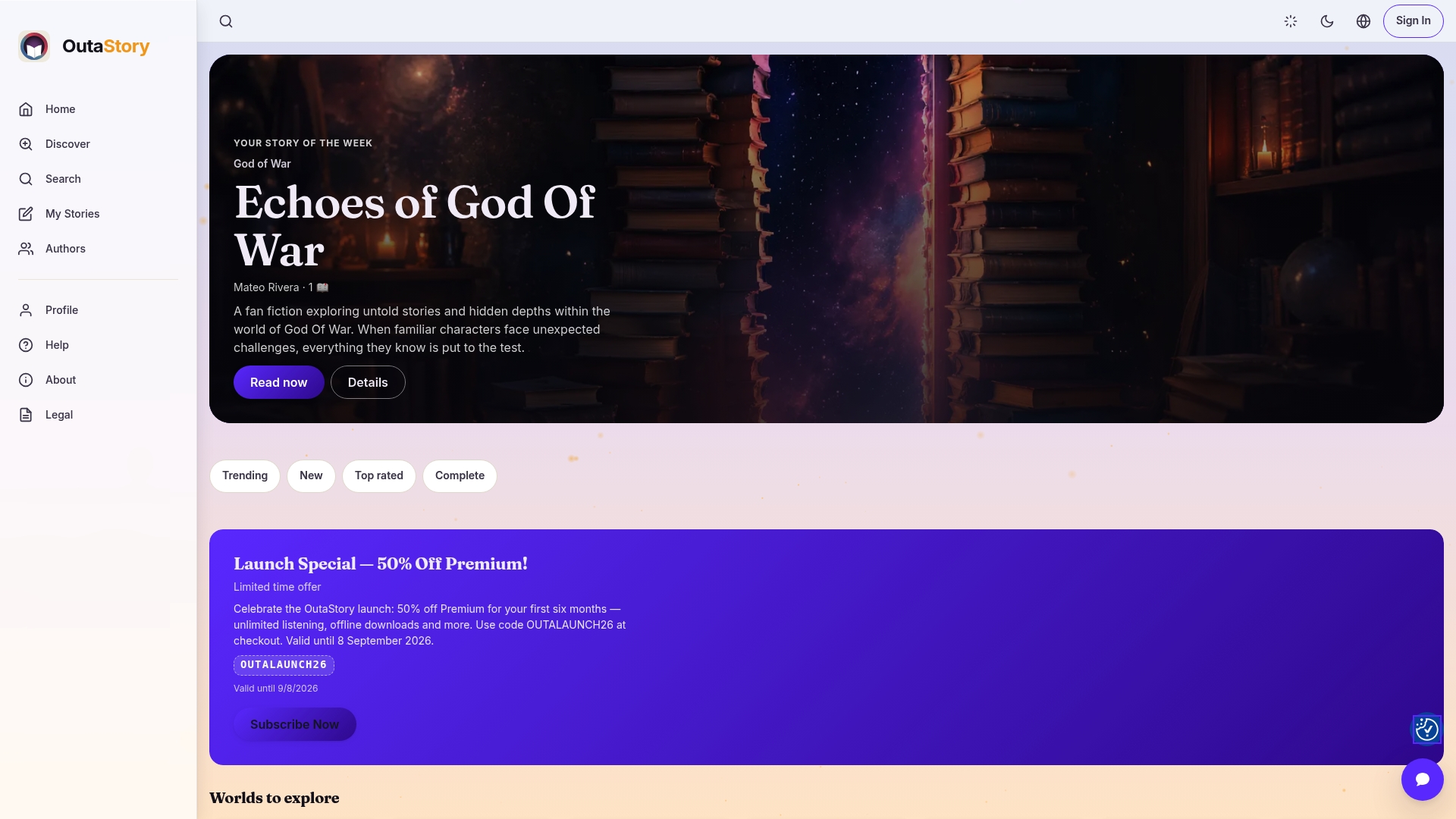
The process is uncomplicated: upload the text, choose a genre (for example fantasy, crime, or even the children's section with bedtime stories), and decide whether the story should be voiced by a produced voice or your own voice. After that, the flash fiction is freely accessible to readers and listeners, while the author participates in the revenue share. If you want to see how other short formats work on the platform first, for example you can find science-fiction short stories as guidance. The next step is simple: open your text, upload it to Outastory and hear how your flash fiction sounds as an audiobook.
Sources
The Wikipedia article on Flash Fiction provides a solid overview of definitions and history. Treffpunkt Schreiben and Wilde Prosa offer German-language practical perspectives. For structured language learning with short texts, also take a look at the free materials from PolishMyGerman.
- Flash Fiction — Wikipedia
- What is Flash Fiction? – Treffpunkt Schreiben
- What is Flash Fiction? – Wilde Prosa (Sela Miller)
- Writing Flash Fiction – Kiki Sieg
- Erzählte Zeit : 50 deutsche Kurzgeschichten der Gegenwart — Internet Archive
FAQ
What is meant by Flash Fiction?
Flash Fiction is an extremely short narrative form without a fixed word limit, with the majority of texts, according to Wikipedia, ranging between 250 and 1,000 words. Characteristic features are strong compression, a single central moment, and often a twist in the final sentence.
What are examples of Flash Fiction?
Well-known examples are the Six-Word Story „For sale: baby shoes, never worn“, Fredric Brown's two-sentence story „Knock“ and Augusto Monterroso's one-sentence „The Dinosaur“. German-language examples can be found in collections like „Erzählte Zeit“ as well as on platforms like Outastory.
What is typical for short stories compared to flash fiction?
Classic short stories allow multiple characters, subplots and a more developed narrative arc, whereas flash fiction is usually reduced to one or two characters and a single moment. The boundary is not sharp but depends on the degree of compression.
Which literary short stories are considered role models for the genre?
Texts by Chekhov, O. Henry and Kafka are considered literary precursors of modern very-short prose, even though the term Flash Fiction was only established through anthologies of the 1990s. These early anthologies laid the foundations for today's definitions and contests.
Recommendations
- Read and listen to romantic short stories for free
- Start now: Free science-fiction short stories on Outastory
Read and write on OutaStory
Thousands of short stories to read for free — or publish your own and find an audience.