
Start right away: science fiction short stories for free on Outastory
If you want to read or listen to a science fiction short story now, start with “Variante Zwei” by Philip K. Dick, “Story of Your Life” by Ted Chiang and Isaac Asimov’s “Der Zweihundertjährige Mann.” All three are considered entry points into their respective oeuvres and are available via anthologies or digitally. On Outastory you will also find additional short stories from the genre that can be read for free or listened to as audiobooks, many of them in the author’s voice.
In short:
- Most good science fiction short stories can be read or listened to in 20 minutes and provoke long-lasting reflection after they end.
- Classic examples like “Variante Zwei”, “Der Zweihundertjährige Mann” and “Story of Your Life” offer different approaches to technology topics and philosophical questions.
- Platforms like Outastory enable free reading and listening, including professionally produced audiobook versions, allowing flexible switching between text and audio.
- To quickly assess a good short story, the premise should be clear, the length appropriate, the idea original and the style fitting.
- If you just want to try once, start with audio versions, as they offer an easy way to experience demanding sci‑fi short stories in everyday situations.
Table of contents
- Which science fiction short stories are really worth reading?
- Where can you find science fiction short stories for free?
- How to recognize a good short story at first glance?
- Read or listen: which format suits you?
- These authors shape the science fiction short story
- OutaStory as a starting point for reading and listening
- Where you can dive deeper into the topic of science fiction short stories
- Your next step: read or listen on Outastory
- Sources
- FAQ
Which science fiction short stories are really worth reading?
The selection of sci‑fi short stories is huge, but only a portion of it still holds up on a second reading. The following list deliberately mixes classics, modern highlights and easily accessible German-language texts so that there is something for every reader type.
-
“Variante Zwei” (Second Variety) by Philip K. Dick. This short story is one of the most printed examples of the genre and explores where humanity ends and simulation begins. Robots disguising themselves as humans to kill humans sounds simple for 1953, but the brevity makes it disturbingly immediate. Reading time: a typical short story that can be read in about half an hour.
-
“Der Zweihundertjährige Mann” by Isaac Asimov. An android fights for legal and emotional recognition as a person over decades. Asimov here uses no action twists but a slow, almost legal argumentation that nonetheless moves. Ideal for readers who want robot stories with substance rather than pure suspense.
-
“Story of Your Life” by Ted Chiang. The basis for the film Arrival tells of a linguist who communicates with aliens and in doing so loses her perception of time. Chiang writes densely, sometimes almost scientifically, but rewards anyone who engages with the unusual structure. Slightly more demanding than the first two entries, but not a 100‑page hurdle.
-
“Der Ausflug ins Gestirn” by Kurd Laßwitz. An early German contribution to the science fiction short story, written long before the genre bore that name. Anyone who wants to know how German authors speculated about space travel in the 19th century will find a curious but worthwhile introduction here.
-
“Die Aufpasser” by Marco Rauch. A contemporary example of German-language sci‑fi short prose, published online directly by the author. The story shows that the format no longer plays out only in large publishers but also among individual authors who distribute their texts themselves.
-
Selected texts from c’t short story sections. The IT magazine c’t regularly publishes science fiction short stories as a fixed section, often with a technical focus and a tendency toward near‑technical future speculation. If you prefer stories about concrete technologies rather than abstract space adventures, you’ll find an underrated resource here.
What unites these six texts: none requires more than an hour of reading time, but each leaves a question that lingers. That is exactly what distinguishes a good short story from a mere sketch.
Where can you find science fiction short stories for free?
Access to sci‑fi short stories has never been easier; the problem is more filtering than finding. There are four types of sources that differ significantly in effort and quality.
Outastory aggregates short stories from various genres, including science fiction, fantasy and crime, for free reading. The difference to pure text archives: every story can also be played as an audiobook, either with professionally produced voices or with the author’s own voice. If you want to listen on the go instead of reading, you don’t have to switch to a separate audiobook service.
Online magazines and anthologies remain the classic source. Tor Online, for example, curates short stories editorially and explains why certain texts are considered “gates to varied walks into strange worlds.” c’t also belongs in this category, with a fixed short story section that gives the format unusually high visibility.
Archives and community collections offer sheer volume. On E‑stories alone there are hundreds to thousands of texts in the science fiction category, often by amateur authors, mixed with occasional real gems. Quality varies widely because there is little editorial preselection.
Forums and discussion platforms provide curated recommendations second‑hand. On Reddit, readers discuss sci‑fi short stories and exchange link tips; the same goes for threads in the SF network. The advantage: real readers instead of an algorithm. The downside: you have to sift through the answers yourself.
A few simple filtering rules help in the search:
- Search by length in words or reading time, not by page count, because formatting varies greatly.
- Use keywords like “thought experiment”, “first contact” or “dystopia” instead of just “science fiction” to narrow down results sensibly.
- Check whether a platform allows filtering by language, especially in mixed German‑English archives.
- Pay attention to the publication year if you are specifically looking for contemporary rather than classic texts.
Pro tip: Save three to four sources with different characters: a curated magazine, a large archive, an audio platform. That way you can switch between guaranteed quality and discovery depending on your mood without searching from scratch every time.
How to recognize a good short story at first glance?
A good science fiction short story doesn't need an elaborate worldbuilding chapter. It must credibly set up its thought experiment in a few pages, sharpen it and usually resolve it with a twist. This economy makes the format a good training ground for readers who want demanding ideas quickly without wading through exposition.
Five criteria help with a quick assessment:
- Premise. Can the core idea be summarized in one sentence? If not, the story will probably try to do too much.
- Length relative to the idea. Does the idea really fit into five to twenty pages, or does it feel like a novel cut down?
- Style. Does the language carry the idea, or does it seem merely functional?
- Tone. Does the mood—melancholic, satirical or coolly analytical—fit the premise?
For a quick test three steps are enough. First: read the first two paragraphs. Is a tension or question established immediately? Second: skip to the last paragraph. Does the ending feel like a logical consequence or like a random cut‑off? Third: compare the total length to your available time; a 40‑minute story is worth assessing differently than a 10‑minute one.
You can usually spot a warning sign just by skimming: an overloaded premise without a recognizable twist. If a short story tries to introduce three different technologies, two timelines and a war at once but then simply stops instead of sharpening one of those threads, it was probably more of a collection of ideas than a finished story.
Awkward sentences become noticeable much faster when listening than when reading silently.*
Read or listen: which format suits you?
The choice between text and audiobook for short stories is less a matter of taste than of situation. A ten‑page tale reads in 15 to 30 minutes; as an audiobook the same story usually takes 20 to 40 minutes depending on speaking speed, word density and narrative style.
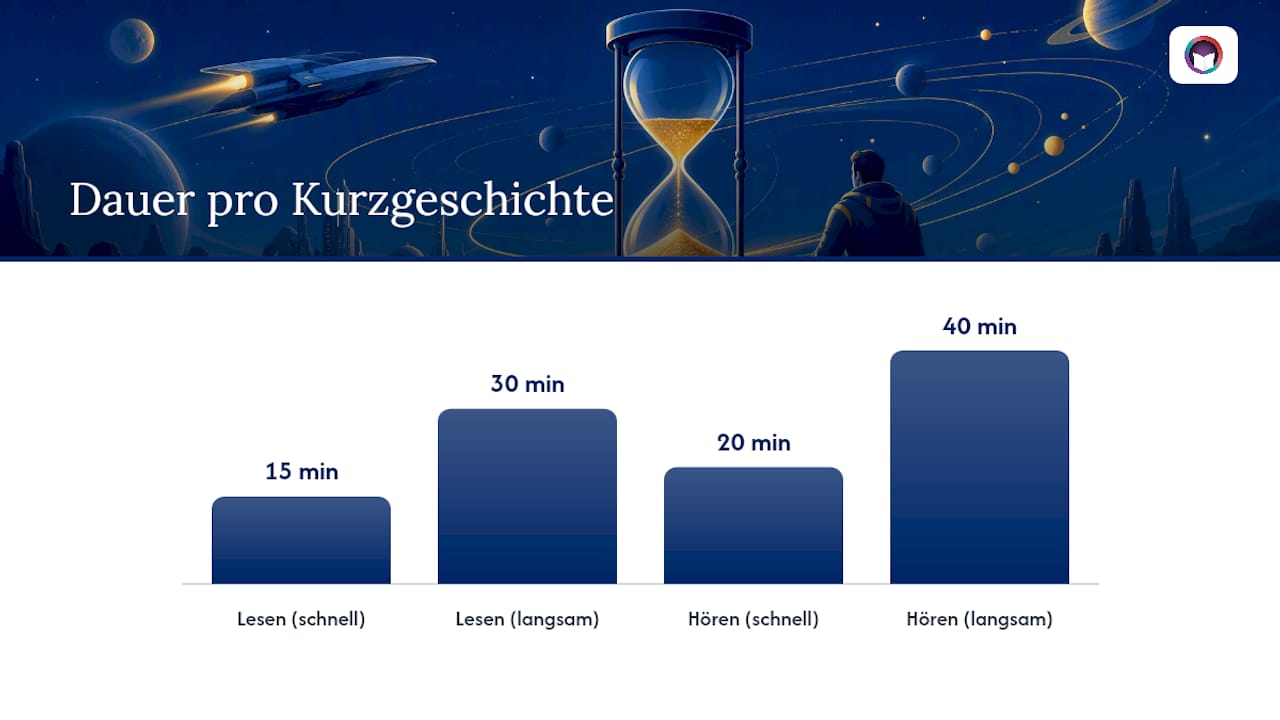
Text has a clear advantage with complex language. Ted Chiang’s nested time structure, for example, is easier to follow when reading because you can simply look at a sentence again. Audiobooks score points in everyday situations: commuting, washing dishes, walking. Short stories are particularly suitable for this because a single trip or walk is often enough for a complete story.
A few practical points for audio versions:
- Pay attention to speaking speed: for dense thought experiments a slightly slower pace helps to avoid missing shifts.
- Professionally produced voices often work more convincingly for dark or emotional texts than plain text‑to‑speech.
- Author voices are especially worthwhile for personally shaped texts because tone and emphasis often mirror the intent behind the text.
- Create a playlist by mood rather than by author, for example “short dystopias for the evening” instead of a rigid sequence of works.
For beginners: if you're unsure whether you like the genre at all, start with audio versions. The time investment per story is smaller and the risk of a “wasted” half hour is lower.
These authors shape the science fiction short story
Three names appear on almost every recommendation list for sci‑fi short stories, and for good reason. Each represents a different way of using the format.
Philip K. Dick wrote short stories where perception and reality never quite align. “Variante Zwei” is one of his most famous contributions and deals with how humanity and simulation blur into each other, a theme Dick returns to throughout much of his work. If you know “Total Recall” or “Blade Runner”, you will find the same unease in his short stories—only more concentrated and without film‑budget effects.
Isaac Asimov, by contrast, works with clear rules. His robot stories, led by the famous Three Laws of Robotics, function almost like logic puzzles: what happens when a machine follows these rules literally but nonsensically? “Der Zweihundertjährige Mann” departs from this puzzle scheme and becomes instead a reflection on identity and mortality. For beginners, Asimov’s texts are often the most accessible because the premises are immediately understandable.
Ted Chiang writes less frequently, but each of his stories is an event. “Story of Your Life” shows his typical approach: a scientific idea—here linguistics and physics—is thought through so consistently that it ends with an almost philosophical statement about free will. Chiang’s texts demand more concentration than Asimov’s but reward it all the more.
German‑language contributions also exist, albeit with less international visibility. Kurd Laßwitz is one of the early German science fiction authors, long before the term was established. Contemporary individual authors like Marco Rauch publish their texts directly online, often outside traditional publisher structures. Translations of the major English‑language classics—Dick, Asimov, Chiang—are usually well available in German anthologies and collections, even if not every single story has its own German edition.
OutaStory as a starting point for reading and listening
Outastory was built exactly for this situation: you don't want to research ten archives via search engines, you want one place where you can open a short story and read or listen right away. The platform offers short stories from multiple genres, including science fiction, fantasy, crime and horror, for free reading and listening.
The practical process is simple: start a search, choose a genre, listen briefly to the sample, then decide whether to continue reading or listening. If you listen regularly, you can later get a premium subscription with unlimited listening time and offline access, but the free option is more than sufficient for getting started.
Three features are particularly relevant for sci‑fi short stories:
- Every story is available as an audiobook, optionally with a professionally produced voice or the author's own voice.
- Serialized stories appear chapter by chapter, so longer ideas can be followed in short form without requiring a full novel.
- Authors receive a revenue share from their stories' income, which gives independent sci‑fi authors a direct incentive to publish new texts.
This combination of text format and audiobook option is not a side aspect but the core of what makes short stories so practical in everyday life.
Where you can dive deeper into the topic of science fiction short stories
If you want to learn more after the first recommendation round, there are three solid starting points. The Tor Online article on the significance of the short story places the format editorially and explains why short texts are particularly suited to thought experiments. The Wikipedia entry on “Variante Zwei” provides background on its origin and a synopsis of one of the most cited examples of the genre.
For concrete texts, check author pages like Marco Rauch’s, who publishes his short stories directly online, or large archives like e‑stories.de with their extensive science fiction category. If you prefer to write yourself rather than just read, tools like novel with ai support the development of your own short stories from the first idea to the finished text.
Your next step: read or listen on Outastory
You now have a list of classics, an idea where to search, and criteria to filter yourself. The last step is simple: start somewhere. Unlike a single archive or magazine, Outastory covers both formats at once—text and audiobook—without forcing you to switch between two services.
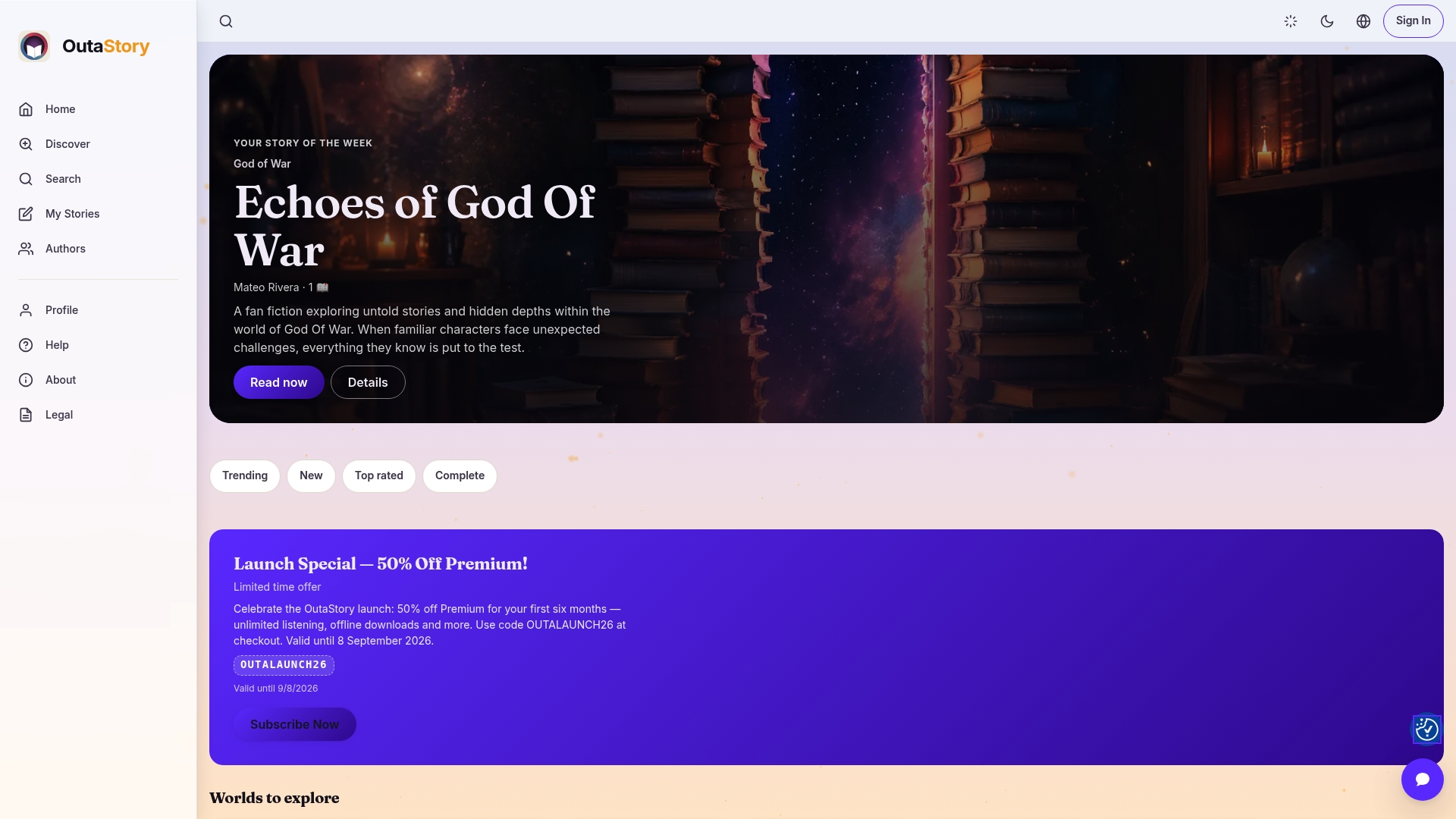
For science fiction readers this means concretely: open a story, read the first paragraphs, and if you like the tone but your hands are busy, simply switch to the audio version, often with the author’s voice. The free offering is entirely sufficient for getting started. If you find yourself listening regularly, you can later upgrade to a premium subscription with unlimited listening time and offline access. And if you write yourself: on Outastory you can publish your own short story in minutes and take part in revenue sharing instead of waiting months for a publisher reply. Just get started: pick a genre, listen into a story and then decide whether text or audiobook is the better choice today.
Sources
FAQ
What is a good example of a science fiction short story?
“Variante Zwei” by Philip K. Dick is considered one of the best‑known examples because it pits humanity against simulation in only a few pages. Ted Chiang’s “Story of Your Life” and Isaac Asimov’s “Der Zweihundertjährige Mann” are also often cited as entry‑level examples.
Which science fiction books or short stories should one have read?
The most frequently mentioned must‑reads include works by Philip K. Dick, Isaac Asimov and Ted Chiang, supplemented by early German‑language works such as those by Kurd Laßwitz. As a short story specifically, “Variante Zwei” is often recommended as a starting point.
Where can I read or listen to science fiction short stories for free?
On Outastory you can read short stories from multiple genres for free and listen to them as audiobooks, either with a professional voice or the author’s voice. Additionally, magazines like Tor Online and archives like e‑stories.de are useful places to find more material.
What distinguishes a science fiction short story from a novel?
A short story focuses on a single thought experiment and usually forgoes extensive worldbuilding, whereas a novel allows multiple plotlines and broader character development. This brevity forces authors into an economical storytelling style where every paragraph must contribute to the central idea.
Which themes frequently appear in science fiction short stories?
Recurring motifs are artificial intelligence and its limits toward humanity, perception of time, first contact with alien intelligences, and dystopian social designs. Philip K. Dick and Ted Chiang are among the authors who address these themes particularly concentratedly in short form.
Read and write on OutaStory
Thousands of short stories to read for free — or publish your own and find an audience.