First rhymes for children: simple verses and finger plays for everyday life
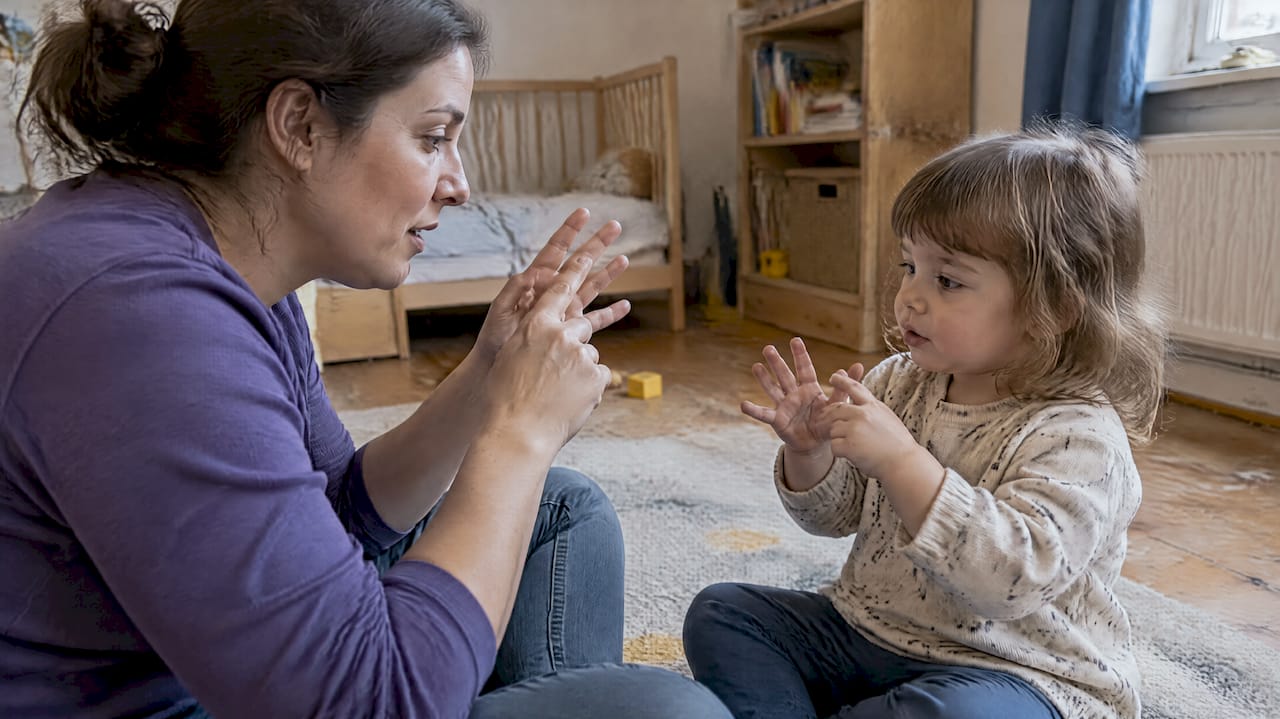
First rhymes are short, easily repeatable verses, finger plays and knee-riders for babies and toddlers. Start small: say two or three verses regularly and combine them with clear, simple movements. This playfully strengthens your child's phonological awareness and fine motor skills, with no preparation.
In short:
- Around age two children remember short verses, at three to four they recognize rhymes, and at four to five many form their first own rhymes.
- Two or three verses are enough to start; say them daily as part of a fixed ritual and end the game as soon as your child becomes restless.
- With knee-riders, hold your child firmly and lower them slowly; avoid jerky movements, and take a break if they are unsettled.
- Start with couplet rhymes, where the sound follows immediately; alternate rhymes require more memory and longer verses may cause toddlers to lose the thread.
- Audiobooks provide emphasis and pauses, but do not replace your voice and attention; when listening, say rhyme words together with your child.
Table of contents
- 1. Twelve simple rhymes and finger plays to start right away
- 2. Why rhymes and finger plays promote language development
- 3. Age guide: when children recognize, remember and rhyme on their own
- 4. Practical tips: how to rhyme and play together
- 5. Couplet rhyme, alternate rhyme, internal rhyme: how each rhyme type works
- 6. How rhymes support early literacy and listening comprehension
- 7. Rhymes in child-friendly audiobooks and stories
- 8. Further rhyme materials for parents and educators
- 9. Inventing your own rhymes: how to do it playfully
- 10. Our kids' section: voiced rhymes as a complement for everyday life
- FAQ
- Sources
1. Twelve simple rhymes and finger plays to start right away
The following templates require no materials or preparation. Choose two or three and stick with them for a while: children love repetition. Those who want more options can find more ready-to-use verses in our collection short children's rhymes for daycare and home.
- This is the Thumb (finger play). “This is the thumb, who shakes the plums, who picks them up …” You tap each finger in turn. For very young babies it's enough to just stroke the thumb and say the first verse.
- All my ducklings (knee-rider). The child sits on your knees, you rock gently in time. If you like, slow down a little and whisper the line at “heads into the water.”
- Hop, hop rider (knee-rider). Rock at a gallop tempo and let the child sink gently between your knees at the end. You can stretch and emphasize the final word “plop.”
- Bake, bake cake (clap game). You clap the child's hands gently together in rhythm. Start slowly, then speed up.
- Ten little wiggly men (finger play). Both hands wiggle; at each number one finger lifts. A simple version works with just a few fingers.
- The nappy song about the belly (nappy rhyme). “Belly, belly, little belly, my little hand strokes you.” Stroke in small circles over the belly while speaking and keep eye contact.
- Little bunny in the pit (movement verse). The child crouches and jumps up at “hop.” Repeat the line up to three times until they join in.
- Heile, heile Segen (from 6 months, soothing verse). “Heile, heile Segen, three days of rain, three days of snow, then it won't hurt anymore.” Blow lightly on the sore spot and speak calmly and deeply.
- Ene, mene, miste (counting rhyme). Point to an object on each syllable, for example to stuffed animals. The child may tap later on their own.
- Five Fish (finger play). One hand becomes the fish and swims through the air. Those who count along practice number words at the same time.
- The rain drips (finger play). Tap with your fingertips first quietly then louder on the child's palm or back. The drip becomes a shower.
- Good night, little moon (sleep verse). Speak quietly and slowly, with a steady stroke over the head. Two lines are enough.
The same verses change their character when you vary volume, tempo and facial expression.
2. Why rhymes and finger plays promote language development
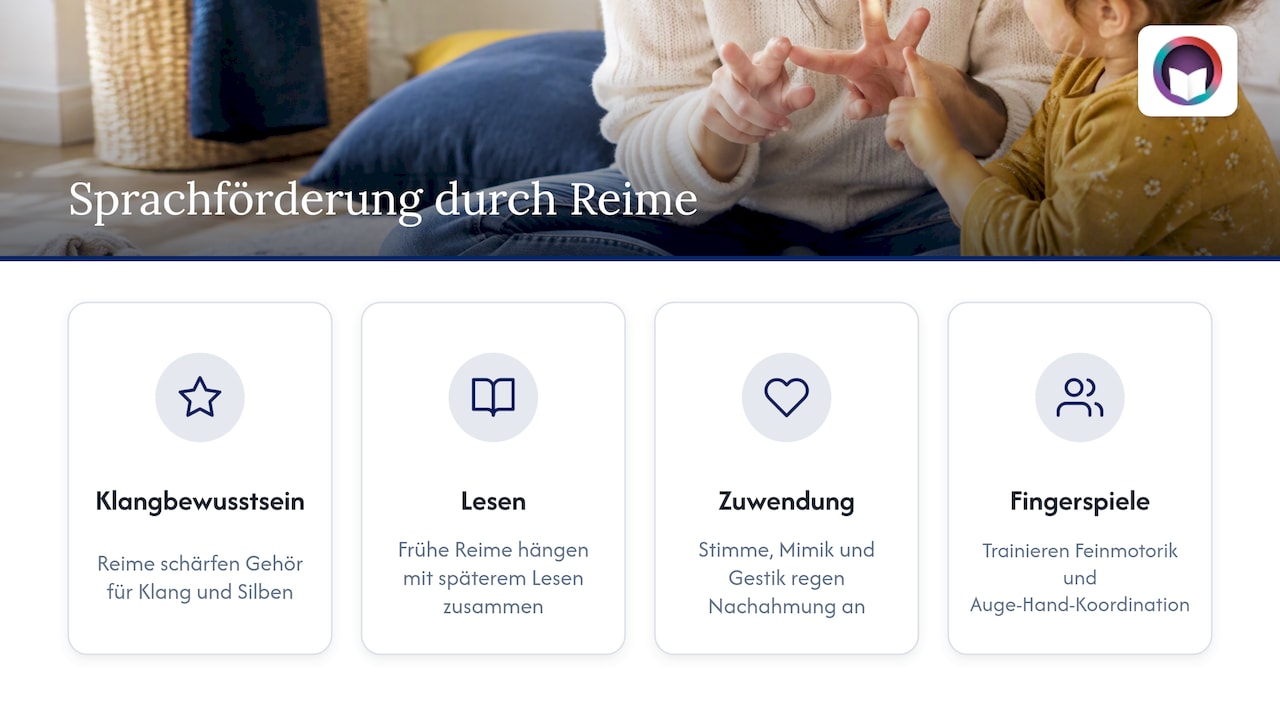
Rhymes sharpen the ear for sound and syllables. This phonological awareness is considered an important precursor to learning to read and write. An overview of children's rhymes, phonological skills and reading summarizes what longitudinal studies show.
Longitudinal studies show a link between early familiarity with children's rhymes and later skills in reading and spelling. Rhymes sensitize children to sound structures without formal instruction being necessary.
There's also the emotional side. The familiar voice of a caregiver, their facial expression and gestures are, according to Kindergesundheit-info, the strongest incentive for language imitation. This refers to the typical melodic address we instinctively give babies. A rhyme from a tablet cannot replace that; your attention gives it its effect.
Finger plays bring the body into play. Moving fingers individually trains fine motor skills and hand-eye coordination. Physical contact also strengthens the child's sense of security. These are effects that a purely listening experience does not provide.
3. Age guide: when children recognize, remember and rhyme on their own
Every child has their own pace. As a rough guide, this sequence as described by kindergesundheit-info.de helps:
- Infants: They enjoy rhythm and sound, watch your face and react to voice and facial expressions.
- From about 2 years: Children actively remember short rhymes and imitate movements.
- At 3 to 4 years: Rhyme recognition begins; the child notices that “house” and “mouse” sound similar.
- At 4 to 5 years: Many children create their first own rhymes, often nonsense words.
How to recognize progress? Your child asks for a verse repeatedly, says the ending words along, or starts the movement before you do. A few minutes a day are completely sufficient. Regularity is more important than length.
4. Practical tips: how to rhyme and play together
Rhymes belong in small rituals, not a separate appointment. These steps have proven effective:
- Choose a fixed situation: nappy changing, falling asleep, transitions like getting dressed, or the morning circle in daycare.
- Start slowly and emphasize the rhyme words clearly.
- Use facial expression deliberately. Big eyes and a smile tell the child: now it's going to be fun.
- Play with tempo and volume: first quiet, then loud, then very slow.
- Watch your child. If they turn away or become restless, stop or switch to a calmer variant.
For safety: keep movements soft and without jerks. With the knee-rider, always hold the child firmly and lower them only slowly. A child who seems overwhelmed does not need repetition but a break.
Pro tip: A verse you say regularly in the same place can become a favorite ritual.
5. Couplet rhyme, alternate rhyme, internal rhyme: how each rhyme type works
Not every rhyme sounds the same, and children feel the differences even if they don't know the names for them.
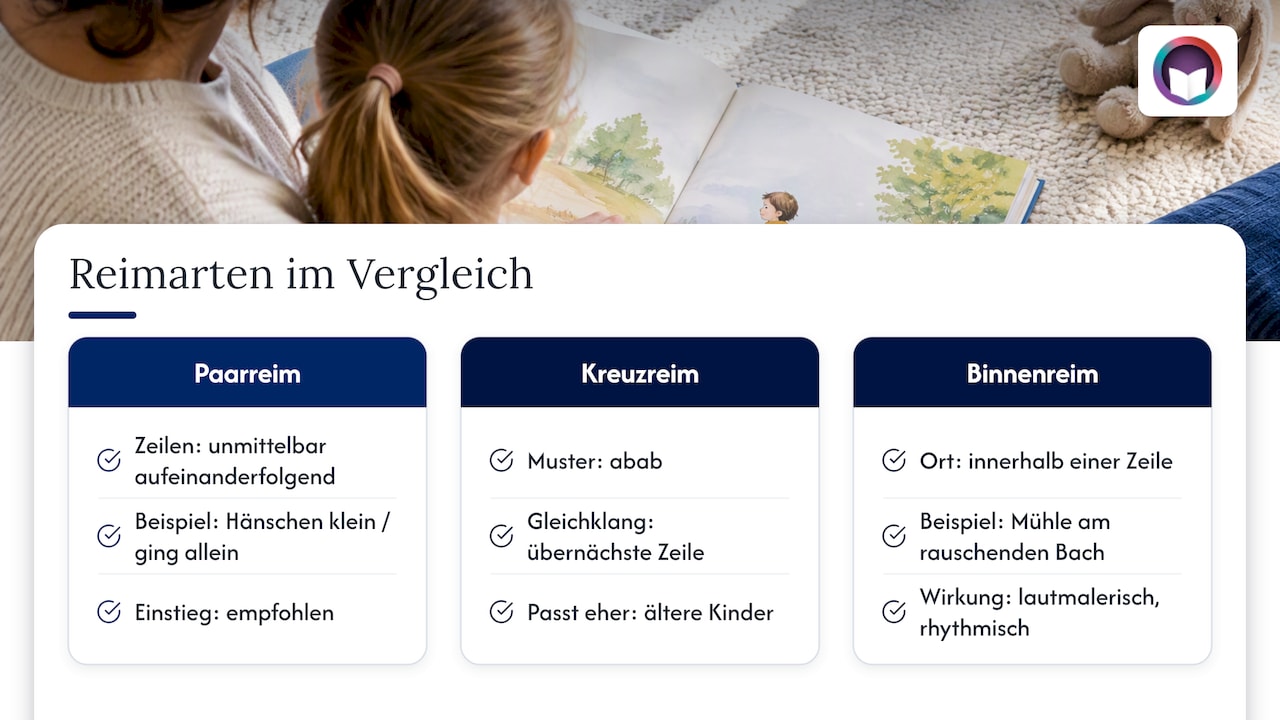
The couplet rhyme (AA) is the classic children's verse: “Hänschen klein / ging allein”. Two lines rhyme immediately; the ear expects the echo and delights in the confirmation.
In the alternate rhyme (abab) the matching sound comes only in the following line. This requires more memory and is therefore better suited to older children who can cope with longer verses. Toddlers easily lose the thread.
The internal rhyme hides the matching sound in the middle of the sentence: “The mill clatters by the rushing brook” lives from the sound within the line. It is onomatopoeic and rhythmic and is well suited for playing with syllables.
My advice: start with couplet rhymes and mix in other forms later. The child will then learn to listen more closely along the way.
6. How rhymes support early literacy and listening comprehension
Those who rhyme listen. A child who waits for the end sound practices attention to language long before they know a letter. This is exactly what experts mean by early literacy: a sense that language is made of small building blocks that can be compared, repeated and recombined.
Rhymes train several things at once. The child remembers a sequence of words. They recognize which words sound similar. And they learn that syllables and sounds have meaning. According to kindergesundheit-info.de, even short programs that explicitly use children's rhymes can significantly improve kindergarten children's phonological skills.
Vocabulary also benefits. Rhymes often introduce words that rarely occur in everyday life, such as “plum” or “pit.” Children pick them up incidentally because rhythm and melody anchor them in memory. Without pressure: rhyming remains a game, not a test.
7. Rhymes in child-friendly audiobooks and stories
Many children's stories deliberately include rhymes: as a recurring refrain, as a refrain at the end of a chapter, or as the main character's magic spell. There is a practical reason for this. The refrain gives the child a fixed place to join in, and that is exactly where active listening begins.
Audiobooks add something a printed rhyme cannot: emphasis, pauses and voice tone are already built in. A well-read version shows the child how a rhyme should sound, and you can sit alongside as a listener, sway and say the rhyme words together with the child.
Especially in the evening, when the energy to read aloud is low, voiced stories help. Our contribution to the best bedtime stories for children ages 0 to 8+ shows how audio formats can be integrated into a bedtime ritual. They should not replace shared rhyming, but they complement it.
8. Further rhyme materials for parents and educators
Those who want to go deeper have several options. First: classic collections with knee-riders, finger plays and counting rhymes, which are usually available for loan in libraries. Second: educators in daycare who often have a rich repertoire of morning-circle songs and are happy to share it. Ask which verses your child already knows there and pick them up at home.
Third: online resources with well-founded information. The site kindergesundheit-info.de explains in a child-friendly way how hand and finger motor skills develop and which games support them. It also shows that animal rhymes, counting rhymes, lullabies, tongue twisters and table sayings serve different purposes in the daily routine.
And fourth: communication overall. Those who want to know how to speak with children of any age will find helpful additions to voice, facial expression and conversation techniques in the practical guide to age-appropriate communication with children. Rhymes are not the main topic there, but the basic attitude fits.
9. Inventing your own rhymes: how to do it playfully
Rhyme-making is easier than many think, and the child doesn't have to know verses for that. The simplest entry is guessing the rhyme word: you say “The dog is …”, pause, and the child adds “colorful.” That it's not correct doesn't matter. Nonsense is explicitly allowed.
A second way is to play with names. From “Lena” becomes “Lena, Schena, bean-stalkena.” A third way: rhyme everyday things. “The sock, the sock, it's hanging on the clock.” You see: it's about sound, not meaning.
According to kindergesundheit-info.de, rhyming is a creative, playful process that shapes learning as a joyful interaction, not a performance task. Praise therefore courage and sound, not correctness. And if the child can't think of a rhyme word, offer two choices. That reduces pressure and keeps the game going.
10. Our kids' section: voiced rhymes as a complement for everyday life
Sometimes your voice is missing in the evening, sometimes the time. For exactly these moments we have compiled short stories and first rhymes as audio versions in our kids' section. They do not replace your voice, but they accompany rituals when you can't read aloud right now.
- Professionally voiced stories and rhymes, playable at any time
- Bedtime stories, animal adventures and short verses for the moment of falling asleep
- Free to read and listen, with extended features like offline use in Premium
Try it out: browse our kids' section for free and discover which verses and stories resonate with your child.

FAQ
Which finger rhymes are suitable for children?
Short, repeatable finger plays like “This is the Thumb” or “Five Fish” work best. They can already be played with babies and grow with the child. According to kindergesundheit-info.de, finger plays, knee-riders and soothing verses are particularly popular.
Which short poems rhyme well for toddlers?
Couplet rhymes with two to four lines and a clear rhythm are good, for example “Hänschen klein” or “Heile, heile Segen.” Short verses stay in the memory better and are easy to combine with movement. Repetition makes them a favorite verse.
Which three types of rhymes are there?
The best-known forms are couplet rhyme, alternate rhyme and internal rhyme. In a couplet rhyme consecutive lines rhyme, in an alternate rhyme every second line, and in an internal rhyme words within a line sound the same. For first rhymes the couplet rhyme is best suited.
When do children start rhyming?
According to kindergesundheit-info.de, children actively remember short rhymes from about two years old. Rhyme recognition usually begins between three and four years, and many children start producing their own rhymes at four to five. Every child develops at their own pace.
Recommendations
- Short children's rhymes: ready-made verses for daycare and home
- The best bedtime stories for children ages 0 to 8+
Read and write on OutaStory
Thousands of short stories to read for free — or publish your own and find an audience.