
About this Story
A salvage pilot working the debris field of a collapsed space station discovers a black box recording that rewrites the official account of the disaster. The deeper she dives into the wreckage, the clearer it becomes that the station did not fail — it was silenced.
The Debris Field
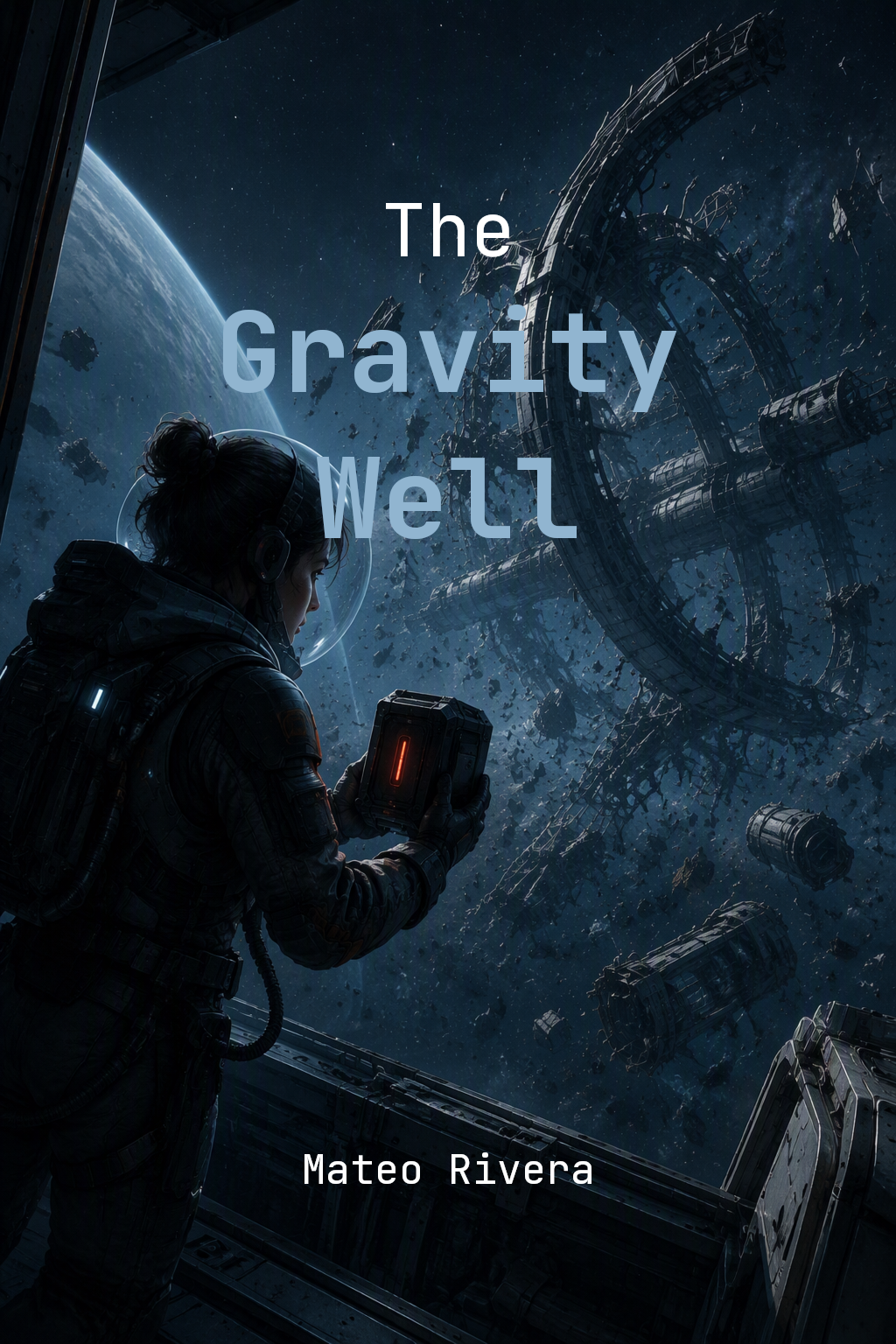
The wreckage of Estacion Altamira hung in the vacuum like a frozen explosion, fragments of hull and conduit and personal effects orbiting the station's dead centre of mass in a slow, silent ballet that would have been beautiful if you did not know what it had been. Salvage pilot Carmen Reyes cut her engines at the debris field's edge and let the Mariposa drift, running passive scans while she studied the tumbling geometry of destruction through the cockpit glass. She had been salvaging wrecks for eleven years, and she could read a debris field the way a detective reads a crime scene — the pattern of fragmentation, the trajectory of the largest pieces, the story the physics told about how something had come apart.
Altamira's story did not make sense. The official report said structural failure — a cascade of micrometeorite impacts weakening the station's spine until it buckled under its own rotational stress. Carmen had read the report before accepting the contract, and she had believed it the way she believed weather forecasts: provisionally, with an eye on the actual sky. The debris pattern told a different story. Structural failure produces a specific signature — radial fragmentation, pieces moving outward from the failure point like petals from a blown flower. Altamira's debris moved in two directions, which meant two failure points, which meant either a catastrophiccoincidence or something that was not failure at all.
She found the black box on the third day, lodged in a section of the command module that had held together better than the rest, its casing scorched but intact, its beacon still pulsing the faint emergency signal that had drawn her contract in the first place. She extracted it with cutting tools and magnetic clamps and brought it aboard the Mariposa and sat in her cargo bay and looked at it for a long time before plugging it in, because she had been in this business long enough to know that some recordings are better left unheard, and she had a feeling — not evidence, not yet, just the itch at the base of her skull that had kept her alive through eleven years of vacuum work — that this was one of them.
Sign in to join the conversation.
Be the first to leave a comment.