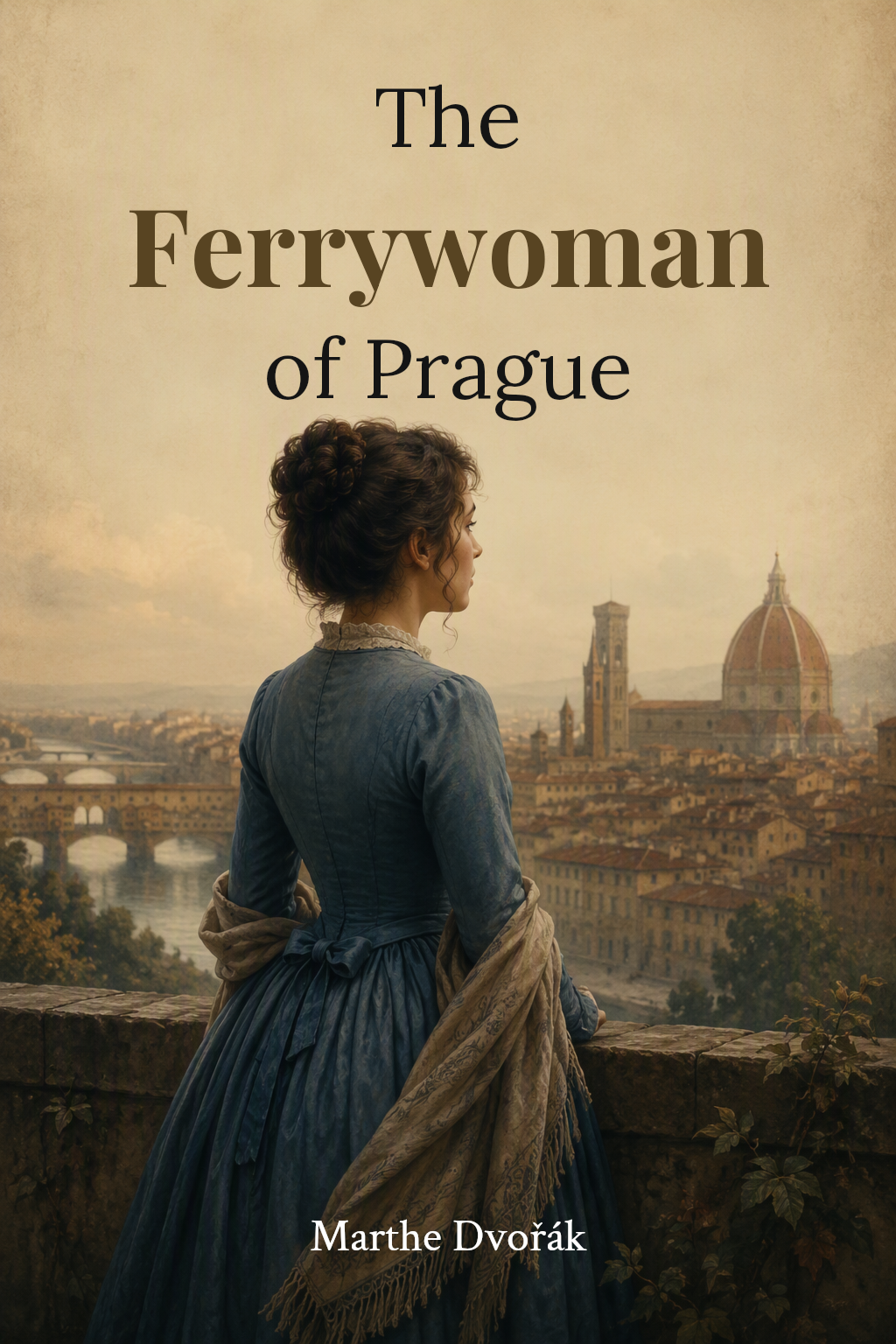

About this Story
Prague, 1941. Zdenka Kocourková is thirty-four years old and runs a small passenger ferry across the Vltava, a licence she inherited from her father along with the boat, the oarlocks, and the habit of reading the river by its smell. The Protectorate is a year old. The Germans have left the ferries alone because they consider them beneath notice, and it is for this reason that her parish priest, in a conversation that was not quite a question, begins to send her passengers who carry nothing but their hands in their pockets. This is the quiet story of her first year inside the resistance she did not volunteer for: the faces she learns not to name, the fear that becomes a kind of weather, a cousin in the wrong uniform, a body taken from the water at an hour when no one should be on it, and at last a winter crossing she will remember for the rest of her life. A patient, exact novel about the small moral arithmetic of occupation.
The Vltava In March
In March the Vltava ran the colour of weak tea, thickened at the banks with the last brown ice, and Zdenka Kocourková could read the temperature of the water through the soles of her boots before she had untied the boat. She had learned this from her father in the summer she turned eleven, standing on the landing at Rašínovo nábřeží while he held her shoulder and named the currents the way other fathers named saints. The eddy beside the third piling of the bridge. The slow pull under the willow. The place where the bottom dropped and the river argued with itself. She had not needed him to tell her a second time.
Her ferry was a flat-bottomed wooden pram with a single oar at the stern, painted the dull green the company required, the number 14 stencilled in white on both sides of the bow. It carried six people if they sat close, eight if one of them was a child. The licence, signed by the magistrate in 1919 and renewed each January, had belonged to her father until the pneumonia took him in the winter of thirty-seven, at which point it had passed to her because there had been no one else and because the clerk in the river office had been at school with her and had signed the paper without looking up.
She worked the short crossing between the Old Town bank and the Kampa landing, ten crowns for an adult, five for a child, free for the postman and the two nuns from the convent atKarmelitská who crossed every Tuesday with a basket between them. The crossing took seven minutes in good water and twelve when the current was high. She made it between thirty and fifty times a day, depending on the weather and on whether the larger steam ferries at Čechův most were running.
It was the second spring of the Protectorate. In the mornings she crossed the square on the Old Town side with her bread ticket folded into the inside pocket of her coat, and she did not look at the red flags that hung now from the upper windows of the buildings she had known all her life, the flags with the black wheel at their centre that she had trained herself not to see in the way one trains oneself not to see a birthmark on the face of a friend. The German signs had gone up in the first weeks — Deutsche Polizei, Eintritt verboten, the street names doubled in gothic script over the Czech — and she had learned to read them the way she read the river, with a small practical part of her mind that was not the part she thought with.
The city in March was thin. The ration cards, which had been introduced the October before, had done their slow work on everyone's faces. The butcher on Karolíny Světlé had a shortage of everything that was not offal. The coffee at the café where she had drunk her morning coffee since she was twenty-two was now a grey water made from roasted chicory and something else she preferred not to know. She drank it anyway because the alternative was to sit in her kitchen alone, and because Pan Horák, who had owned the café since before the republic, had begun to look at her across the counter in a particular way when she came in, as if to say: we are still here, you and I. That was enough.
Her passengers that morning were the usual. A woman with two string
Sign in to join the conversation.
Be the first to leave a comment.