BookTok explains Romantasy: What readers love and what authors learn
Romantasy is fantasy in which a love story forms the driving force of the plot, not merely embellishment. Typical are pronounced tropes such as enemies-to-lovers constellations, a happy ending or at least a hopeful conclusion, and relationships with non-human beings like Fae or dragons. Authors such as Sarah J. Maas and Rebecca Yarros have made the genre mainstream since the mid-2020s.
In short:
- Romantasy combines the emotional storytelling of a romance with deep fantasy worldbuilding and is especially shaped by trope motifs like enemies-to-lovers and prophecies.
- The genre term has established itself since around 2005, influenced by feminist approaches and the introduction of darker elements such as moral grey areas and dark power structures.
- The hype arises mainly from social media like TikTok, where emotional peaks in short videos significantly drive sales.
- Typical stories are based on female protagonists whose relationship forms the central line of conflict, while the world usually serves as a stable framework.
- Critics often criticize clichéd tropes, stereotypical gender portrayals, and problematic depictions of toxic relationships, which are made visible especially through content platforms.
Table of contents
- What exactly is Romantasy? Definition and core characteristics
- How has the term Romantasy developed?
- Which tropes and narrative patterns shape Romantasy?
- Who reads Romantasy and why?
- Romantasy or Fantasy-Romance: Where is the difference?
- Which authors and series represent the genre?
- What criticism is there of Romantasy?
- Why is Romantasy booming right now? The role of BookTok
- How do authors write and publish successful Romantasy?
- Sources
- FAQ
What exactly is Romantasy? Definition and core characteristics
At its core, Romantasy merges two storytelling traditions: the emotional force of a romance with the worldbuilding depth of classic fantasy. The Cambridge Dictionary describes it as a story in an imaginary world in which a romantic relationship between the main characters shapes the entire action. Love does not decorate the fantasy plot; it drives it.
A few features repeat in almost every work of the genre:
- The love story determines the arc of tension and turning points, not just a subplot.
- It is usually told from the perspective of a female protagonist, often alternating with the love interest.
- A happy ending or at least an emotionally satisfying conclusion is almost always included.
- Recurring tropes such as enemies-to-lovers, chosen-one prophecies, or bonds with supernatural beings structure the plot.
These building blocks clearly distinguish Romantasy from pure fantasy, in which political intrigues or quests are in the foreground and romance at most remains a footnote.
How has the term Romantasy developed?
The roots run deeper than many think. Already in the 1970s, authors like Anne McCaffrey mixed fantasy and romance without a specific name for it. From the 2000s these elements condensed into a recognizable pattern, and the term itself established itself as an independent genre label around 2005. Feminist perspectives played a role: heroines became more agentic, their desires and longings were no longer in the shadow of male protagonists. In parallel, elements of dark fantasy flowed in: grim power structures, moral grey areas, violence as part of the order of the world. The genre finally became visible through bestseller lists, where series like “A Court of Thorns and Roses” dominated for weeks and proved a market that publishers had previously underestimated.
Which tropes and narrative patterns shape Romantasy?
Anyone who wants to understand Romantasy must know its tropes. They are not a sign of lack of imagination, but an expectation framework that authors consciously satisfy or subvert.
- Enemies-to-lovers: Two characters start as opponents, often from different factions, and develop attraction over the course of conflict.
- Chosen-one motif: A character carries a prophecy or special power that inevitably links them to the love interest.
- Bonding with non-human partners: Fae, dragon riders, or shadow beings as love objects shift the emotional tension into the fantastical.
- Slow burn versus instalove: Some series stretch the attraction across volumes, others rely on immediate intensity.
Emotionality and worldbuilding intertwine: A well-built world with clear rules of power makes the love story more believable because the obstacles feel real.
Pro tip: You can recognize a fresh trope by the fact that it deliberately subverts the reader's expectation, for example when the "chosen one" rejects her role instead of fulfilling it. A worn-out trope, by contrast, delivers only the familiar choreography without a new twist.
Who reads Romantasy and why?
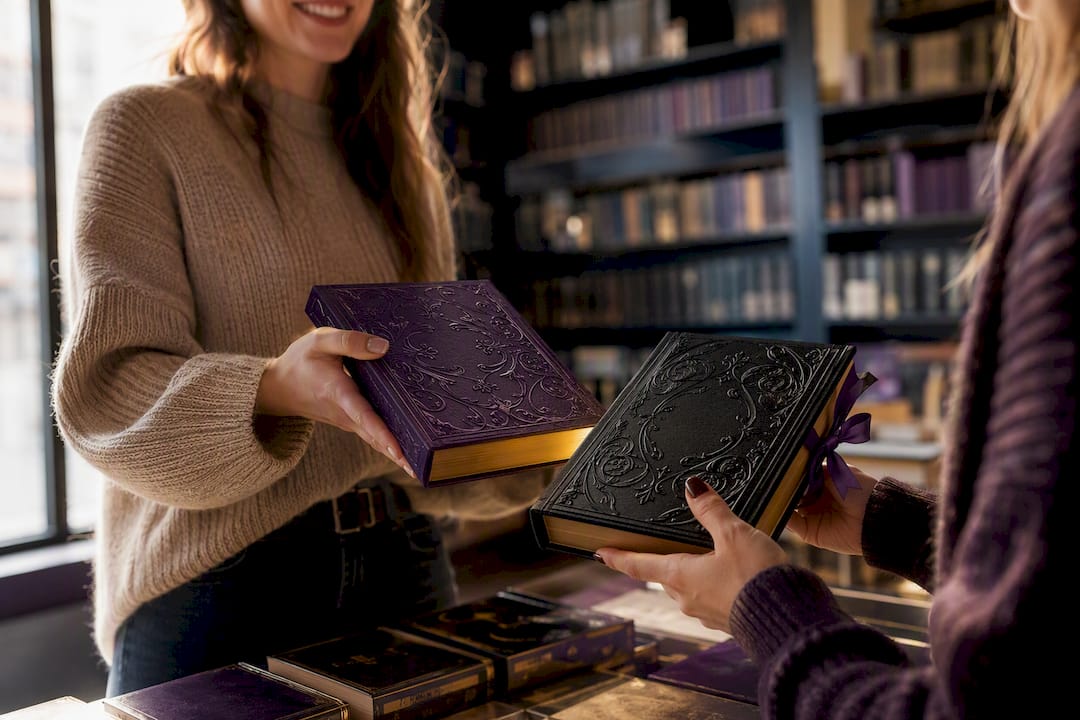
The core target group is young adults, with a clear majority of female readers. But Romantasy has long been more than reading material; it is a collector culture. Hardcovers with colored page edges, special editions and limited prints are purposely sought, photographed and traded. The reading motives behind it are not surprising, but effective: escapism into a world with clear moral lines and identification with characters who fight for self-determination despite powerlessness.
Romantasy or Fantasy-Romance: Where is the difference?
The terms are often used synonymously but imply different emphases. Romantasy sets the love story as the main plot, the fantasy world remains the frame. Fantasy-Romance (also called Romantic Fantasy) reverses the relationship: the world conflict, a war action, a political struggle, is at the center; the romance runs alongside, without carrying the plot.
Three questions help classify a work:
- Would the story still work without the romantic relationship, or would the plot collapse without it?
- Does the conflict between factions take up more space than the relationship dynamics?
- Does the book end with a conclusion typical for romances, or does the romantic element remain open?
If you answer all three questions in favor of the relationship, you are probably holding Romantasy.
Which authors and series represent the genre?
Two names arise in almost every conversation about Romantasy: Sarah J. Maas created a Fae world with “A Court of Thorns and Roses” in which power struggles and desire are inextricably intertwined. Rebecca Yarros has shown with “Fourth Wing” how dragonrider academies and an enemies-to-lovers dynamic together produce an international bestseller.
- Both series are available in German translation and helped popularize the genre term in the German-speaking market.
- They are considered representative because they bundle almost all typical tropes without copying each other.
- Other authors serve niches within the genre, ranging from lighter to distinctly darker tones.
A long best-of list doesn't add much here. These two examples suffice to understand the principle.
What criticism is there of Romantasy?
Not every voice celebrates the boom. Critics accuse the genre of kitsch, predictable dialogue, exaggerated descriptions of longing, and interchangeable conflicts. Another point of contention is stereotypical gender images: the heroine may appear strong but in the end submits to the male love interest. It becomes problematic where violence and toxic relationship dynamics are romanticized, for example when possessiveness or control are portrayed as signs of passion.
Those who want to choose sensitively should check reviews with trigger warnings before buying. Many readers specifically mark depictions of violence or problematic power imbalances in reviews; that saves disappointment and protects against unexpected themes.
Why is Romantasy booming right now? The role of BookTok
The current boom can hardly be explained without social media. BookTok, the book community on TikTok, is a major driver of the hype, viral recommendations turn individual scenes into sales arguments. Emotional high points, a particular kiss, a betrayal, a reunion, are perfect as short video clips that capture reactions.
Romantasy captures the zeitgeist because it combines escapism with emotional depth; readers seek identification in characters who experience power and moral dilemmas.
Community discourses further amplify certain tropes: if an enemies-to-lovers plot is celebrated virally, publishers follow and bring similar material to market faster. Visible effects are new editions of older titles with striking coloured page edges, limited special editions and bestseller spots that would have been hardly attainable without the Bookstagram and BookTok aesthetic.
How do authors write and publish successful Romantasy?
Those who want to write Romantasy themselves should first keep an eye on the balance between worldbuilding and emotional development: a fantasy world with complicated rules is of little use if the characters' emotions remain flat. Fresh perspectives on familiar tropes, for example a chosen one who questions her role instead of fulfilling it, elevate a manuscript above the crowd.
For publication, it's worth looking at short forms and serialization: stories released chapter by chapter keep readers engaged and can be promoted piece by piece via social media.
- Short stories are good for testing a trope or character constellation before it becomes a full series.
- Chapter-by-chapter release generates suspense similar to classic serial novels.
- Outreach via social media works best with short, emotionally sharp excerpts, in line with BookTok logic.
Those who want to delve deeper into trope mechanics can find in Thimo's contribution on Romantasy tropes on Outastory a more detailed consideration of how familiar patterns can be credibly retold. Authors who want to publish their stories chapter by chapter and participate in revenue sharing can try this directly via Outastory, readable and listenable for the community for free, with voices ranging from professional narrators to the author's own voice.
Sources
- Romantasy — Wikipedia
- Romantasy: What's behind the literary hype — Marie Claire
- Romantasy — Cambridge Dictionary
FAQ
What is the difference between Fantasy-Romance and Romantasy?
In Romantasy the love story carries the main plot, in Fantasy-Romance a world conflict is usually at the center and the romance plays along as a subplot.
Which Romantasy books are particularly well-known?
“A Court of Thorns and Roses” by Sarah J. Maas and “Fourth Wing” by Rebecca Yarros are among the most internationally well-known series of the genre.
Which romance genres exist besides Romantasy?
Besides Romantasy there are, among others, Contemporary Romance, Historical Romance and Dark Romance, which mainly differ in setting and tone, while Romantasy stands out through its fantastical setting.
How can I tell if a book is Romantasy?
If the romantic relationship drives the plot, a fantastical setting frames the story, and typical tropes like enemies-to-lovers appear, it is very likely Romantasy.
Recommendations
Read and write on OutaStory
Thousands of short stories to read for free — or publish your own and find an audience.