
Reading along with audiobooks: How the method improves reading
Yes, reading along with an audiobook demonstrably improves reading fluency, and initial progress often appears after only a few weeks. Those who benefit especially are struggling readers, DaZ learners, and older students who still hesitate. The IQES study documents the effect; among others, Outastory provides suitable audio versions.
In short:
- Reading along with audiobooks improves reading fluency within just a few weeks, especially for struggling children and DaZ learners.
- Suitable text-audiobooks are unabridged, clearly structured, and matched to the reading level, while radio plays with effects are more distracting.
- Regular training with several sessions per week over several months is necessary to achieve lasting progress.
- For getting started, short stories on platforms like Outastory are suitable, as they can be completed in a short time and are motivating.
- Synchronized text-audiobooks with highlighting are ideal; TTS readers like Speechify are only a fallback when the original offering is not available.
Table of contents
- How does reading along with an audiobook work in practice?
- What studies show about the effect of reading along
- Choosing the right titles and formats for successful reading-along
- How to succeed with reading-along in class and at home
- Outastory as a starting point for reading along with audiobooks
- Sources
- FAQ
How does reading along with an audiobook work in practice?
Not every audiobook is suitable for synchronous reading and listening. A text-audiobook links the spoken recording directly to a running text, often with word-by-word highlighting. A classic radio play, by contrast, works with multiple speakers, music and sound effects and tends to distract from the reading focus.
Technically there are several ways to do this. Some apps automatically highlight the sentence being spoken in the e-book, other readers combine a printed book with a separate audio player, where you keep an eye on the line yourself. The Swiss Library Service describes that many text-audiobooks also allow adjustments to font size, contrast and playback speed, which makes it easier for inexperienced readers to get started.
Before you start, a quick technical check is worthwhile:
- Check whether text and audio truly run synchronously or whether there are only two separate files.
- Set the device or app so that font size and tempo fit the reader's ability.
- Download the audiobook for offline use if the session takes place without a stable network.
- Do a short test run of one to two minutes before the actual exercise begins.
If you can't find a synchronized format, you can alternatively use a text reader like Speechify, which converts arbitrary texts into spoken language. This is not an audiobook in the strict sense, but it works as a transitional solution when no suitable title is available.
What studies show about the effect of reading along
The effect is well documented and practically noticeable. According to IQES, reading fluency improves with consistent application already after a few weeks — a remarkably short period for such a clearly measurable learning effect.
Briefly explained: The audiobook takes on the role of a reading model. It provides rhythm, emphasis and correct pronunciation while the eyes follow the text. As a result, the visual word form links with the heard sound, and this double stimulation processing speeds up automatic word recognition, according to the Berlin-Brandenburg Education Server.
A single session is of course not enough for lasting effects. A training program lasting several months with several sessions per week is recommended to achieve lasting results. Those who only read along occasionally will hardly see lasting progress, but those who keep at it often notice after the first week that hesitations while reading occur less frequently.
Not every audiobook is suitable. Radio plays with distributed roles, musical accompaniment or sound effects are more likely to disturb the reading focus rather than support it, because the ear constantly switches between voices and effects. A quiet single-narrator reading works much better for training.
Pro tip: Choose shorter stories consciously for the start instead of a thick novel. The sense of achievement after completing a short story often motivates more than a chapter of a long book.
Choosing the right titles and formats for successful reading-along
Not every audiobook with text is equally suitable. A few clear criteria decide whether the exercise is enjoyable or frustrating.
- Choose unabridged readings. Abridged versions omit whole paragraphs, which causes text and audio to fall out of sync.
- Pay attention to a clear chapter structure. Short, self-contained sections are easier to divide into individual sessions than continuous running text.
- Match the language to the reading level. A text that is linguistically well above one's own level quickly produces frustration instead of progress.
- Choose a motivating topic. According to the Education Server, motivation increases significantly when learners have a say in the choice of title.
- Check the speaking tempo. Some narrators read briskly; if you are still insecure, you should reduce the playback speed to 0.8 to 0.9x.
- Choose the format deliberately. An e-book-plus-audiobook combination with highlighting is usually more comfortable than printed text plus a separate player, but the latter works just as well if no digital offering exists.
TTS readers like Speechify are practical when no original text-audiobook is available, but often sound more monotonous than a professionally produced narration and are therefore better suited as an emergency solution. Before the actual start, a short checklist helps: check the file and synchronization, charge the device, do a short test run, plan fixed breaks for longer texts.
How to make reading-along succeed in class and at home
A reading-along session does not require elaborate preparation, but it does need a clear structure so the time is really effective. Before starting, briefly clarify who will read along, prepare the materials and check whether headphones, speakers and the file work.
A proven routine looks like this:
- Short warm-up: read aloud for one to two minutes without the audiobook to get in the mood.
- Reading along together: listen and read along synchronously for 15 to 30 minutes, depending on concentration span.
- Short feedback: two to three minutes on what was easy and where there were still hesitations.
For lasting effects, several such sessions per week should take place, not just a single session on the weekend.
For DaZ learners or very insecure readers, a slower tempo and repeated listening to individual sections combined with partner reading, where two people take turns, is worthwhile. This differentiation hardly costs more time but makes the exercise significantly more accessible for heterogeneous groups.

Pro tip: If a group has different reading speeds, divide into pairs with similar levels instead of one large group. That way no one falls behind the text and no one gets bored.
Outastory as a starting point for reading along with audiobooks
Outastory was made precisely for this format. The platform offers short stories that can both be read and listened to, optionally with professionally produced voices or with the author's original voice.
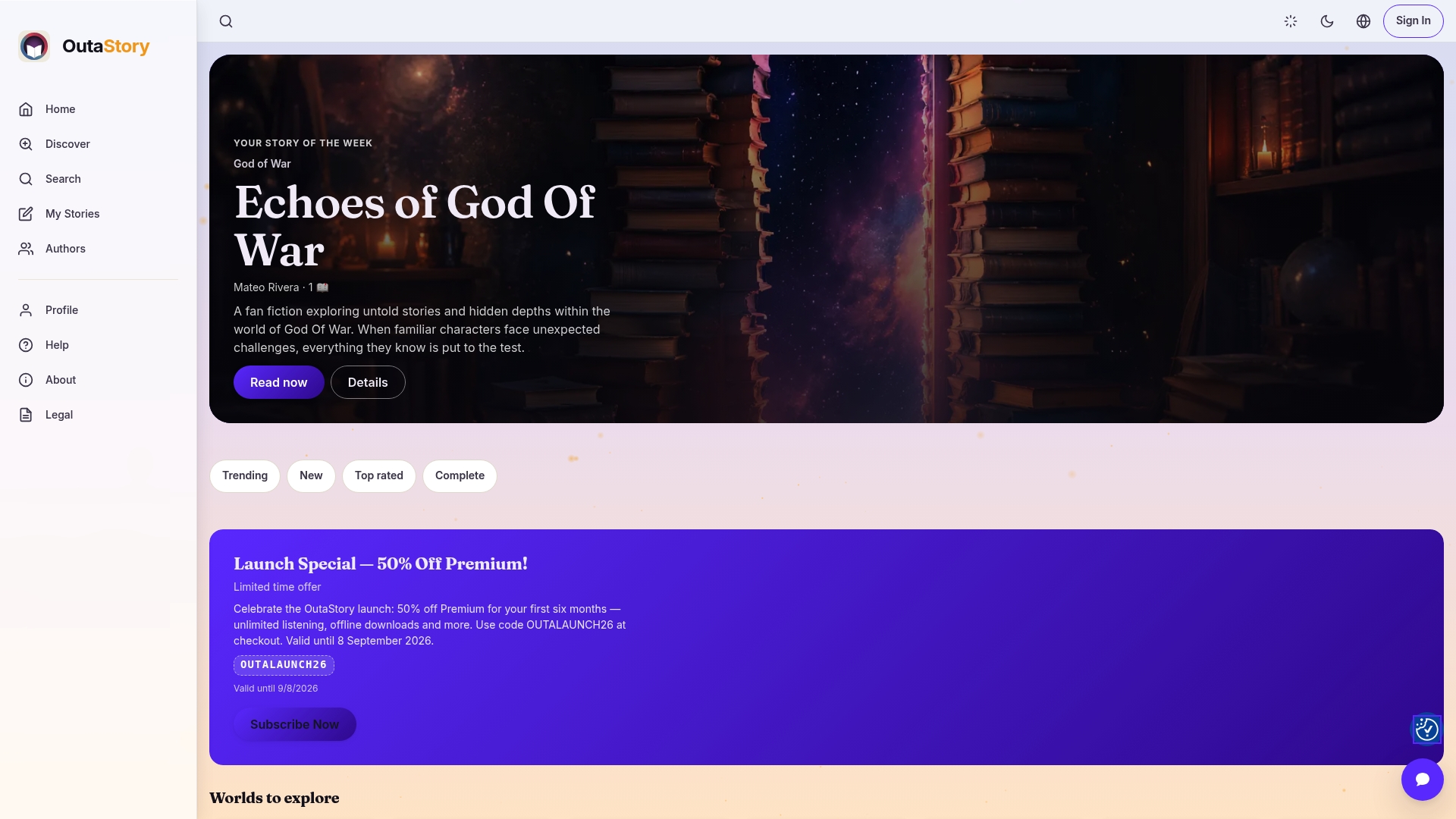
For getting started with reading-along, this brevity is an advantage: a completed short story can be read through in a single session of 15 to 30 minutes without having to stop in the middle of a chapter. The genre range extends from fantasy, romantasy and science fiction to crime and thrillers, as well as a dedicated children's section with bedtime stories and first rhymes, so that a suitable title can be found for almost any reading level. Serialized stories are published chapter by chapter, which can be easily integrated into a regular training rhythm.
Those who want to listen unlimitedly beyond the free content or save stories offline can find that in the premium subscription. The easiest way is to choose a first short story in German directly on Outastory and try the reading-along exercise today.
Sources
- Reading with audiobook – IQES
- Oral reading training with audiobooks – Berlin‑Brandenburg Education Server
- Text-audiobooks – SBS
FAQ
Can you read along on Audible?
Certain titles on streaming providers support a text display with synchronization, but this is not available for every audiobook. When purchasing, look specifically for whether the title is listed as a text-audiobook with highlighting.
Which audiobooks are best suited for reading along?
Unabridged single-narrator readings with a clear chapter structure and age-appropriate language work best; not radio plays with multiple roles or musical accompaniment. Short stories like those on Outastory are particularly suitable for getting started because a story can be completed in one session.
Is it better to listen to audiobooks or to read oneself?
Both have their place, but the combination brings the greatest effect in reading training. According to IQES, simultaneous listening and reading along improves reading fluency more than pure independent reading alone.
How often should one practice reading along with an audiobook?
Several short sessions per week over a period of about four to five months are recommended, as described by the Berlin‑Brandenburg Education Server. Individual sessions of 15 to 30 minutes are usually sufficient for this.
For whom is reading along with an audiobook particularly suitable?
The method is particularly suitable for struggling children, DaZ learners and older students who still hesitate, but motivated adult readers also benefit from the double stimulation processing. For very insecure readers, a reduced speaking pace and repeated listening to individual sections helps.
Read and write on OutaStory
Thousands of short stories to read for free — or publish your own and find an audience.