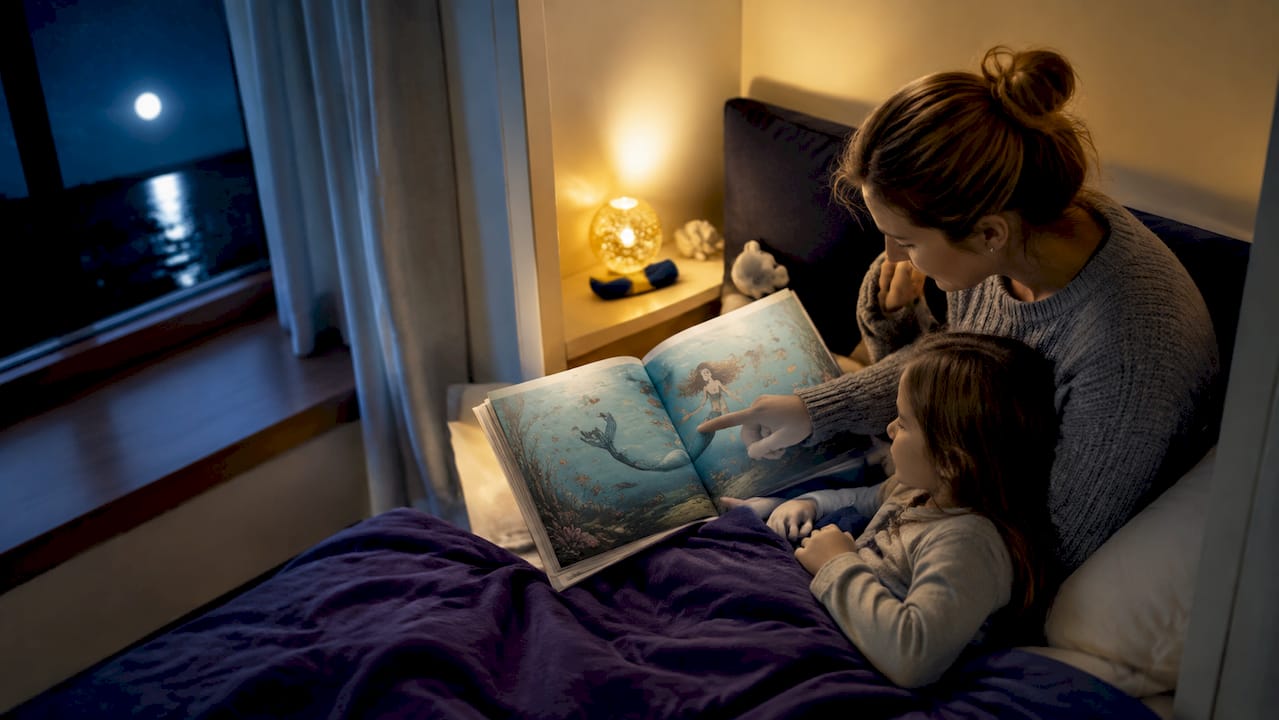
8 ready-to-read mermaid stories for parents with reading time
If you’re looking for a mermaid story to read tonight, here are eight age-appropriate tales with reading duration, age recommendation and conversation prompts. Andersen’s "The Little Mermaid" serves as a reference, supplemented by more modern, gentler versions for young listeners. If you want to read the stories directly or listen to audio versions, OutaStory provides a free hub with its own children's section.
In short:
- The classic version of Hans Christian Andersen’s "The Little Mermaid" is suitable for children from about 6 years, and takes roughly 6 to 8 minutes in an abridged form.
- More modern stories like "The Brave Rescue" or "The Gift of the Shell" can be read to children aged 3 and up and are usually shorter and calmer.
- For a bedtime ritual, stories with a mild tone, few dramatic scenes and clear conversation prompts that gently resolve conflicts work best.
- If mood matters, adventurous tales like "The Storm and the Quiet Bay" are better read in the afternoon so they don’t cause too much excitement before sleep.
- Varying voice tone, pauses and consistent rituals while reading significantly enhance the effect of mermaid stories.
Table of contents
- Mermaid stories for storytime: Eight recommendations
- Which story fits when? Tone, sensitive spots and conversation prompts
- How to choose the right mermaid story
- Reading with impact: voice, pace and small rituals
- Where to find mermaid stories: free and purchased
- OutaStory: Read and listen to mermaid stories in one place
- Where does the myth of the mermaid come from?
- Recurring motifs in mermaid stories
- Picture books and films as a complement to mermaid stories
- OutaStory: The easiest way to new mermaid stories
- Sources
- FAQ
Mermaid stories for storytime: Eight recommendations
Not every mermaid story suits every age or time of day. Some children want something calm right before bed, others want a little adventure in the afternoon. The following selection covers both and provides the key details for each title.
- "The Little Mermaid" by Hans Christian Andersen: The original from 1837 tells of a young mermaid who sacrifices her voice for the love of a prince. Reading time in the full version: a quarter of an hour to nearly half an hour; for children from 6 years it's better in an abridged version. Numerous children's sites offer an abridged, age-appropriate version with a reading time of about 6 to 8 minutes.
- "The Sea Maiden" from Celtic tales: A calmer European variant without Andersen’s dramatic ending. This Celtic version after Joseph Jacobs lasts about 8 minutes and is suitable for children from 5 years.
- The Brave Rescue: A modern short story in which a young mermaid helps a stranded dolphin. About 5 minutes reading time, suitable from 3 years, without a sad turn.
- The Lost Pearl Ring: A light underwater detective story where a mermaid and a seahorse search for a ring together. Around 6 minutes, from 4 years.
- Friendship on the Coral Reef: Two mermaids from different underwater realms learn to let go of prejudices. About 7 minutes, from 5 years, with a clear focus on solidarity.
- The Singing Cave: A short, sound-rich story ideal for participation with sea noises. About 4 minutes, from 3 years.
- The Storm and the Quiet Bay: Slightly more adventurous, with a storm at sea that the protagonist must overcome. About 8 minutes, from 5 years, best for alert afternoon hours rather than right before lights-out.
- The Gift of the Shell: A calm bedtime story about gratitude in which a mermaid passes on a magical gift. About 5 minutes, from 3 years.
Several of these short stories and similar collections with mermaid motifs can also be found as illustrated read-aloud books, often with audio samples for listening on the go.
Which story fits when? Tone, sensitive spots and conversation prompts
Not every mermaid tale is suitable for a bedtime ritual. Some have an adventurous tone that wakes children up rather than calms them. Four examples show how to match your choice to the evening's mood.
- "The Little Mermaid" (Andersen): The tone is melancholic; the original ends with the protagonist's death and her transformation into an air spirit. This literary classification describes the motif of self-sacrifice as the core of the tale. For small children, a gentle phrasing is recommended: instead of saying she died, you can say the mermaid "became part of the sea and the sky." Good for quiet evenings with older children who can be allowed to ask questions about farewell.
- The Brave Rescue: Consistently warm, encouraging tone without a sad turn. Works well as a pure bedtime story with hardly any sensitive spots. Conversation prompt afterwards: "What would you do if an animal needed your help?"
- The Storm and the Quiet Bay: Adventurous, with noticeable tension during the storm. Better for the afternoon or early evening, not right before lights-out. If the storm feels too intense, you can shorten the description of the lightning and instead emphasize how the mermaid remains calm.
- Friendship on the Coral Reef: Gentle tone with a small conflict at the start that gets resolved. Ideal for talking about arguments and reconciliation. Question afterwards: "How else could the two mermaids have made up?"
For sad or dramatic scenes it helps to slow the pace and insert a short pause before continuing. That gives children time to process what they've heard instead of jumping straight to the next twist.
How to choose the right mermaid story
Five points are enough to quickly find the appropriate story without reading every book completely.
- Reading time: Check how much time is actually available. Short versions often last only 2 to 6 minutes, longer classic texts 4 to 12 minutes.
- Language level: Younger children need short sentences and few subordinate clauses; from about 6 years children can handle more complex phrasing and light irony.
- Thematic suitability: Watch for motifs of loss, separation or fear and decide whether the child is ready for that tonight.
- Illustration level: Picture books with lots of detail are good for active viewing, pure text versions are better for children who can already imagine pictures.
- Availability as audio: Useful for car rides or when the parent's voice is tired.
Do: Slightly adapt the ending if it seems too sad. Don’t: Rewrite the whole plot, otherwise the story loses its meaning.
Pro tip: If a story is too long for the evening, read the first half today and the second half tomorrow. A short recap at the start ("Do you remember where the mermaid was?") is enough to pick the thread up again.
Reading with impact: voice, pace and small rituals
A mermaid story gains a lot from the way it is read, not just from the text itself.
- Vary voice and pace: Speak calm underwater scenes more slowly and in a softer voice, speed up slightly when a storm or a rescue is described. Short pauses before important turns increase suspense without exciting the child.
- Include children: Let your child make sea noises, e.g. a soft "shhh" for the waves, or ask in between how they imagine the mermaid looks.
- Create fixed rituals: Start each story with the same sentence, such as "Deep down in the blue sea…". That signals to the child that storytime has begun and helps with the transition to sleep.
Where to find mermaid stories: free and purchased
Classic texts like Andersen’s fairy tale are available in the public domain and can be read in numerous editions. Modern short stories with mermaid motifs are more often found in illustrated anthologies or on specialized children’s sites.
- Public domain texts: Andersen's original text is freely available and is a good choice if you want the classic version, possibly shortened in your own words.
- Library and digital lending: Many city libraries have picture book collections with mermaid themes, often also as digital loans.
- Check audio versions: Pay attention to the narrator's voice, the length of individual episodes and whether offline use is possible if you want to read on the go.
- Filter online catalogs: Search bookstores with keywords like "mermaid picture book from 4 years" to narrow down the age recommendation directly.
OutaStory: Read and listen to mermaid stories in one place
A platform brings these needs together. It offers a dedicated children's section with bedtime stories and animal adventures where mermaid motifs can also be found, free to read or listen to. Each story can be played as an audiobook, either with professionally produced voices or with the author's original voice.
Authors publish their short stories in minutes and can release them chapter by chapter as sequels, which is especially suitable for mermaid adventures with multiple episodes. OutaStory supports German-language content as well as English, which is practical for bilingual families. If you want to rest your voice in the evening, the audio feature is a simple alternative to reading aloud yourself, without missing out on the story.
Where does the myth of the mermaid come from?
The myth of the mermaid is not an invention of Andersen's but goes much further back. In ancient seafaring stories, beings appeared that were half human, half fish and lured or warned ships. These early fables about mermaids likely arose from observations of real sea animals like manatees and seals, combined with the fear and fascination the open sea inspired in sailors.
In European folk belief these water spirits merged with legendary figures like the nixie or the siren, who in Greek mythology already endangered sailors with their song. Andersen's "The Little Mermaid" from 1837 later humanized this figure: instead of a dangerous seductress, he centers a young mermaid with her own wishes and feelings. This shift from a warning myth to a feeling protagonist shapes to this day how mermaid stories for children are told: less as a threat, more as beings with their own story and conflict.
In many cultures, from Celtic tales to West African water spirit stories, the basic idea of a human-like sea figure appears repeatedly. That explains why mermaid legends exist today in so many different variations.
Recurring motifs in mermaid stories
If you read several mermaid tales, you quickly recognize a few basic patterns that repeat often, usually slightly modified depending on the target audience.
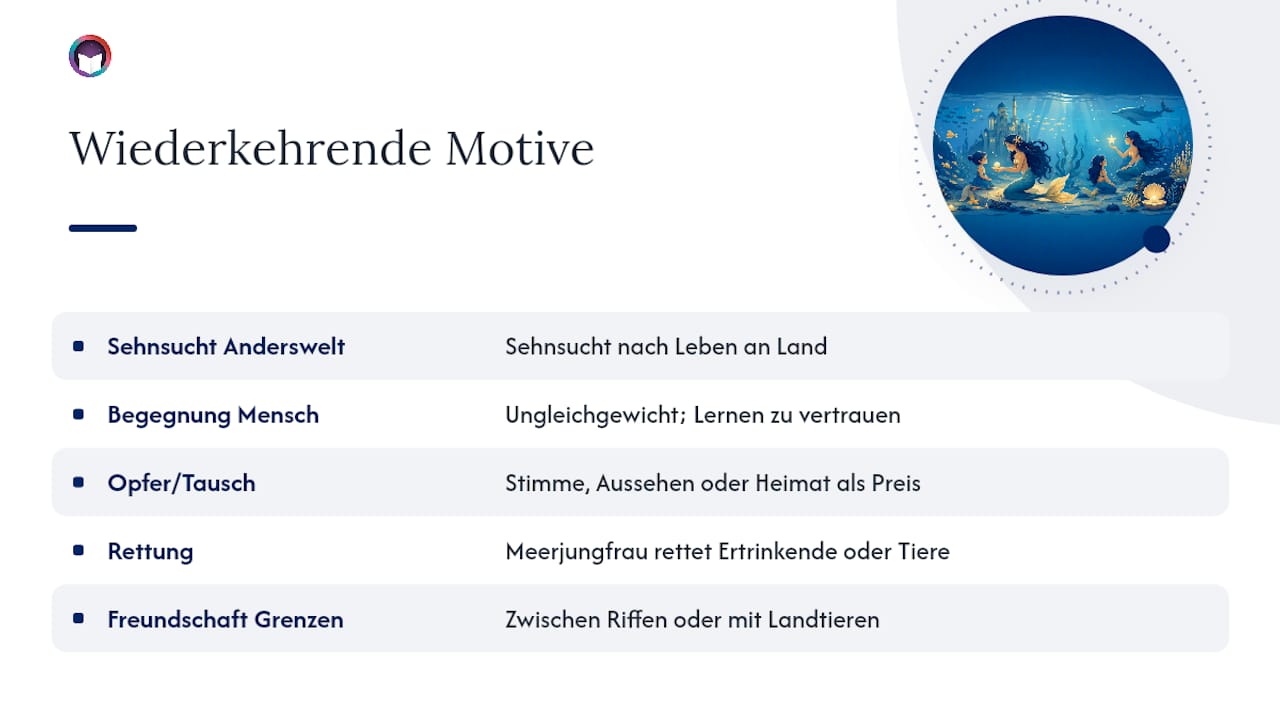
The strongest motif is the longing for the other world: the mermaid wants to experience something her own element cannot offer, usually life on land or closeness to a human. From this arises the second major motif, the encounter between mermaid and human, which almost always begins with an imbalance: one side does not know the other's world and must learn to trust it.
A third motif is sacrifice or exchange, often symbolized by voice, appearance or home that the mermaid gives up to achieve her goal. Modern children's versions usually tone down this exchange and replace it with courage or helpfulness instead of loss.
Fourth, the rescue motif frequently appears, where the mermaid herself becomes the heroine, for example by saving a drowning person or freeing another sea creature. And fifth, there is often the motif of friendship across boundaries, between two mermaids from different reefs or between a mermaid and a land animal. These archetypes repeat because they easily map onto children's experiences, such as friendship, courage and feeling different from others.
Picture books and films as a complement to mermaid stories
A read-aloud story often resonates even more if children can also recognize the characters visually. Illustrated editions of Andersen's tale exist in many styles, from delicate watercolor illustrations to comic-like drawings that are especially suitable for younger children who respond strongly to pictures.
For the afternoon or as a weekend ritual, short animated films with mermaid themes are also suitable; they pick up the same basic motifs as the read-aloud stories: curiosity, friendship and the desire to bridge two worlds. It is important to check briefly beforehand whether the film version matches the age group, as some adaptations show more dramatic scenes than the written original.
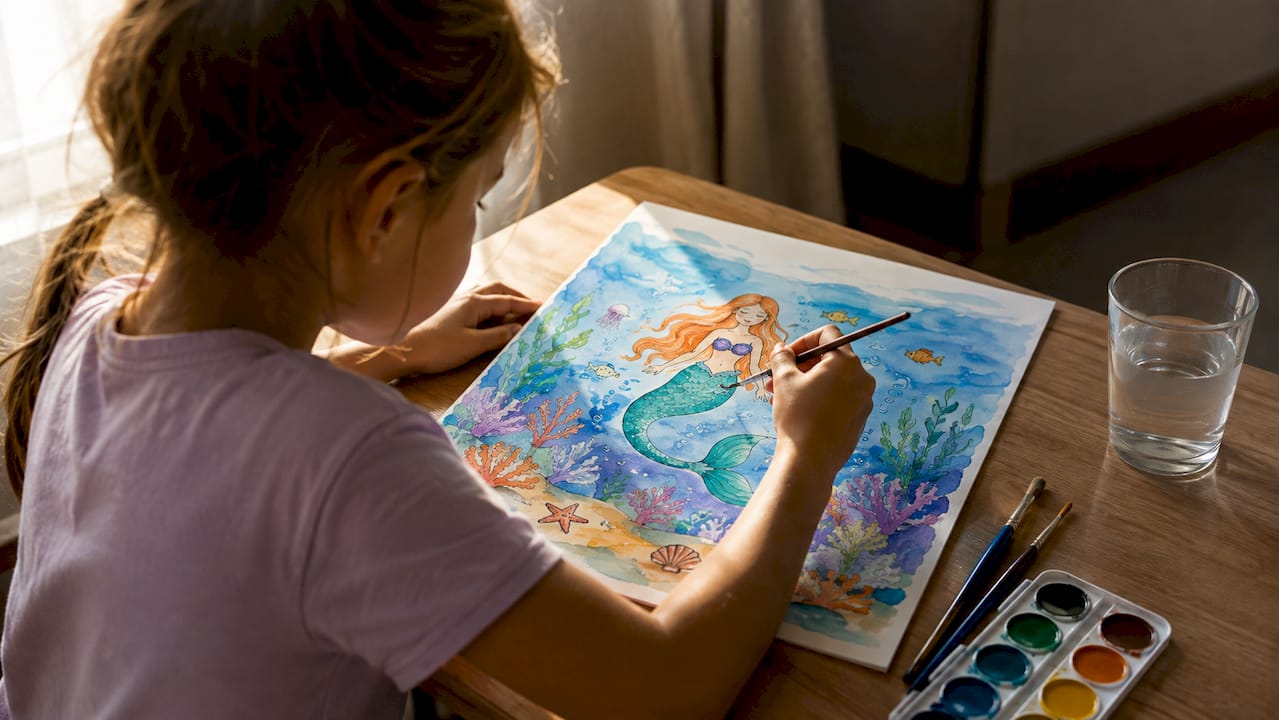
A good combination of book and moving image often works like this: first read the story aloud, then paint a matching picture together or reenact the favorite scene from the film. That way the mermaid world remains present for several days without needing a new story every night. If you’re looking for more topics for the bedtime routine, OutaStory has a broader collection of bedtime stories with a similar structure of tone, length and age recommendation.
OutaStory: The easiest way to new mermaid stories
Instead of searching the internet every night for suitable mermaid stories, OutaStory offers a fixed place for that. The platform is free to use for both reading and listening, and the children's section constantly grows with new short stories and sequels.
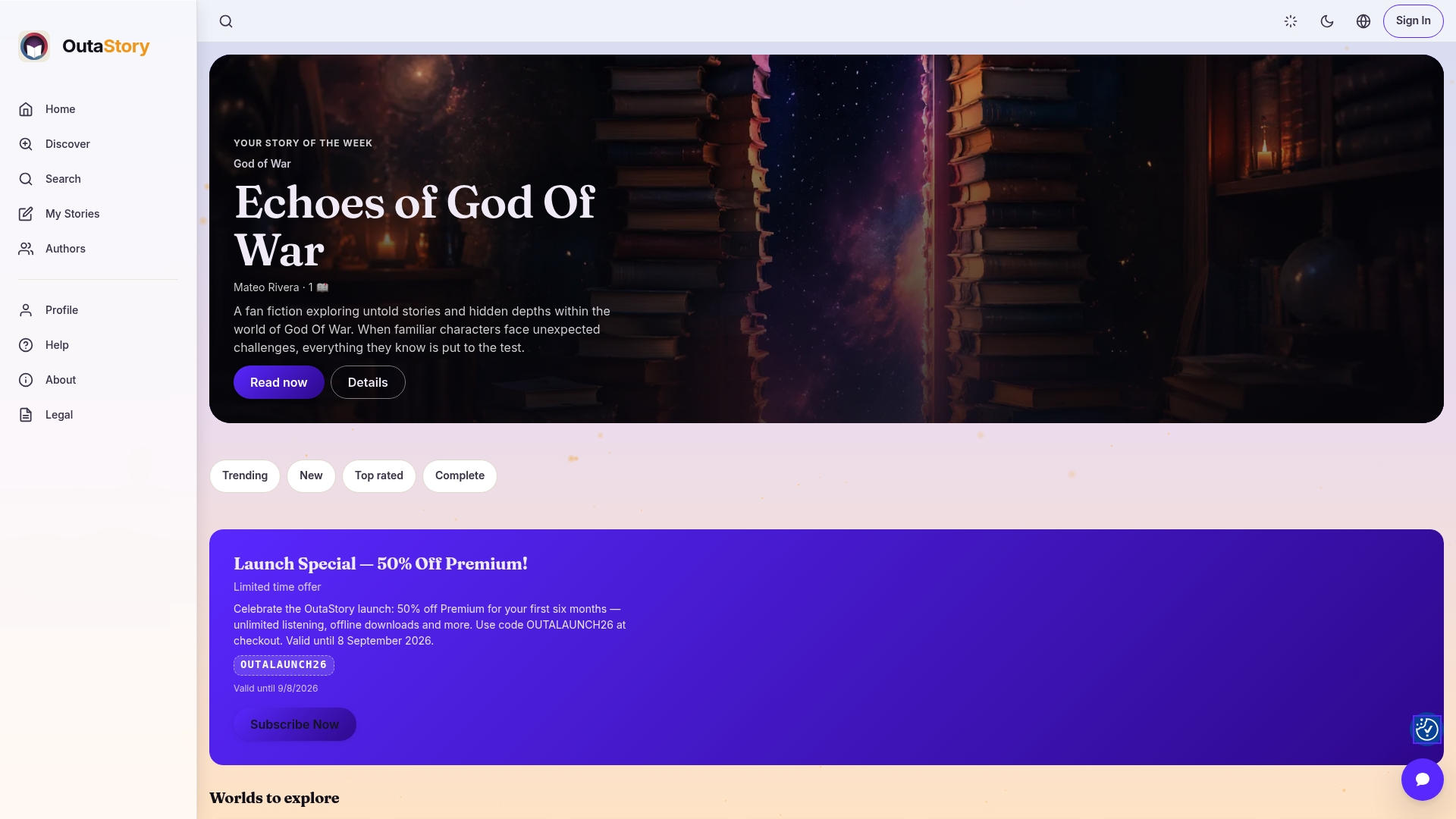
Those who read regularly benefit especially from the audio feature: some stories are available with professionally produced voices, others in the author's original voice, which gives the stories a personal touch. For families who want more listening time or offline access, there is an optional paid premium subscription, while a free basic use is available.
If you don’t have a new mermaid story ready tonight, visit OutaStory and browse the children's section. The next read-aloud story can be found there in minutes, with no long searching needed.
Sources
If you want to dive deeper into the material, the following resources are useful:
FAQ
Which short sea story is suitable for children?
Short, calm tales like "The Gift of the Shell" or "The Brave Rescue" work well because they avoid sad turns and can be read in about 4 to 5 minutes.
What is the myth of the mermaid?
The myth of the mermaid goes back to ancient seafaring stories about beings that were half human, half fish, later merging with legendary figures like the nixie and becoming a feeling protagonist in the 19th century through Andersen.
What is the fairy tale of The Little Mermaid?
It is Hans Christian Andersen's 1837 tale about a mermaid who gives up her voice and her life in the sea for the love of a prince and becomes an air spirit at the end.
What are the names of the three mermaids in Andersen's tale?
In Andersen's original, the little mermaid's sisters do not have individual names; they are described simply as her sisters. Other mermaid tales and modern adaptations, however, assign names that vary widely by version.
Recommendations
- Best bedtime stories for children from 0 to 8+
- Stories to read aloud: free & age-appropriate for children
Read and write on OutaStory
Thousands of short stories to read for free — or publish your own and find an audience.