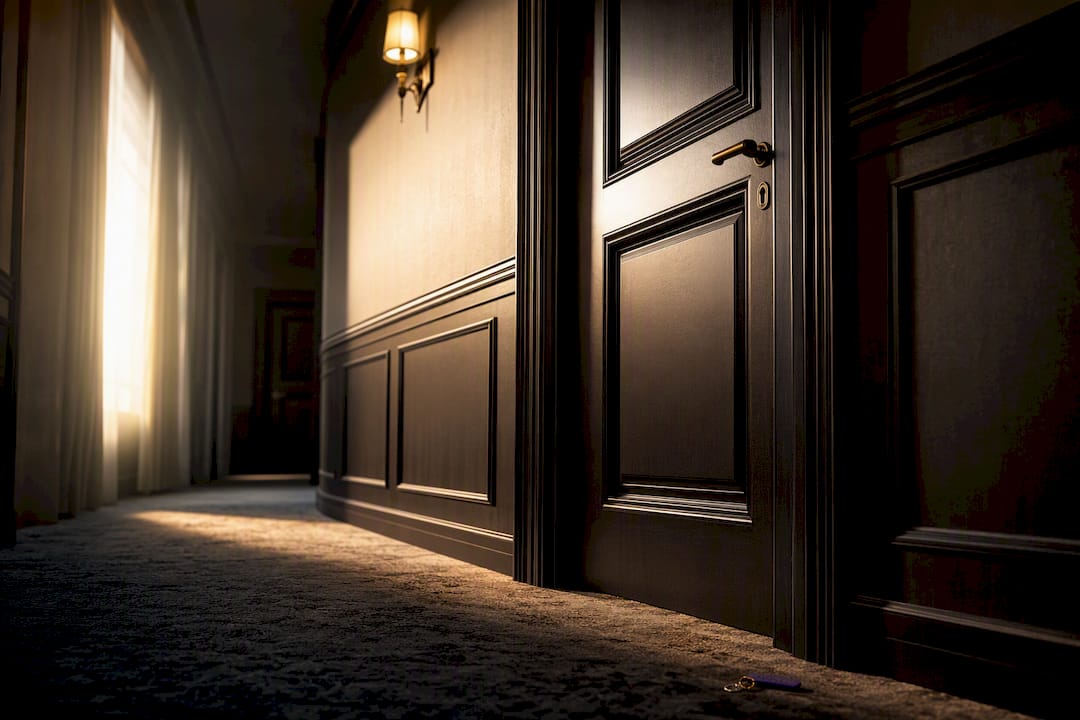
Locked Room Mystery: The Puzzle of the Sealed Room
A locked-room mystery presents an apparently impossible crime: a victim lies in a room that was locked from the inside, with no escape route and no murder weapon in sight. The central question is not "Who?", but "How?". It is precisely this puzzle of locked doors that turns the genre into an intellectual duel between author and reader.
In short:
- The puzzle of locked rooms is based solely on plausible tricks that can be mechanical, psychological, or due to chance.
- Classical works like Poe, Leroux and Carr focus on clear clues and fair solutions that are comprehensible even without narrator staging.
- Modern adaptations use the motif in films, series, escape rooms or genre-mixes, while the basic question always remains: How could the perpetrator have gotten in and out again?
- For authors it is essential to scatter clues carefully to ensure a fair and realistic solution that remains comprehensible even in short form.
- Readers and writers benefit from platforms that offer free short stories on the topic and can publish and monetize their own ideas easily.
Table of contents
- Characteristics and classic premises of the genre
- Short history of the locked-room motif
- Common solution principles: How an impossible crime becomes possible
- Classics and reading tips: Recommendations by subtype and mood
- How authors credibly construct a locked-room puzzle
- Modern variants and adaptations of the motif
- Practical tips for readers and aspiring authors
- Outastory: Where you can read and publish locked-room short stories
- Sources
- FAQ
Characteristics and classic premises of the genre
A locked-room mystery lives off a contradiction that seems insoluble at first glance. The room is closed, the victim is dead, and yet someone must have gotten in. Typical crime scene features repeat over decades because they work:
- Doors that are locked or wedged from the inside
- Windows that are barred, locked, or too high to exit through
- Untouched snow or dust in front of the only access
- A missing weapon, even though the act was clearly violent
Alongside it is the related variant of the „closed circle“, in which it is not the room but the list of suspects that is limited, for example on a ship or in a country house. In the riddle of locked doors the question "How?" determines the entire structure of the plot, not the motive.
Short history of the locked-room motif
The motif is older than the modern crime genre itself. Biblical narratives already know of riddles about locked rooms, but the literary form only established itself in the 19th century.
- Edgar Allan Poe laid the groundwork in 1841 with „The Murders in the Rue Morgue“ for the rational detective story with an impossible crime scene.
- Gaston Leroux provided in 1907 with „Das Geheimnis des gelben Zimmers“ one of the most influential early resolutions of the genre.
- Anna Katharine Green shaped modern detective concepts in the USA in parallel, from which the motif further developed.
- John Dickson Carr and Agatha Christie raised the riddle of locked rooms to its peak during the Golden Age of the 1920s to 1940s.
After the Golden Age the pure puzzle mystery lost some ground to more psychological forms. Pop culture, film and modern authors, however, keep returning to the motif, precisely because it works well for adaptations.
Common solution principles: How an impossible crime becomes possible
Every solution to a locked-room puzzle must be plausible in the end, otherwise the reader feels cheated. Authors therefore draw on a limited repertoire of tricks that can roughly be divided into three categories:
- Physical-mechanical tricks: keys turned from the outside, threads and cords that set a bolt under tension, or tampered hinges.
- Psychological and staging tricks: false time indications, manipulated clocks or witnesses who perceive something different than what actually happened.
- Chains of coincidences: an accident that looks like a murder, or several independent events that add up to an apparent puzzle.
Leroux uses exactly this third category in „Das Geheimnis des gelben Zimmers“: the resolution relies on chains of coincidences and clever staging, not on a supernatural trick. That makes the novel to this day a lesson in rational solutions.
Pro tip: Check in each solution whether it would still be comprehensible without the narrator's voice. If the trick only works because the text conceals certain details, it is not fair but a breach of trust with the reader.
Forensic reality sets limits to such constructions anyway. The more closely one examines a crime scene, the less likely a truly perfect, trace-free solution becomes.
Classics and reading tips: Recommendations by subtype and mood
Anyone new to the genre should not choose at random. The works differ greatly in how much value they place on pure puzzle logic versus atmosphere.
- Edgar Allan Poe’s „The Murders in the Rue Morgue“ is the origin text. Short, dense, with a resolution that seems surprising today but invents the rules of the genre.
- Gaston Leroux’s „Das Geheimnis des gelben Zimmers“ requires patience but rewards it with one of the cleverest constructions in crime literature. Those who prioritize puzzle logic over pace will find it right here.
- John Dickson Carr’s „Der verschlossene Raum“ (originally „The Hollow Man“) is considered by many a masterpiece of the subgenre. Carr even includes a theoretical excursus on possible solution types, almost like a handbook in novel form.
- Agatha Christie relies less consistently on pure puzzle mechanics than Carr, instead focusing more on character psychology and atmosphere. Those looking for the classic whodunit with a feel-good factor will find a more suitable entry here.
- Modern works increasingly combine the motif with other genres, such as thrillers or noir, and experiment with unreliable narrators, which challenges the classic fairness rule in new ways.
For genre fans who want to read beyond the well-known titles, it's also worth taking a look at crime novels with unusual case constructions, which place the principle of the impossible crime in new narrative contexts. Crime specialist portals like Krimi-Couch also offer curated reading lists specifically for this motif.
How authors credibly construct a locked-room puzzle
A good locked-room puzzle follows an implicit agreement with the reader: All clues that lead to the solution must be in the text, even if cleverly hidden. The genre requires a fair intellectual duel from the author, not a solution out of nowhere.
Concretely this means: A key trick only works if the reader at some point learns that a second key existed. A time deception needs a clock or an alibi that was already mentioned early. Authors who combine constructions of mechanical tricks, temporal manipulation and distraction therefore deliberately distribute their clues across several chapters.

Forensic reality provides a useful reality check here. Forensic biologist Mark Benecke points out that traces at the crime scene would quickly expose purely fictional constructions:
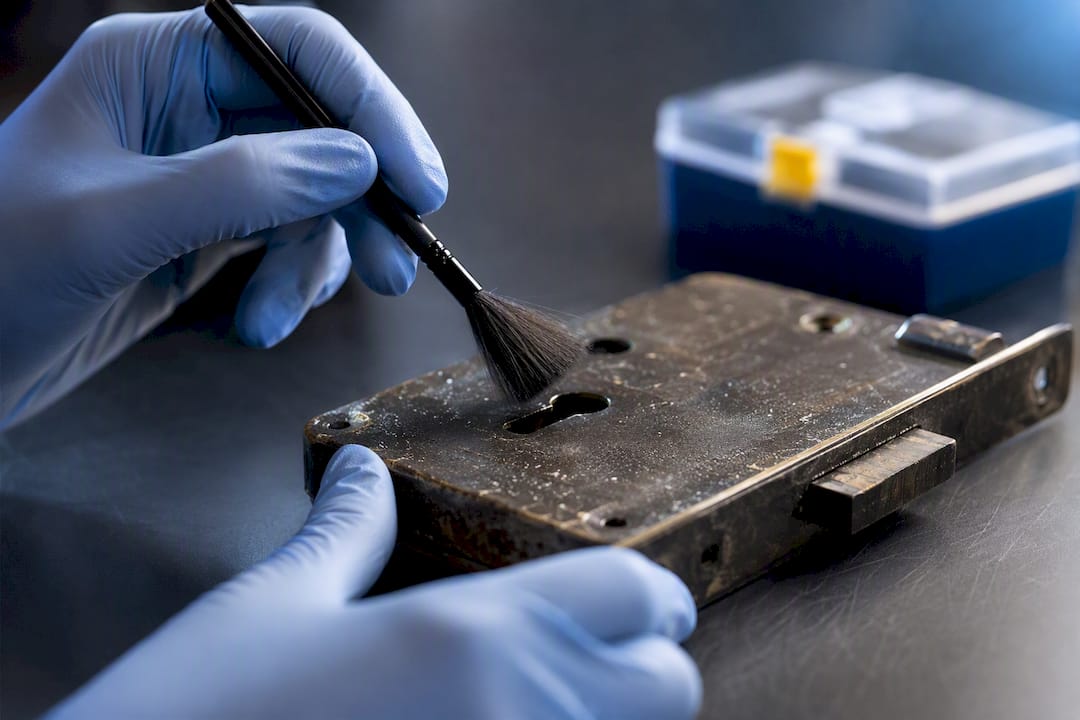
For authors who want to write a locked-room short story, this is a useful corrective: The closer you stay to real forensics, the more credible the solution appears, even in a short form of text.
Modern variants and adaptations of the motif
The puzzle of locked doors has long since jumped out of the book. Films and series regularly pick up the construction, often borrowing from the classic authors of the Golden Age. Escape rooms even make the motif a physical experience in which visitors themselves must find the way out of a sealed room, a direct echo of the literary template.
Also as a cross-genre motif the construction remains attractive. Horror uses the closed room for claustrophobia, thrillers for time pressure, noir for moral ambivalence. The basic question always remains the same: How did the perpetrator get in and out again?
Practical tips for readers and aspiring authors
Those who want to get to know the genre should not start with the most complex work.
- Start with Poe's „The Murders in the Rue Morgue“, because the story is short and clearly demonstrates the basic rules of the genre.
- Then read Leroux's „Das Geheimnis des gelben Zimmers“ to see how the basic idea can be expanded into a full novel.
- Only then venture into Carr's „Der verschlossene Raum“, which deliberately plays with the reader's expectations.
For aspiring authors, a small writing exercise is worthwhile: design a room with exactly one exit, one victim and a single physical trick that explains the locked door. The most common trap is mechanics that are too complicated with too many moving parts, which the reader can no longer follow.
Pro tip: Write the solution first, then the story backwards. That way you distribute clues more naturally instead of inserting them afterwards.
Outastory: Where you can read and publish locked-room short stories
Those who, after reading the classics, want fresh, short locked-room stories will find online platforms that offer uncomplicated access, often without the need for a subscription to try them out.

On the platform, crime stories with puzzles can be read or listened to for free, optionally with professionally produced voices or the author's own voice. If you have a locked-room idea in mind, you can publish it in minutes and build it up chapter by chapter as a serial, which is particularly suitable for a puzzle with multiple turning points. Through a revenue share, authors also participate directly in the income from their stories. If you write yourself, you can publish your first locked-room crime idea directly on the Outastory homepage and see how readers react.
Sources
FAQ
What exactly is a Locked Room mystery?
A locked-room mystery presents a crime in a sealed room with no apparent escape route, where the central question is how the act could have been carried out.
Which book is considered the origin of the genre?
Edgar Allan Poe's „The Murders in the Rue Morgue“ from 1841 is considered a founding work, Gaston Leroux’s „Das Geheimnis des gelben Zimmers“ from 1907 one of the most influential early examples.
What distinguishes a locked room from a closed circle?
In a locked room the crime scene itself is physically sealed, whereas in a closed circle the number of possible suspects is artificially limited, for example by an isolated location.
How can one recognize a fair solution in the genre?
A fair resolution relies on clues that the reader already finds in the text, not on information that is only introduced as a surprise at the end.
Can I publish my own locked-room short stories?
Yes, platforms like Outastory allow you to publish such stories for free, continue them chapter by chapter, and participate in revenues via a revenue share.
Read and write on OutaStory
Thousands of short stories to read for free — or publish your own and find an audience.