
Short story length: 1,000–10,000 words, trimming tips for authors
Short stories typically range between 1,000 and 10,000 words, with many published texts falling in the middle of this spectrum. For submissions to literary magazines and competitions, 1,500 to 5,000 words are recommended, because this range gives editors enough room for character development without blowing their page budgets. Flash fiction, with under 1,000 words, forms the other extreme: uncompromisingly concise, but fully recognized as literature.
In short:
- Stories between 1,000 and 5,000 words are best suited for literary magazines without blowing the page budget.
- In texts under 1,000 words, a single punchline or image is usually the focus; in longer ones there is more room for plotlines.
- Length in words is only a tool for classification; quality depends on structure and content, not on size.
- Conversion to standard pages and reading time is only an approximate rule of thumb, because formatting and reading speed vary.
- For competitions and platforms, you should always adhere to the respective guidelines for maximum word count.
Table of contents
- Word count ranges of short stories: From flash fiction to the novelette
- Word count, standard pages and reading time: The conversion
- Which length for which purpose: magazines, competitions, anthologies
- Flash fiction, short story, novelette: where do the boundaries lie?
- How to find the right length and cut correctly
- Short story lengths on OutaStory: what practice shows
- Sources
- FAQ
Word count ranges of short stories: From flash fiction to the novelette
The boundaries between genres are fluid, but four ranges have become established in practice. If you want to classify your story, you should measure it against these guidelines rather than a rigid standard.
- Flash Fiction: under 1,000 words, often even under 500. This form thrives on a single image or a single punchline.
- Short short story: about 1,000 to 3,000 words. The classic length for anthologies and many literary magazines.
- Typical short story: around 3,000 to 7,000 words. Here a complete plot arc usually unfolds with two or three scenes.
- Longer short story / Novelette: 7,000 to 17,500 words. From here the transition to the novella becomes blurred.
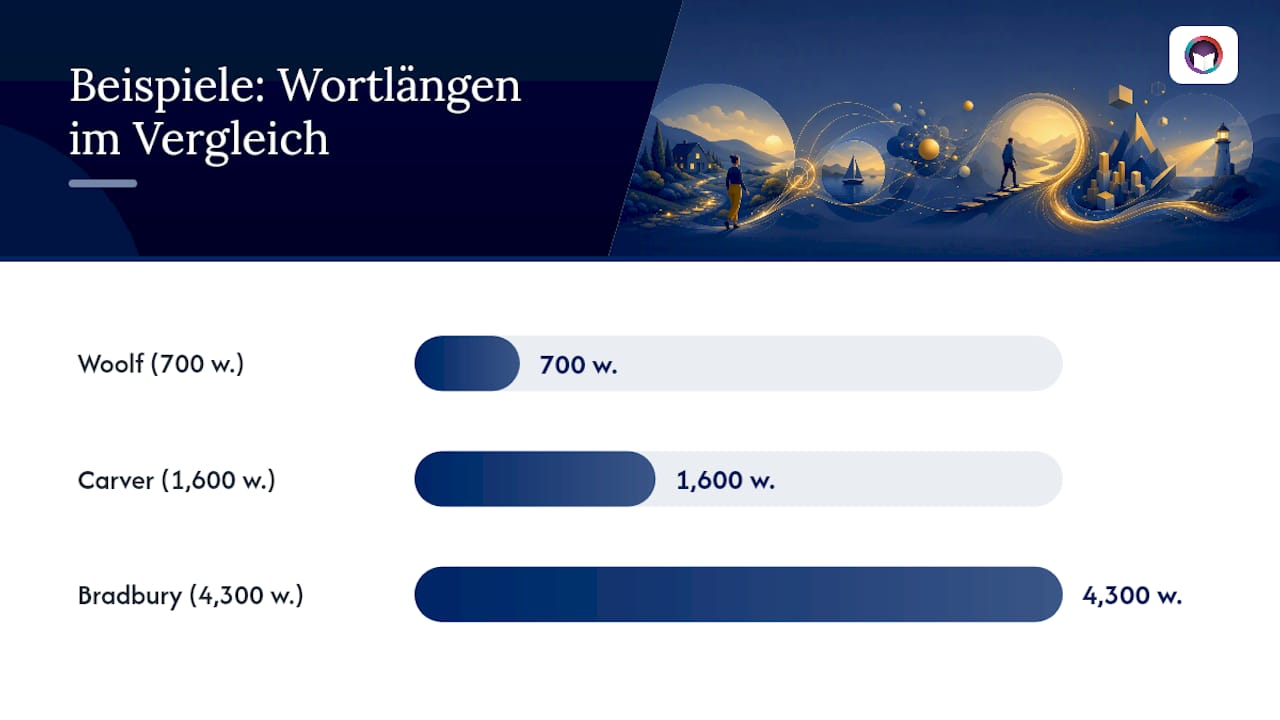
A look at real texts shows how wide the range actually is. Virginia Woolf's “A Haunted House” comes in at around 700 words, hardly exceeding flash-fiction length, while Raymond Carver's typical stories are about 1,600 words. Ray Bradbury's stories, by contrast, often stretch to around 4,300 words without the narrative losing density.
These figures show something important: the literary quality of a short story does not depend on its length. Woolf needs 700 words for a condensation that other authors would require ten times the space for. That is exactly the point many aspiring authors overlook when they set a specific word count as a goal instead of letting the story itself decide when it is finished. Word count is a tool for classification, not a measure of quality.
Word count, standard pages and reading time: The conversion
Anyone preparing a manuscript for a magazine or publisher cannot avoid the so-called standard page. A standard page, by classical definition, comprises 30 lines with 60 characters each, so about 1,800 characters including spaces. That corresponds to roughly 250 to 300 words, depending on word length and punctuation in the text. This conversion remains a rough rule of thumb, not an exact formula, because formatting, paragraph frequency and the proportion of dialogue shift the result.
For practical purposes, simple approximate values are perfectly sufficient:
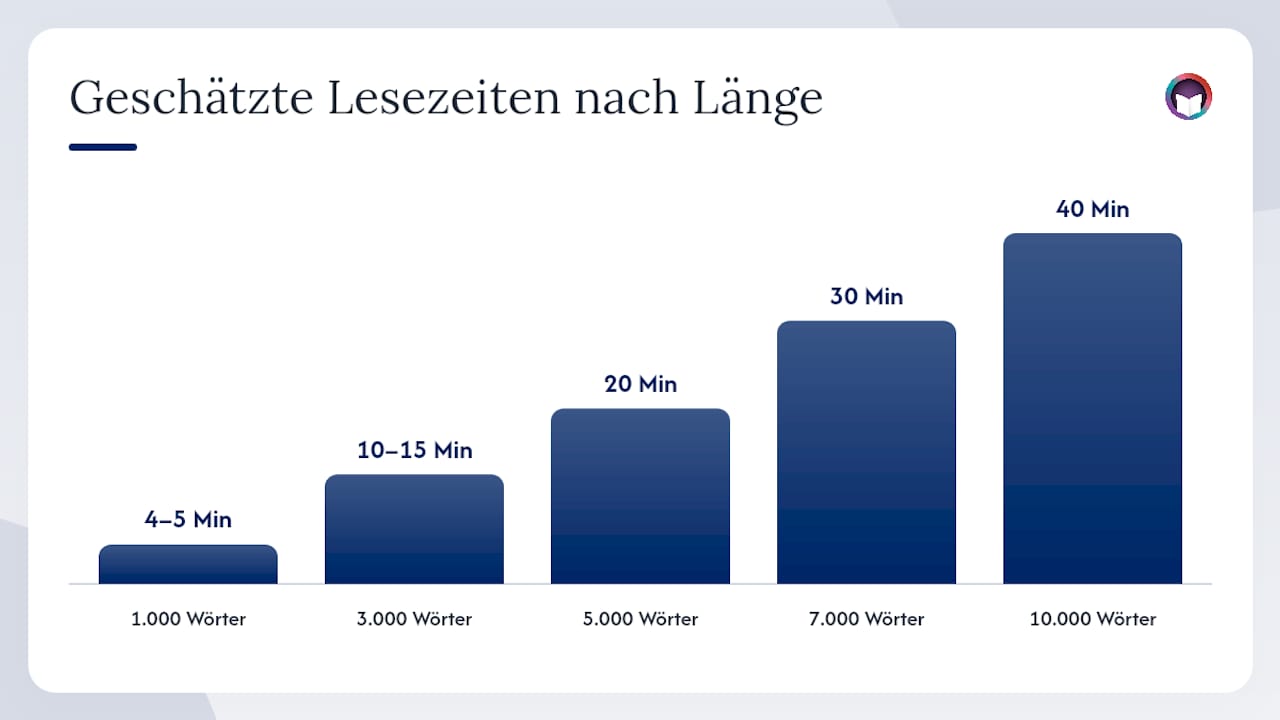
| Word count | Standard pages (approx.) | Printed book pages (approx.) | Reading time (approx.) |
|---|---|---|---|
| 1.000 | 3–4 | 3–4 | 4–5 minutes |
| 3.000 | 10 | 8–10 | 10–15 minutes |
| 5.000 | 17–20 | 14–15 | 20 minutes |
| 7.000 | 25 | 20–23 | 30 minutes |
| 10.000 | 33–39 | 27–31 | 40 minutes |
Reading time can be estimated using a guideline of about 200 to 250 words per minute for silent reading flow. Many audiobook productions also fall within exactly this range, which makes comparing text and audio formats easier. If you also turn your story into audio, you'll find in short audiobooks a good example of how word count translates into actual listening time. Printed pages vary more than standard pages because font size, line spacing and book format vary widely.
Which length for which purpose: magazines, competitions, anthologies
The ideal length of a short story almost always depends on where it is to appear. A text that fits perfectly for a literary magazine can be too short for an anthology or simply too long for a competition.
- Writing competitions: Many calls set fixed upper limits, often between 2,000 and 3,000 words. Some even require flash fiction under 1,000 words as a separate category.
- Theme anthologies: Editors often accept longer texts up to 7,000 or 8,000 words here if the theme justifies it and the collection is intended to include few but more extensive contributions.
Before submitting, it's always worth taking a look at the specific submission guidelines of the magazine or competition. Some editors count titles and subtitles, others do not. Some accept exceptions for particularly strong texts, others automatically reject everything above the word limit without reading the text at all. It's better to adapt your manuscript one time too many to a requirement than to risk a rejection over a mere formality.
Flash fiction, short story, novelette: where do the boundaries lie?
Word count alone never fully explains the genre. The short story is defined by structural features that apply regardless of length:
- An abrupt opening, often in the middle of a situation, without a long backstory.
- Focus on a single event or turning point, instead of a complete life story.
- A frequently open or surprising ending that leaves room for the reader's interpretation.
- Few characters and a narrow time frame, often only hours or a single day.
Flash fiction radicalizes these principles even further: an image, a sentence, a punchline, done. The novelette and the novella, by contrast, allow themselves more space for minor characters and a second plotline, but remain closer to the short story than to the novel as long as they concentrate on a central conflict. The word count ranges therefore overlap intentionally because publishers and critics set different thresholds. If you are unsure whether your text is more of a short story or a novelette, you should look less at the word count and more at how many plotlines the story carries. A text of 6,000 words with a single conflict remains a short story. A text of 4,000 words with three subplots often feels more like a compressed novelette.
How to find the right length and cut correctly
The appropriate length rarely emerges at the beginning, but usually only in revision. Proceed in clear steps:
- Define the goal: Decide before writing where the story should go, for example to a magazine with a 3,000-word limit or to a platform with no requirement.
- Write the rough draft: Write the first version without regard to word count. Cutting down later is easier than adding material afterwards.
- Focused editing instead of mere proofreading: A substantive edit checks structure, pace and superfluous scenes, while a copyedit only smooths spelling and grammar. When cutting you almost always need the former.
- Check format against the guideline: Compare the final word count once more with the submission guidelines before sending.
When cutting, three questions reliably help: Does this subplot really contribute to the central event? Does the perspective jump unnecessarily between characters? Does this dialogue say something that doesn't already emerge from the action?
These are exactly the passages the reader also perceives as superfluous.*
Short story lengths on OutaStory: what practice shows
On OutaStory, authors publish both compact short stories and multipart serial stories that unfold chapter by chapter. The platform makes visible what formulas alone do not show: listening time and reader engagement are more closely linked than listening time and pure word count. A dense 2,000-word story with a strong opening often keeps listeners engaged longer than a text twice as long with a sluggish start.
Authors publishing on OutaStory can therefore go both ways: a single, clearly finished short story or a series of shorter chapters that together form a longer narrative. These practical guidelines do not replace official requirements from literary magazines or competitions. Those who want to apply there should still follow the respective submission guidelines. For all other forms of publication, the platform offers a good indicator of which length actually keeps readers and listeners until the end. Those looking for inspiration can find examples of different lengths and narrative forms in the overview of free short stories, as well as in the collection of romantic short stories.
Sources
The Wikipedia definition of the short story provides a solid basis for genre characteristics and historical classification. For the formal distinction via structure instead of word count, the specialist article on the characteristics of narrative and short story is worthwhile. Concrete word count examples and industry benchmarks are provided by the guide to the average length of a short story. Those additionally interested in the didactic use of short texts will find additional notes in the article Learning English with short stories.
FAQ
How long should a short story be?
Most short stories are between 1,000 and 10,000 words, with 1,500 to 5,000 words being best suited for submissions to literary magazines.
How long does it take to read a 300-page book?
With about 250 words per standard page and a reading speed of around 200 to 250 words per minute, reading a 300-page book typically takes five to seven hours, depending on text density and reading pace.
How many pages must a short story have?
A typical short story of 3,000 to 5,000 words corresponds to about 10 to 20 standard pages, but fixed page requirements exist only if a magazine or competition explicitly demands them.
What are the 4 characteristics of a short story?
The central characteristics include an abrupt beginning, concentration on a single event, few characters within a narrow time frame, and often an open or surprising ending.
Recommendations
Read and write on OutaStory
Thousands of short stories to read for free — or publish your own and find an audience.