Short stories for beginning readers: Where to find suitable reading material right away
You will find the best short stories for beginning readers in age-graded collections with large primer font, syllable separation, short sentences and optional audiobooks. These formats are suitable immediately for reading aloud and for independent reading. Children in grades 1 and 2 need texts that build on the syllable method and use many illustrations so they don't get stuck on every second word.
Three routes will get you to suitable material fastest. Institutional providers like Stiftung Lesen provide free downloads with accompanying material. Teaching series from the book trade, for example around Loewe Verlag or Ravensburger, deliver printed beginner-reader volumes with tested syllable separation. And digital platforms like Outastory complement both with audio versions that additionally support word recognition.
Concretely for everyday use, this means:
- To print: free PDFs from educational initiatives, ideal for worksheets and homework.
- For practice: printed beginner reader books with primer font, good for daily reading sessions.
- To listen: audio formats that help weaker readers with word recognition without them having to struggle through alone.
Key takeaways
Good beginning-reader short stories combine large primer font, short sentences, syllable separation and illustrations with audio offerings that further support independent reading.
| Topic | Details |
|---|---|
| Check format features | Look for primer font, short sentences, syllable marking and chapters with a manageable length. |
| Use free sources | Stiftung Lesen and bpb.de offer downloads with differentiated reading levels and accompanying material. |
| Use printed series | Leselöwen, Leserabe and Zwergenstark are suitable for daily practice time at home and in the classroom. |
| Structure the read-aloud routine | A ten-minute block with an introduction, shared reading and a reader quiz keeps concentration high. |
| Complement digitally with Outastory | Free reading and listening in the children's area specifically supports word recognition during independent reading. |
Table of contents
- Collections and sources for beginning-reader stories at a glance
- How to recognize a good beginning-reader short story?
- How to use short stories when reading aloud and for learning?
- Concrete titles and collections for immediate use
- How Outastory supports learning to read in practice
- How to start with Outastory in a few minutes
- Sources
- FAQ
Collections and sources for beginning-reader stories at a glance
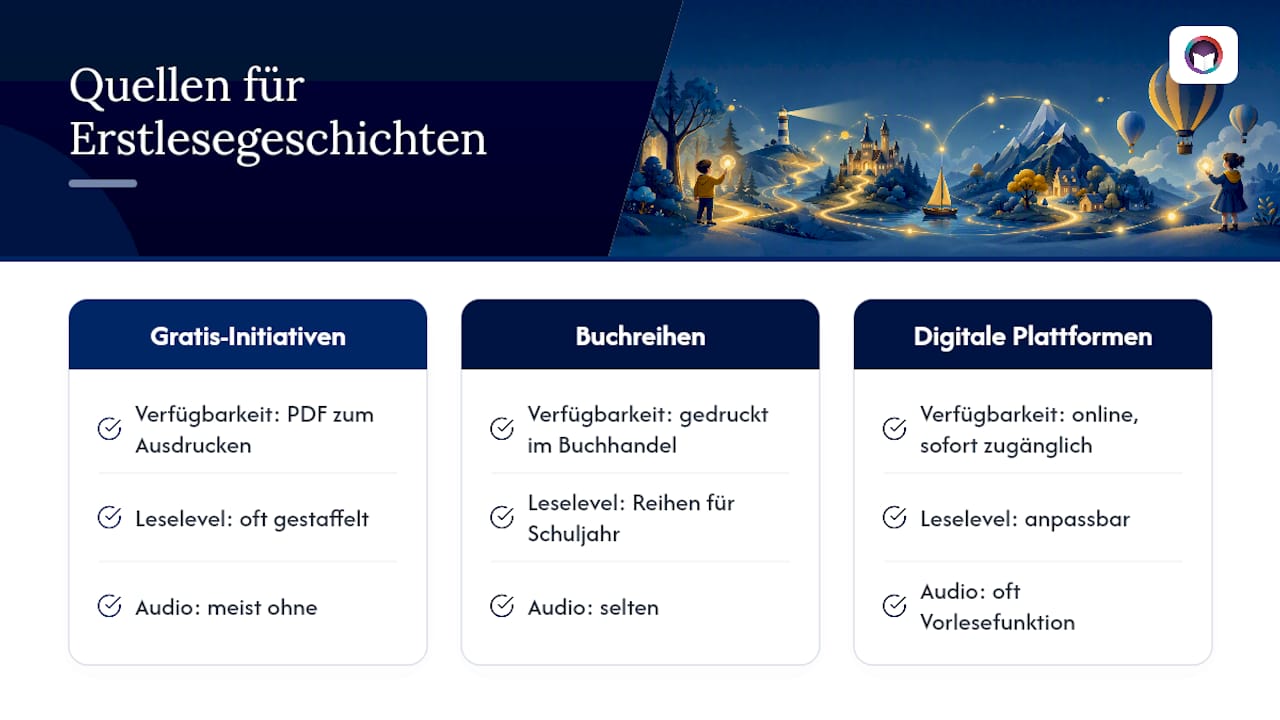
Not every source fits every situation. Some parents need something to print immediately, other teachers are looking for an entire series for the school year. Three categories cover the most common needs.
Free materials from educational initiatives
Foundations and educational portals often offer the quickest solution when you want something in hand immediately. For example, the Leserabe Geschichten-Spiel from Stiftung Lesen offers two stories each in two differentiation levels for free download, including accompanying material for class use. This is particularly practical when a class consists of children with very different reading speeds: you give weaker readers the easier level without it being noticeable.
Also Bpb provides guidance for didactic use. Those who work with changing topics in class often find more up-to-date material here than in traditional textbooks.
Printed beginner-reader series from the book trade
Series like Leselöwen (Loewe Verlag) or Leserabe (Ravensburger) are a regular fixture in German elementary school classes, for good reason. They use extra large primer font, colored syllable marking and short chapters of two to three pages. Zwergenstark follows a similar approach with clearly graded reading levels.
These volumes are particularly well suited for the daily practice block at home because children can physically see progress: a book that gradually becomes thinner motivates differently than a loose PDF collection. Many of these series integrate a reader quiz as a didactic element at the end of each story, allowing children to check their understanding themselves.
Digital platforms with audio features
Digital offerings solve a problem that printed books cannot: what happens when a child reads alone and gets stuck on a word? Interactive online formats combine visual and auditory input, which promotes reading motivation and comprehension at the same time. Interactive reader quizzes provide immediate feedback without an adult having to sit beside them.
Outastory addresses this exact point. Stories can be read for free or played as audiobooks, sometimes with professionally produced voices, sometimes with the author's own voice. The dedicated children's area with bedtime stories, animal adventures and first rhymes thus provides a complement to print that children also use voluntarily outside of school time.
In short, here's what to choose depending on the situation:
- Quick and free: downloads from Stiftung Lesen or bpb.de for immediate classroom use.
- For daily practice: printed series like Leselöwen, Leserabe or Zwergenstark with clear reading level information.
- For motivation in between: digital offerings with audio functionality that also work without supervision.
How to recognize a good beginning-reader short story?
Not every text with short sentences is automatically suitable for beginning readers. A few concrete, measurable features separate usable material from well-meaning but overwhelming content.
The most important core features can be checked quickly:
- Extra large primer font: children in first grade need significantly larger letters than practiced readers, usually starting at 16 point and up.
- Short sentences: one main clause per line is the rule of thumb; nested subordinate clauses do not yet belong in beginning-reader texts.
- Syllable separation or colored syllable marking: Colored marking of syllables or letter groups makes it much easier to grasp parts of words.
- High proportion of illustrations: images carry part of the action, which relieves the text itself.
There are also guideline values for length that have proven themselves in practice. Typical beginning-reader chapters are about two to three pages, focusing on simple sound combinations rather than complex word formations. A single story should be manageable in five to ten minutes, otherwise the child loses motivation before reaching the end.
Didactic extras make the difference between a nice text and truly useful learning material. Reader quizzes or comprehension questions at the end are now standard in good beginning-reader volumes. Equally important are differentiation levels that offer the same content in two difficulty levels, as demonstrated by the Leserabe Geschichten-Spiel.
Pro tip: When printing PDF material, it's worth a short test beforehand: print one page as a test and check whether the font size still appears large enough on paper. Digital previews often deceive about actual readability.
How to use short stories when reading aloud and for learning?
The read-aloud routine should ideally not last longer than ten minutes, otherwise concentration collapses. A proven pattern:
- Short introduction based on the picture on the first page: What might happen?
- Shared reading, with the child taking over individual words or sentences.
- One to two conversational prompts during the story, not an interrogation.
- Reader quiz or comprehension question at the end for self-checking.
The transition from reading aloud to true independent reading rarely succeeds abruptly. Reading-flow exercises with audio support help because the child can read along while listening. The reading partner technique, where a more practiced reader alternates reading with the child, works both at home with siblings and in the classroom. Reading aloud in small sections, for example paragraph by paragraph, prevents overload.
In the classroom, differentiation needs fixed tools, not ad-hoc solutions:
- Use two-level editions in parallel, as suggested by the Leserabe model.
- Additional tasks for faster readers, such as writing their own continuations.
- Targeted phonics work for children who are still struggling with individual letter combinations.
A 45-minute lesson can be roughly divided like this: ten minutes of shared reading, fifteen minutes of individual or partner reading, twenty minutes of follow-up with reader quizzes and vocabulary cards. Role plays based on the story or a picture story as a writing prompt round off the lesson without it looking like pure practice.
Concrete titles and collections for immediate use
If you don't want to search for long, here is a handy selection sorted by use case rather than publisher.
- Leserabe Geschichten-Spiel (Stiftung Lesen): two stories in two reading levels, free download with accompanying material. Suitable for first grade, PDF format, ready for differentiation in class.
- Leselöwen (Loewe Verlag): classic beginner-reader series with large primer font and short chapters. Suitable from age 6, printed book format, ideal for daily practice time at home.
- Leserabe (Ravensburger): similarly structured to the Stiftung Lesen materials, often with puzzle pages at the end of chapters. Reviews of such volumes often mention page count and target group indications from grade 1, which makes selection in bookstores easier.
- Zwergenstark: series with clearly graded reading levels and syllable method, well suited for children just beginning to read.
- Beginning-reader short stories with syllable method: product descriptions of such volumes show short sentences, colored syllable separation and illustrations as common features, making them suitable for first reading practice.
- Outastory children's area: digital supplement with bedtime stories and animal adventures, readable or listenable for free, good for moments without a printed book at hand.
When choosing, pay particular attention to series with clear reading level differentiation and accompanying worksheets; this will save you time later in lesson preparation. A complete publisher comparison is of little use here; what matters is whether the material matches the child's current reading level and whether free downloads with additional material are available.
How Outastory concretely supports learning to read
Outastory provides a digital complement to printed beginner-reader material, with its strength particularly in audio support. Children can read or listen to stories for free, with professionally produced voices or the author's own voice. This helps exactly at the moment when a child is reading alone and gets stuck on a word.
The platform offers specific use cases for this:
- Read-aloud with audio: parents play a story while the child reads along in the book or on the screen.
- Independent reading practice with audio support: the child listens when they get stuck on a word, without adults having to intervene.
- Reading lists for class or home: teachers or parents compile suitable stories from the children's area, sorted by theme or length.
The business model is a freemium approach: basic use for reading and listening remains free, a premium subscription unlocks unlimited listening and offline use. Beyond the children's area, the platform also covers genres like fantasy, crime or science fiction and is available in German and English, which also makes it interesting for children growing up bilingually.
Pro tip: Use the audio feature specifically for words your child repeatedly reads incorrectly. A second pass with audio alone often consolidates the correct pronunciation faster than another round of silent reading.
How to start with Outastory in a few minutes
You don't need to create an account to get started immediately: one click on Outastory is enough to browse the children's area and listen to the first story for free.
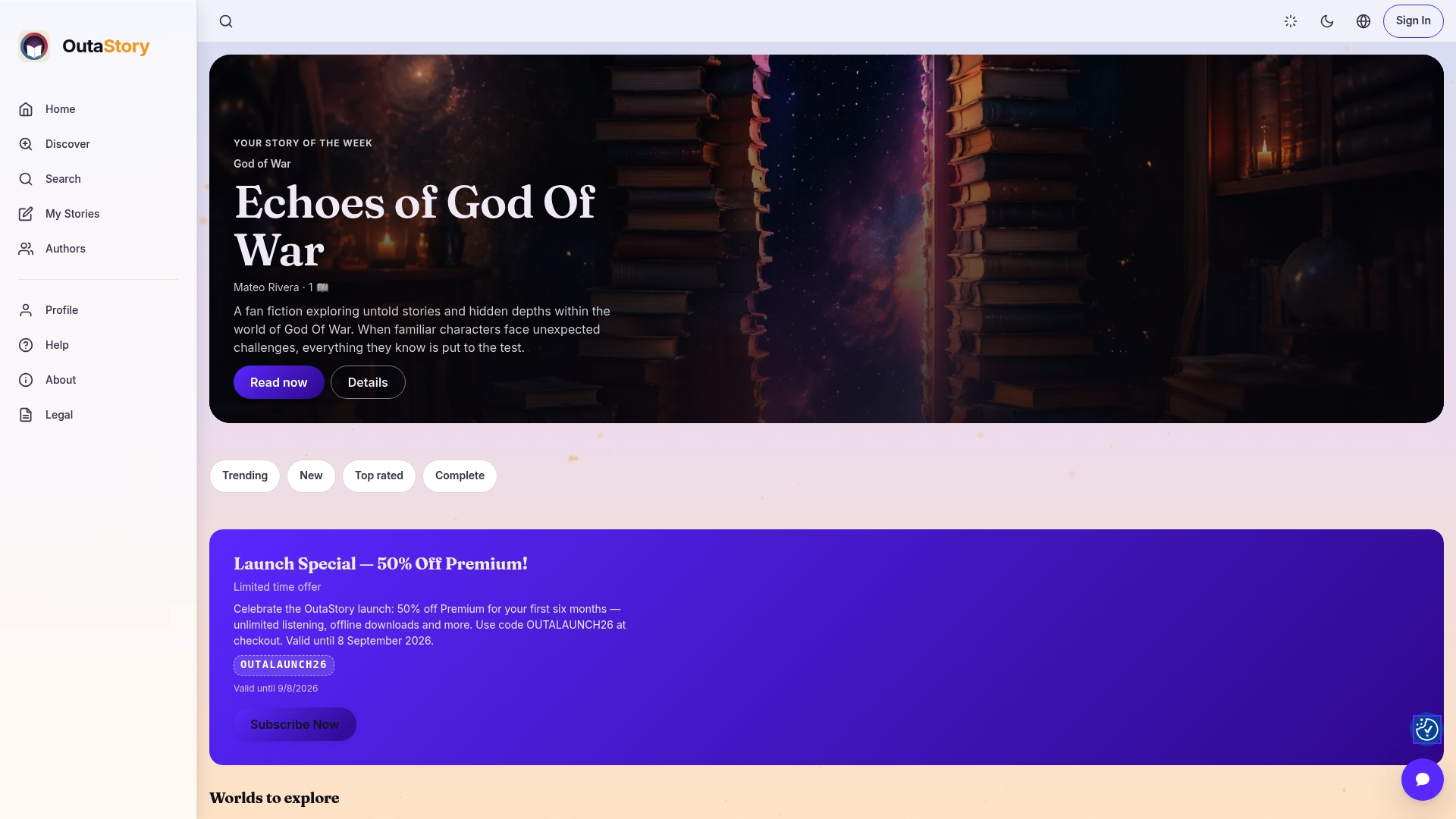
For targeted use at home or in class, a short, systematic approach is worthwhile: search the children's area for short stories, set the filter to the audio version if your child is currently working on word recognition, and create a small reading list of three to five titles to use over the week. This creates a fixed routine without much effort that adapts to your child's reading pace rather than the other way around. Those who regularly need new stories will also find suitable reading material for older siblings in the platform's wide genre range, so a single account can be worthwhile for the whole family.
Sources
- Product page: beginning-reader book package with syllable method — Backwinkel
- For beginning readers: The Leserabe Geschichten‑Spiel — Stiftung Lesen
- Bpb
- Didactic features of beginning-reader texts — Buchtutgut
FAQ
From what age are short stories suitable for beginning readers?
Most series are aimed at children from six years old or first grade, when initial syllable combinations are reliably recognized.
What makes a text a beginning-reader story?
Extra large primer font, short sentences, syllable separation and a high proportion of illustrations are the central features, supplemented by reader quizzes at the end of the text.
Are audiobooks really helpful when learning to read?
Yes, audio formats support word recognition because children can listen to difficult parts without immediately needing adult help.
Where can I find free beginning-reader stories to print?
Stiftung Lesen and bpb.de offer free downloads with reading level indications and accompanying material for direct classroom use.
Can Outastory replace printed beginning-reader books?
Outastory does not completely replace printed books, but it usefully complements them through free reading and listening in the children's area, especially with audio support.
Recommendation
Read and write on OutaStory
Thousands of short stories to read for free — or publish your own and find an audience.