Crime novel or thriller: 5 characteristics for readers and authors
In short: A crime novel solves a crime, a thriller fights an immediate threat. In a crime novel the question "Who did it?" is central, in a thriller the question is "Does the protagonist survive?" The investigator's role in a crime novel is usually detached and methodical, while in a thriller it is often personally affected. Overlaps are common, but the following sections show how to recognise the dominant genre.
In short:
- If the central question is "Who did it?", the work is probably a crime novel, whereas if it is "Does the character survive?" it's a thriller.
- A crime novel is set in the past and focuses on solving the crime, while a thriller focuses on the immediate danger and survival.
- Protagonists in thrillers are often incidentally affected or themselves in danger, whereas in crime novels investigators act in a detached and controlled manner.
- The narrative pace in a crime novel is rather calm and analytical; in a thriller it is fast and intensified chapter by chapter.
- The decision for the genre significantly influences how readers are addressed, visibility in retail and audience reactions.
Table of contents
- What is a crime novel? Definition, structure and reader expectations
- What is a thriller? Structure, suspense techniques and characters
- Crime novel and thriller compared: the checklist
- Subgenres with character: classics and modern examples
- For authors: choosing crime novel or thriller?
- OutaStory as a testing field for crime novels and thrillers
- Sources
- FAQ
What is a crime novel? Definition, structure and reader expectations
A crime novel tells of a crime that has already occurred, and the path to solving it forms the actual plot. This construction is also called the "whodunit" mechanism: the murder is already committed, clues are distributed across the chapters, and the reader builds her own theory in parallel with the investigator character. The appeal lies in the puzzle, not in the thrill.
The investigator character carries a special burden in this genre. Whether a police inspector, private detective or retired amateur sleuth as in Agatha Christie: these characters almost always retain control of the situation. They question, piece things together, sometimes err, yet they rarely find themselves in immediate mortal danger. It is precisely this distance from the event that allows readers to guess along without being swept away by fear of death.
From a literary studies perspective, the crime novel is often described as a genre of intellectual satisfaction. Someone reading a crime novel seeks the reconstruction of causal relationships, similar to a puzzle in which every piece finds its place at the end. This mindset differs fundamentally from the emotional escalation that drives thrillers. The cultural embedding of the genre also runs deep: Planet Wissen describes how the crime novel established itself over decades as a fixed element of German reading life, from the Sunday-evening TV crime drama to the bestseller shelf.
Within the crime novel there are several clearly distinguishable subgenres:
- Whodunit: The classic puzzle form, in which the question of the perpetrator remains open until the end, as in Agatha Christie's Hercule Poirot novels.
- Regional crime: Investigation with strong local colour, often with recurring settings and characters.
- Social crime: The crime serves as a starting point for societal themes, for example in Henning Mankell's Wallander series.
- Legal crime: The focus is on court proceedings and legal processing rather than on pure detection of the perpetrator.
Crime novels and thrillers together have made up almost 25 percent of the fiction market in Germany for years. This figure shows how firmly suspense literature is rooted in the German-language book market, far beyond a niche preference.
What is a thriller? Structure, suspense techniques and characters
A thriller turns the perspective around: instead of clarifying a past crime, it's about preventing or surviving an impending one. The main difference lies in the focus: crime fiction centers on investigation, thrillers on countering an acute danger. This shift changes everything, from narrative pace to character depiction.
Protagonists in thrillers differ significantly from the classic investigator figure. They are often:
- Ordinary people unexpectedly affected: People without investigative training who unwittingly find themselves in a threatening situation.
- Former investigators who become the target: The role reversal from hunter to hunted drives the tension.
- Victims who become actors: Characters who must learn over the course of the plot to defend themselves.
The thriller also has clear subgenres. The psychological thriller, as exemplified by Simon Beckett with his forensically influenced novels, relies on psychological wearing down rather than pure action. The political thriller moves the threat to a state or intelligence-agency level. The disaster thriller, in turn, places an entire community before an existential danger, whether through natural disasters or technical failure. Journalistic classifications point out that the intensity of the tension is the real distinguishing feature, even though publishers often label titles according to marketing logic rather than strict genre definition.
Crime novel and thriller compared: the checklist
If you want to classify a book unambiguously, you can compare five features directly:
| Feature | Crime novel | Thriller |
|---|---|---|
| Central question | Who did it? | Does the protagonist survive? |
| Time of the crime | Already occurred | Is about to occur or is happening right now |
| Role of the main character | Detached investigator | Often personally endangered or affected |
| Source of tension | Puzzle, clues, logic | Threat, time pressure, loss of control |
| Narrative pace | Calmer, analytical | Fast, often intensified chapter by chapter |
Many novels deliberately mix both patterns. A book can begin with a murder case and still feel like a thriller if the investigator herself becomes a target. In such borderline cases it is decided by which plot strand occupies the larger share of the pages and which question remains open at the end: the puzzle or survival.
Five questions help with a quick classification of a work:
- Has the crime already occurred at the beginning, or is it still threatened?
- Is the investigator figure outside the danger or in the middle of it?
- Is the tension driven by puzzle or by threat?
- Does the plot resolve through clarification or through defence?
- Is the narrative pace more analytical or more breathless?
Pro tip: Count in the first three chapters how often the main character actively seeks answers instead of fleeing from a danger. If searching predominates, you have a crime novel in your hands. If fleeing or defending predominates, you are reading a thriller.
Subgenres with character: classics and modern examples
Agatha Christie remains the reference point for the classic whodunit crime novel. Her novels about Hercule Poirot or Miss Marple follow the investigative pattern almost text-book style: a closed circle of suspects, distributed clues, a surprising solution in the last chapter. Anyone who wants to understand what a crime novel is at its core will find the purest form of it in Christie.
Henning Mankell developed the genre in a different direction. His Wallander novels use the criminal case as a vehicle for social observation: immigration, the welfare state, loneliness in old age. The case is solved, but the real interest lies in the society in which the crime was possible in the first place. This variation, often called "social crime", earned Scandinavian crime fiction its international reputation.
Simon Beckett, in turn, shows how close crime novels and thrillers can be. His novels about the forensic anthropologist David Hunter contain classic investigative elements, but the tension mainly arises from the physical and psychological threat to the protagonist himself. This mixture makes Beckett a good example of borderline cases: more thriller than crime novel, but with a clearly recognisable investigative framework.
For practical reading selection it is worth sorting by subgenre:
- Psychological thriller: Simon Beckett for forensic suspense with a strong psychological component.
- Regional crime: Suitable for readers who prefer recurring settings and a calmer narrative pace.
- Political thriller: For those who seek threats on a societal or state level.
- Disaster thriller: Appropriate when the tension should arise from an existential, collective danger.
Crime novels and thrillers together reach a market share of almost 25 percent of total fiction in Germany. This magnitude explains why publishers put so much care into the precise classification of their new releases: a mislabelled book misses its target audience, even if the content is right.
Anyone who wants to look beyond the classic crime novel will also find interesting perspectives in related genre fields, for example in the analysis of what African-American crime fiction differs from the classic whodunit tradition. Such studies show how cultural perspectives can colour the same basic structure—crime and investigation—in very different ways.
For authors: choosing crime novel or thriller?
Before the first chapter there is a decision that shapes the entire novel. Three questions help:
- Do you want to place the puzzle or the threat at the centre? If your reader should above all know "Who did it?" at the end, you are writing a crime novel. If they should be gripped by "Will they make it in time?", you are writing a thriller.
- How close is your protagonist to the danger? A detached investigator fits a crime novel, an immediately threatened figure fits a thriller.
- How fast should your plot move? Crime novels tolerate calmer, analytical passages. Thrillers demand short chapters and constant forward pressure.
From these answers a small convention checklist emerges: tempo (calm vs. fast), perspective (detached vs. close), degree of violence (hinted vs. explicit) and resolution requirement (complete explanation vs. survival as an open resolution). Anyone who consciously sets these four controls will automatically meet the expectations readers bring to the respective genre.
Before you commit an entire novel to a genre decision, a small test is worthwhile. Write the basic idea as a short story or publish it chapterwise as a serial and observe how readers react. Do they linger on the puzzle or constantly ask "What happens next?" This reaction often reveals more about the actual genre of your material than any theory.
Pro tip: Try the same basic idea once from the investigator's perspective and once from the victim's perspective. The version that feels more exciting while writing usually shows you which genre your material actually belongs to.
The correct classification also has tangible effects on your book's visibility. A precise genre choice helps determine whether a psychological thriller appears in the search results and recommendation lists for crime readers or gets lost in the wrong category. Listing your book as a crime novel when it is structurally a thriller wastes reach with exactly the audience that would read it.
OutaStory as a testing field for crime novels and thrillers
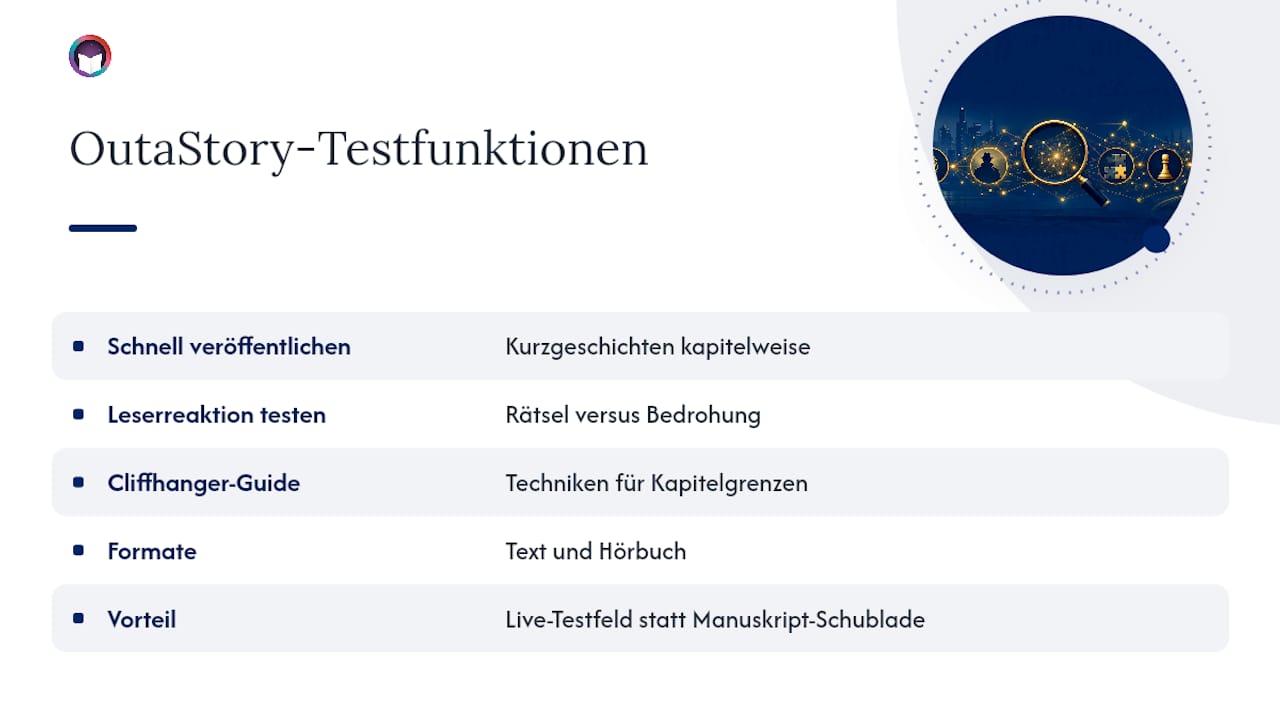
A platform makes the practical test possible: publishing short stories quickly and releasing them chapter by chapter as serials is ideal for finding out whether readers react to the puzzle or to the threat. The practice guide to cliffhangers shows concrete techniques with which thriller tension can be built deliberately across chapter boundaries. Since stories appear both as text and as audiobooks, you can also directly hear whether a suspense arc holds up when read aloud—a test field that classic manuscript drawers do not offer.
Sources
- Understanding psychological thrillers — difference from crime novels
- Suspense in the Shadow of Love — Börsenverein/Book Monitor
- Difference between crime novel and thriller - the comparison
- What is the difference between a crime novel and a thriller? Explained with examples
FAQ
What is the difference between a crime novel and a thriller?
A crime novel resolves a crime that has already occurred; a thriller prevents or survives an immediate threat. This shift in focus determines the pace, perspective and role of the protagonist throughout the book.
Which crime novels and thrillers are considered particularly successful?
Agatha Christie's classic whodunits, Henning Mankell's socially critical Wallander series and Simon Beckett's forensically influenced psychological thrillers are regarded as reference works. All three display different but characteristic genre features.
How can I tell if a book is more of a crime novel or a thriller?
Check whether the central question is "Who did it?" or "Does the character survive?" and whether the protagonist investigates at a distance or is themselves in danger. If the threat predominates, it is usually a thriller.
What is a thriller as opposed to a novel with a crime?
A thriller requires an immediate, ongoing danger that drives the plot, not just a crime as background. If this acute pressure of threat is missing, it is more likely a classic crime novel.
Which crime films are considered particularly worth watching?
Film adaptations of Agatha Christie works as well as adaptations of the Wallander novels are among the best-known examples of successful crime adaptations in film. The exact ranking depends heavily on personal taste and the year of release, which is why no universally valid top list can be reliably named here.
Read and write on OutaStory
Thousands of short stories to read for free — or publish your own and find an audience.