Short English audiobooks for beginners: start listening now
For beginners, short English stories, especially children's stories and short stories, are the fastest way to immediately enjoy audiobooks. No textbook, no grammar drills. Just a voice that tells you a story you would also like to hear in German. That's exactly what makes English audiobooks so pleasant for beginners: you need no preparation, only ten minutes and headphones.
The simplest way to get started looks like this:
- Open a platform with short, clearly spoken stories, for example the children's section or the short stories category on Outastory.
- Choose a story under 15 minutes of listening time, ideally with a calm, clearly speaking narrator.
- Listen to the first chapter straight through without trying to understand every word. The meaning usually comes across anyway.
This first attempt often determines whether you stick with it or give up after five minutes.
Key findings
Short English short stories with clearly speaking voices are the most reliable entry into English audiobooks for beginners because they combine comprehensibility with a clear ending.
| Topic | Details |
|---|---|
| Make a first choice | Start with children's short stories or short everyday tales under 15 minutes of listening time. |
| Check the voice before the text | Listen to the first two minutes before you decide on an entire chapter. |
| Use reflection | Brief retelling or notes measurably strengthen the positive effects of listening. |
| Build a routine | Ten to twenty minutes daily are more effective than infrequent long sessions. |
| Choose a platform | Outastory offers free English short stories with a children's section, chapter continuations, and an offline option in the premium access. |
Table of contents
- English audiobooks for beginners: which stories really work
- Why does listening work particularly well for starting a language?
- How do I tell if a story matches my level?
- Which listening strategies really help beginners?
- OutaStory: the easiest starting point for English audiobooks
- Sources
- FAQ
English audiobooks for beginners: which stories really work
Not every story is a good entry point, even if it is advertised as "simple". Some short stories seem short but are full of technical words or complex sentences. Others sound like children's books but are exactly right for the first contact with spoken English. A small shortlist helps separate the wheat from the chaff.
- Children's short stories and rhymes. Texts for the bedtime area are almost always the easiest starting point because vocabulary and sentence structure are deliberately kept simple. Rhymes and recurring phrases (“once upon a time”, “and they all lived happily”) give you a structure to hold onto.
- Short stories for a single listening session. Stories that can be listened to in one session hold attention better than a novel with twenty chapters. You have an end in sight that motivates you.
- Light fantasy and everyday stories. A simple plot, clear characters, few time jumps. If you could follow the story easily in German, you'll follow it more easily in English as well.
- Short mysteries with a manageable cast. Suspense keeps you alert, but only if the story doesn't throw around fifteen supporting characters. Two or three characters are completely sufficient for the beginning.
When choosing, the voice counts at least as much as the text. A female or male narrator with clear pronunciation, moderate tempo, and clear emphasis makes the difference between "I understand half" and "I understand almost everything". Native speakers with a neutral accent, such as American or British standard English without a strong dialect, are a safer choice for the beginning. If you choose a child-friendly version, you should also check whether the narration voice is calm and not over-the-top. That also keeps adults engaged longer.
Outastory brings together exactly this selection in its own categories: The children's section contains bedtime stories, animal adventures, and first rhymes, while the short stories category gathers light fantasy, everyday scenes, and short crime stories for adults. That way you don't have to scroll through hundreds of titles to find something suitable.
Pro tip: Listen to the first two minutes of a story before you decide on the whole chapter. If you already understand little there, it rarely gets easier later on.
Why does listening work particularly well for starting a language?
Listening is not a weaker version of reading, but its own skill with its own benefits. When you follow an audiobook, you activate similar cognitive and emotional areas as when reading and additionally train pure listening comprehension, because no visual aids like print or punctuation are available. You learn to hear intonation, rhythm, and natural language patterns directly from the sound—precisely the skill that matters in real conversation.
Fiction has an effect that goes beyond pure language practice. Meta-analyses with hundreds of effect sizes show small but measurable cognitive benefits from reading and listening to stories, especially for verbal skills and empathy. The effect is not huge, but it is real, and it accumulates with every story heard.
A key detail that many overlook is decisive here: pure consumption alone often isn't enough for the full benefit. Studies on different forms of contact with fiction show that reflection and discussion about the story amplify the positive effects on mood and well-being. So someone who briefly thinks about what happened in the story or retells it to someone gets more out of listening than someone who only listens in passing.
Shorter formats play a practical role here:
- A short story can be finished in one session without losing the thread.
- Focus is maintained throughout the listening time because no long arc has to be sustained over several days.
- A clear ending motivates you to the next story instead of creating frustration through dropouts.
How do I tell if a story matches my level?
The most reliable test is simple: listen. The first one to two minutes of a story almost always show whether you can follow or keep dropping out. If you understand the beginning without having to guess every third word, the story is likely suitable. If you have to pause at every sentence, another title is more worthwhile than brave perseverance.
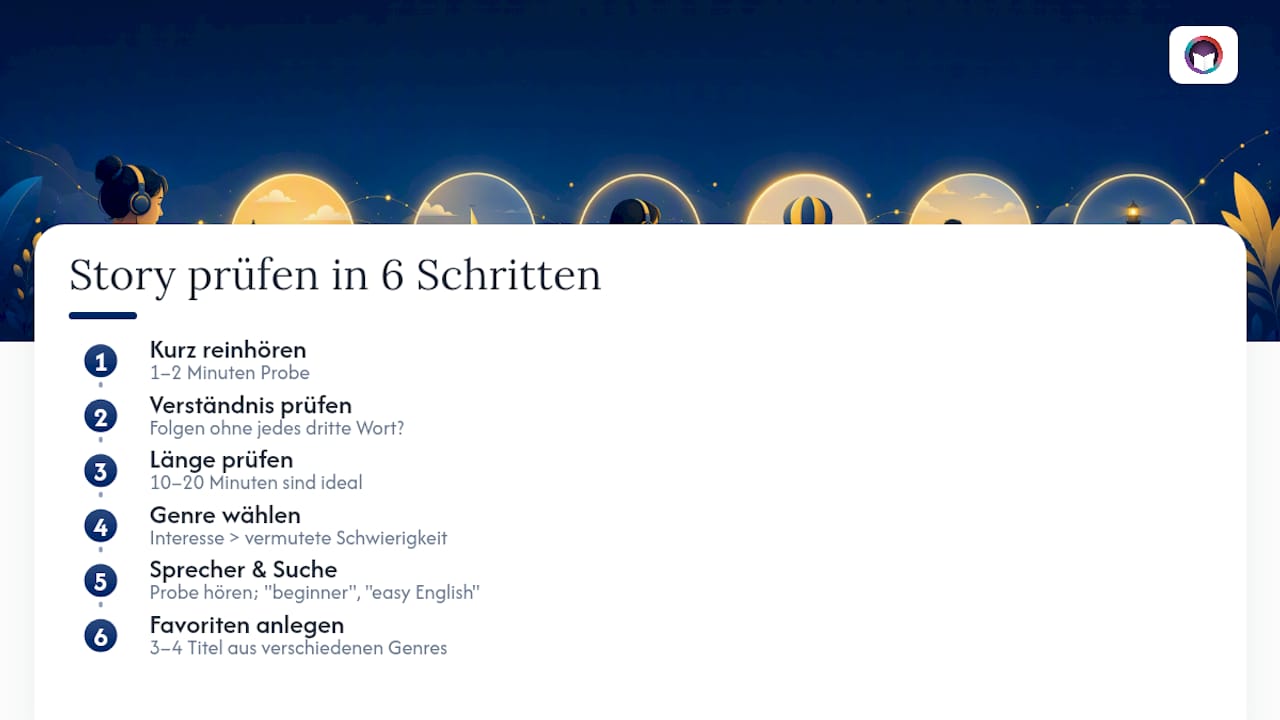
As for length, a simple rule of thumb applies: episodes between ten and twenty minutes fit well into commuting times, walks, or the time before falling asleep. Longer chapters often feel tiring at first because concentration in English fades faster than when listening in your native language.
Choose the genre based on interest, not presumed difficulty. A crime short story that truly piques your curiosity will get you further than a text labeled "easy" that bores you. Motivation carries you over language hurdles; boredom never does.
For children or shared family listening, it's worth taking an additional look at content warnings and age ratings. Not every "short story" is automatically child-appropriate, even if the listening time is short. A separate, clearly delimited children's section, like the one Outastory runs, takes most of this checking off your hands.
When searching, certain terms help more reliably than others: "short stories", "bedtime for kids", "beginner" or "easy English" filter the selection faster than vague keywords like "simple". Also include the speaker check in the selection process: a short sample shows whether tempo and pronunciation match your current comprehension level.
Pro tip: Create three to four favorites from different genres instead of fixating on a single title. That way you always have an alternative if a story turns out to be too difficult or too boring.
Which listening strategies really help beginners?
How you listen often matters more than what you listen to. A few simple habits turn occasional listening into a routine that actually produces results.
- Read along when a text is available. Following text and audio in parallel significantly accelerates vocabulary acquisition because eyes and ears work together.
- Schedule short, regular sessions. Ten to twenty minutes daily are more effective than one hour once a week, because the ear continuously gets used to sound and tempo.
- Listen actively instead of just letting it play in the background. Short notes on characters or plot, targeted pauses, and a second listening of the same scene reinforce understanding.
- Create set rituals for children. A bedtime story at the same time or a shared family listening time on weekends anchors the habit without pressure.
- Adjust technology. Reduce speed if the narrator seems too fast, and download chapters offline for train journeys or airplane mode without interruptions.
OutaStory: the easiest starting point for English audiobooks
Outastory collects exactly the kind of stories that are suitable for first contact with English listening: short, clearly told texts, available for free, with professionally produced voices or the author's own voice.
The children's section offers bedtime stories, animal adventures and first rhymes, while the categories for adults range from light fantasy through everyday stories to short crime stories. Stories can be listened to chapter by chapter as continuations, so you don't have to tackle a whole book at once but can progress chapter by chapter. Those who listen regularly can, with a Premium access, also listen unlimitedly and download chapters offline, practical for commute times without a stable network.
Getting started requires no preparation: create an account, filter the short stories and audiobooks on Outastory by category or genre, and start the first chapter. If you like the voice and the first minutes were understandable, you've already overcome the most important hurdle in learning English with audiobooks: having listened to the first title to the end.
Sources
- Is Listening To An Audiobook As Good As Reading? — Psychology Today
- Five studies evaluating the impact on mental health and mood of recalling, reading, and discussing fiction — PLOS One
- Meta-analyses on cognitive effects of fiction — Kent Academic Repository
FAQ
Which English audiobooks are best suited for beginners?
Short stories and child-friendly bedtime texts with clearly speaking native voices are best for starting out, because they offer simple sentences and a manageable plot.

How long should an audiobook episode be for beginners?
Ten to twenty minutes per chapter or story work best for a single listening session without overwhelming concentration.
Does reading along while listening really help with learning?
Yes, reading along while listening accelerates vocabulary acquisition because the eyes and ears work together and support each other.
Are children's short stories also suitable for adult beginners?
Absolutely—because the simple language and clear structure of children's short stories make them a relaxed entry point, regardless of the listener's age.
Where can I find free English short stories to listen to?
Outastory offers its own children's section as well as short story categories in various genres, all available for free and with professionally narrated voices.
Read and write on OutaStory
Thousands of short stories to read for free — or publish your own and find an audience.