
5-minute stories: Ready-to-read ideas for parents
5-minute stories are short, self-contained tales that can be read calmly and without rush in about five minutes. They focus on a single conflict, have little subplot, and end reassuringly. That is exactly what makes them the best choice when time before bedtime is short or a child simply wants one more story before the light goes out.
Three ways get you there immediately:
- Free collections on the web: categorized by age and genre, usually usable without registration
- Anthologies and books with indicated reading times, ideal for fixed bedtime rituals
- Audio and platforms like Outastory: stories to read or listen to, including a dedicated children's area with bedtime stories and animal adventures
Publishers often state the reading time directly for 5-minute fairy tales, because parents need exactly this orientation when choosing quickly. As a rough guideline: stories for toddlers under three years remain shorter, while preschoolers and early readers can follow somewhat more complex five-minute texts well.
Key findings
Five-minute stories work best when they are read regularly, briefly, and as part of a fixed ritual, whether as text or audio.
| Topic | Details |
|---|---|
| Word count as a guideline | An average reading pace covers several hundred words in five minutes. |
| Choose genre by occasion | Bedtime stories for the evening, fables for daytime when attention is alert. |
| Cut rather than rewrite | Remove subplots and mark pauses, instead of rewriting the whole text. |
| Fixed rituals strengthen the effect | The same closing sentence and the same voice every evening make falling asleep easier. |
| Outastory as a quick solution | Free text and audio access with a children's area, premium for offline use on the go. |
Table of contents
- Five-minute stories by genre and age at a glance
- How long is a 5-minute story really?
- Which reading tricks work best at bedtime?
- Where to find ready-made 5-minute stories for immediate reading?
- What makes Outastory a practical solution for five-minute stories?
- Start a five-minute story on Outastory now
- Sources
- FAQ
Five-minute stories by genre and age at a glance
The choice of a suitable story depends on two things: the child's mood and the occasion. A short overview by genre helps you make the right decision faster, instead of leafing through books for a long time.
Bedtime stories are built around calm. Little happens, the tone stays gentle, and the ending almost always finds the main character falling asleep themselves, a small trick that triggers the same drowsiness in the child.
- “The tired little bear looking for his nest” – a short story suitable for children from 2 years
- “Moonlight journey with Frieda the owl” – a story for children from 3 years
- “How the star went to bed” – a short story suitable for children from 2 years
- “The little cloud of sheep and its lullaby” – a story for children from 3 years
- “Sandman's smallest sack” – a story for children from 4 years
Animal stories work because children easily identify with animal characters. A small conflict, usually getting lost or a quarrel among friends, is quickly resolved.
- “The hedgehog who couldn't find his way” – approx. 5 minutes, from 3 years
- “Two ducks and a pond that's too small” – approx. 4 minutes, from 3 years
- “The fox who didn't want to sleep” – approx. 5 minutes, from 4 years
- “The mouse who helped the tomcat” – approx. 4 minutes, from 3 years
- “Why the elephant walked quietly” – approx. 5 minutes, from 4 years
Fantasy and fairy tales live from small wonders and vivid language. A talking tree, a magic stone, a door that only appears at night. These stories may carry some tension as long as the ending remains safe and warm.
- “The gate in the old tree trunk” – a story for children from 4 years
- “The queen of the raindrops” – a story for children from 5 years
- “The boy who collected clouds” – a story for children from 4 years
- “Seven stones for the wizard” – a story for children from 5 years
- “The girl with the lantern made of light” – a story for children from 4 years
Funny stories and fables either rely on humor or on a clear lesson at the end. Both forms are well suited for children who are still awake and lively during the day but still want to hear a story.
- “The frog who wanted to play the trumpet” – approx. 4 minutes, from 3 years
- “Why the snail was late” – approx. 5 minutes, from 4 years (fable with a moral about patience)
- “The bear who lost his growl” – approx. 4 minutes, from 3 years
- “The ant and the crumb that was too big” – approx. 5 minutes, from 4 years (fable about cooperation)
- “How the rooster lost his alarm clock” – approx. 4 minutes, from 3 years
These twenty titles serve as models for how a 5-minute text is constructed. Similar structures can also be found in ready-made collections like Short Bedtime Stories, which provide concrete three- and five-minute texts with length indications.
How long is a 5-minute story really?
An average reading pace with calm, clear pronunciation means a story for five minutes of reading time contains several hundred words. Pauses, emphasis, and direct speech can extend the actual duration. That's exactly why the indications of different collections vary slightly from each other.
If you want to shorten a longer text to five minutes, you don't need a literary education, just a clear method:
- Remove subplots, keep only one conflict
- Shorten descriptive passages, but leave the key scene intact
- Mark deliberate pauses at sentence ends, for example with a small dash in your own copy of the text
- Include repeating sentences; they slow the pace without increasing text length
For toddlers under three years, often three minutes of pure text plus repetitions and eye contact are enough. Preschoolers tolerate the full five minutes well, while first readers at six or seven years already read along themselves and benefit from a little more action.
This way you immediately notice where you need to cut and where a pause feels natural.*
Which reading tricks work best at bedtime?
The beginning often decides the whole story. Start calmly, without big announcements, and give the main character a clear name and place in the first sentence.
- Speak slower than in everyday life, especially in the last two sentences
- Insert deliberate pauses after tense moments, not just at the end of sentences
- Use recurring sentences or rhymes; they give the child a sense of security
- Close with a fixed ritual sentence, the same one every evening
- Dim the lights already during the last minute of the story
Children often ask mid-story why a character does something. A short, honest answer is usually enough; long explanations tend to wake them up rather than calm them. Regular reading aloud supports child development demonstrably, and reliability often counts more than the length of individual stories.
Pro tip: Always use the same calm tone for the narrator's voice, regardless of content. Children quickly associate this sound with falling asleep, even with more exciting stories.
Where to find ready-made 5-minute stories for immediate reading?
Free websites like OhMyTales offer large collections, filtered by age and genre, often supplemented by audio samples. Also EmHeMa provides categorized five-minute texts as downloads, practical for on the go or for printing out.
Books and anthologies like 5-Minute Stories: For Reading Aloud are suitable if you prefer a fixed bedtime ritual with a real book, completely screen-free.
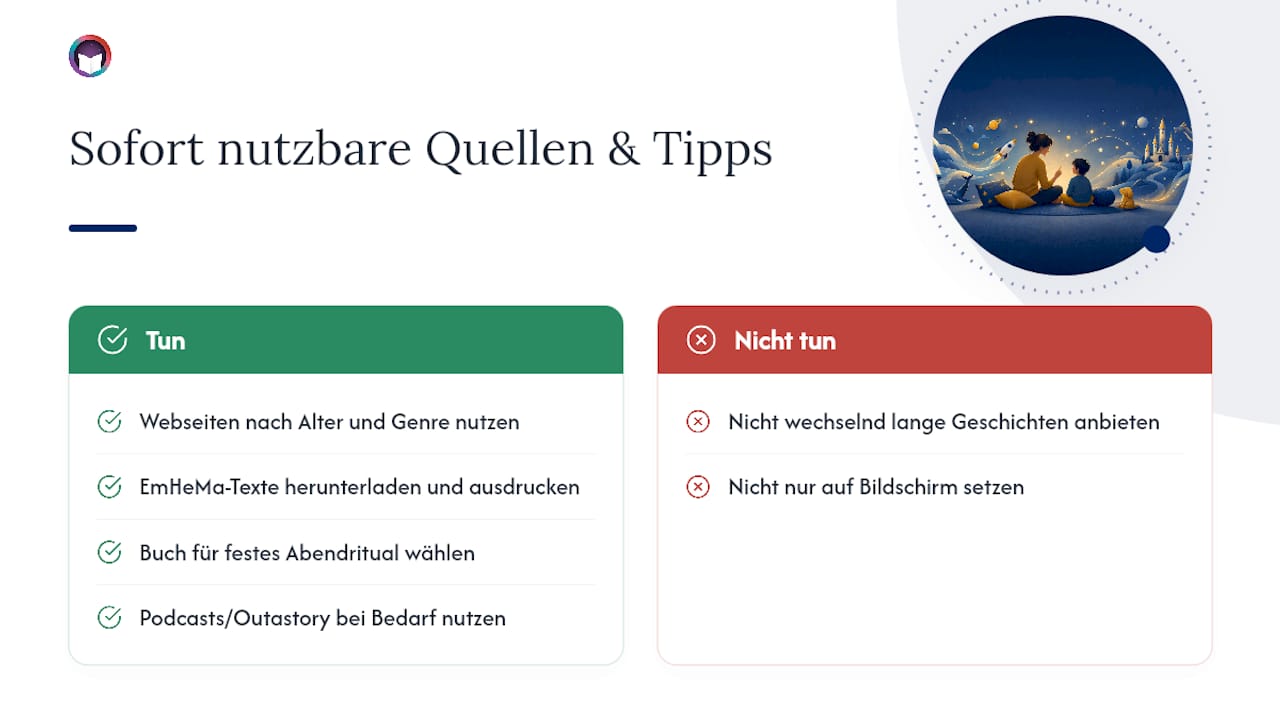
Podcasts fill a different gap: series with regular five-minute episodes simply play in bed or in the car when you don't have a voice to read yourself.
Platforms like Outastory combine both worlds: text for self-reading and professionally produced or author-read audio versions in one place.
Reliability beats length. A child who experiences the same short structure every evening often falls asleep more easily than one with stories of varying lengths.
What makes Outastory a practical solution for five-minute stories?
Outastory collects short stories to read or listen to for free, with a dedicated children's area for bedtime stories, animal adventures, and first rhymes. Each story can be played directly as an audiobook, either with professionally produced voices or the voice of the respective author.
- Immediate access without long searching across various collections
- Serialized stories released chapter by chapter, for children who want to see the same characters again
- Publishing opportunity for authors who share in the revenues of their stories
A platform that offers text and audio simultaneously takes away the decision that often consumes the most time in the evening for parents: which story and in which format.
Start a five-minute story on Outastory now
Outastory is the answer for parents who don't have time to search ten different websites for the right story. Instead of switching between a book, podcast app, and children's collection, you find text and audiobook in one place, usable for free and with a dedicated section for children's stories.

The free access is sufficient for most evenings: read or listen, without required registration for individual stories. Those who regularly read on the go or want unlimited ad-free listening in the evening will find offline access for long car rides or flights without a connection in the Premium subscription. Open Outastory today, choose a bedtime story from the children's area, and have it read aloud or read it yourself. Five minutes is enough to find out whether the voice and the story fit your bedtime ritual.
Sources
Those who want to delve deeper into reading durations, podcast formats, or scientific background will find solid starting points in the following sources:
- 5‑Minute Fairy Tales — Hugendubel
- Reading aloud: Why the bedtime story is important for children — Spektrum
FAQ
Which 5-minute stories are there for children?
There are bedtime stories, animal stories, fantasy stories and fables with morals, each in versions of about four to five minutes of reading time. Platforms like Outastory consolidate such stories in a dedicated children's section with text and audio versions.
Which are the shortest short stories?
The shortest forms are about three minutes of reading time, as offered by collections with three- and five-minute texts. These are particularly suitable for toddlers under three years old.
What ideas are there for short stories?
Good ideas are based on a single small conflict, e.g., an animal that has lost its way, or a character who cannot fall asleep. A gentle, reassuring ending makes the difference between an exciting and a calming story.
Which short, funny bedtime stories are there?
Humorous variations like a frog who wants to learn the trumpet, or a rooster who loses its alarm clock, work well during the day or as a warm-up before the actual bedtime ritual. For the pure moment of falling asleep, calmer variants usually suit better than very funny stories.
Recommendation
Read and write on OutaStory
Thousands of short stories to read for free — or publish your own and find an audience.