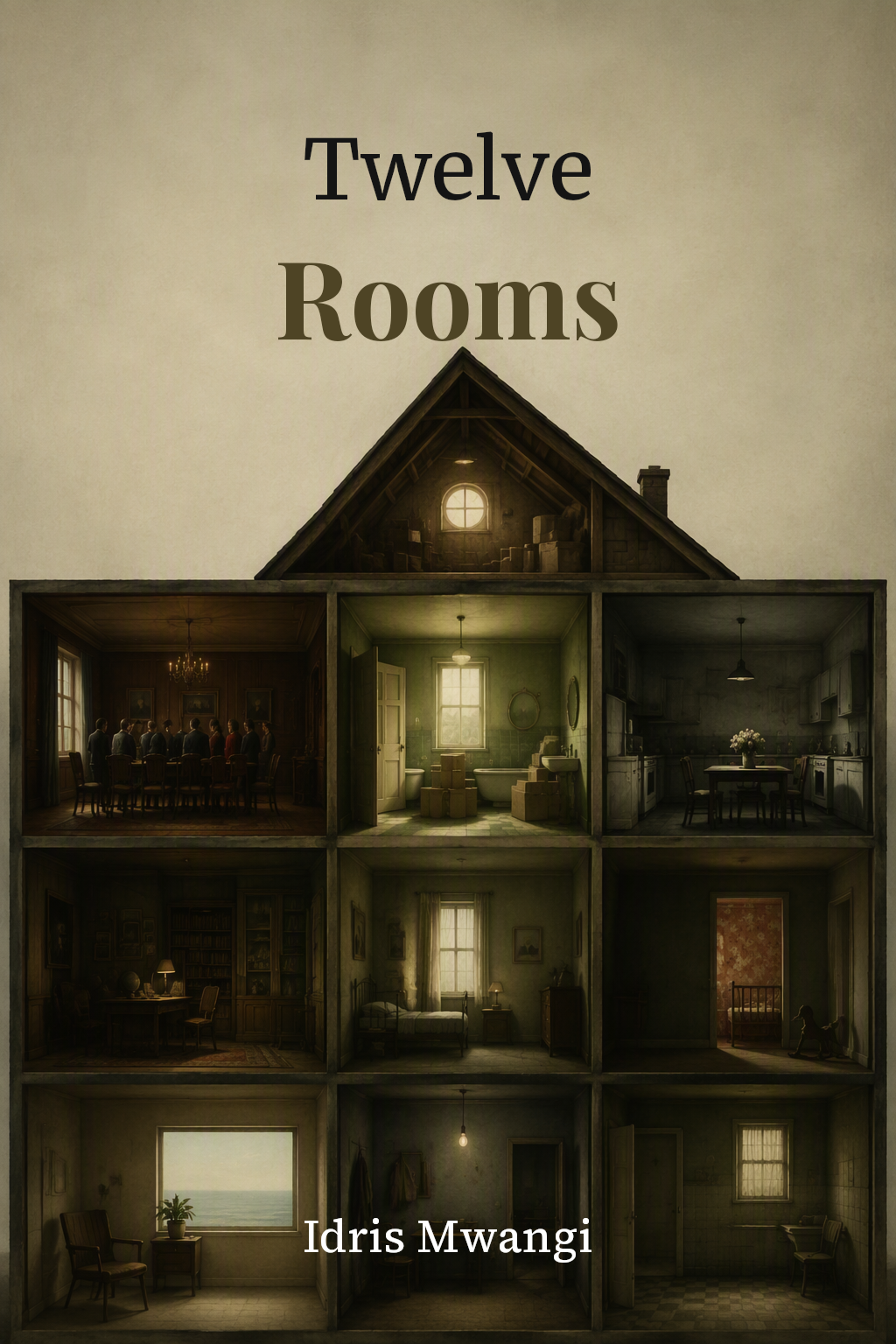

About this Story
Eleven short stories, each set in a single room. A country-house hall where an inheritance is divided. A green bathroom in a Finnish flat being emptied out. A kitchen after a funeral. A grandfather's locked study in 1990s Nairobi. An attic that is not on any floor plan. A hotel room in Mombasa during the 2007 election. An underfunded Nairobi classroom between shifts. A Kampala radio studio and the caller who keeps coming back. A hospital waiting room at four in the morning. A Wisconsin greenhouse in February. A last room a woman cannot quite place. Idris Mwangi, the former Nairobi magazine editor, believes the short story is the one form of prose that trusts a reader to stop and think. Twelve Rooms is his case for that belief: intimate, travelled, unshowy, and unafraid of silence.
The Hall Of The Long Table
The table seated eighteen at full stretch and had since my grandfather's time, when he had bought it at auction out of a demolished rectory in Herefordshire and brought it down to Wiltshire on a flatbed lorry. By my father's reckoning, it had never been full. The best we managed, even at Christmas, was fourteen. That evening we were nine, and my father had insisted on the full length anyway, so we sat in two uncomfortable clusters at either end like negotiators who had been told to pretend to be a family.
I was the eldest. That had always been the trouble. I sat to my father's right where my mother used to sit, and my mother's chair remained empty at the foot of the table as it had since the previous spring, not out of any particular sentiment but because no one had yet had the nerve to sit in it. Across from me was Nicholas, my brother, who had flown in from Geneva that morning and who looked, as he always did after a flight, like a man who had been assembled slightly out of order. Beside him was Hugh, our youngest, in a corduroy jacket that had belonged to our father and still smelled faintly of him. Two uncles I had not seen in four years. My father's solicitor, Mr Pell, who had driven down from London and was eating the soup with the concentrated politeness of a man who wanted to be somewhere else. An aunt. A cousin. The dog under the table, pretending to be asleep.
Myfather did not make speeches. He had the countryman's distrust of anyone who seemed to be enjoying himself in public, and he waited until the plates had been cleared and the port brought in before he said, quite mildly, "I think we should talk about the business before anyone is too comfortable to mean it."
The business was the farm, and around the farm a joinery my grandfather had started in 1919 to employ men coming back from France, and around the joinery a scatter of cottages, a small sawmill, a twelve-acre wood, a piece of river, and the house itself. None of it was worth very much in the way a City man measures worth. All of it was, as my father sometimes said, worth everything, which was his way of admitting he did not know what to do with it.
Mr Pell unrolled a plan of the land. The candles leaned in the draught from the door. My uncle Edward, who had married money and forgotten the price of things, began to say something about obligation, and my father lifted one finger and he stopped.
"Helen," my father said, looking at me, "will have the house and the twelve acres of the wood."
Nicholas did not look up.
"Nicholas will have the joinery. And the freehold on the cottages in the village, because you have the patience for tenants and your sister does not."
Hugh I saw flinch, very slightly, as our father came to him.
"Hugh will have the sawmill and a cash sum, to be determined by Pell on a basis we have already discussed, sufficient to allow him to do whatever foolish thing he has decided on this year, within reason."
Hugh gave the thin smile he had perfected at school.
"The piece of river," my father said, "I propose to leave to the river. There is a trust in Salisbury that will manage it."
No one spoke for some time. The dog under the table shifted
Sign in to join the conversation.
Be the first to leave a comment.