
About this Story
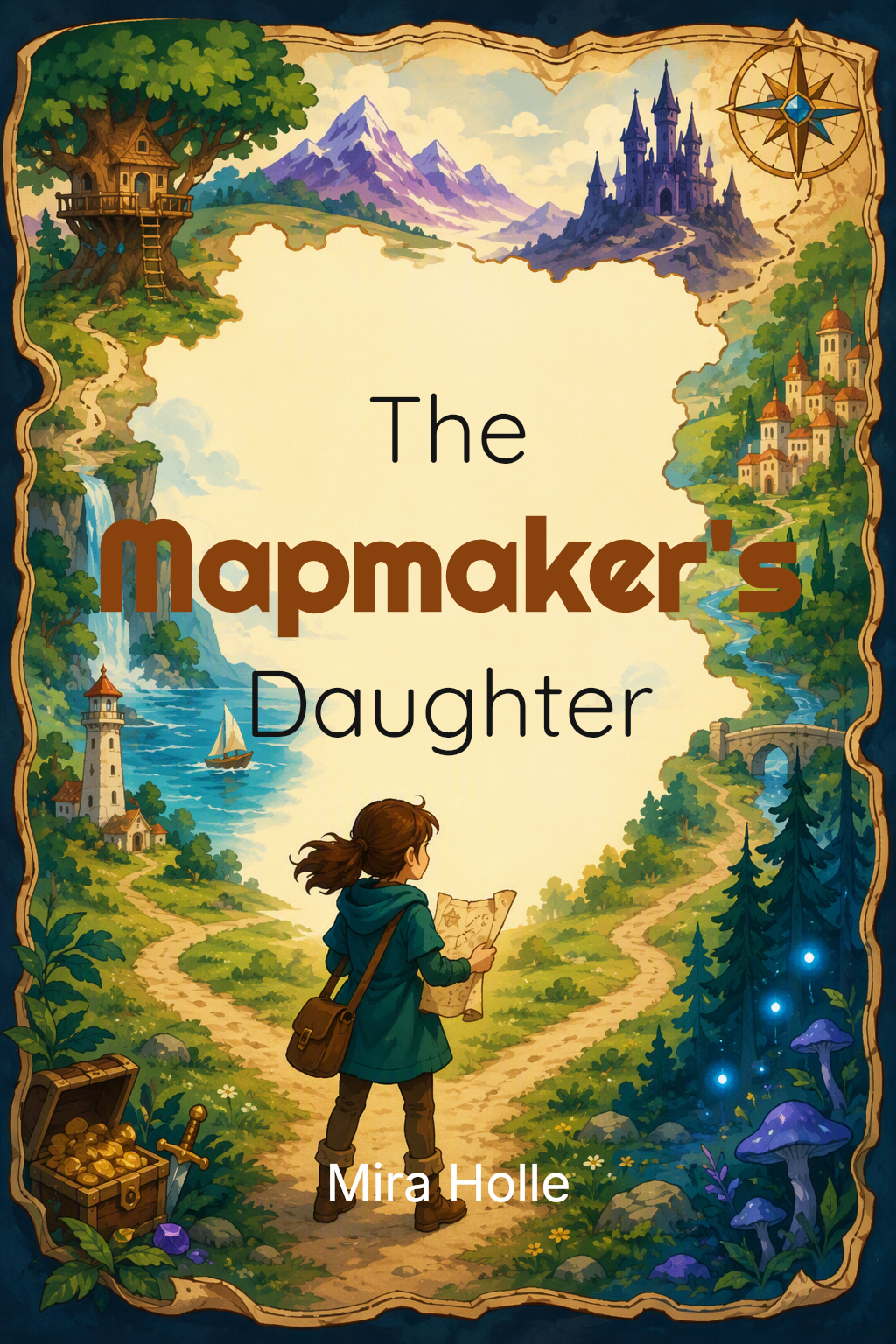
When Saskia's father dies, the only thing he leaves her is a half-finished map. The map fills itself in as she walks. The places it shows are real — and one of them is somewhere her father wanted her to go.
A Map That Fills Itself
When Saskia's father died, the inheritance was small. He had been a mapmaker. He had not been a wealthy mapmaker. He had been a careful one — the kind who measured twice and inked once and made maps that other mapmakers, very quietly, copied.
The lawyer read out the will at the small kitchen table.
To his only daughter Saskia, age eleven, he left:
— his blue cloak
— his draughtsman's set of pens
— and one half-finished map, in a wooden case lined with velvet
That was all.
Saskia had expected nothing more. The cloak was warm. The pens were beautiful. The map — the map was strange.
It was drawn on a heavy paper that did not crumple, even when she sat on it by accident. The ink on it was the slow brown of oak gall. It showed a small region of countryside that Saskia knew well: the village, the river, the woods to the east.
But the map was unfinished. Past the woods, the paper was blank. And — Saskia noticed, the first afternoon — the map was not quite the same as it had been at lunch.
A small mark had appeared in the woods, where she had walked that morning to fetch firewood. The mark was a tiny drawing of a stack of cut wood. It had not been there before.
Saskia held the map up to the light. The ink was the same colour as the rest. The mark looked like it had always been there, and yet it had not been there an hour ago.
She walked to the river. She came back. The riverwas now finely shaded on the map where she had stood, with tiny waves drawn in.
The map was filling itself in. Wherever she walked, the map noticed, and recorded. Quietly. Faithfully.
Saskia sat down at the kitchen table with a candle and the map. She did not show her mother. She did not show anyone. She just looked.
In one corner of the map, in handwriting that was clearly her father's, was a small note that she had not seen before.
Saskia, the note said. When you are ready, walk east. The map will know what to do. — Pa.
Saskia held the map for a long time.
Then she folded it, very carefully, and put it back in its wooden case.
She would walk east. But not yet. First she would say goodbye properly. First she would help her mother through the worst of the autumn. Maps, after all, did not run out of patience. They waited.
Sign in to join the conversation.
Be the first to leave a comment.