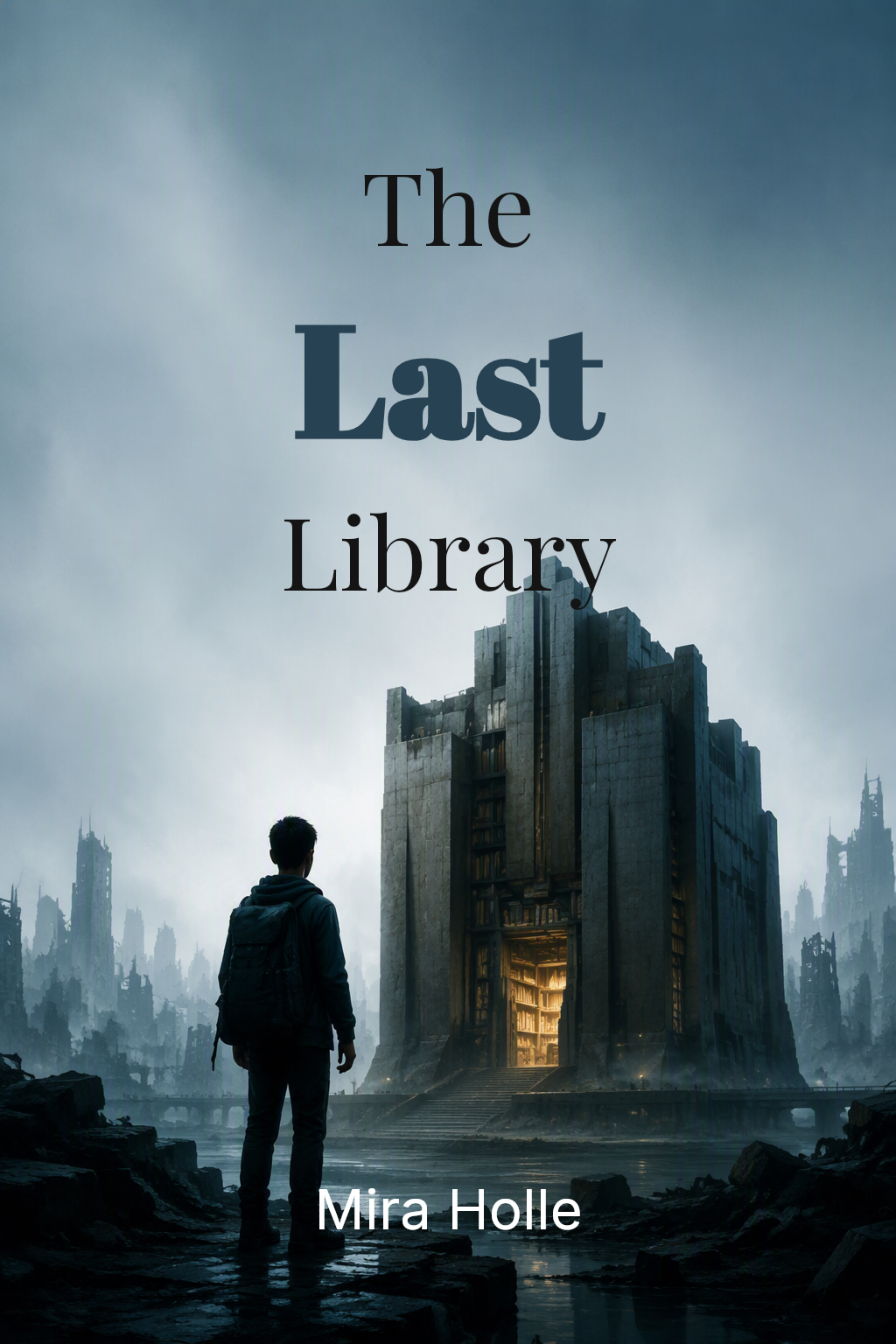

About this Story
In the year after the Reading Act, owning a printed book is illegal. Karim is fourteen, the son of a former librarian, and he has just been asked to do something his mother never asked him to do — help her move the last library.
After The Reading Act
It had not been an Act about books.
The Reading Act, signed two years before, had been written as a public-safety measure. The argument had been that printed materials — particularly older ones — were a vector for unverified information, and that centralised, certified, screen-based sources were safer for citizens. Books were not, the Act insisted, banned. Books were merely deprecated. Owning a book in your home was not, technically, illegal. Distributing books — lending, gifting, selling — was illegal. Operating a library was illegal. Possessing more than five books was illegal.
The result, in the country where Karim lived, had been the same as a ban.
In the first year of the Act, the public libraries had been emptied. Their stock had been processed — most of it pulped, some of it scanned and uploaded to the certified state archive, where access required a permit. The librarians had been retrained. Some of them had been given new jobs. Some had not.
Karim's mother, Mrs Halpren, had not been retrained. She had been a children's librarian for twenty-three years. She had refused — politely, in writing — the new role offered to her at the certified archive. She had taken her redundancy package and gone home. She had spent the first year of the Act mostly in the kitchen, drinking tea, looking out the window. Karim had been twelve and had not, then, fully understood.
Heunderstood better now. He was fourteen. He had finished, the previous summer, the last printed book his family was legally allowed to keep. (His mother had cleared their shelves down to the five permitted volumes. The other ninety had gone — quietly, over a period of months — to other homes. Where, exactly, Karim had not been told.)
In April, his mother sat down with him at the kitchen table.
"Karim. I want to tell you something. I should have told you earlier. I have been — running, since the year of the Act, a small library. Out of our basement. There are forty-eight people in this town who use it. We meet twice a month. They come to me with permission slips that look like other things. They borrow a book. They bring it back."
Karim stared at his mother.
"For two years?"
"For two years."
"Mum."
"I know."
"What happens if you get caught?"
"I lose my freedom for several years. I have known this since I started. I have decided it is a risk I am willing to take. I have not told you because I did not want you to carry the secret. You are now fourteen. You are old enough to be told. You are also old enough — if you want — to help. Or to refuse. I will not be angry if you refuse."
Karim sat with this.
He had — he realised — known. Not in detail, but in the way you know things in your own house. He had noticed the comings and goings. He had noticed the carefully wrapped parcels. He had assumed, vaguely, that his mother was helping people with — something. He had not asked.
"Mum. Why are you telling me now?"
"Because the last library is moving. We have had a tip-off. The licensing inspectors are due in our district next month. The basement is no longer safe. I am moving the library tonight. I need help. Two adults are helping me. We are short by one pair of hands.
Sign in to join the conversation.
Be the first to leave a comment.